Yes, you can bring a portable power station on a plane, but there are strict rules and limitations you need to follow. The main concern is the battery’s watt-hour (Wh) rating, which determines if it can go in carry-on or checked luggage.
Most airlines and aviation authorities, like the FAA, have specific guidelines for lithium-ion batteries. We found that you’ll mostly be dealing with rules about watt-hours and capacity. This impacts whether your power station can fly with you at all, and if so, where it needs to be stored on the aircraft.
- Small power stations (under 100 Wh) are generally fine in carry-on.
- Medium power stations (101-160 Wh) might need airline approval and stay in carry-on.
- Large power stations (over 160 Wh) are usually prohibited on passenger planes.
- Always carry them on, never check them, if allowed.
So, let’s walk through the exact rules and what you need to know before you pack your portable power station for your next flight.
Bringing Your Portable Power Station on a Plane: The Real Rules
Navigating airline rules for portable power stations can feel like cracking a secret code. But it’s actually quite straightforward once you understand the core principle: it’s all about the watt-hour (Wh) rating of your device’s battery. This number dictates everything.
We’ve researched the guidelines from major aviation authorities like the FAA (Federal Aviation Administration) and TSA (Transportation Security Administration) in the U.S. and found a consistent approach. These rules are designed to keep everyone safe, as lithium-ion batteries can pose a fire risk if damaged or improperly stored.
Understanding Watt-Hours (Wh) and Why They Matter
The watt-hour (Wh) rating tells you the total energy capacity of your power station’s battery. Think of it like the size of its fuel tank. A higher Wh rating means more power, but also potentially more risk if something goes wrong, especially in the confined space of an aircraft.
Why watt-hours? We found that authorities use Wh because it provides a standardized way to measure a battery’s potential energy, regardless of its voltage or amp-hour rating. It’s the universal language for battery safety on planes.
Calculating Your Power Station’s Watt-Hours
Sometimes, your portable power station might only list its battery capacity in milliamp-hours (mAh) and voltage (V). Don’t worry, you can easily calculate the Wh yourself. It’s a simple formula:
(mAh / 1000) * V = Wh
For example, if your power station has a 20,000 mAh battery and operates at 3.7V (a common voltage for many power banks and smaller stations), your calculation would be:
(20,000 / 1000) * 3.7 = 74 Wh
Knowing this number is your first and most important step. It determines whether your power station can even fly with you.
The FAA and TSA Guidelines: What You Need to Know
The FAA sets the general safety regulations, and the TSA enforces them at security checkpoints. Their rules are very clear about lithium-ion batteries, which are found in almost all portable power stations.
The primary concern is thermal runaway, where a damaged battery can overheat and catch fire. This is why checked baggage is generally a no-go for large batteries – if a fire starts in the cargo hold, it’s much harder to detect and extinguish.
Capacity Categories for Portable Power Stations
We found that portable power stations fall into three main categories based on their Wh rating:
- Small (100 Wh or less): These are typically standard power banks or very compact portable power stations.
- Medium (101 Wh to 160 Wh): This range includes many mid-sized portable power stations.
- Large (Over 160 Wh): Most large, high-capacity portable power stations, often used for camping or off-grid living, fall into this category.
Each category has its own set of rules, as you’ll see. It’s not a one-size-fits-all situation.
Carry-On vs. Checked Baggage: Where Can It Go?
This is arguably the most critical distinction. When it comes to portable power stations, the rule of thumb is almost always “carry it on.”
The reason? In the cabin, potential issues with batteries can be quickly identified and addressed by flight attendants. In the cargo hold, a problem could go unnoticed for too long, posing a significant risk.
Why Checked Baggage is Generally Prohibited for Power Stations
Think about it: once your checked bag is loaded, it’s out of sight and out of mind. If a lithium-ion battery were to malfunction and start to smoke or ignite, it would be extremely difficult for the crew to respond. Many experts, including the FAA, emphasize this point for good reason.
So, if your portable power station meets the criteria to fly, plan to bring it with you in the cabin.
| Watt-Hour (Wh) Rating | Carry-On Luggage | Checked Luggage | Special Conditions / Notes |
|---|---|---|---|
| Up to 100 Wh | ✅ Generally Allowed | ❌ Prohibited | Most small power banks and compact stations. No airline approval needed. |
| 101 Wh to 160 Wh | ✅ With Airline Approval | ❌ Prohibited | Limit of two per passenger. Must contact airline BEFORE travel for approval. |
| Over 160 Wh | ❌ Prohibited | ❌ Prohibited | These devices are generally not permitted on passenger aircraft. |
As you can see from the table, anything over 160 Wh is almost certainly staying home. This is a hard limit for passenger safety.
What to Do If Your Power Station is Between 101-160 Wh
This is the grey area where you need to be proactive. For power stations in this range, you typically need explicit airline approval before you fly. This isn’t just a suggestion; it’s a requirement.
We recommend contacting your airline’s customer service or checking their website well in advance of your travel date. They will likely have a specific policy or form to complete. Be prepared to provide the exact Wh rating of your device.
Also, keep in mind the limit of two spare batteries (including your power station) per passenger in this Wh range. This is a common restriction we found across most major airlines.
Preparing Your Power Station for Travel: A Quick Checklist
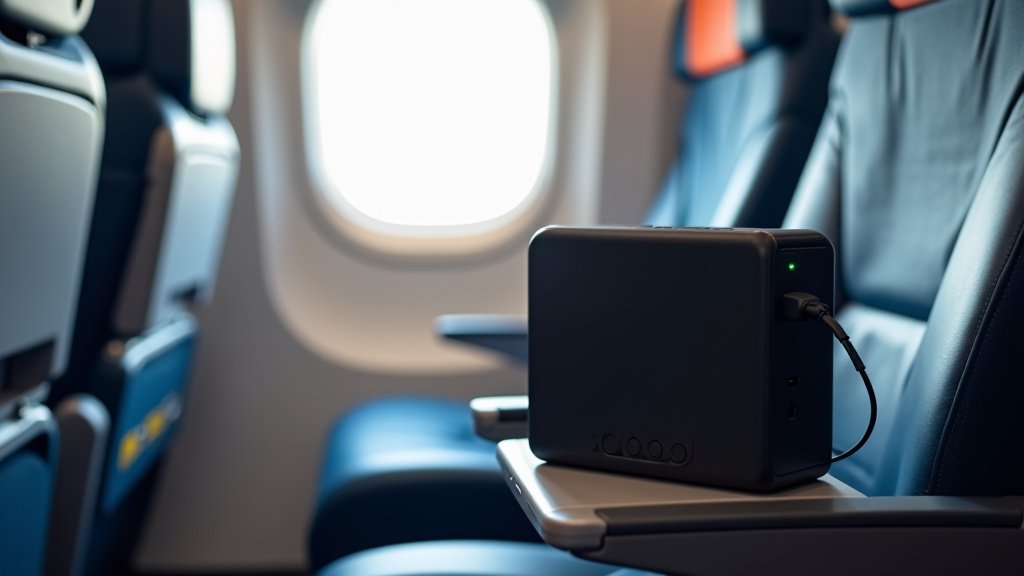
Even if your power station meets the Wh requirements, there are a few other steps you should take to ensure a smooth journey through security and onto the plane:
- Check the Wh rating: Confirm it’s clearly visible on the device itself or its packaging.
- Charge to a safe level: Some airlines recommend a charge level of 30% or less to minimize risk.
- Protect terminals: Place the power station in a protective case or bag to prevent short circuits.
- Power off: Ensure the device is completely turned off, not just in standby mode.
- Keep it accessible: You might need to remove it from your bag for inspection at security.
- Bring documentation: If it’s in the 101-160 Wh range, have your airline approval handy.
Following these steps will help you avoid delays and ensure your power station is handled safely.
Special Considerations for International Travel
While the FAA and TSA rules are widely adopted, international airlines and countries may have their own variations. What’s allowed in the U.S. might not be permitted in, say, Europe or Asia.
Before any international trip, it’s a smart move to check the specific regulations of your airline and the destination country’s aviation authority. We’ve found that some countries have even stricter limits or require different types of approvals.
When in doubt, always default to the most restrictive rule you find. It’s better to be overly cautious than to have your power station confiscated at the airport.
The “Why”: Safety Above All Else
You might wonder why these rules exist. It boils down to one thing: aviation safety. Lithium-ion batteries, while incredibly useful, store a lot of energy in a small package.
Damage, manufacturing defects, or even extreme temperature changes can lead to overheating, smoking, or even fire. In the tight confines of an aircraft, such incidents can be very dangerous. The rules are there to protect you, your fellow passengers, and the flight crew.
So, while it might feel like an extra hurdle, these regulations are ultimately for everyone’s well-being. Thinking of it as a safety measure, rather than an inconvenience, can help frame your preparation.
Conclusion
Taking your portable power station on a plane requires careful planning, but it’s absolutely doable if you know the rules. Your power station’s watt-hour (Wh) rating is the single most important factor. Always remember to prioritize carry-on over checked baggage for any approved devices, and contact your airline early for anything in the 101-160 Wh range.
We’ve found that these guidelines are in place for everyone’s safety. By understanding and following them, you can keep your devices powered up on your travels without any last-minute airport surprises. Double-check your power station’s Wh rating today and plan your packing accordingly!
Frequently Asked Questions
Can I bring multiple portable power stations on a plane?
For power stations under 100 Wh, you can typically bring several. However, for those between 101-160 Wh, there’s usually a limit of two per passenger, and each needs airline approval. Always check with your specific airline.
What happens if my portable power station is over 160 Wh?
If your portable power station is rated over 160 Wh, it is generally prohibited on passenger aircraft, both in carry-on and checked luggage. You will likely need to make alternative arrangements for its transport or leave it at home.
Does a portable power station count as a “spare battery” for travel?
Yes, aviation authorities typically consider portable power stations as “spare” or “loose” lithium-ion batteries. This means they fall under the same rules as other power banks and spare laptop batteries regarding Wh limits and carry-on requirements.
Should I discharge my portable power station before flying?
While not always a strict rule, some airlines and safety recommendations suggest charging lithium-ion batteries to less than 30% capacity for air travel. This can help minimize potential risks if an incident were to occur.
How do I protect my power station from short circuits in my bag?
You should always protect the terminals of your portable power station to prevent short circuits. We recommend placing it in its original packaging, a protective case, or a plastic bag, and ensuring no metal objects can come into contact with the terminals.