
The easiest way to run a mini fridge off a power station is to match your fridge’s power needs with your power station’s output capacity and battery size. You will need to check both the starting wattage and running wattage of your mini fridge.
Many folks want to keep drinks cold while camping or have extra fridge space during a power outage. We found that portable power stations offer a convenient and quiet solution for these situations. You can keep your snacks cool without needing a loud generator or an extension cord stretching miles.
- Check your mini fridge’s wattage.
- Choose a power station with enough capacity.
- Understand surge wattage for starting.
- Connect and monitor power usage.
Let’s walk through exactly how this works step by step, ensuring your food stays perfectly chilled.
Getting Your Mini Fridge to Power Up with a Portable Station
Running a mini fridge off a power station is quite doable. The key is understanding your fridge’s power demands and matching them with the right portable power unit.
Understanding Your Mini Fridge’s Power Needs
Before you pick a power station, you need to know what your mini fridge requires. This isn’t just about plugging it in. You need to look at two main numbers: running wattage and starting wattage.
Running Wattage: The Steady Power Draw
Your mini fridge uses running wattage continuously. This is the power it needs to keep cool once it’s already running. You can usually find this on a sticker inside the fridge door or on the back. It might be listed as “watts” or “W.” If it’s in “amps” (A), you can multiply amps by volts (usually 120V in the US) to get watts. For example, 1.0A x 120V = 120W.
This number tells you how much power your power station will need to provide steadily. We found that most mini fridges use between 50 to 150 watts while running.
Starting Wattage (Surge): The Initial Power Spike
This is where many people get tripped up. When your mini fridge’s compressor kicks on, it needs a quick burst of extra power. This is called the starting wattage or surge wattage. It can be 2 to 10 times higher than the running wattage for a very short moment.
For example, a fridge that runs at 100 watts might need 500-1000 watts for a second or two to start. If your power station can’t handle this surge, the fridge won’t start, or the power station might shut down. Always check your power station’s peak output rating.
Choosing the Right Power Station Capacity
Once you know your fridge’s wattage, you can select a power station. You need to consider both its output (how much power it can deliver at once) and its battery capacity (how long it can deliver that power).
Power Output: Matching Watts to Your Fridge
Your power station needs an inverter that can handle both the running and surge wattage of your mini fridge. Look for the “AC output” specification. If your fridge has a 100W running wattage and a 600W starting wattage, your power station should ideally have an AC output of at least 600-700W peak and around 150-200W continuous. This gives you a little buffer.
Battery Capacity: How Long Will It Last?
Battery capacity is measured in watt-hours (Wh). This tells you how much energy the power station can store. To estimate how long your mini fridge will run, divide the power station’s Wh by your fridge’s running wattage. But there’s a catch!
Mini fridges cycle on and off. They don’t run 100% of the time. We found that a mini fridge typically runs about one-third to one-half of the time, depending on ambient temperature and how often you open the door. So, if your fridge runs at 100W, it might only use 50W on average over an hour (100W * 0.5 = 50W). For example, a 500Wh power station might run a 100W mini fridge for about 10 hours (500Wh / 50W average = 10 hours).
Here’s a quick guide for common mini fridge sizes and power station recommendations:
| Mini Fridge Size (Cubic Feet) | Approx. Running Watts | Approx. Starting Watts | Recommended Power Station (Wh) |
|---|---|---|---|
| 1.0 – 1.7 cu ft (Compact) | 50 – 70W | 200 – 300W | 300Wh – 500Wh |
| 2.0 – 3.2 cu ft (Medium) | 70 – 100W | 300 – 500W | 500Wh – 800Wh |
| 3.5 – 4.5 cu ft (Larger) | 100 – 150W | 500 – 800W | 800Wh – 1200Wh+ |
Remember, these are estimates. Your mileage may vary based on fridge efficiency and how warm it is outside.
Connecting Your Mini Fridge to the Power Station
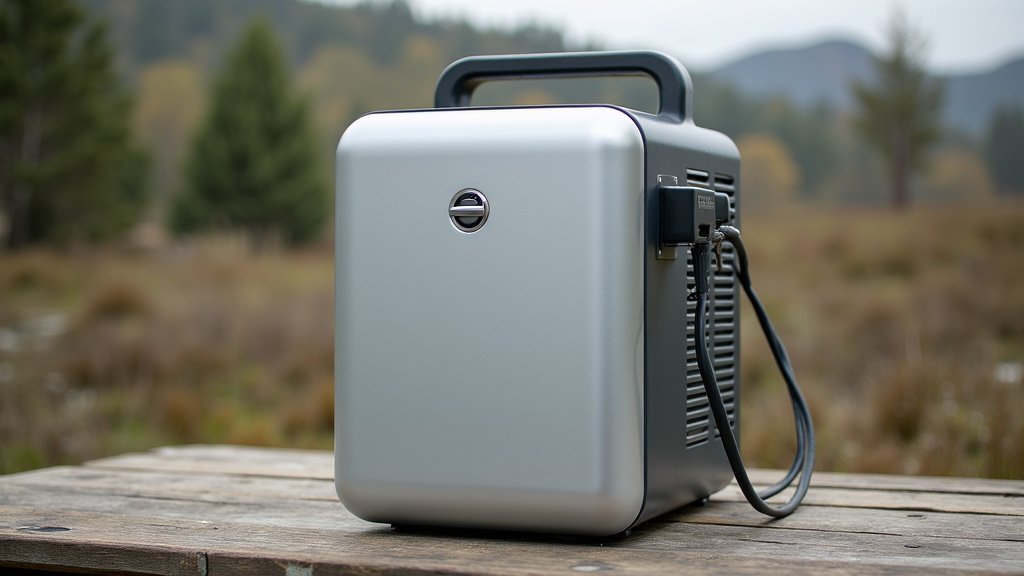
This part is usually straightforward. Most mini fridges use a standard three-prong AC plug. Your power station will have AC outlets that look just like wall outlets at home.
- Plug it in: Simply plug your mini fridge directly into one of the AC outlets on your power station.
- Turn on AC output: Make sure the AC output on your power station is turned on. Many power stations have a separate button for this.
- Monitor: Keep an eye on the power station’s display. It will usually show you the current power draw (watts) and the remaining battery percentage.
It’s a good idea to plug in the fridge when it’s already cool if possible. Starting a warm fridge requires more energy initially.
Optimizing Run Time and Efficiency
You want your mini fridge to run as long as possible, right? There are a few tricks to make your power station last longer.
- Keep it full: A full fridge (even with bottles of water) holds its temperature better than an empty one. Less warm air rushes in when you open the door.
- Limit door openings: Every time you open the door, cold air escapes, and the compressor has to work harder. Plan your fridge visits!
- Location, location, location: Keep your mini fridge in a cool, shaded spot. Avoid direct sunlight or hot tents. The cooler the ambient temperature, the less work your fridge has to do.
- Check seals: Make sure the door seals are tight. If cold air is leaking out, your fridge will run more often.
- Clean coils: On some fridges, the condenser coils are on the back. Dust and dirt can make them less efficient. Keep them clean if accessible.
Safety Considerations and Best Practices
Running electronics, especially those with compressors, requires a little caution. We want you to be safe and successful!
- Ventilation: Ensure your power station has good airflow. Don’t cover its vents. Power stations can generate heat, especially when under load.
- Overload protection: Quality power stations have built-in overload protection. If you try to draw too much power, it will shut down to prevent damage. Don’t constantly push it to its limits.
- Weather protection: Keep your power station dry and out of extreme temperatures. It’s an electronic device, after all.
- Read the manuals: Always read the user manuals for both your mini fridge and your power station. They contain specific instructions and warnings.
Checklist for Success
To recap, here’s a quick checklist to ensure you’re ready to power your mini fridge with a portable power station:
- Identify your mini fridge’s running wattage.
- Determine your mini fridge’s starting (surge) wattage.
- Select a power station with adequate AC output for the surge.
- Choose a power station with enough battery capacity (Wh) for your desired run time.
- Ensure your power station has working AC outlets.
- Plan to keep your fridge in a cool, shaded area for efficiency.
Conclusion
Running your mini fridge off a portable power station is a fantastic way to keep things cool wherever you are. We’ve seen that understanding your fridge’s running and starting wattage is the first critical step. Then, carefully match those needs with a power station that has enough output and battery capacity. By optimizing placement and usage, you can significantly extend your run time.
You now have all the tools to confidently select, connect, and efficiently run your mini fridge. Say goodbye to warm drinks on your next adventure or during unexpected outages. Go ahead and get that setup ready!
Frequently Asked Questions
Can I run any mini fridge off a power station?
Almost any mini fridge can theoretically run off a power station, but the real question is if your power station can handle it. You need to verify that the power station’s AC output can meet the fridge’s starting wattage and that its battery capacity (Wh) is large enough for your desired run time. Always check those specs!
Will running a mini fridge drain my power station quickly?
A mini fridge can drain a power station faster than smaller devices due to its compressor. However, modern mini fridges are fairly efficient. How quickly it drains depends heavily on your fridge’s wattage, how often it cycles on, and the overall capacity (Wh) of your power station. Optimizing fridge use helps a lot.
Is it better to use a power station or a car battery for a mini fridge?
A power station is generally a better and safer choice. It includes an inverter, which converts DC power to the AC power your fridge needs, and built-in safety features. Car batteries are designed for short bursts of high power to start an engine, not for sustained power delivery to appliances, and require additional equipment like an inverter and charge controller.
Can I charge my power station while it’s running the mini fridge?
Many power stations offer “pass-through charging,” meaning you can charge the power station while it’s simultaneously powering devices like your mini fridge. This is a very useful feature, especially if you have a solar panel or a car charger connected. Check your specific power station’s manual to confirm if it supports pass-through charging.
How do I know if my power station is powerful enough for a mini fridge?
First, find your mini fridge’s running and starting wattages. Then, compare these numbers to your power station’s “AC continuous output” and “AC peak/surge output” specifications. The power station’s continuous output should be higher than your fridge’s running watts, and its peak output must be higher than your fridge’s starting watts. If it meets these, you’re likely good to go.
