
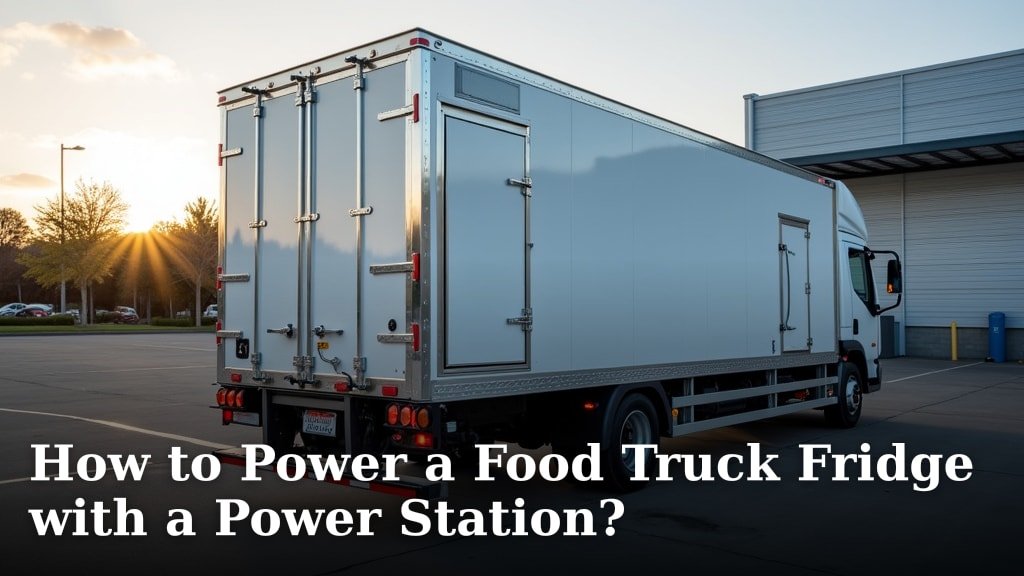
Yes, you can absolutely power your food truck fridge with a portable power station, and it’s becoming a popular solution for mobile vendors. This method offers a convenient and quieter alternative to noisy generators. You just need to ensure the power station has enough wattage to handle your fridge’s needs. This offers a convenient and quieter alternative to gas generators; a portable power station can replace fossil fuel generator.
Many food truck owners are turning to power stations to keep their perishables cold without the constant rumble of a gas generator. This shift means quieter operations and often less maintenance. We found that choosing the right power station depends heavily on your fridge’s power draw and how long you need it to run.
- Power stations can run food truck fridges.
- Check your fridge’s wattage carefully.
- Consider battery capacity for long run times.
- Silent operation is a big plus.
- It’s a cleaner alternative to gas generators.
Let’s walk through how to pick the right power station and set it up so your fridge stays frosty, even on the busiest days.
Powering Your Food Truck Fridge with a Power Station: A Practical Guide
Using a power station to keep your food truck fridge running is a smart move. It offers a quiet, clean, and often more efficient way to maintain cold temperatures for your ingredients. We found that the key is matching the right power station to your fridge’s specific needs.
Forget the loud roar of a generator. Power stations provide a peaceful environment for you and your customers. This guide will help you understand what to look for and how to make it work for your business.
Understanding Your Food Truck Fridge’s Power Needs
Before you even look at power stations, you need to know exactly how much power your fridge uses. This is the most important step. Without this information, you risk buying a power station that’s too small or unnecessarily large.
Finding Your Fridge’s Wattage: The Critical First Step
Your fridge will have a power rating listed on a sticker. This is usually on the back or inside the door. You’re looking for two numbers: running watts and starting watts. Running watts are how much power it uses constantly. Starting watts are the surge needed when the compressor kicks on.
For example, a small beverage cooler might use 100 running watts. A larger commercial fridge could need 500 running watts. The starting watts can be 2-3 times higher than the running watts. So, a fridge that runs on 100 watts might need 300 watts to start.
Calculating Total Power Consumption
You’ll need a power station that can handle both the running watts and the starting watts. It’s best to choose a power station with a continuous output higher than your fridge’s running watts. Also, ensure its surge capacity can handle the starting watts. Many experts recommend having a buffer of at least 20-30% extra capacity.
What if you have other equipment running? You need to add up the wattage of everything you plan to power simultaneously. This includes lights, blenders, or charging devices. For instance, if your fridge needs 200 running watts and you also run a 50-watt blender, your total continuous need is 250 watts. Remember to factor in starting surges for all appliances that have them.
Choosing the Right Power Station for Your Fridge
Not all power stations are created equal. When picking one for your food truck fridge, focus on a few key specifications. These will ensure your fridge stays reliably cold.
Battery Capacity (Watt-Hours): How Long Will It Last?
The watt-hour (Wh) rating tells you how much energy the power station can store. Think of it like the size of the gas tank in your car. A higher Wh means it can power your fridge for longer periods between recharges.
To estimate run time, divide the power station’s watt-hours by your fridge’s running wattage. For example, a 1000Wh power station running a 100W fridge would theoretically last 10 hours (1000Wh / 100W = 10 hours). This is a simplified calculation, as efficiency losses occur.
Output Power (Watts): Handling the Load
This is about the peak and continuous power the station can deliver. You need to match this to your fridge’s running and starting watts. Check the “continuous output” and “surge output” ratings on the power station.
A fridge with a 150W running wattage and a 400W surge would need a power station with at least 150W continuous output and 400W surge capacity. Many food truck fridges are relatively low power consumers compared to other appliances. This is why power stations are a viable option.
Rechargeability and Portability
Consider how you’ll recharge the power station. Can it be charged via solar panels, your vehicle’s alternator, or a wall outlet? For mobile use, the ability to recharge on the go is essential.
Portability matters too. You’ll be moving this around. Look for units with sturdy handles and a manageable weight. Some larger units might be on wheels, which can be a big help.
Setting Up Your Power Station and Fridge
Once you have the right power station, setting it up is straightforward. It’s much simpler than dealing with generator fuel and oil changes.
Connecting Your Fridge
Most modern power stations have standard AC outlets, just like the ones in your home. You’ll simply plug your fridge’s power cord directly into the power station. Make sure the outlet on the power station is rated for the type of plug your fridge uses (e.g., standard 3-prong).
Always double-check that the power station is turned on and has sufficient charge before plugging in your fridge. It’s like plugging in any appliance at home. No complicated wiring or adapters are usually needed for basic fridge operation.
Monitoring Power Usage and Battery Life
Many power stations have built-in displays that show real-time power draw and remaining battery life. This is incredibly useful for managing your energy. You can see how much power your fridge is consuming and get an estimate of how much longer the power station will last.
This monitoring helps you plan your recharge schedule. You don’t want to run out of power in the middle of a busy service. Keeping an eye on these numbers prevents surprises and ensures your food stays safe.
Maintenance and Best Practices for Longevity
Power stations require minimal maintenance, but a few practices ensure they last and perform well.
Battery Care and Charging Habits
Avoid fully draining the battery whenever possible. Most lithium-ion batteries, common in power stations, perform best when kept between 20% and 80% charge. Many units have battery management systems (BMS) to protect against overcharging or deep discharge.
Recharge your power station whenever you have a convenient opportunity. If you’re not using it for an extended period, store it with a partial charge (around 50%) in a cool, dry place. Follow the manufacturer’s recommendations for long-term storage.
Protecting Your Investment
Keep the power station clean and free from dust and debris, especially around vents. Dust can impede airflow and cause overheating. Protect it from extreme temperatures, both hot and cold. Extreme heat can degrade battery performance and lifespan.
Use surge protectors if you’re concerned about power fluctuations, though most power stations have built-in protections. If you’re using it in a food truck, secure it so it doesn’t move around during transit. A stable unit is a safe unit.
Troubleshooting Common Issues
If your fridge isn’t powering on, check these things:
- Is the power station turned on?
- Is the battery charged sufficiently?
- Is the fridge plugged in securely to the power station’s outlet?
- Does the power station’s output meet your fridge’s starting wattage requirements?
- Is the power station’s circuit breaker tripped?
Most issues are simple fixes. If problems persist, consult the power station’s manual or contact customer support. They are usually quite helpful.
When to Consider a Larger Power Station or Backup
While a single power station can work wonders, sometimes your needs might exceed its capacity. This is especially true if you add more equipment or operate for very long hours.
Evaluating Your Ongoing Needs
If you find yourself constantly worried about battery life, or if your fridge cycles frequently, it might be time for an upgrade. Consider the total energy demand over a full workday. Are you meeting it comfortably?
If your food truck operations grow, or if you plan to add more energy-hungry appliances, you’ll need a power solution that can scale. A larger capacity power station might be the answer. Or, you might consider a second unit for redundancy.
Backup Power Strategies
For critical operations, having a backup is wise. This could be a smaller, portable generator that you only use in emergencies, or a second, fully charged power station. This redundancy ensures that a power failure never spoils your inventory.
Planning for the unexpected is part of running a successful food truck. Having a backup power strategy can save you a lot of money and stress down the line. It’s about being prepared for anything.
Quick Checklist for Powering Your Food Truck Fridge
Here’s a quick rundown to make sure you’re on the right track:
- Know your fridge’s running and starting wattage.
- Calculate your total power needs (fridge + other equipment).
- Choose a power station with sufficient continuous and surge watts.
- Select a watt-hour capacity for your desired run time.
- Ensure the power station can be recharged conveniently.
- Test your setup before your first busy service.
Conclusion
You’ve learned how a portable power station can be a fantastic, quiet solution for your food truck fridge. By carefully checking your fridge’s wattage and understanding the power station’s capacity, you can keep your perishables perfectly chilled. It’s a smart upgrade that reduces noise and hassle. Now, your next step is to assess your fridge’s specific needs and start comparing power station models. This will ensure your mobile kitchen runs smoothly and silently, keeping both your food and your customers happy.
Frequently Asked Questions
How do I know if a power station is strong enough for my food truck fridge?
You’ll need to check your fridge’s label for its running watts and starting (surge) watts. Then, ensure the power station’s continuous output rating exceeds your fridge’s running watts, and its surge capacity can handle the starting watts. We suggest aiming for a power station with at least 20-30% more capacity than your fridge’s maximum draw.
Can a power station run my fridge all day without needing a recharge?
It depends on the power station’s watt-hour (Wh) capacity and your fridge’s wattage. A higher Wh rating means longer run times. For example, a 1000Wh power station might run a 100W fridge for about 10 hours, but efficiency losses can reduce this. You’ll need to calculate this based on your specific fridge and power station.
What happens if the power station runs out of battery during a busy service?
If the power station runs out, your fridge will stop running, potentially spoiling your food. This is why monitoring your battery life is key. Having a backup plan, like a small generator or a second charged power station, is a wise idea for critical operations to avoid food loss.
Are there any special considerations for charging the power station while I’m on the road?
Yes, recharging on the go is important. Many power stations can be recharged via your vehicle’s DC outlet, solar panels, or even a generator if needed. Look for a model that offers flexible recharging options that fit your food truck’s setup and typical routes.
Will a power station work with older or commercial-grade food truck fridges?
Generally, yes, as long as you match the wattage requirements. Older or commercial units might have higher starting watt demands. Always check the specific ratings on your fridge and compare them to the power station’s output capabilities to ensure compatibility and reliable operation.
