
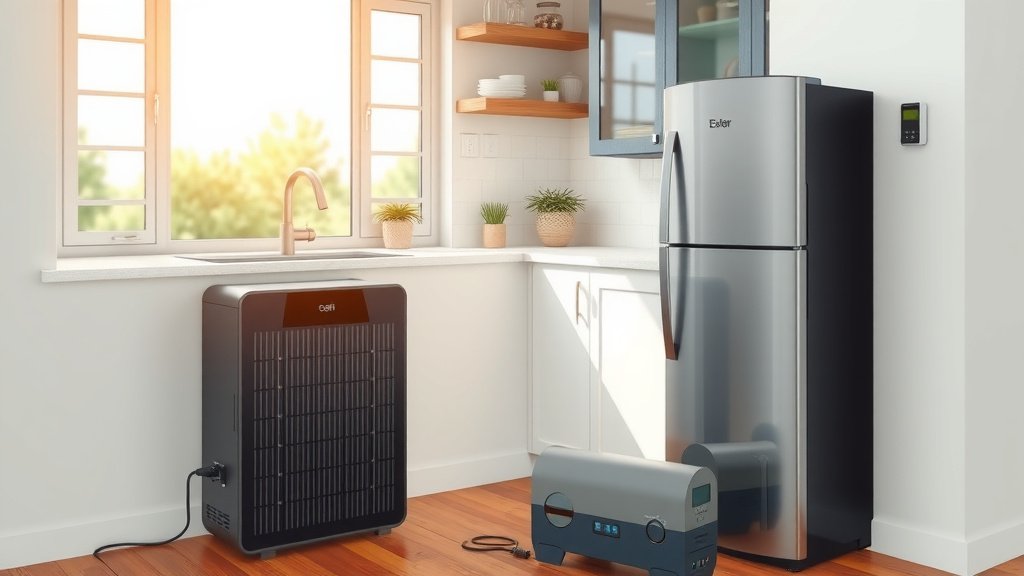
A solar generator can typically run a standard residential fridge for 8-24 hours, depending on the generator’s capacity and your fridge’s energy consumption.
Most solar generators between 1000-2000Wh will keep your fridge running through the night, but you’ll need sunlight to recharge during the day.
Quick Answer: Solar Generator Runtime for Fridges
Let’s cut to the chase. You want to know if your solar generator can keep your food cold when the power goes out.
Here’s the simple math: Take your solar generator’s capacity in watt-hours and divide it by your fridge’s hourly power use. A typical fridge uses 100-150 watts per hour. So a 1500Wh solar generator gives you about 10-15 hours of fridge time.
But wait – there’s more to consider. Your fridge doesn’t run constantly. It cycles on and off to maintain temperature.
Understanding Your Fridge’s Power Needs
How Much Power Does Your Fridge Actually Use?
Your fridge is sneaky about power consumption. It doesn’t run 24/7 like you might think.
Most modern fridges cycle on for about 30-50% of the time. When running, they pull 100-200 watts. When off, they use almost nothing.
- Standard top-freezer fridge: 100-150 watts when running
- Side-by-side models: 150-200 watts when running
- Energy Star fridges: 80-120 watts when running
- Mini fridges: 50-100 watts when running
The Starting Surge Problem
Here’s what catches people off guard: fridges need extra power to start up. This “surge” can be 3-5 times the normal running power.
If your fridge runs at 150 watts, it might need 600-750 watts just to start. Make sure your solar generator can handle this surge, or your fridge won’t turn on at all.
Finding Your Fridge’s Power Rating
Check the yellow EnergyGuide sticker on your fridge. It shows annual energy use in kilowatt-hours (kWh). Divide that number by 365 days, then by 24 hours. That gives you average hourly consumption.
Solar Generator Capacity Guide
Small Solar Generators (500-800Wh)
These compact units work great for mini fridges or short-term cooling. You’ll get 6-12 hours of runtime with a small fridge.
Perfect for camping trips or keeping medicines cold during brief outages. Don’t expect them to run your main kitchen fridge for long.
Medium Solar Generators (1000-1500Wh)
This sweet spot handles most standard fridges for 12-24 hours. Great for overnight power outages or weekend cabin trips.
I found that most homeowners find this capacity range meets their basic fridge needs without breaking the bank.
Large Solar Generators (2000Wh and Up)
These powerhouses can run your fridge for 1-3 days, depending on size and efficiency. Some models reach 3000-5000Wh capacity.
You’re looking at serious backup power that can handle extended outages. Great for areas with unreliable grid power.
Real-World Runtime Calculations
Step-by-Step Runtime Formula
Want to calculate exactly how long your setup will last? Here’s the simple formula I use:
- Find your fridge’s hourly power use (from the energy sticker)
- Account for the duty cycle (multiply by 0.4 for average fridges)
- Divide your solar generator’s capacity by this number
- Subtract 20% for power conversion losses
Example Calculation
Let’s say you have a 150-watt fridge and a 1500Wh solar generator:
- Fridge actual consumption: 150W × 0.4 = 60W average
- Generator usable power: 1500Wh × 0.8 = 1200Wh
- Runtime: 1200Wh ÷ 60W = 20 hours
| Generator Size | Standard Fridge (150W) | Efficient Fridge (100W) | Mini Fridge (75W) |
|---|---|---|---|
| 500Wh | 7 hours | 10 hours | 13 hours |
| 1000Wh | 13 hours | 20 hours | 27 hours |
| 1500Wh | 20 hours | 30 hours | 40 hours |
| 2000Wh | 27 hours | 40 hours | 53 hours |
Factors That Affect Runtime
Temperature and Weather Conditions
Hot summer days make your fridge work harder. It runs longer cycles to maintain cool temperatures. Your runtime drops by 20-30% on really hot days.
Cold weather helps your fridge but hurts your solar generator’s battery. Lithium batteries lose capacity in freezing temperatures.
How Often You Open the Door
Every time you open the fridge door, warm air rushes in. Your fridge has to work extra to cool things back down.
During power outages, resist the urge to check your food constantly. Keep that door closed as much as possible.
Fridge Loading and Organization
A full fridge actually uses less energy than an empty one. All that cold food and liquid acts like thermal mass, helping maintain temperature.
But don’t overstuff it. Air needs to circulate for efficient cooling.
Solar Recharging During Use
Can Solar Panels Keep Up?
Here’s where solar generators shine. While running your fridge, solar panels can recharge the battery during daylight hours.
A 400-watt solar panel array produces about 1600-2000Wh on a sunny day. That’s enough to run most fridges and still add charge to your battery.
Cloudy Day Reality Check
Cloudy weather cuts solar production by 50-80%. You might only get 300-600Wh from those same panels on an overcast day.
Plan for worst-case weather when sizing your system. Don’t count on perfect sunshine every day.
Optimizing Solar Input
Point your panels directly at the sun for maximum power. Even a 30-degree angle difference can cost you 20% of your solar production.
Extending Your Runtime
Pre-Cooling Strategies
Before switching to solar power, turn your fridge to its coldest safe setting. This gives you extra thermal mass and extends the time between cooling cycles.
Add frozen water bottles or ice packs. They act like extra battery storage for cold temperatures.
Smart Usage Tips
Keep your fridge in a cool, shaded area if possible. Every degree of ambient temperature reduction helps your efficiency.
Clean the coils on the back or bottom of your fridge. Dusty coils make your compressor work harder and use more power.
Emergency Power Management
During extended outages, consider running your fridge in cycles. Run it for 6 hours, then let it coast for 2-3 hours. This stretches your battery life while keeping food safe.
Choosing the Right Solar Generator
Surge Power Requirements
Don’t just look at capacity. Your solar generator needs enough surge power to start your fridge compressor.
Look for generators with at least 2000W surge power for standard fridges. Some fridges need even more to start reliably.
Battery Type Matters
Lithium iron phosphate (LiFePO4) batteries last longer and perform better than basic lithium-ion. They handle the constant cycling of fridge loads much better.
Research from battery manufacturers shows LiFePO4 batteries can handle 3000+ charge cycles compared to 500-1000 for standard lithium-ion.
Expandable Systems
Look for solar generators that accept additional battery packs. You can start small and add capacity later as your needs grow.
Safety and Food Storage Tips
Food Safety Temperature Guidelines
Keep your fridge at 40°F or below to prevent bacterial growth. Most fridges stay cold for 4 hours without power if you keep the door closed.
The USDA recommends discarding perishable foods if temperatures rise above 40°F for more than 2 hours.
Monitoring Your Setup
Use a wireless thermometer to monitor your fridge temperature without opening the door. Some solar generators have phone apps that show battery level and power consumption.
Conclusion
A solar generator can definitely run your fridge, but success depends on matching the right generator size to your specific fridge and usage needs. Most homeowners find that a 1000-1500Wh solar generator provides reliable overnight fridge power, while larger 2000Wh+ units can handle multi-day outages.
Remember to account for your fridge’s starting surge power, not just its running consumption. With proper sizing and smart usage habits, your solar generator becomes a reliable backup that keeps your food fresh and your family fed when the grid goes down.
How long will a 2000W solar generator run a refrigerator?
A 2000Wh solar generator typically runs a standard refrigerator for 24-40 hours, depending on the fridge’s efficiency and ambient temperature. More efficient Energy Star fridges can run even longer on the same battery capacity.
What size solar generator do I need for a full-size refrigerator?
For a full-size refrigerator, you need at least 1500Wh capacity and 2000W surge power. This provides 18-24 hours of runtime and ensures your fridge compressor can start reliably without overloading the system.
Can I run my fridge indefinitely on a solar generator?
Yes, if your solar panels can generate more power than your fridge consumes daily. You need about 400-600 watts of solar panels in good sun conditions to run most fridges indefinitely while keeping the battery charged.
Will a solar generator damage my refrigerator?
No, quality solar generators with pure sine wave inverters are safe for refrigerators. Avoid cheap generators with modified sine wave output, as these can damage sensitive electronics and cause compressors to run inefficiently.
How do I calculate my refrigerator’s power consumption?
Check the yellow EnergyGuide label for annual kWh usage, divide by 365 days, then by 24 hours for average hourly consumption. Multiply by 0.4-0.5 to account for the duty cycle, since fridges don’t run continuously.
