
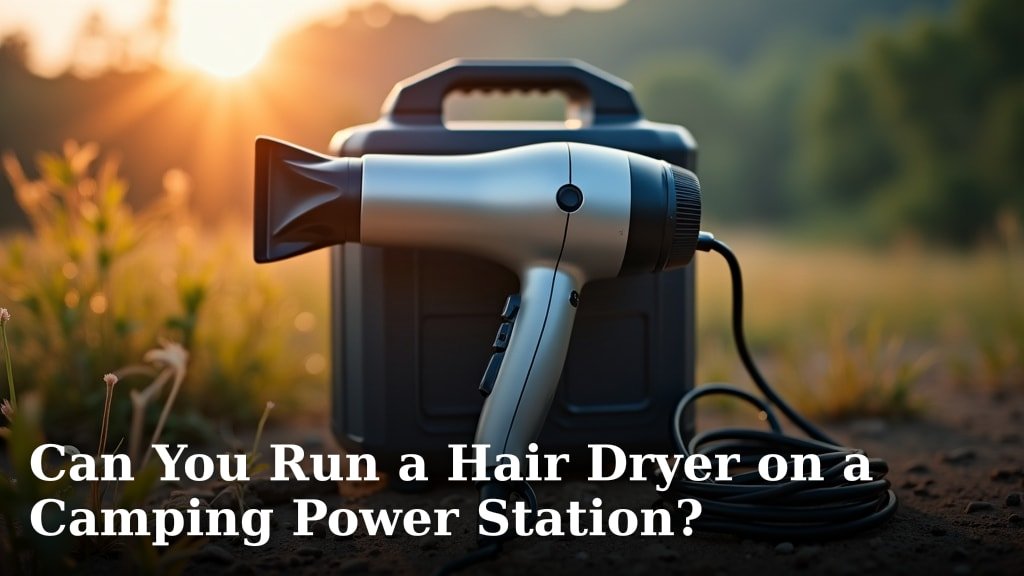
Yes, you can run a hair dryer on a camping power station, but it depends heavily on the power station’s capacity and the hair dryer’s wattage. Most standard hair dryers require a lot of power, often more than smaller portable power stations can handle. You’ll need to check the continuous output wattage of your power station to see if it matches your hair dryer’s needs.
Running a high-wattage appliance like a hair dryer can drain a power station very quickly. It’s essential to understand your device’s limits before you try to plug in your favorite hair-drying tool. We found that not all power stations are created equal for this task; it’s a real balancing act between portability and power delivery for camping comfort.
TL;DR:
- Yes, you can use a hair dryer on a power station.
- Check your power station’s wattage against the hair dryer’s needs.
- High-wattage hair dryers drain batteries fast.
- Choose a power station with a high continuous output.
- Consider a lower-wattage travel hair dryer if possible.
So, can you really get salon-worthy hair at the campsite? Let’s walk through exactly how to figure this out and what you need to consider.
Powering Your Hair Dryer With a Camping Power Station: What You Need to Know
So, you’re dreaming of a fresh blowout even when you’re miles from the nearest outlet. Can your trusty camping power station handle your hair dryer? The short answer is: sometimes. It really comes down to matching the power demands of your hair dryer with the output capabilities of your power station. We’ve found that this is the most common stumbling block for campers who want a little bit of home comfort.
Understanding Wattage: The Key to Compatibility
The most important thing to check is the wattage. Wattage is a measure of electrical power. You’ll see it listed on both your hair dryer and your power station. Think of it like this: your hair dryer needs a certain amount of “oomph” to run, and your power station has to be able to provide that much “oomph.”
Hair Dryer Wattage Explained
Hair dryers are notoriously power-hungry appliances. Standard, full-sized hair dryers often range from 1200 to 1875 watts. Some professional models can even go higher! This is a lot of power for a portable device to deliver consistently.
We found that even a seemingly simple task like drying your hair requires a significant electrical load. This is why many campers are surprised when their power station doesn’t quite cut it.
Power Station Output: Continuous vs. Surge
When you look at your power station’s specs, you’ll usually see two wattage numbers: continuous output and surge output.
- Continuous Output Wattage: This is the power your station can deliver steadily over time. This is the most important number for appliances like hair dryers that run for extended periods.
- Surge Output Wattage: This is the peak power your station can provide for a very short burst, usually when an appliance first starts up. Some devices need a surge to get going, but hair dryers typically don’t require a massive surge.
For running a hair dryer, you need to focus on the continuous output wattage. If your power station’s continuous output is lower than your hair dryer’s wattage, it won’t work, or it could even damage your equipment.
Matching Your Power Station to Your Hair Dryer
Here’s where we get practical. You need to do some detective work before you hit the road.
Step 1: Find Your Hair Dryer’s Wattage
Check the label or the back of your hair dryer. It’s usually printed small. You might see a wattage number (e.g., “1875W”) or sometimes you’ll see voltage and amperage (e.g., “120V ~ 15A”). If you only have volts and amps, you can calculate wattage: Volts x Amps = Watts. So, 120V x 15A = 1800W.
Step 2: Find Your Power Station’s Continuous Output Wattage
Look at the product manual or the specifications list on the manufacturer’s website. Make sure you’re looking for the continuous or rated output, not just the peak or surge power.
Step 3: Compare the Numbers
Your power station’s continuous output wattage must be equal to or greater than your hair dryer’s wattage.
If your hair dryer is 1875W, your power station needs to offer at least 1875W of continuous power. Many common camping power stations offer between 300W and 1000W of continuous power, which simply isn’t enough for most standard hair dryers.
What Happens If the Wattage Doesn’t Match?
It’s not a good situation. If your hair dryer’s wattage requirement is higher than your power station’s continuous output, you’ll likely experience one of a few things:
- Nothing: The power station might sense the overload and simply refuse to turn on the outlet.
- Intermittent Power: The hair dryer might turn on but then shut off repeatedly as the power station struggles to keep up.
- Overload Protection: Most modern power stations have built-in safety features. They will likely shut down to protect themselves and your appliance from damage.
- Damage: In a worst-case scenario, you could damage the power station’s inverter or the hair dryer itself. We found that this is rare with modern devices, but it’s still a risk you don’t want to take.
Battery Capacity: How Long Can You Actually Dry Your Hair?
Even if your power station has enough wattage, its battery capacity (measured in Watt-hours or Wh) determines how long it can sustain that power draw.
Think of wattage as the *speed* your power station can deliver electricity, and watt-hours as the *size of the fuel tank*. A big fuel tank lets you go further, or in this case, run high-power devices longer.
Calculating Run Time
You can estimate how long your power station can run your hair dryer with this formula:
(Battery Capacity in Wh x Inverter Efficiency) / Hair Dryer Wattage = Estimated Run Time in Hours
We found that inverter efficiency is typically around 85-90%.
Example: Let’s say you have a 1000Wh power station with a 1000W continuous output and a 1500W hair dryer. Even though the output is high enough, let’s calculate the run time. Let’s assume 85% inverter efficiency.
(1000 Wh x 0.85) / 1500 W = 0.85 hours
That’s about 51 minutes of total run time. But remember, this is if the power station *can* actually output 1500W continuously. If it can only output 1000W, then the hair dryer might not even turn on or will perform poorly.
Draining Your Battery Faster Than You Think
High-wattage appliances are battery drainers. Running a 1500W hair dryer for just 10 minutes can consume around 250 Wh of battery capacity. That’s a quarter of a 1000Wh battery gone!
We found that many campers underestimate how quickly these high-draw items deplete their power station’s reserves. You might think you have hours of power, but a few minutes with a hair dryer can use it up faster than you anticipate.
Are There Alternatives for Camping Hair Drying?
If your current power station isn’t up to the task, or if you just want a more practical solution, consider these options:
Low-Wattage Travel Hair Dryers
These are specifically designed for lower power needs. Many run on 300W to 800W.
- Pros: Much more likely to work with smaller to medium-sized power stations. They are also lighter and more compact for packing.
- Cons: They may not dry your hair as quickly or as hot as a full-sized dryer. The airflow might be less powerful.
We found that many travel hair dryers have a dual-wattage setting, often with a lower setting around 600-800W that’s perfect for camping power stations.
Dual-Wattage Power Stations
Some higher-end power stations offer a dual-wattage feature or an “eco-mode” that can limit output. However, you still need to ensure the continuous output matches your appliance.
Consider the Need vs. The Convenience
Is a perfectly dry, styled head of hair truly a necessity for your camping trip? Sometimes, embracing the “camp hair” look is part of the adventure! Weigh the convenience against the battery drain and the potential strain on your equipment.
Tips for Success if You Try It
If you’ve checked your specs and are ready to give it a go, here are some tips we’ve gathered:
Pre-Drying with a Towel
Get your hair as dry as possible with a towel before you even turn on the dryer. This significantly reduces the amount of time you’ll need the dryer on, saving precious battery power.
Use the Lowest Heat Setting
High heat uses more power. If your hair dryer has adjustable settings, use the low heat or cool shot option. This might extend your drying time a bit, but it’s kinder to your power station’s battery.
Consider Your Power Station’s Capacity and Hair Dryer Wattage Checklist:
- Check your hair dryer’s wattage (usually on the unit or in the manual).
- Find your power station’s continuous output wattage (check specs, not surge).
- Ensure continuous output >= hair dryer wattage.
- Calculate estimated run time using Wh capacity and hair dryer wattage.
- Pack a quick-drying towel to minimize dryer use.
- Consider a low-wattage travel hair dryer as a backup.
Charge Up Before You Go
Make sure your power station is 100% charged before you leave home. This gives you the maximum amount of energy to work with right from the start.
Conclusion
So, can you run a hair dryer on your camping power station? The answer is a resounding “maybe.” Your ability hinges on matching your hair dryer’s power demands with your power station’s capabilities. We’ve found that most standard hair dryers are power-hungry, requiring a higher continuous wattage than many portable units can provide. Before you pack that blow dryer, always check the wattage on both devices. If your power station falls short, consider a travel-sized, low-wattage dryer for a more practical camping experience. Being prepared with the right gear means you can enjoy those little comforts without draining your power or damaging your equipment.
Frequently Asked Questions
What’s the minimum continuous wattage my power station needs for a hair dryer?
You need your power station’s continuous output wattage to be equal to or greater than your hair dryer’s wattage. We found that standard hair dryers often require 1200W to 1875W, so look for a power station that can consistently deliver at least that much power.
How long can I actually use a hair dryer on my power station?
The battery capacity (in Watt-hours or Wh) determines your run time. Even if your power station has enough wattage, a high-power appliance like a hair dryer will drain its battery quickly. We calculated that a 1500W dryer on a 1000Wh battery might only last about 50 minutes.
What happens if my power station’s wattage is too low for my hair dryer?
If the wattage doesn’t match, your power station will likely shut down to protect itself and your appliance. You might see nothing happen, or the hair dryer could turn on and off repeatedly. We’ve also seen cases where it could potentially damage the equipment.
Are there hair dryers designed for camping power stations?
Yes, low-wattage travel hair dryers are a great alternative. They typically run between 300W and 800W, making them much more compatible with smaller to medium camping power stations. We found these are often lighter and more compact too.
Should I use the high or low setting on my hair dryer when camping?
Always opt for the lowest heat setting or even the cool shot option if your hair dryer has one. Higher heat settings consume more power. This small adjustment can significantly extend your battery life and reduce the strain on your power station, as we discovered.
