
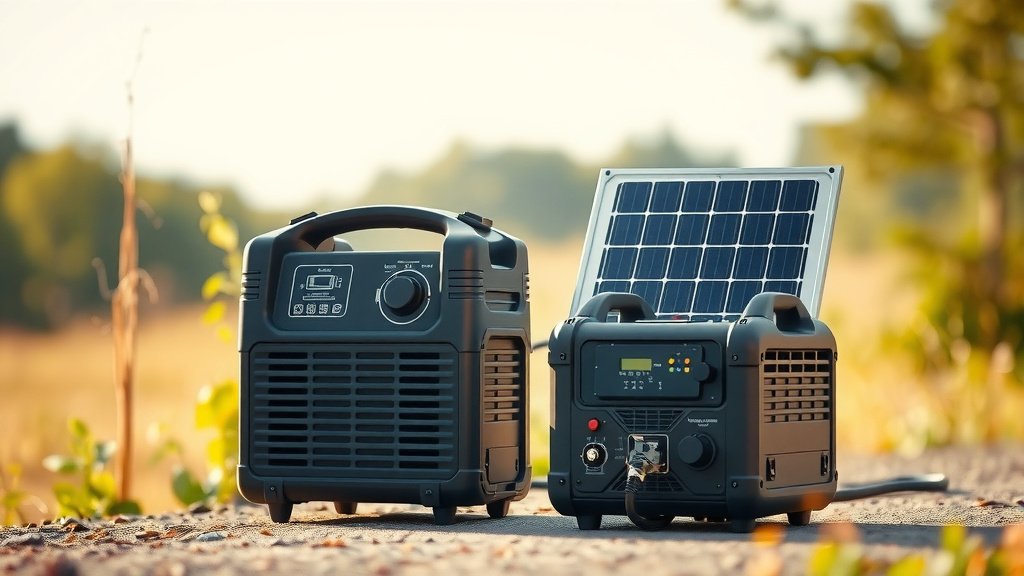
The Jackery 1000 uses an NMC battery, offering good portability and a moderate cycle life, making it a reliable choice for casual outdoor adventures.
In contrast, the EcoFlow Delta features a LiFePO4 battery, providing a much longer lifespan and significantly faster charging, better suited for demanding applications and home backup.
- TL;DR:
- Jackery 1000 is great for **light, portable use** with its NMC battery and user-friendly design.
- EcoFlow Delta offers **higher power output** and a longer-lasting LiFePO4 battery, ideal for more demanding tasks.
- The **charging speed difference** is a major factor, with EcoFlow Delta leading by a significant margin.
- Consider your **specific power needs** and planned usage to pick the right one.
How Does Jackery 1000 Compare To EcoFlow Delta?
When you’re looking for a portable power station, both the Jackery 1000 and EcoFlow Delta appear as strong contenders. We find their main differences lie in battery chemistry, power output, and charging speed.
Battery Type: NMC Versus LiFePO4
This is often the **biggest distinction** between these two powerhouses. Jackery 1000 utilizes an NMC (Nickel Manganese Cobalt) battery. We found that NMC batteries generally offer a good power-to-weight ratio.
EcoFlow Delta, on the other hand, comes with a LiFePO4 (Lithium Iron Phosphate) battery. Many experts say LiFePO4 batteries are known for their **longer lifespan and enhanced safety** (Government energy sites).
Lifespan and Cycle Count
What does battery type mean for you? An NMC battery like in the Jackery 1000 typically offers around 500-800 charge cycles before its capacity drops to 80%. This means you’ll get many years of regular use.
The LiFePO4 battery in the EcoFlow Delta often provides 2,500 to 3,000+ cycles to 80% capacity. That’s a **much longer operational life**, making it a more durable long-term investment for frequent use.
Power Output and Capacity
Both units aim to give you reliable power, but they approach it differently. The Jackery 1000 has a 1002Wh capacity and delivers 1000W continuous output. This is **solid for many devices** like laptops, mini-fridges, and lights.
The EcoFlow Delta, with its 1260Wh capacity, offers a robust 1800W continuous output. It can even handle surges up to 3300W with its X-Boost technology. This makes it **capable of running heavier appliances** and power tools.
What Can Each Run?
Think about your needs. The Jackery 1000 can keep your camping gear humming along. Want to run a blender or a small space heater? The EcoFlow Delta is often the **better choice** for those higher-draw items.
Charging Speed: A Clear Winner
How quickly can you get back to full power? This is where a **significant difference** emerges. The Jackery 1000 charges from 0-80% in about 5.5 hours from an AC wall outlet. From solar, it’s about 8 hours with two 100W panels.
The EcoFlow Delta boasts incredibly fast X-Stream charging. It can go from 0-80% in just about 1 hour and 0-100% in 1.6 hours using AC power. Many users find this **rapid charging** incredibly convenient (Consumer reviews).
Portability and Design
Are you moving it often? The Jackery 1000 weighs around 22 pounds and features a comfortable folding handle. Its design is **sleek and compact**, making it easy to carry for camping or tailgating.
The EcoFlow Delta is heavier, at about 30.9 pounds, and has a more rectangular shape with integrated handles. While still portable, its extra weight is noticeable if you’re **carrying it long distances**.
Price Point and Value
Pricing can vary, but generally, the Jackery 1000 is often found at a slightly lower price point. This can make it an **attractive entry-level option** for many users.
The EcoFlow Delta, with its advanced battery, higher output, and faster charging, typically comes at a higher cost. We found its features often **justify the price** for those needing more power and longevity.
Side-by-Side Comparison
Let’s put it all together. Here’s a quick overview of how they stack up:
| Feature | Jackery Explorer 1000 | EcoFlow DELTA |
|---|---|---|
| Battery Type | NMC Lithium | LiFePO4 Lithium |
| Capacity | 1002Wh | 1260Wh |
| Continuous Output | 1000W | 1800W (3300W surge with X-Boost) |
| AC Charge Time (0-80%) | ~5.5 hours | ~1 hour |
| Life Cycles (to 80%) | 500-800 | 2500-3000+ |
| Weight | ~22 lbs | ~30.9 lbs |
Who is Each Power Station For?
Are you wondering which one fits your life? Let’s break it down by typical user profiles. Knowing your needs helps you make a great choice.
The Jackery 1000 User
You might love the Jackery 1000 if you’re a **weekend camper or road-tripper**. It’s ideal for powering small devices like phones, lights, drones, and a mini-fridge. Portability is often a top priority for you.
Perhaps you need a **light backup power source** for occasional outages to keep basic essentials running. You appreciate simplicity and don’t need to run heavy-duty tools or charge super fast. It’s often seen as a reliable companion for modest energy needs.
The EcoFlow Delta User
If you’re looking for more robust power, the EcoFlow Delta could be your match. It’s excellent for those who need to **power larger appliances** during power outages, like blenders, hair dryers, or some power tools. Its high output and capacity are a big plus.
You also likely value **speed and durability**. If you frequently use your power station or plan to keep it for many years, the longer LiFePO4 lifespan and rapid charging will be very appealing. It’s also a good fit for job sites or as a more substantial home backup solution.
Making Your Choice: A Quick Checklist
Still on the fence? Ask yourself these questions to guide your decision:
- What are your main activities? (Camping, home backup, work tools?)
- How much power do you truly need? (Think watts and watt-hours.)
- How quickly do you need to recharge? (Fast charging can save you time.)
- Is portability a top priority? (Every pound matters when you’re carrying it.)
- What’s your budget for a power station? (Cost vs. features.)
- How often will you be using it? (Consider battery cycle life.)
Important Considerations Beyond Specs
Beyond the numbers, think about the user experience. Both brands often offer excellent customer support, but how do they feel to use?
Expandability and Ecosystem
While the standard EcoFlow Delta isn’t directly expandable with extra batteries, some other EcoFlow models are. Jackery tends to focus on standalone units. Consider if you might want to **grow your power system** later.
App Control and Monitoring
EcoFlow typically offers a more robust mobile app for monitoring and controlling your power station. Jackery tends to rely more on **on-unit displays**. Do you like managing things from your phone?
Noise Levels During Operation
When the fans kick in, both units make some noise. However, the larger power output and faster charging of the EcoFlow Delta can sometimes mean **more fan activity**. If you’re using it indoors, this might be something to consider.
Conclusion
Choosing between the Jackery 1000 and the EcoFlow Delta really comes down to your individual needs and priorities. The Jackery 1000 is often the better friend for those seeking **portability, simplicity, and reliable power** for lighter tasks.
The EcoFlow Delta, with its LiFePO4 battery, higher output, and blazing fast charging, shines for users who demand **more power, faster turnaround, and long-term durability**. Evaluate your typical usage scenarios, and you’ll find the perfect fit for your power adventures.
Frequently Asked Questions
Can I use solar panels from one brand with the other power station?
Generally, yes, if the solar panel’s output voltage and connector type match the power station’s input specifications. We found that many universal solar panels work with both, but always double-check the voltage and current requirements for safety.
Are these power stations safe to use indoors?
Yes, both Jackery and EcoFlow power stations are designed for safe indoor use because they produce no fumes or emissions, unlike gas generators. Always ensure proper ventilation, especially if the unit is charging or under heavy load.
How should I store my portable power station for long periods?
For long-term storage, it’s often recommended to store them in a cool, dry place with the battery charged to around 50-80%. Fully discharging or overcharging for extended periods can shorten battery lifespan (Battery maintenance guides).
Do these power stations require any maintenance?
These power stations are generally low-maintenance. Keep them clean, avoid extreme temperatures, and ensure the ventilation ports are clear. Regular usage, rather than letting them sit unused for months, can actually help maintain battery health.
Can I charge and use the power station at the same time?
Yes, both the Jackery 1000 and EcoFlow Delta support pass-through charging. This means you can charge the power station from a wall outlet or solar panels while simultaneously powering your devices. This feature is very convenient for continuous power.
