
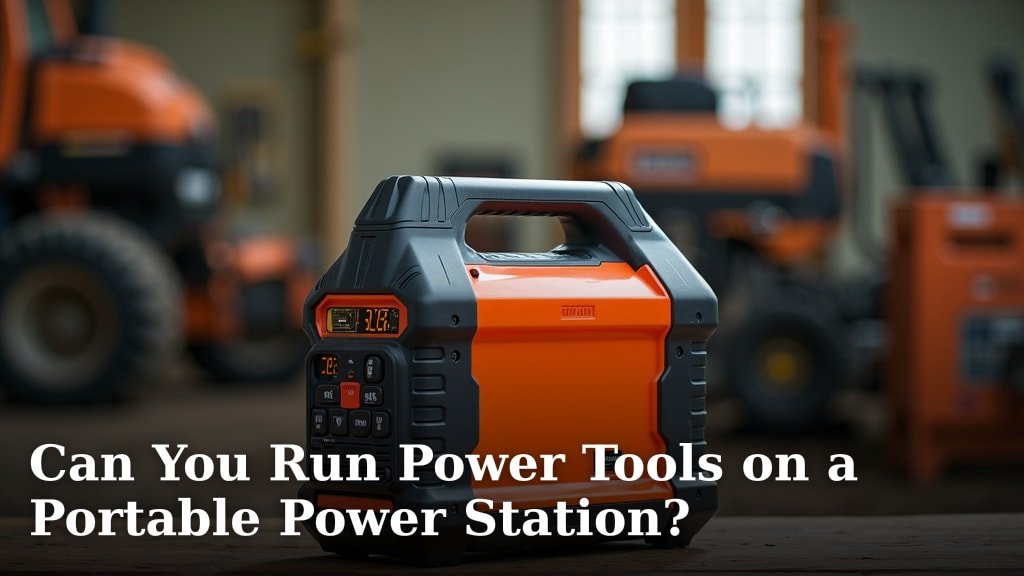
Yes, you absolutely can run power tools on a portable power station, but there are some important details to consider. You need to match the power station’s output to your tool’s needs for safe and effective operation.
Many modern power stations are designed with enough capacity and wattage to handle common power tools. This offers a convenient and quiet alternative to gas generators for your DIY projects or job site needs. Understanding your tools’ power requirements is key to selecting the right portable power station.
- Portable power stations can run most power tools.
- Match the power station’s wattage to your tool’s needs.
- Consider surge power for tools that draw more at startup.
- Battery capacity determines how long you can run tools.
- Portable power stations are a quiet, fume-free alternative to gas generators.
Let’s dive into the specifics, so you can confidently pick the perfect portable power station for your power tools.
Powering Your Tools with Portable Stations: What You Need to Know
So, you’re wondering if a portable power station can really handle your trusty power tools, right? The short answer is often a resounding “yes,” but it’s not quite as simple as just plugging anything in. You need to understand the relationship between your tool’s power demands and your station’s output capabilities. It’s like pairing the right engine with the right car.
Many people are moving towards these stations for their convenience. They’re quieter, fume-free, and often more portable than traditional gas generators. But to make sure you get the most out of your setup, let’s break down the key factors.
Understanding Your Tool’s Power Requirements
Before you even think about buying a portable power station, you need to know how much power your tools actually need. This is crucial for both performance and safety. Overloading a power station can cause it to shut down, or worse, damage the unit or your tool.
Think of it like this: trying to run a marathon on a glass of water won’t work well. Your tools need enough “juice” to perform their tasks efficiently.
Watts, Amps, and Volts: The Power Triangle
These terms might sound intimidating, but they’re pretty straightforward. You’ll often see them listed on your power tool’s label or in its manual. Here’s a quick rundown:
- Watts (W): This is the total power your tool consumes when it’s running. It’s often the most important number to look for. You’ll see two types:
- Running Watts: The power needed to keep the tool operating steadily.
- Surge Watts (or Starting Watts): The extra burst of power many tools need just to start up. This can be 2-3 times higher than the running watts for tools with motors.
- Amps (A): This measures the current flow. It’s related to watts by voltage.
- Volts (V): This is the electrical pressure. For most standard power tools in the US, this will be 120V.
The good news? You usually don’t need to do complex math. Most power stations and tools will list the wattage directly. Just remember that surge wattage is a big deal for many power tools.
Matching Your Power Station to Your Tools
Once you know your tools’ power demands, you can start looking at power stations. It’s a bit like buying a car; you want one that can handle your driving needs.
Your portable power station will have two key ratings to consider:
- Continuous Output (Running Watts): This is the power the station can supply steadily over time. It should be equal to or greater than your tool’s running watts.
- Peak/Surge Output (Starting Watts): This is the maximum power the station can provide for a very short time (usually a few seconds) to get a motor tool started. This needs to be equal to or greater than your tool’s surge watts.
If your tool’s surge wattage is higher than your power station’s peak output, the power station might just shut down when you try to start the tool. Or it might not even turn on.
Consider Battery Capacity (Watt-Hours)
Beyond how much power a station can deliver at one time, you also need to know how long it can deliver that power. This is where battery capacity comes in, measured in Watt-hours (Wh) or Kilowatt-hours (kWh). One kWh is 1000 Wh.
Think of Wh as the size of your fuel tank. A larger Wh number means your tools will run longer. To estimate run time, divide the power station’s Wh by your tool’s running watts. For example, a 1000Wh power station running a 100W tool would theoretically last 10 hours (1000Wh / 100W = 10 hours). In practice, it will be a bit less due to efficiency losses.
We found that for most DIY projects, having a capacity that allows for at least a few hours of continuous tool use is ideal. For professional work, you’ll likely need a much larger capacity or a plan for recharging.
Common Power Tools and Their Power Needs
Let’s look at some popular power tools and what kind of power you might need to run them. Keep in mind these are general estimates; always check your specific tool’s label.
| Tool Type | Estimated Running Watts | Estimated Surge Watts (if applicable) | Typical Usage |
|---|---|---|---|
| Cordless Drill Charger | 50-150W | N/A | Charging battery packs |
| Orbital Sander | 150-300W | N/A | Light sanding tasks |
| Circular Saw (6.5″) | 1000-1500W | 2000-3000W | Cutting wood, light construction |
| Jigsaw | 400-800W | N/A | Detailed cuts in wood, metal |
| Reciprocating Saw | 800-1200W | 1600-2400W | Demolition, cutting pipes |
| Table Saw (10″) | 1500-2000W | 3000-4000W | Ripping wood, larger projects |
| Angle Grinder | 700-1500W | 1400-3000W | Grinding metal, cutting stone |
As you can see, tools with motors like circular saws or table saws often have significantly higher surge watts. This is where many people run into trouble if their power station isn’t robust enough.
Inverter Type: Pure Sine Wave is Best for Tools
Portable power stations use an inverter to convert the DC power from their battery into AC power for your tools. There are two main types of inverters:
- Modified Sine Wave: These are less expensive but produce a “choppier” electrical signal. This can be perfectly fine for basic electronics like phone chargers or lights.
- Pure Sine Wave: These produce a clean, smooth electrical signal, just like the power from your wall outlets.
For sensitive electronics and, critically, for most power tools with motors, a pure sine wave inverter is highly recommended. It helps motors run cooler, more efficiently, and can even prolong their lifespan. Many experts say that using a modified sine wave inverter with certain power tools can lead to overheating or damage over time.
Advantages Over Gas Generators
Why choose a portable power station over a traditional gas generator? There are several compelling reasons that make them a great choice for many users.
- Quiet Operation: Power stations are virtually silent, making them perfect for residential areas, indoor use, or quiet job sites. No more shouting over a loud engine!
- No Fumes: Since they don’t burn fossil fuels, there are no exhaust fumes. This means you can use them indoors, in garages, or in enclosed spaces without ventilation concerns.
- Zero Maintenance: Forget oil changes, spark plugs, and fuel stabilizers. Power stations generally require very little maintenance.
- Instant Power: Just press a button, and you have power. No pull cords or priming needed.
- Eco-Friendly: They produce zero emissions during operation. You can recharge them from solar panels, making them even greener.
- Portability: While some larger units are heavy, many power stations are designed for easy transport.
We found that for quick tasks, smaller job sites, or areas where noise is a concern, power stations are an absolute game-changer.
Safety Considerations and Best Practices
Even though portable power stations are generally safer than gas generators, it’s still important to follow some best practices to ensure a smooth and safe experience.
- Don’t Overload: Always respect the continuous and peak wattage ratings of your power station. Overloading can trigger safety shutdowns or damage the unit.
- Ventilation: While they don’t produce fumes, power stations do generate a small amount of heat during operation and charging. Ensure they have adequate airflow.
- Keep Dry: Protect your power station from rain, snow, and excessive moisture. Electronics and water don’t mix.
- Proper Storage: Store your power station in a cool, dry place. Avoid extreme temperatures. For optimal battery health, many manufacturers recommend storing them at a partial charge (e.g., 50-80%).
- Use Quality Cables: Always use the charging cables and adapters provided by the manufacturer or high-quality replacements.
Your power station is a significant investment; treating it well will ensure it serves you for many projects to come.
Choosing the Right Portable Power Station: Your Checklist
Ready to pick out your perfect power-tool companion? Here’s a quick checklist to guide your decision:
- Identify the running watts of your most power-hungry tool.
- Determine the surge watts for any motor-driven tools.
- Look for a power station with a continuous output higher than your tool’s running watts.
- Ensure the power station’s peak/surge output exceeds your tool’s surge watts.
- Consider the Watt-hour (Wh) capacity to get the run time you need.
- Verify it has a pure sine wave inverter for sensitive electronics and motors.
Following this checklist will help you avoid common pitfalls and ensure you pick a portable power station that truly meets your needs. It’s about empowering your projects, not creating new problems!
Conclusion
Running power tools on a portable power station is not only possible but often a superior choice for many projects. By carefully matching your tool’s wattages (especially surge watts) with your power station’s capabilities and ensuring a pure sine wave inverter, you can enjoy quiet, fume-free, and convenient power. We found that taking a few moments to understand these key specs prevents frustration and ensures you get the most out of your setup. Your next step is clear: check your tools, then pick the portable power station that truly powers your passion.
Frequently Asked Questions
Can I charge a portable power station with solar panels while it’s running tools?
Yes, many portable power stations support simultaneous charging and discharging, often called “pass-through charging.” This means you can recharge the power station using solar panels or an AC outlet while it’s actively
