
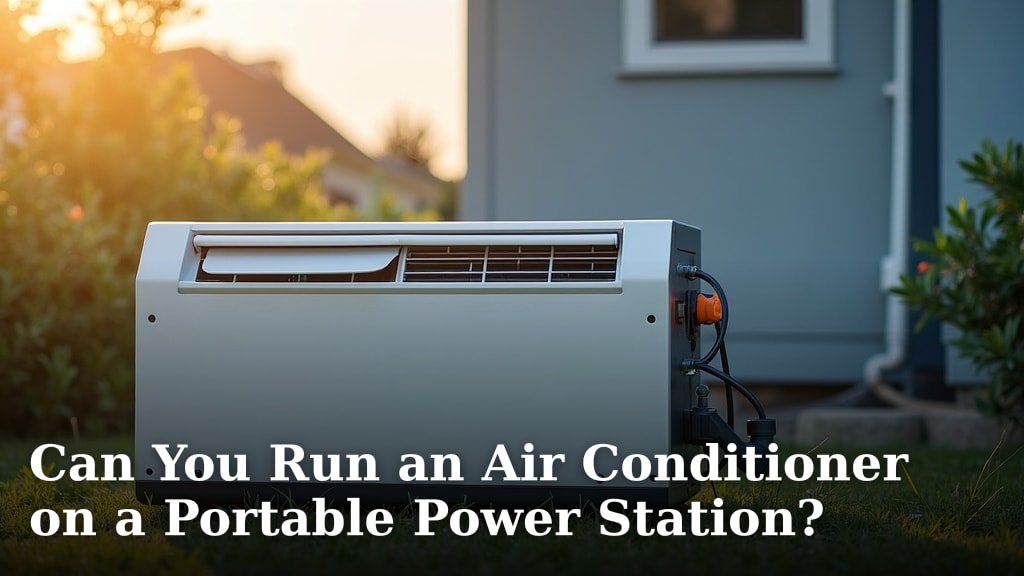
Yes, you can run an air conditioner on a portable power station, but it depends heavily on the AC unit’s power requirements and the power station’s capacity. You’ll need a unit that can supply enough wattage for both starting and continuous operation.
Many smaller, portable AC units are designed to be more energy-efficient. We found that matching your AC’s needs with a sufficiently powerful portable power station is key for effective cooling away from traditional outlets.
- AC compatibility is crucial.
- Power station capacity matters most.
- Look for surge and running wattage.
- Battery life varies greatly.
- Consider efficiency for best results.
Thinking about staying cool on your next outdoor adventure or during a power outage? Let’s walk through everything you need to know about powering your AC with a portable station.
Powering Your AC with a Portable Station: What You Need to Know
Yes, you absolutely can use a portable power station to run an air conditioner, but it’s not always a straightforward plug-and-play situation. The success of this pairing hinges on understanding both your AC unit’s demands and your power station’s capabilities.
Think of it like trying to tow a trailer with your car. You wouldn’t use a compact car to tow a huge RV, right? The same principle applies here. You need enough power to get the job done effectively and safely.
Understanding Your AC Unit’s Power Needs
Before you even look at power stations, you need to know your air conditioner. This is the most critical first step. Without this information, you’re just guessing, and that can lead to frustration or even damage.
AC units have two main power ratings: running wattage and starting (or surge) wattage. These are very different numbers, and both are important.
Running Wattage Explained
The running wattage is the power your AC unit needs to operate continuously once it’s already on. This is what keeps the compressor humming and the cool air flowing. We found that most small, portable AC units designed for camping or single rooms typically have a running wattage between 300 to 1,000 watts.
You can usually find this number on a sticker or plate directly on your AC unit, often near the power cord. It might be listed as “rated power” or “operating watts.”
Starting (Surge) Wattage Explained
Now, this is where many people get tripped up. The starting wattage is the brief burst of power your AC needs when its compressor first kicks on. It’s like the initial push required to get a heavy object moving.
This surge can be 2 to 3 times higher than the running wattage. So, an AC unit that runs at 500 watts might need 1,000 to 1,500 watts for a few seconds to start up. If your power station can’t provide this initial surge, your AC simply won’t turn on.
We found that many manufacturers don’t explicitly list the surge wattage. A good rule of thumb is to multiply the running wattage by 2.5 to get a rough estimate of the surge power needed.
Portable Power Station Capacity: What to Look For
Once you know your AC’s power requirements, you can start evaluating portable power stations. You need to match the power station’s output capabilities to your AC’s needs. There are two key specifications here: output wattage and battery capacity.
Output Wattage (Inverter Size)
The output wattage tells you how much power the power station can deliver at any given moment. This is limited by the inverter built into the unit. You need a power station with an inverter that can handle both your AC’s running wattage and its surge wattage.
If your AC has a running wattage of 600W and a surge of 1500W, you need a power station with a continuous output of at least 600W and a peak (surge) output of at least 1500W. We found that failing to meet the surge requirement is a common reason why ACs won’t start with smaller power stations.
Battery Capacity (Watt-Hours)
This specification tells you how long the power station can run your AC. Battery capacity is measured in watt-hours (Wh). A higher Wh number means longer run times.
To estimate run time, divide the power station’s Wh by your AC’s running wattage. For example, a 1000Wh power station running a 500W AC would theoretically last about 2 hours (1000Wh / 500W = 2 hours).
Keep in mind that this is an ideal scenario. Factors like efficiency losses, temperature, and the AC cycling on and off will reduce actual run time. We generally recommend subtracting about 20% from the theoretical run time for a more realistic estimate.
Choosing the Right Power Station: A Checklist
So, you’ve done your homework on your AC. Now, how do you pick the right power station? Here’s a quick checklist to guide your decision:
- Does the power station’s continuous output meet or exceed your AC’s running wattage?
- Can the power station’s peak output handle your AC’s starting (surge) wattage?
- Is the battery capacity (Wh) sufficient for your desired run time?
- Does it have AC outlets (standard wall plugs) that your AC can plug into?
- Does it offer fast charging options for quick recharges?
- Are there good safety features like overcharge protection and temperature control?
Not All AC Units Are Created Equal for Portable Power
It’s important to understand that some AC units are simply better suited for portable power than others. We found that smaller, personal air coolers or evaporative coolers (swamp coolers) use significantly less power than traditional compressor-based AC units.
These simpler units often require less than 100-200 watts. If your goal is just a little personal cooling, you might get away with a much smaller, more affordable power station.
However, if you’re trying to cool a whole room or tent with a standard portable AC, you’ll need a power station with substantial wattage and battery capacity. Don’t expect to run a large window AC unit on most portable power stations for very long.
Optimizing for Longer Run Times
Even with the right setup, you want to make the most of your battery life. After all, nobody wants their cool air to cut out unexpectedly. Here are a few tips we’ve gathered to help you extend your run time:
- Pre-cool your space: If possible, cool the area before relying solely on battery power.
- Insulate well: Keep windows and doors closed. Use curtains or blinds to block out sun.
- Set a higher temperature: Every degree you raise the thermostat saves power.
- Use “Eco” mode: Many AC units have an energy-saving mode that cycles the compressor less.
- Keep the power station charged: Always start with a full battery.
- Consider solar charging: If you’re outdoors, a solar panel can help replenish your power station.
Comparing Power Station Capabilities
To give you a better idea, here’s a general comparison of what different sizes of portable power stations might handle:
| Power Station Size (Wh) | Continuous Output (Watts) | Likely AC Type Supported | Estimated Run Time (for 300W AC) |
|---|---|---|---|
| 500-700 Wh | 500-800W | Small personal evaporative cooler | 1.5 – 2 hours |
| 1000-1500 Wh | 1000-1500W | Most small portable ACs (single room) | 3 – 5 hours |
| 2000 Wh+ | 2000W+ | Larger portable ACs, potentially small window units | 6+ hours |
Remember, these are rough estimates. Your actual results will depend on your specific AC unit and environmental factors.
Safety Considerations for Portable AC Power
Whenever you’re dealing with electricity, especially high-wattage appliances, safety should be a top priority. We found that paying attention to a few key details can prevent problems.
Always ensure your portable power station is placed on a stable, flat surface away from direct sunlight and excessive heat. Overheating can reduce performance and lifespan, or even become a fire hazard. Make sure there’s adequate ventilation around the power station.
Also, don’t overload your power station. Trying to draw more power than it’s rated for can cause it to shut down (a built-in safety feature) or, in worse cases, damage the unit. Always use the original or manufacturer-approved charging cables and accessories.
We’ve seen reports from many users emphasizing the importance of keeping your power station dry. Water and electricity do not mix, so protect your unit from rain or spills, especially if you’re using it outdoors.
Conclusion
Running an air conditioner on a portable power station is definitely achievable. The secret lies in carefully matching your AC’s power demands with a station that offers sufficient wattage and battery capacity. You now understand the difference between running and surge wattage, and how vital both are.
Always prioritize safety and optimize your setup for efficiency. By following the tips we’ve covered, you can enjoy cool comfort wherever your adventures take you or when the power goes out. So, go ahead and choose your portable power solution with confidence!
Frequently Asked Questions
Can a portable power station damage my AC unit?
No, a properly sized portable power station is unlikely to damage your AC unit. The power station’s inverter produces clean AC power similar to a wall outlet. However, using an undersized power station might prevent the AC from starting or cause the power station to shut down due to overload, but it generally won’t harm the AC.
How long does it take to recharge a portable power station large enough for an AC?
Recharge times vary greatly depending on the power station’s capacity and the charging method. A large unit (1000Wh+) can take 5-10 hours to fully recharge from a wall outlet. Many offer faster charging via multiple inputs or solar panels, which can extend recharge times depending on sunlight.
Are there any special cords or adapters needed to connect my AC to a power station?
Typically, no. Most portable power stations come with standard AC outlets, just like the ones in your home. You’ll simply plug your AC unit’s existing power cord directly into the power station. Always check that the power station’s outlet type matches your AC’s plug.
Can I run other appliances along with my AC on a single power station?
It depends on the power station’s total output capacity. You need to calculate the combined running wattage of all devices you wish to run simultaneously. If the total exceeds the power station’s continuous output rating, it will likely shut down. We recommend dedicating a station to the AC if it’s a high-wattage unit.
Is it more efficient to run an AC on “Eco” mode with a power station?
Yes, running your AC in “Eco” or “Energy Saver” mode is highly recommended when using a portable power station. This mode often cycles the compressor on and off to maintain a comfortable temperature rather than running continuously, significantly reducing overall power consumption and extending your battery life.
