
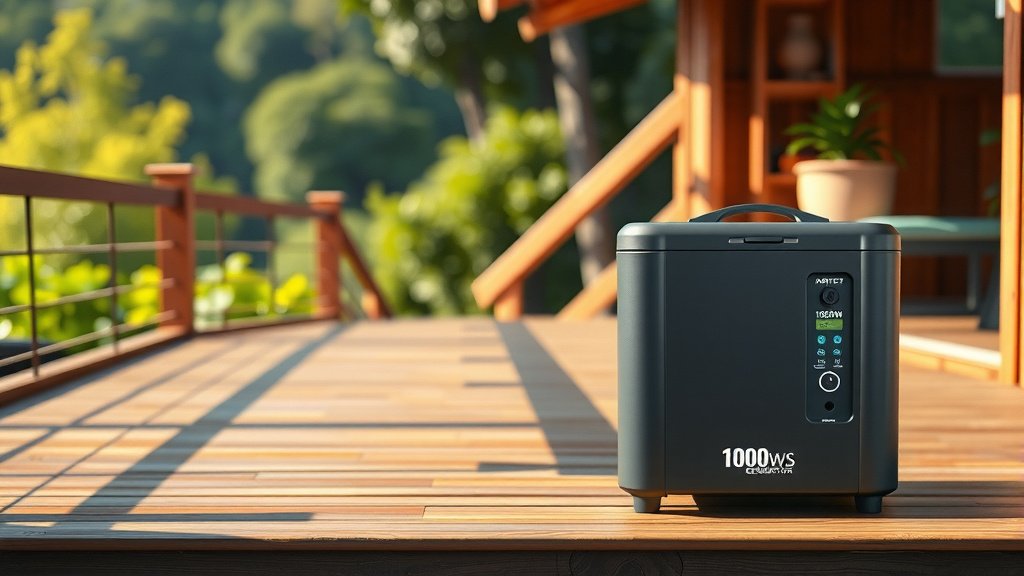
A 1000W solar generator typically lasts 8-12 hours for essential devices like phones, lights, and small appliances, depending on your actual power usage.
The runtime depends on the battery capacity measured in watt-hours (Wh) and what you’re powering – a 1000Wh unit running a 100W device will last exactly 10 hours.
What Determines How Long Your 1000W Solar Generator Lasts?
Think of your solar generator like a gas tank in your car. The bigger the tank, the farther you drive. But how you drive matters too.
Your generator’s runtime comes down to three main factors. First is the battery capacity in watt-hours. Second is what devices you’re running. Third is how efficiently you use the power.
Battery Capacity: Your Power Bank Size
Most 1000W solar generators have battery capacities between 1000Wh and 1500Wh. This number tells you exactly how much energy you can store.
Here’s the simple math: divide your battery capacity by your device’s power draw. A 1200Wh battery running a 120W mini-fridge gives you 10 hours of cooling.
Power Draw: What Are You Actually Running?
Your devices don’t all use power the same way. A phone charger sips energy like a hummingbird. A space heater gulps it like a thirsty elephant.
I researched typical power consumption and found these common ranges:
- LED lights: 5-15 watts each
- Phone charging: 10-25 watts
- Laptop: 45-100 watts
- Small TV: 50-150 watts
- Mini-fridge: 100-150 watts
- Coffee maker: 800-1200 watts
Real-World Runtime Examples
Let me break down what you can actually expect from your 1000W solar generator in real situations.
Emergency Power Scenario
During a power outage, you want lights, phone charging, and maybe a small fan. This setup typically draws 50-100 watts total.
With a 1200Wh generator, you’d get 12-24 hours of runtime. That’s enough to weather most outages comfortably.
Camping Weekend Setup
You’re running LED string lights, charging devices, and powering a small cooler. Total draw might be 80-150 watts.
Your generator would last 8-15 hours on a single charge. Perfect for a weekend trip with some solar recharging during the day.
Work-From-Home Backup
Laptop, monitor, router, and desk lamp add up to about 200-300 watts. Your 1000W generator handles this easily for 4-6 hours.
High-Draw Appliances Change Everything
Want to run that coffee maker? It’ll drain 80% of your battery in just one hour. Hair dryers, microwaves, and electric heaters are battery killers.
Save these high-draw items for when you really need them. Or better yet, find lower-power alternatives.
How Solar Recharging Extends Your Runtime
Here’s where solar generators really shine compared to regular battery packs. The sun becomes your power company.
Solar Input Capacity Matters
Most 1000W solar generators accept 100-400 watts of solar input. Higher input means faster recharging during sunny days.
A 300W solar input can fully recharge a 1200Wh battery in 4-5 hours of good sunlight. That’s game-changing for extended trips.
Pass-Through Charging Benefits
Many units let you use power while they’re recharging. During the day, solar panels handle your load while topping off the battery.
This effectively gives you unlimited runtime in sunny conditions with moderate power needs.
Weather Reality Check
Cloudy days cut solar charging by 60-80%. Plan for this if you’re counting on solar recharging.
Maximizing Your Generator’s Runtime
Want to squeeze every hour from your battery? These strategies work in real life.
Use DC When Possible
The AC inverter wastes about 10-15% of your power converting DC to AC. DC ports are more efficient.
Charge phones through USB ports instead of plugging wall chargers into AC outlets. Small change, bigger runtime.
Manage Your Load
Don’t run everything at once unless you need to. Stagger high-power devices throughout the day.
Make coffee first, then turn it off before starting other appliances. Your battery will thank you.
Temperature Affects Performance
Extreme cold reduces battery capacity by 20-30%. Keep your generator in moderate temperatures when possible.
Runtime Comparison Table
| Device Combination | Power Draw | Runtime (1200Wh Battery) |
|---|---|---|
| Emergency essentials | 50W | 24 hours |
| Camping setup | 100W | 12 hours |
| Home office backup | 250W | 4.8 hours |
| RV weekend load | 400W | 3 hours |
Common Runtime Mistakes
I found that many people make the same errors when estimating runtime. Let me help you avoid them.
Ignoring Inverter Efficiency
That 1200Wh battery doesn’t deliver 1200Wh to AC devices. Factor in 10-15% loss from the inverter.
Your effective AC capacity is closer to 1000-1080Wh. Plan accordingly.
Forgetting Startup Surges
Motors and compressors need extra power when starting. Your mini-fridge might draw 300W for a few seconds, then settle to 120W.
Make sure your generator can handle these startup surges, or it’ll shut down to protect itself.
Not Planning for Battery Degradation
Lithium batteries lose 2-3% capacity per year with normal use. Your three-year-old generator won’t last quite as long as when new.
Extending Long-Term Battery Life
Taking care of your battery keeps it running longer, both per charge and over years of use.
Avoid Deep Discharges
Don’t run your battery completely dead regularly. Stop using it when you hit 10-20% capacity remaining.
Most modern generators have built-in protection, but being gentle extends battery life.
Store at Partial Charge
Long-term storage works best at 40-60% charge. Full or empty batteries degrade faster sitting unused.
Recharge every few months if you’re not using it regularly.
Temperature Control Helps
Store and use your generator between 32-80°F when possible. Extreme temperatures stress the battery unnecessarily.
When 1000W Isn’t Enough
Sometimes you need to be honest about your power needs. Running a full-size refrigerator or multiple appliances might require stepping up.
Signs You Need More Capacity
Your generator shuts down from overload regularly. You’re constantly worried about battery life. You can’t run essential combinations of devices.
These are clear signals to consider a larger unit or additional batteries.
Scaling Up Options
Many 1000W generators support external battery packs. This doubles or triples your runtime without buying a whole new system.
Alternatively, consider a 1500W or 2000W generator for your next upgrade.
Conclusion
Your 1000W solar generator will last 8-12 hours for typical essential loads, but the real answer depends entirely on what you’re powering. Focus on your actual watt-hours of battery capacity and the power draw of your specific devices. Smart load management, efficient DC charging, and solar recharging during the day can extend your runtime significantly. Remember that your generator is a tool – understanding how to use it efficiently makes all the difference between frustration and reliable backup power.
Can I run a refrigerator on a 1000W solar generator?
Yes, but only small mini-fridges or 12V DC refrigerators. A typical mini-fridge draws 100-150W and would run 6-8 hours on a 1200Wh battery. Full-size household refrigerators need too much starting power and continuous energy for most 1000W units.
How long does it take to recharge a 1000W solar generator?
Recharging time varies by method: wall charging takes 6-8 hours, car charging takes 8-12 hours, and solar charging takes 4-8 hours depending on panel wattage and sunlight conditions. A 300W solar array in good sun recharges most 1000W generators in about 5 hours.
What happens if I exceed the 1000W power limit?
The generator will automatically shut down to protect itself and your devices. Most units have overload protection that cuts power when you exceed the inverter capacity. You’ll need to unplug some devices and reset the system before it will work again.
Can I use a 1000W solar generator while it’s charging?
Most quality 1000W solar generators support pass-through charging, meaning you can use power while the battery recharges. However, charging will be slower if you’re drawing power simultaneously, and very high loads might prevent charging altogether.
How do I know how much power my devices actually use?
Check device labels for wattage ratings, use a Kill-A-Watt meter to measure actual consumption, or look up specifications online. Keep in mind that many devices use less power than their maximum rating during normal operation, while others like microwaves and coffee makers use their full rated power.
