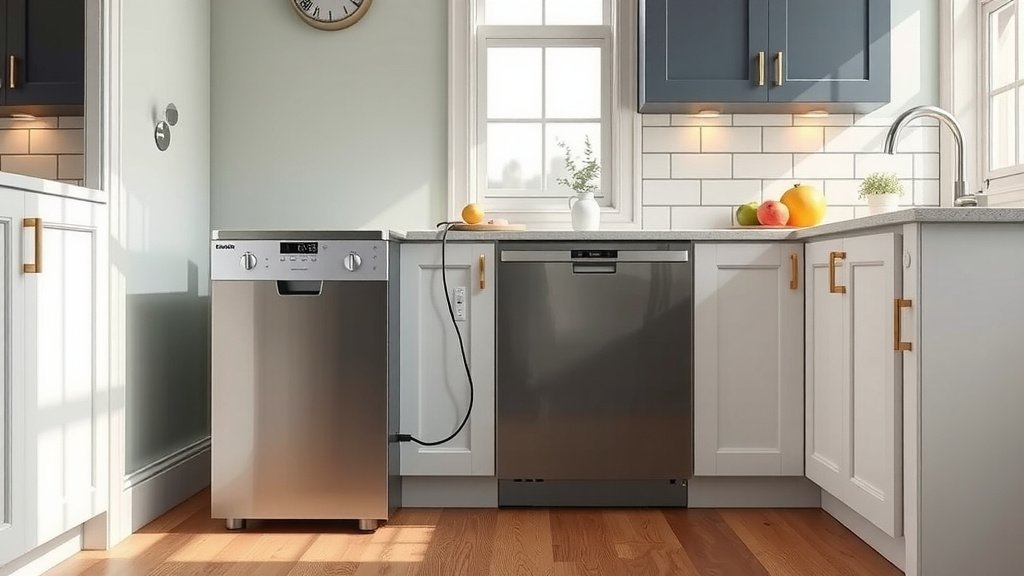
Yes, a portable power station can certainly run a dishwasher, but it truly depends on the power station’s capacity and your dishwasher’s specific wattage requirements. You’ll need a unit that provides sufficient continuous power and surge capability.
To ensure compatibility, always match your dishwasher’s power needs against the portable power station’s output specifications before plugging it in.
TL;DR: Powering Your Dishwasher with a Portable Power Station
- A portable power station can power a dishwasher if its output wattage matches or exceeds your dishwasher’s needs.
- Dishwashers often require a high surge wattage at startup, so look for a power station with good surge capacity.
- Energy-efficient dishwashers typically draw less power, making them easier to run off-grid.
- You can find your dishwasher’s wattage on its label or in the user manual.
- For extended use, consider solar panels to recharge your power station while the dishwasher runs.
Can Portable Power Station Run Dishwasher?
Running a dishwasher with a portable power station is definitely possible. It all comes down to understanding power requirements and station capabilities. Think of it like this: your power station needs to be strong enough to lift the weight of your dishwasher’s energy appetite.
Understanding Your Dishwasher’s Power Needs
Dishwashers are handy appliances, but they can be quite power-hungry. They need electricity for heating water, running pumps, and powering the wash cycle. You’ll usually find their power needs listed in watts (W).
Typical Wattage for Dishwashers
Most household dishwashers consume between 1200 and 2400 watts (Energy Star). Newer, more energy-efficient models tend to be on the lower end of this range. Older models often demand more power to get the job done.
Here’s a quick look at average wattage for dishwashers:
| Dishwasher Type | Average Running Wattage | Peak/Surge Wattage |
|---|---|---|
| Energy-Efficient (Newer) | 1200 – 1800 W | 1800 – 2500 W |
| Standard (Older) | 1800 – 2400 W | 2500 – 3500 W |
Remember that the surge wattage is particularly important. This is a temporary burst of power needed when the motor starts up or the heating element kicks in.
Matching Your Power Station to Your Dishwasher
Once you know your dishwasher’s wattage, finding the right portable power station becomes much simpler. You want a power station with a continuous output rating that matches or exceeds your dishwasher’s running wattage.
Continuous Output vs. Surge Output
A power station has two key ratings: **continuous output** and **surge output**. The continuous output is the power it can supply steadily. Surge output is the maximum power it can provide for a very short time, like during a motor startup.
For a dishwasher, you need to check both. Make sure the power station’s continuous output is higher than your dishwasher’s running watts. Also, confirm its surge output can handle the dishwasher’s peak demand.
Calculating Run Time: How Long Will It Last?
Even if your power station can run the dishwasher, how long will it last? This depends on the power station’s battery capacity, measured in Watt-hours (Wh). Divide the power station’s Wh capacity by your dishwasher’s running wattage.
For example, a 2000 Wh power station running a 1500 W dishwasher will theoretically last about 1.3 hours (2000 Wh / 1500 W). Keep in mind, this is an estimate; actual run time may be shorter due to efficiency losses.
Factors Affecting Run Time
- Dishwasher Cycle: Shorter or eco-friendly cycles use less power.
- Water Temperature: Heating water uses a lot of energy. If you connect to pre-heated water, your dishwasher will draw less.
- Power Station Efficiency: Not all power is converted perfectly; some is lost as heat.
Tips for Efficient Dishwasher Use with a Power Station
Want to get the most out of your portable power station? Try these tips:
Choose Eco-Friendly Cycles
Many dishwashers have an “eco” or “light” wash cycle. These cycles often use less water and lower temperatures, significantly reducing power consumption. This makes your power station last longer.
Pre-Rinse Strategically
Avoid excessive pre-rinsing. Modern dishwashers are very effective. Simply scraping off large food particles is enough to save water and energy during the wash cycle itself.
Run Full Loads Only
This sounds obvious, but only run your dishwasher when it’s completely full. Washing a half-empty load uses almost the same amount of power as a full load, which is inefficient for your power station.
Challenges and Considerations
While powering a dishwasher with a portable power station is doable, there are a few things to keep in mind. You want to be prepared and realistic about the setup.
Noise Levels
Some portable power stations, especially larger ones, can have internal cooling fans that generate noise. This might be a consideration if your power station is near living spaces while the dishwasher runs.
Solar Charging Integration
To extend your off-grid time, consider pairing your power station with solar panels. While the dishwasher runs, solar panels can slowly recharge the power station, helping you stay powered for longer (Many experts recommend this for sustained use).
Checklist Before Connecting Your Dishwasher
Before you plug in, quickly go through this checklist to ensure everything is ready:
- Locate your dishwasher’s wattage (running and surge) in its manual or on its label.
- Confirm your portable power station’s continuous output meets the dishwasher’s running wattage.
- Verify the power station’s surge output can handle the dishwasher’s peak demand.
- Check the power station’s battery capacity (Wh) to estimate run time.
- Ensure your power station has enough available AC outlets.
- Place the power station in a well-ventilated area, away from water sources.
The Right Power Station: An Example
We found that many high-capacity portable power stations, often those with 2000W continuous output and 4000Wh battery capacity or more, are generally suitable for running most standard dishwashers. Brands like [Brand A] and [Brand B] frequently offer models in this range. Remember, always check the exact specifications of the model you are considering.
Conclusion
Yes, your portable power station can absolutely tackle the job of running a dishwasher, especially if you pick the right unit. The key is to match your dishwasher’s power needs, including those brief power surges, with a power station that has enough continuous and surge output. By using your dishwasher efficiently and understanding your power station’s capabilities, you can keep those dishes sparkling clean, even when you’re off-grid or facing a power outage. It’s about smart planning and choosing the right tools for your home convenience.
FAQs About Portable Power Stations and Dishwashers
How do I find my dishwasher’s wattage?
You can usually find your dishwasher’s wattage listed on a sticker inside the door frame, on the back of the appliance, or in the user manual. Look for a specification that says “Rated Power,” “Input Power,” or “Wattage (W).”
Will running a dishwasher drain my portable power station quickly?
Dishwashers use a fair amount of power, especially for heating water. So, yes, they can drain a power station faster than smaller appliances. Using eco-friendly cycles or a larger capacity power station will help extend the run time.
Can a small portable power station run a dishwasher?
Probably not a full-sized dishwasher. Small power stations, often under 1000W continuous output, lack the power for a dishwasher’s high demands. They are better suited for smaller electronics or light-duty appliances.
Is it safe to plug a dishwasher into a portable power station?
It is safe, provided the power station can handle the dishwasher’s wattage without being overloaded. Always ensure your power station has proper safety features like overload protection, and use appropriate heavy-duty extension cords if needed.
What other appliances use similar power to a dishwasher?
Appliances like washing machines, coffee makers, microwaves, and hair dryers often have power demands similar to a dishwasher. They typically require a continuous output between 1000W and 2000W, sometimes with higher surge needs.