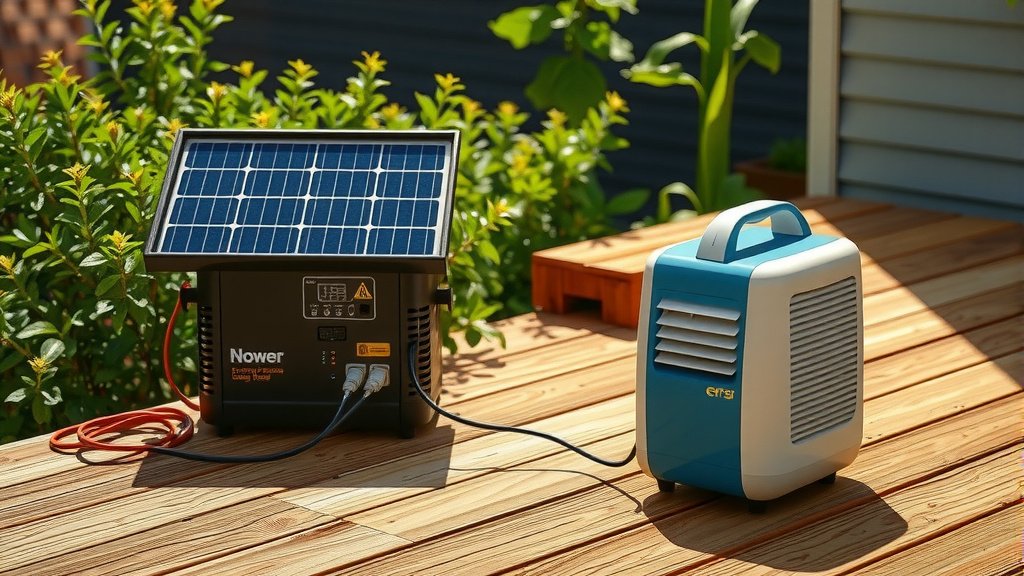
Yes, a solar generator can power a portable AC unit, though it depends entirely on the AC’s wattage and the solar generator’s output capacity.
You’ll need to match your portable AC’s power demands with the solar generator’s capabilities to ensure effective and reliable cooling.
- Running a portable AC unit with a solar generator is generally possible, but requires careful planning.
- The key is matching the AC’s power consumption (watts) with your solar generator’s output capacity and battery size.
- High-wattage ACs demand larger, more powerful solar generators for adequate runtime.
- Calculating your AC’s wattage and projected run time is a vital first step.
- Investing in an efficient AC and a high-capacity solar generator will give you the best results.
Can Solar Generator Run Portable AC Unit?
Yes, a solar generator can certainly run a portable AC unit! The main consideration is matching the AC’s power needs with your solar generator’s output capability.
Think of it like trying to fill a bucket with a cup. If your AC is a huge bucket and your generator is a small cup, you will struggle to get enough water. We need to find the right size match.
Understanding the Power Connection
When we talk about solar generators, we are looking at portable power stations paired with solar panels. These units store energy in a battery, then convert it to AC power your devices can use.
Portable AC units, however, are known for being energy-hungry. They need a consistent flow of power to keep you cool, especially during startup.
What to Look For: Watts, Watt-Hours, and Pure Sine Wave
There are a few key terms to understand when sizing up your equipment. First, know your AC’s wattage. This tells you how much power it consumes when running.
Your solar generator will list its output wattage (how much power it can deliver) and its battery capacity in watt-hours (Wh) or kilowatt-hours (kWh), showing how much energy it can store.
It’s also important that your solar generator offers a pure sine wave inverter. This kind of power is cleaner and safer for sensitive electronics like AC units, preventing potential damage (Many experts say).
Matching Your AC to Your Generator
Let’s get practical. How do you know if your solar generator is strong enough? Here’s a simple guide.
First, find the running watts of your portable AC unit. This is usually listed on the AC unit itself, in the manual, or on the manufacturer’s website. AC units also have a higher “surge” or “starting” wattage for a few seconds when they first turn on. Your generator needs to handle this brief spike too.
Calculating Your Run Time
Once you have your AC’s running watts and your generator’s battery capacity, you can estimate run time.
A basic formula is: (Generator’s Battery Capacity in Wh) / (AC’s Running Watts) = Estimated Run Time in Hours.
For example, if your AC uses 500 watts and your generator has a 1000Wh battery, you might get about 2 hours of run time (1000 Wh / 500 W = 2 hours). Remember, this is an estimate; factors like battery efficiency losses and ambient temperature can reduce it (Research often shows).
Considerations for Choosing the Right Setup
Not all solar generators are equal. For running a portable AC, you’ll generally want a higher-capacity unit. We found that generators with a minimum of 1500Wh battery capacity and 1500W continuous output are often a good starting point for smaller ACs.
Larger ACs will demand even more. Think about how long you need the AC to run. Do you just need an hour or two to cool down a space, or do you plan to run it overnight?
Solar Panel Input Matters
Your solar generator’s charging speed from solar panels is also a consideration. If you are recharging daily, you will want sufficient solar panel input to keep your battery topped up.
If you use 500Wh of power, you need to put at least that much back in from your solar panels, accounting for conversion losses, to maintain your power levels (Many guidelines point to efficient solar panel pairing).
Tips for Efficient AC Use with Solar Power
You can make your portable AC more solar-friendly with a few smart moves.
- Insulate Your Space: Close windows and blinds to keep cool air in and hot air out.
- Choose an Efficient AC: Look for units with higher EER (Energy Efficiency Ratio) ratings. They use less power to produce the same cooling.
- Run Intermittently: Instead of constant running, cool your space down, then turn the AC off until it warms up again. This saves battery life.
- Pre-Cool: If you have access to grid power before going off-grid, pre-cool your space.
- Use Fans: Fans consume much less power than ACs and can make a cooler room feel even colder.
When a Solar Generator Might Not Be Enough
For very large spaces, or if you need continuous, powerful cooling for extended periods, a solar generator might struggle. You might need a more permanent solar setup or be prepared for shorter AC run times.
Don’t expect a small 500Wh generator to run a large 10,000 BTU AC for hours. That’s asking a lot!
A Quick Comparison: AC Wattage vs. Generator Size
Here’s a general idea of what you might need, based on typical portable AC sizes. Remember, specific models will differ.
| Portable AC Size (BTU) | Typical Running Watts | Minimum Generator Capacity (Wh) for ~3-4 hrs runtime | Minimum Continuous Output (Watts) |
|---|---|---|---|
| 5,000 BTU | ~450-600W | 1500-2000 Wh | 600W+ |
| 8,000 BTU | ~700-900W | 2500-3500 Wh | 900W+ |
| 10,000 BTU | ~900-1100W | 3500-4500 Wh | 1100W+ |
| 12,000 BTU | ~1100-1300W | 4000-5000 Wh | 1300W+ |
Checklist for Success
Before you commit to a purchase, go through this simple checklist:
- Know your AC’s running watts and surge watts.
- Confirm your solar generator’s continuous output wattage can handle both.
- Verify the generator’s battery capacity (Wh) meets your desired run time.
- Ensure the generator has a pure sine wave inverter.
- Consider the solar input wattage if you plan to recharge via solar panels.
- Read reviews for real-world performance, not just specs.
Conclusion
Running a portable AC unit with a solar generator is absolutely within reach for many, offering a cool escape whether you are camping, experiencing a power outage, or just seeking some off-grid comfort. The trick is to do your homework. Match your AC’s power demands with your solar generator’s capabilities, paying close attention to wattage and battery capacity.
With a bit of planning and the right setup, you can enjoy refreshing coolness powered by the sun. It’s a great feeling to stay comfortable without relying on grid power. So, yes, you can get cool with solar power!
Are all portable AC units compatible with solar generators?
Not all portable AC units are automatically compatible. The AC unit needs to match the solar generator’s power output (watts) and surge capability. Newer, more efficient AC units and those designed for RVs often work better with solar setups due to lower power consumption.
How do I find my portable AC unit’s wattage?
You can usually find your portable AC unit’s running wattage on a label or sticker on the unit itself, often on the side or back. It will also be in the product manual or on the manufacturer’s website under specifications. Remember to look for both running watts and potential surge watts.
Will running a portable AC drain my solar generator battery quickly?
Yes, portable AC units are among the most power-hungry appliances. Running one will drain your solar generator’s battery much faster than smaller devices like laptops or lights. The rate of drain depends on the AC’s wattage and the generator’s battery size. For longer run times, you’ll need a large-capacity generator and possibly continuous solar input.
Can I charge my solar generator and run the AC at the same time?
Yes, many solar generators allow for “pass-through charging,” which means you can charge the generator with solar panels while it’s actively powering your portable AC. This setup can extend your AC’s run time significantly, as power is being replenished while it’s being used.
What is the best type of portable AC unit for solar power?
For solar power, look for highly efficient portable AC units with a low running wattage. Inverter AC units are often a great choice as they can vary their compressor speed, using less power once the desired temperature is reached. Smaller BTU units also naturally consume less power.