
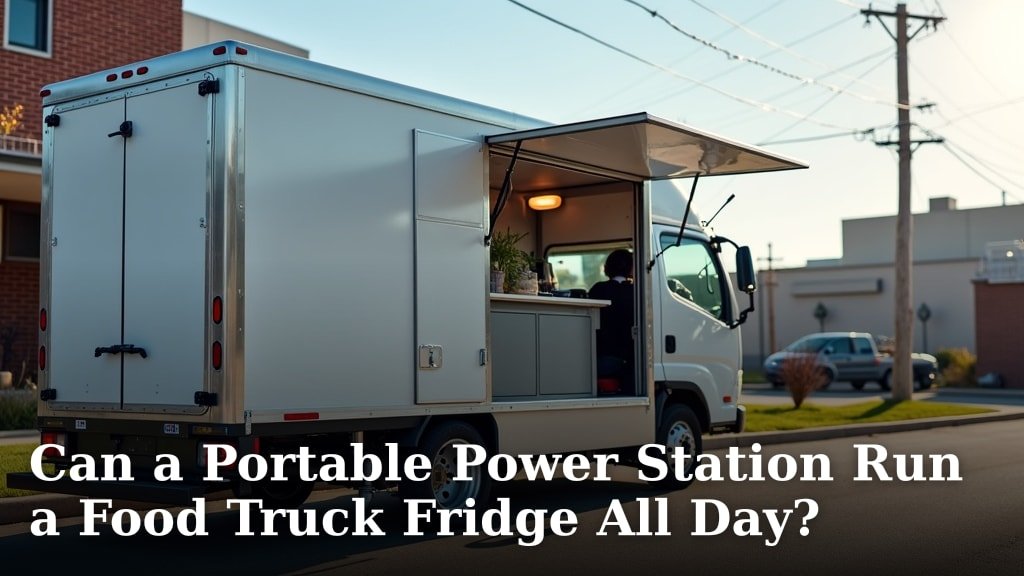
Yes, a portable power station can run a food truck fridge all day, but it depends on the fridge’s power needs and the power station’s capacity. You’ll need to match the wattage requirements of your specific fridge to the continuous output of the power station. Many smaller to medium-sized fridges are well within reach for capable power stations.
When choosing a power station, consider both its surge and continuous wattage. Your fridge might need a burst of power to start its compressor, but then it needs a steady supply to keep things cool. Finding the right balance ensures your food stays safely chilled without draining your power source too quickly. This is a key consideration for mobile vendors.
- Not all power stations are created equal for this job.
- Fridge wattage is your most important number.
- Look for both surge and continuous power ratings.
- Matching these specs prevents premature battery drain.
Let’s break down how to figure out if your food truck fridge can be powered by a portable unit all day long.
Powering Your Food Truck Fridge: Can a Portable Unit Handle It?
The short answer is a resounding maybe. Whether a portable power station can keep your food truck fridge humming all day depends on a few key factors. You’re not just plugging in any old appliance. You need to understand your fridge’s appetite for power and the capabilities of your portable powerhouse.
Think of it like fueling a car. You wouldn’t put diesel in a gasoline engine, right? Similarly, you need to match the right kind of power to your fridge. Let’s get into the nitty-gritty to help you figure this out.
Understanding Your Fridge’s Power Needs
Your food truck fridge isn’t just one constant draw of electricity. It’s more like a creature with specific needs. The biggest power user is usually the compressor. This is the heart of your cooling system. When it kicks on, it needs a jolt of power.
Wattage: The Magic Number
The most important piece of information you need is the wattage of your fridge. This tells you how much power it uses. You’ll typically find this information on a sticker on the back of your fridge or in its user manual. It’s usually listed in watts (W).
There are two kinds of wattage to pay attention to: running wattage and surge wattage. The running wattage is the steady amount of power the fridge needs to keep running. The surge wattage, also called starting wattage, is the much higher amount it needs for a brief moment when the compressor starts.
Running Wattage Explained
This is the consistent power draw. It’s what keeps the air inside your fridge nice and cold after the compressor has done its job. Most smaller under-counter fridges might run on 100-200 watts. Larger, commercial-grade fridges can easily use 400-600 watts or even more.
Surge Wattage Explained
This is the temporary power spike. We found that compressors can often need 2-3 times their running wattage to start up. So, a fridge that runs on 100 watts might need 200-300 watts for a second or two. This is a critical detail for power station selection.
How Long Does It Run?
Another factor is how often the compressor cycles on and off. This depends on a few things. How often you open the fridge door is a big one. The outside temperature also plays a role. A hotter day means the compressor will work harder and cycle on more often.
We’ve found that for a typical food truck fridge, the compressor might cycle on for a few minutes every 15-30 minutes. This is an estimate, of course. Your specific fridge will have its own pattern. Understanding this helps calculate the total energy needed over a day.
What is a Portable Power Station?
A portable power station is essentially a big battery with outlets. It stores electrical energy. You can then use this stored energy to power various devices. Think of it like a giant, rechargeable battery pack for your appliances.
Key Specifications to Look For
When you’re looking at power stations, two numbers are going to be your best friends: continuous wattage and peak/surge wattage. You’ll also want to consider the battery capacity, measured in watt-hours (Wh).
Continuous Wattage
This is the maximum power the station can supply continuously. Your power station must be able to meet or exceed your fridge’s running wattage. If your fridge needs 150 watts to run, your power station should offer at least 150 watts of continuous output.
Peak/Surge Wattage
This is the maximum power the station can provide for a short burst. This needs to be high enough to handle your fridge’s compressor starting up. If your fridge has a surge requirement of 300 watts, your power station’s peak wattage must be at least that high. Many experts recommend having a buffer of 20-30% for surge capacity.
Battery Capacity (Watt-Hours)
This number tells you how much energy the power station stores. It’s like the size of the fuel tank. A higher watt-hour (Wh) rating means it can power your devices for longer. To run a fridge all day, you’ll need a substantial capacity.
We can calculate this using a simple formula: (Fridge Running Watts * Hours of Operation) / Efficiency Factor = Required Wh. For example, a 150W fridge running for 10 hours would need approximately (150W * 10h) = 1500Wh. We then divide by an efficiency factor (often around 0.85) to account for energy loss, so 1500Wh / 0.85 ≈ 1765Wh. This gives you a target for your power station’s battery capacity.
Can Your Power Station Power a Food Truck Fridge All Day?
So, can it really make it through a whole day? Let’s look at some common scenarios.
Scenario 1: The Small Cooler Fridge
Imagine a compact, under-counter fridge. These often have running watts around 100-150W and surge watts around 200-300W. A good quality portable power station with a continuous output of 300-500W and a peak output of 600-1000W could potentially handle this.
The key here is the battery capacity. To run this fridge for, say, 8-10 hours, you’d likely need a unit with at least 1500-2000Wh. Many high-capacity power stations on the market today can meet this requirement. For this scenario, a unit with at least 1500Wh would be a good starting point.
Scenario 2: The Medium-Sized Fridge
Now, consider a slightly larger fridge, perhaps one that holds more inventory. These might have running watts of 200-300W and surge watts of 400-600W. You’ll need a more robust power station for this.
Look for units with a continuous output of 500-1000W and a peak output of 1000-2000W. For all-day operation (8-10 hours), a battery capacity of 2000-3000Wh or more would be advisable. This is where you start looking at the larger, more powerful models.
Scenario 3: The Large Commercial Fridge
If you have a substantial commercial fridge, often found in larger trucks, these can be real power hogs. They might draw 400-600W continuously and require a surge of 800-1200W or more. Running one of these all day from a portable power station is a significant challenge.
You would need a top-tier power station with a continuous output of 1000W+ and a peak output of 2000W+. More importantly, you’d need an extremely large battery capacity, likely 3000Wh and upwards, possibly even requiring multiple units daisy-chained together. This often becomes less practical and more expensive than alternative solutions.
Tips for Maximizing Power Station Performance
Even with the right equipment, there are ways to ensure your power station lasts. Think of these as energy-saving tips for your fridge.
- Minimize Door Openings: Every time you open the door, cold air escapes. This forces the compressor to work harder. Keep it closed as much as possible.
- Efficient Fridge Placement: Make sure your fridge isn’t in direct sunlight. Heat makes it work harder. Proper ventilation around the unit is also key.
- Pre-Chill Your Fridge: Before your workday begins, make sure your fridge is already at its target temperature. Plug it into shore power at home or your depot to get it there.
- Don’t Overfill: A packed fridge can sometimes make it harder for cold air to circulate efficiently. Find that sweet spot for optimal cooling.
- Monitor Your Power Station: Keep an eye on the battery level. Many power stations have apps that let you track usage and remaining power.
Are There Any Limitations?
Yes, there are definitely limitations to consider. Portable power stations are great, but they aren’t magic. The biggest limitation is battery capacity.
Running a fridge all day is a marathon, not a sprint. You need enough stored energy. If your fridge is particularly power-hungry, or you need it to run for an extended period, a single portable power station might not be enough. You might need to recharge it during the day, which isn’t always feasible when you’re on the go.
We also found that extreme temperatures can affect battery performance. Cold weather can reduce battery capacity. In very hot conditions, the power station itself might need to cool down, potentially interrupting power flow. It’s always wise to check the operating temperature range for your specific unit.
Making the Right Choice: A Quick Checklist
Before you buy, ask yourself these questions:
- What are the exact running and surge watts of my fridge?
- What is the daily energy consumption in watt-hours (Wh)?
- Does the power station’s continuous wattage meet or exceed my fridge’s running watts?
- Does the power station’s surge wattage handle my fridge’s starting requirements?
- Is the power station’s battery capacity (Wh) sufficient for an entire day’s operation, plus a buffer?
- Can I reliably recharge the power station if needed during the day?
Conclusion
You’ve learned that powering your food truck fridge all day with a portable power station is achievable. It all boils down to matching your fridge’s specific wattage needs with a power station’s continuous and surge output. Don’t forget that battery capacity, measured in watt-hours, is your key to a full day of operation. By carefully calculating your fridge’s power draw and considering your usage habits, you can find the right unit. Your next step? Grab your fridge’s manual, note those wattage figures, and start comparing power station specs to keep your inventory perfectly chilled.
Frequently Asked Questions
What happens if my power station’s surge wattage is too low?
If your power station can’t meet your fridge’s surge wattage, the compressor might not start up. This means your fridge won’t get cold at all. You might experience an overload or the power station may shut itself off to protect its components.
Can I use a smaller power station and just recharge it during the day?
While it’s possible, recharging on the go can be tricky for a food truck. If your fridge is running for many hours, you’d need a very fast recharge capability or a second backup unit. It’s generally more reliable to get a unit with enough capacity from the start.
Will a generator be a better option than a portable power station for my fridge?
Generators can offer more raw power, but they produce noise and exhaust fumes, which might not be ideal for all food truck setups. Portable power stations are silent, emission-free, and can be recharged using solar panels, offering a cleaner and quieter alternative if sized correctly.
How can I estimate my fridge’s watt-hours if the manual doesn’t say?
We found that for many under-counter fridges, you can estimate running watts at 100-200W. You can also measure the actual draw using a plug-in energy meter. Multiply the running watts by your expected daily usage hours to get a rough watt-hour estimate.
Is a power station suitable for powering other appliances in my food truck too?
Yes, many food truck operators use portable power stations for other needs like charging devices, running lights, or even a small coffee maker. Just be sure the power station’s total continuous and surge wattage can handle the combined load of all devices you plan to run simultaneously.
