
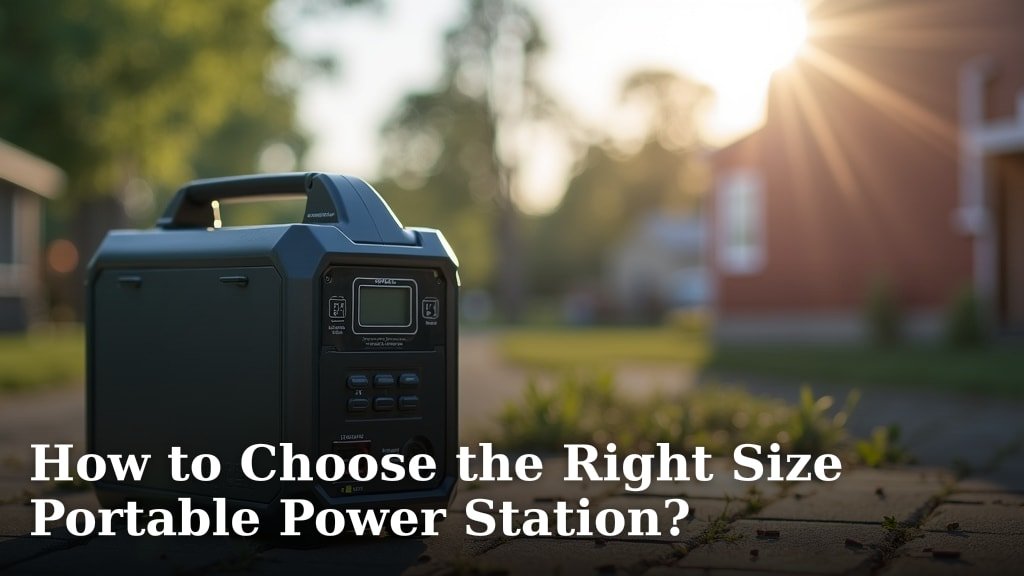
To choose the right size portable power station, you need to first calculate your total power needs based on the devices you want to run. Look at the wattage requirements of your gadgets and how long you need them to operate, then pick a power station with enough capacity and output to match. It’s like finding the perfect portable battery for your whole campsite.
Thinking about a portable power station can feel a bit overwhelming, right? You want enough juice to keep your devices charged, but not something so big it’s a hassle to carry. We found that the secret is to match its capacity to your specific use, whether you’re camping, having a backyard party, or preparing for an outage. Size up carefully to avoid running out of power when you need it most.
TL;DR:
- Calculate device wattage.
- Estimate total run time.
- Match station capacity (Wh) and output (W) to your needs.
- Consider peak power (surge wattage).
- Don’t forget port types and quantity.
Let’s walk through exactly how to figure out what size portable power station will serve you best, ensuring you always have power on the go.
Sizing Up Your Portable Power Station Needs
To choose the right portable power station, you need to first understand your power requirements. It’s like planning a road trip; you need to know your destination and how much fuel it takes. We found that the biggest mistake people make is guessing instead of calculating. This can lead to either an underpowered unit or one that’s overkill and too heavy.
Calculate the Wattage of Your Devices
First, grab all the devices you plan to power. Think about everything: your phone, laptop, mini-fridge, CPAP machine, or even a small fan. Each device has a wattage rating. We often see this listed on a sticker on the back or bottom of the device itself. It might be labeled in “W” for watts, or sometimes as “Volts (V) x Amps (A).” If you see V and A, multiply them together to get watts.
- Look for a label on the device or its charger.
- Find “W” for watts.
- If you see “V” and “A,” multiply V x A to get watts.
- An iPhone charger might be 5W-20W, while a laptop could be 45W-100W.
- A small mini-fridge often uses 40W-60W when running.
Many household appliances have two wattage numbers: a running wattage and a peak (surge) wattage. The running wattage is what it uses continuously. The peak wattage is a temporary spike needed to start the motor, like in a refrigerator or a power drill. Your power station needs to handle both.
Estimate How Long You Need Each Device to Run
Once you know the wattage, think about how long you’ll use each device. Will you charge your phone constantly? Or just use your laptop for a couple of hours? This helps determine the total energy you need, measured in Watt-hours (Wh). For example, a 100W laptop used for 5 hours needs 500 Wh (100W x 5h).
It’s important to be realistic here. Overestimating isn’t bad for capacity, but it might mean a heavier, more expensive unit. Underestimating, however, means you’ll run out of power too soon. We recommend thinking about your “typical” usage for a 24-hour period.
Typical Device Wattage and Usage Examples
Let’s look at some common devices and their power needs. This table can help you quickly estimate your own setup. Remember, these are averages, and your specific device might vary slightly.
| Device | Average Running Wattage | Typical Usage (per 24 hrs) | Total Wh Needed |
|---|---|---|---|
| Smartphone | 5W-10W (charging) | 2 hours (charging) | 10-20 Wh |
| Laptop | 45W-100W (charging/running) | 4 hours | 180-400 Wh |
| LED Light (small) | 5W-15W | 6 hours | 30-90 Wh |
| Portable Fan | 20W-50W | 8 hours | 160-400 Wh |
| Mini-Fridge | 40W-60W (running) | 12 hours (compressor on/off) | 480-720 Wh |
| CPAP Machine | 30W-60W (without humidifier) | 8 hours | 240-480 Wh |
Add up the “Total Wh Needed” column for all your devices. This sum gives you your total daily Watt-hour requirement. This number is your magic number when looking at power station capacity.
Understanding Portable Power Station Specifications
Now that you know your power needs, it’s time to translate that into power station specs. Two main numbers matter: Watt-hours (Wh) and Watts (W). These are often confused, but they mean different things. We often explain it like fuel in a car (Wh) and engine power (W).
Capacity: Watt-Hours (Wh)
Watt-hours (Wh) tell you how much energy the power station can store. It’s like the size of your car’s fuel tank. If your total daily need is 500 Wh, you’ll need a power station with at least 500 Wh capacity. We often recommend adding a 20-30% buffer to this. Why? Because batteries aren’t always 100% efficient, and it gives you a little extra wiggle room for unexpected needs (National Renewable Energy Laboratory).
So, for 500 Wh daily, aim for a power station with a capacity of around 600-650 Wh or more. This buffer also helps prolong the battery’s lifespan, as frequently draining it to zero isn’t ideal.
Output Power: Watts (W) and Peak (Surge) Watts
The “Watts (W)” rating of a power station tells you how much power it can deliver at any given moment. This is like the horsepower of your car’s engine. If you plug in a device that needs 100W, the power station must be able to output at least 100W continuously. If you run multiple devices at once, sum their wattages. For instance, a 60W laptop and a 10W phone charging simultaneously require 70W output.
Don’t forget about peak (surge) wattage. Some appliances, especially those with motors, draw significantly more power for a few seconds when they first turn on. Your power station needs to handle this temporary surge. If your mini-fridge runs at 50W but surges to 150W when it starts, your power station must have a peak wattage rating of at least 150W (or more). If it doesn’t, the appliance may not start, or the power station could shut off.
Consider the Number and Types of Ports
It’s not just about capacity and output; you also need the right connectors. Think about what you’ll be plugging in. Do you need multiple AC outlets? USB-A or USB-C ports? What about 12V car ports for specific camping gear?
- AC Outlets (Wall Plugs): Essential for laptops, small appliances, and anything with a standard wall plug. Ensure there are enough for your simultaneous devices.
- USB-A Ports: Common for older phones, tablets, and small electronics.
- USB-C Ports (PD): Increasingly popular for fast charging modern phones, laptops, and drones. Look for “Power Delivery” (PD) for faster charging.
- 12V Car Outlets: Handy for coolers, air pumps, or certain specific RV accessories.
We’ve found that having fewer AC outlets than you expect can be a real headache. Portable power stations with two to four AC outlets are common and usually sufficient for most users. If you need more, consider a model with a higher count, or plan to charge devices sequentially.
Factors Beyond Just Power: Portability and Features
Once you’ve narrowed down the power specs, think about the practicalities. After all, it’s a “portable” power station!
Weight and Size
Where will you use it? A 30lb power station is fine for car camping, but not ideal for hiking. Smaller, less powerful units are lighter. Larger capacity equals heavier weight. We’ve seen models ranging from a few pounds (for phones only) to over 50 pounds (for larger appliances and extended use). Will you be carrying it far? Will it fit in your trunk or backpack?
Charging Options for the Power Station Itself
How will you recharge the power station?
- Wall Outlet: The fastest way, typically.
- Car Charger (12V): Great for recharging while driving.
- Solar Panels: An excellent option for off-grid or extended use. Check if the power station comes with a solar charging controller or if you need to buy one separately.
Many units offer multiple charging methods. This flexibility is a huge advantage, especially during emergencies or long outdoor trips. We often recommend solar panel compatibility for anyone planning to be away from traditional power sources for more than a day or two.
Your Portable Power Station Checklist
To help you, here’s a quick checklist to guide your decision-making process:
- Have you calculated the wattage for all your devices?
- Did you estimate the total Watt-hours needed per day?
- Does the power station capacity (Wh) meet your needs + buffer?
- Can the power station output (W and Peak W) handle your highest-demand device?
- Does it have the right number and types of ports you need?
- Is the weight and size suitable for your intended use?
- Does it offer convenient recharging options (wall, car, solar)?
By going through these steps, you’ll feel much more confident in choosing a portable power station that truly meets your needs, instead of ending up with a device that’s either too weak or unnecessarily large.
Conclusion
Choosing the right portable power station doesn’t have to be a guessing game. By carefully calculating your device wattages and estimated run times, you get a clear picture of your total Watt-hour needs. Remember to factor in a buffer and consider peak wattage requirements for tools and appliances with motors. We’ve found that matching these specs to a station’s capacity and output is key.
Don’t forget the practical aspects like port types, weight, and recharge options. Taking the time to do this research now will save you from frustration later. Now, go confidently pick the perfect power station that keeps your adventures and emergencies fully charged!
Frequently Asked Questions
Is it better to get a power station with more Watt-hours than I think I need?
Yes, we generally recommend getting a power station with 20-30% more Watt-hours than your calculated daily need. This buffer accounts for battery inefficiencies and gives you extra power for unexpected situations. It also helps prolong the battery’s overall lifespan by avoiding frequent deep discharges.
Can I use a power station while it’s being charged by solar panels?
Many modern portable power stations offer pass-through charging, meaning you can power your devices while the station itself is recharging. This is a very useful feature, especially when using solar panels for extended off-grid trips. Always check the manufacturer’s specifications to confirm if your chosen model supports this.
What’s the difference between a portable power station and a car jump starter?
A portable power station is designed to provide continuous AC and DC power for various devices like phones, laptops, and small appliances. A car jump starter, while also portable and battery-powered, is primarily designed to deliver a high burst of power specifically to start a car’s engine. Some larger power stations might have a jump-start feature, but it’s not their main purpose.
How do I know if a power station can run my CPAP machine all night?
First, find your CPAP machine’s wattage (check the label or manual, often 30-60W without a humidifier). Then, multiply this by the hours you sleep (e.g., 8 hours). This gives you the total Watt-hours needed. Many CPAP users find that a power station with at least 300-500 Wh capacity is a good starting point for one night’s use.
Do larger power stations charge faster than smaller ones?
Not necessarily. The charging speed of a portable power station depends on its input watt capabilities and the charger being used, not just its overall capacity. A larger station might have a higher input wattage, allowing it to charge faster, but a smaller one with high-speed charging technology could charge quickly too. Always check the input wattage spec.
