
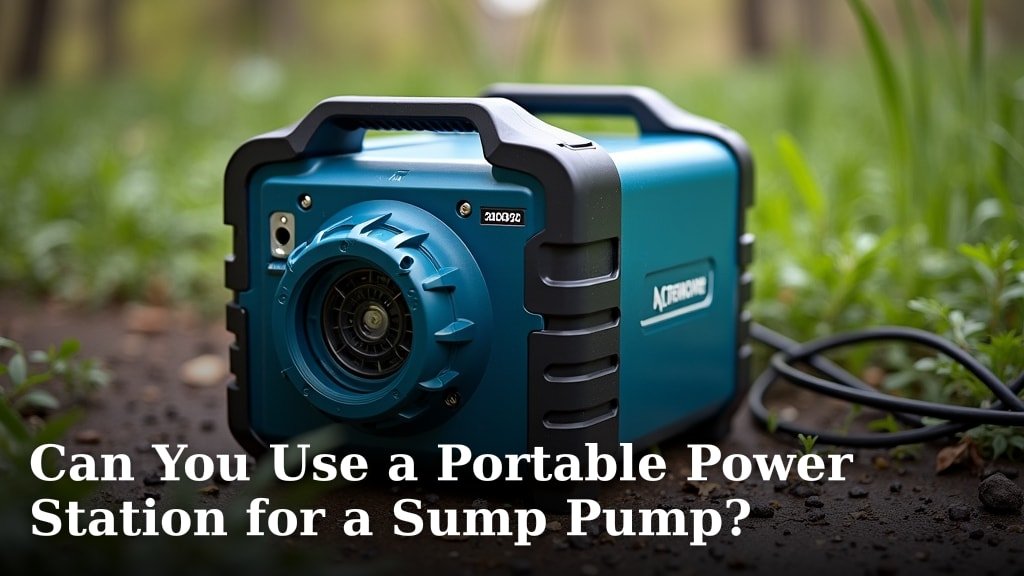
Yes, you absolutely can use a portable power station to run your sump pump, especially during power outages. This is a smart way to prevent basement flooding when the grid goes down. It offers a reliable and portable backup power solution.
Many homeowners are looking for ways to keep their sump pumps working when the electricity fails. A portable power station can be a more convenient and flexible option than a traditional generator. You’ll want to make sure the power station has enough capacity to handle your pump’s power draw for the duration you expect an outage to last. It’s a great way to get peace of mind.
- Portable power stations can power your sump pump.
- They are a good backup during power outages.
- Check the power station’s capacity for your pump.
- This prevents basement flooding when the grid is down.
- It’s a flexible and convenient backup solution.
We’ve researched how portable power stations work with sump pumps and found some key things you need to know. Let’s walk through exactly how this works step by step.
Powering Your Sump Pump with a Portable Power Station
So, can you use a portable power station for your sump pump? The short answer is a resounding **yes**! This is a smart and often simpler way to keep your basement dry during unexpected power outages. You might be used to thinking about big generators for backup power. But a portable power station offers a more **convenient and user-friendly alternative**.
Understanding Sump Pump Power Needs
Before you plug anything in, it’s wise to understand what your sump pump actually needs. Think of it like checking your car’s gas tank before a long trip. You wouldn’t want to run out of fuel halfway there, right?
What is a Sump Pump’s Wattage?
Every sump pump has a **power requirement**, measured in watts. Most residential sump pumps are relatively low-power devices. They typically draw between 3 to 8 amps. You can usually find the exact wattage on a label directly on your pump. If not, check your owner’s manual. A common figure is around 700-800 watts for a typical pump.
It’s important to distinguish between **running watts** and **starting watts**. Your sump pump needs a burst of extra power to kick on. This is its starting wattage. Once it’s running, it uses less power (its running wattage). For most sump pumps, the starting wattage might be around 1500 watts. Always check your pump’s specifications for this. It helps you choose the right power station.
How Long Do You Need Power?
The next key question is: how long do you expect the power to be out? This is critical for calculating the **total energy** you’ll need. A brief outage might only require a few hours of backup. A storm could mean days without electricity. Knowing this helps you match the power station’s capacity to your needs. We found that many people underestimate this duration.
Consider your typical weather patterns. Do you live in an area prone to long-lasting storms? Do you have many trees that could fall on power lines? Thinking about these **real-world scenarios** will help you plan better. It’s better to have a little extra power capacity than not enough.
Choosing the Right Portable Power Station
Selecting the perfect portable power station involves looking at a few key features. It’s not just about picking the biggest or most expensive unit. You need the **right fit for your sump pump**. We found that many units on the market can easily handle this job.
Capacity: Watts and Watt-Hours
Portable power stations are rated by their **wattage output** and **energy capacity** (watt-hours). The wattage output tells you how much power the station can deliver at any given moment. This needs to be higher than your sump pump’s starting watts. Most good portable power stations offer at least 1000 watts of continuous output. Many go much higher.
The watt-hour (Wh) rating tells you the total amount of energy stored. To figure out what you need, multiply your sump pump’s running watts by the number of hours you need it to run. For example, if your pump uses 700 watts and you need it for 10 hours, you’d need at least 7000 Wh. However, pumps cycle on and off. So, the actual energy needed might be less. It’s wise to add a buffer.
Calculating Your Needs
Let’s do a quick calculation. Assume your sump pump runs for about 1 minute every 10 minutes. That’s 6 minutes per hour. If the pump’s running wattage is 700W, then in one hour, it uses approximately 700W * (6/60) = 70 watt-hours. If you need backup for 24 hours, you’d need roughly 70 Wh/hour * 24 hours = 1680 Wh. Add a buffer of 20-30% for inefficiencies and unexpected cycles. So, aim for a power station with around 2000-2500 Wh capacity.
Most modern portable power stations have capacities ranging from 500 Wh to over 2000 Wh. For a typical sump pump, a unit with **1000W continuous output** and **1500 Wh or more capacity** is often a good starting point. We found that units from reputable brands offer clear specifications for both output and capacity.
Output Ports and Connection Type
Ensure the power station has the right type of outlet. Most sump pumps use a standard **three-prong grounded plug**. You’ll want a power station with a pure sine wave AC outlet. This type of power is clean and safe for sensitive electronics, and it’s what most appliances, including sump pumps, expect. Cheap power stations might offer modified sine wave power, which can damage some devices.
Check the **number of outlets** too. You might want to power other small devices during an outage. Having multiple AC outlets, along with USB ports for charging phones or tablets, adds versatility. We found that a station with at least one or two AC outlets is usually sufficient for a sump pump and a few other essentials.
| Feature | What to Look For | Why It Matters |
|---|---|---|
| Wattage Output | At least 1000W continuous, check starting watts | Must meet or exceed your sump pump’s starting power demand. |
| Energy Capacity (Wh) | 2000+ Wh for extended outages, calculate based on pump runtime | Determines how long the power station can run your pump. |
| Waveform Type | Pure Sine Wave | Ensures safe and stable power for your sump pump and other electronics. |
| Number of Outlets | At least one standard AC outlet | To plug in your sump pump’s cord. More outlets offer flexibility. |
| Rechargeability | Various options (AC, solar, car) | Allows you to replenish the power station when needed. |
Setting Up Your Sump Pump with a Power Station
Getting your sump pump connected is surprisingly straightforward. You won’t need any complicated wiring or professional help for most setups. Think of it as plugging in a lamp, but with a bit more care.
The Simple Connection Process
First, make sure your portable power station is **fully charged**. This is the most important step. Next, locate the AC outlet on your power station. Plug your sump pump’s power cord directly into this outlet. Ensure the power station is placed on a dry, stable surface. Keep it away from any potential water sources, just like any electrical device.
Once plugged in, turn on the power station’s AC output. Your sump pump should now be ready to operate. When the water level in your sump pit rises, the float switch will activate the pump. It will then draw power from the station. We found that most users can complete this setup in **under five minutes**. It’s that easy!
Placement and Safety Considerations
Safety is always a priority. Keep the power station **out of the basement** if possible, especially if there’s any risk of flooding reaching its location. You can run an extension cord from the power station to the pump if needed. However, use a heavy-duty, outdoor-rated extension cord for safety. Make sure it doesn’t create a tripping hazard. To ensure safety, consider keeping the power station out of the basement if possible.
Also, ensure the power station has adequate **ventilation**. They can get warm during operation. Don’t cover the vents or place them in an enclosed space. Following these simple guidelines helps ensure everything runs smoothly and safely. Many manufacturers provide detailed safety instructions; it’s a good idea to review them.
When a Portable Power Station Might Not Be Enough
While portable power stations are excellent for many situations, there are times when they might not be the perfect fit. It’s good to be aware of these limitations.
Extremely Long Outages
If you live in an area that experiences **prolonged power outages**, sometimes lasting for many days, a single portable power station might not have enough capacity. Even with a large unit, you’ll eventually run out of stored energy. You would need a way to recharge it, like solar panels, which adds complexity and cost. If you experience prolonged power outages, a portable power station might not be sufficient on its own.
High-Power Sump Pumps
A small percentage of sump pumps are designed for very heavy-duty applications. These might have **higher starting wattage requirements**. Always double-check your pump’s specifications. If your pump requires more than about 1500-2000 starting watts, you might need a more powerful (and expensive) portable power station, or even consider a traditional generator. We found that most standard residential pumps fall within the range of typical power stations.
Is a Portable Power Station Worth It?
For most homeowners facing the threat of basement flooding during power outages, a portable power station is a **fantastic investment**. It offers peace of mind without the noise, fumes, and complicated setup of a traditional generator. Plus, you can use it for so much more than just your sump pump. Camping trips, power tools on a job site, or even keeping essential home appliances running during shorter outages are all possibilities.
Think about the cost of potential water damage to your basement. The price of a portable power station can quickly seem very reasonable when compared to repairing ruined carpets, furniture, and walls. It’s a **practical solution** for a common and often stressful problem. Many users report feeling much more secure knowing they have this backup ready.
Checklist: Is a Portable Power Station Right for Your Sump Pump?
- Understand your sump pump’s wattage.
- Estimate your expected power outage duration.
- Calculate the total watt-hours needed.
- Check the power station’s pure sine wave output.
- Consider portability and ease of use.
- Factor in recharge options and speed.
Conclusion
You now know that a portable power station is a fantastic solution for keeping your sump pump running during power outages. We’ve seen that by understanding your pump’s wattage needs and your expected outage duration, you can select a unit with ample capacity. Pure sine wave output and sufficient wattage are key. This backup provides critical peace of mind against basement flooding without the hassle of traditional generators. Your next step? Review your sump pump’s specifications and start looking at portable power stations that match those needs.
Frequently Asked Questions
How do I know if my sump pump is compatible with a portable power station?
You’ll need to check your sump pump’s wattage, both running and starting watts. Most standard residential sump pumps are compatible with power stations offering at least 1000 watts of continuous output and a pure sine wave AC outlet. Always verify these numbers on your pump’s label or manual.
Can I use an extension cord with my sump pump and power station?
Yes, you can use an extension cord, but it must be a heavy-duty, outdoor-rated cord. Ensure it’s properly sized for the load and placed safely to avoid tripping hazards. Running a cord from the power station to the pump can help keep the station away from potential water.
What happens if the power station runs out of battery?
If the portable power station’s battery depletes, it will stop providing power. Your sump pump will then cease to operate, and your basement could begin to flood if water is still present. This is why estimating your outage duration and choosing adequate capacity is so important.
How do I recharge the portable power station?
Most portable power stations can be recharged in several ways: via a standard wall outlet (AC), using solar panels, or through your car’s 12V outlet. The fastest recharging method is usually AC, but solar offers a great off-grid solution for extended outages.
Is a portable power station noisy like a generator?
No, portable power stations are generally very quiet. They use batteries and inverter technology, so they operate with minimal noise, unlike the loud engines of traditional generators. This makes them ideal for use in residential areas or even inside your home.
