9 Best Deep-Cycle Battery Maintainers (November 2026)
The best deep cycle battery maintainers include the Battery Tender Plus 12V 1.25 AMP Car for stored vehicles and simple float maintenance, the NOCO GENIUS1 1A 6/12V Smart Battery Charger for small 6V and 12V batteries, and the TowerTop 2/10/25 Amp 12V Smart Car Battery for large batteries and fast charging.
On this page (8 sections)
- The best deep cycle battery maintainers compared
- Best deep cycle battery maintainer: high-amp vs low-amp
- How we compared these maintainers
- What amps do you need for a deep cycle battery?
- Can a maintainer replace a charger?
- Which battery types do these maintainers support?
- How do you set up a maintainer for winter storage?
- Verdict: best deep cycle battery maintainer picks
The best deep cycle battery maintainer for most people is the Battery Tender Plus 12V 1.25 AMP, because its 4-step program charges, then floats without overcharging. It suits stored RV, marine and solar batteries in the small to mid range.
A maintainer holds a stored battery at full charge, while a charger refills a run-down battery. Deep cycle batteries often sit at partial charge, so they sulfate faster than starting batteries.
If you are new to this, start with what is a deep cycle battery to match the maintainer to your battery type. Then check how to charge a deep cycle battery before you connect anything.
Our picks at a glance
-
1
 Best for stored vehicles and simple float maintenance
Battery Tender Plus 12V 1.25 AMP Car
9.7/10 our score
See it on Amazon -
2
 Best for small 6V and 12V batteries
NOCO GENIUS1 1A 6/12V Smart Battery Charger
9.6/10 our score
See it on Amazon -
3
 Best for large batteries and fast charging
TowerTop 2/10/25 Amp 12V Smart Car Battery
9.6/10 our score
See it on Amazon
- 4
 Check it
NOCO GENIUS5 5A 6/12V Smart Battery Charger
Best for mid-size deep-cycle batteries - 5
 Check it
NOCO GENIUS2 2A 6/12V Smart Battery Charger
Best for RV and marine batteries up to 40Ah - 6
 Check it
MOTOPOWER MP00205A 12V 800mA Automatic Battery Charger
Best for small powersports batteries - 7
 Best for motorcycles and small powersports batteriesCheck it
- 8
 Best for set-and-forget float and pulse chargingCheck it
- 9
 Best for lead-acid and LiFePO4 batteries up to 85AhCheck it
The best deep cycle battery maintainers compared
The Battery Tender Plus leads for simple float maintenance. The NOCO models cover 6V and 12V batteries with temperature compensation.
The TowerTop leads for speed at 25A.
Our score weighs specs, features and buyer feedback against what you are shopping for. We compared amps, charging stages, battery types, included cables and warranty terms.
How the picks break down by job
Three groups emerge here. Low amp models under 2A focus on storage and small batteries.
Mid amp models from 2A to 5A balance recovery and maintenance. The single high amp model at 25A focuses on fast refill for large banks.
Warranty terms also split the group. Battery Tender lists 10 years on the Plus and 5 years on the Junior.
NOCO lists 3 years across its GENIUS range. MOTOPOWER and Mroinge list 2 years.
TowerTop lists 18 months.
Cable choices matter for daily use. Ring terminals suit permanent installs in tight compartments.
Clamps suit quick tests and shared use.
Battery Tender Plus 12V 1.25 AMP Car: Best for stored vehicles and simple float maintenance
- 12V, 1.25A output
- 4-step charging program
- Fused ring terminal and alligator clip cables
- Two-color charge status light
- Quick disconnect harness
A compact 1.25A smart maintainer that charges in 4 steps, then switches to float mode for long-term storage.
Pros
- 4-step program protects against overcharging
- Includes fused ring terminal and clip cables
- Quick disconnect harness for easy hookup
- 10-year warranty from Battery Tender
Cons
- 1.25A is slow for large deep-cycle banks
- 12V only, no 6V option
The Battery Tender Plus suits owners who store a vehicle or a battery for weeks at a time. Its 1.25A output is modest, but that is fine for maintenance work.
You want a steady float charge, not a fast refill for a large bank.
Its 4-step program runs through charging stages, then switches to float mode. A two-color LED shows the charge state.
If voltage drops too far under load, charging resumes at full output power.
You get fused ring terminal and alligator clip cables. The ring terminals are handy for a battery in a tight compartment.
The quick disconnect harness makes daily hookup and removal much easier.
The trade-off is speed. A large deep cycle bank will charge slowly at 1.25A, and it is 12V only.
If you need a faster refill, check the best deep cycle battery charger roundup for higher amp models.
NOCO GENIUS1 1A 6/12V Smart Battery Charger: Best for small 6V and 12V batteries
- 1A, 6V and 12V output
- Thermal sensor for temperature compensation
- Force Mode for dead batteries
- Pulse charging for sulfation
- Clamps with integrated eyelet terminals
A 1A NOCO maintainer for 6V and 12V lead-acid and LiFePO4 batteries, with thermal sensing and Force Mode recovery.
Pros
- Works with 6V and 12V batteries
- Charges from as low as 1 volt
- Thermal sensor adjusts for temperature
- 3-year warranty from NOCO
Cons
- 1A is slow for larger deep-cycle batteries
- NOCO says it suits batteries up to 30 amp-hours
The NOCO GENIUS1 suits small 6V and 12V batteries, including powersports and deep cycle types up to 30 amp hours. Its 1A output means patience.
This is a maintainer first, and a charger second.
NOCO lists support for lead acid types including AGM, gel, SLA and VRLA, plus lithium ion LiFePO4. That range helps if you own mixed battery types across several vehicles.
An integrated thermal sensor adjusts charging based on ambient temperature. That helps prevent overcharging in heat and undercharging in cold weather during storage.
Force Mode can manually charge a completely dead battery down to zero volts. Pulse charging targets sulfation and acid stratification automatically.
The trade-off is capacity. Larger deep cycle batteries will take a long time at 1A.
For a bigger battery, move up to the GENIUS2 or GENIUS5 in this roundup.
TowerTop 2/10/25 Amp 12V Smart Car Battery: Best for large batteries and fast charging
- 2A, 10A, 25A and AUTO settings
- 8-stage intelligent charging
- HD LCD screen
- Engine start at 100A
- Winter Mode adds 0.2V
A 25A smart charger with 8-stage charging, an LCD screen, repair mode and engine start for 12V deep-cycle and AGM batteries.
Pros
- 25A output charges large batteries faster
- LCD screen shows charging stage
- Desulfator and repair modes included
- 18-month warranty from TowerTop
Cons
- Largest and heaviest option here
- Repair mode cannot revive completely drained batteries
The TowerTop suits buyers who want speed and visibility. Its 25A maximum output can fully charge a 100Ah battery in under 3.5 hours, per TowerTop.
That is a different class from the 1A and 2A maintainers here.
It offers adjustable settings at 2A, 10A, 25A and AUTO. An HD LCD screen shows the charging stage and parameters.
That display helps you track progress without guessing at a single light.
The 8-stage program covers desulfurization, soft start, bulk charge, absorption, analysis, repair, float and pulse maintenance. Manual desulfurization and repair buttons are included for older batteries.
Winter Mode adds 0.2V at low temperatures. Engine start delivers 100A in the listed spec for activating a battery to start a vehicle.
The trade-off is size. At 7.68 x 10.04 x 4.92 inches, it is the largest model here.
It also cannot repair completely drained batteries, per TowerTop.
NOCO GENIUS5 5A 6/12V Smart Battery Charger: Best for mid-size deep-cycle batteries
- 5A, 6V and 12V output
- Thermal sensor for temperature compensation
- Force Mode for dead batteries
- Pulse charging for sulfation
- Mounting bracket included
A 5A NOCO maintainer for 6V and 12V lead-acid and LiFePO4 batteries, with temperature compensation and a mounting bracket.
Pros
- 5A output suits mid-size batteries
- Charges from as low as 1 volt
- Thermal sensor adjusts for temperature
- 3-year warranty from NOCO
Cons
- Still slow for very large battery banks
- NOCO says it suits batteries up to 120 amp-hours
The NOCO GENIUS5 suits mid size deep cycle batteries up to 120 amp hours. Its 5A output is a practical middle ground.
It charges faster than 1A and 2A models, without the bulk of a 25A unit.
NOCO lists support for 6V and 12V lead acid and LiFePO4 batteries, including flooded, maintenance free, deep cycle, marine and powersport types. That makes it versatile for mixed stored equipment.
A thermal sensor adjusts charging for ambient temperature. Force Mode can charge a dead battery down to zero volts.
Pulse charging targets sulfation and acid stratification.
The box includes a mounting bracket, screws, clamps and eyelet terminals. That helps if you want a fixed charger in a garage or shed for seasonal storage.
The trade-off is still speed for very large banks, where 10A or 25A is faster. For a 200Ah bank, even 5A is a slow refill, so plan the time before a trip.
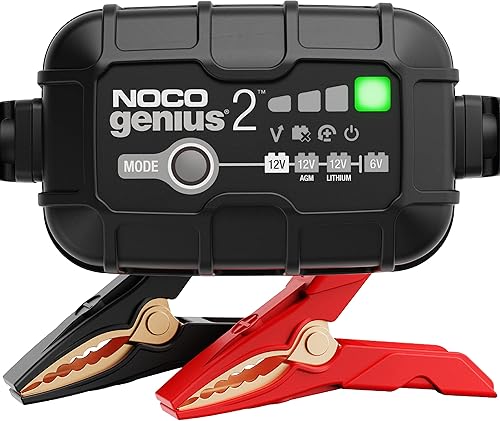
NOCO GENIUS2 2A 6/12V Smart Battery Charger: Best for RV and marine batteries up to 40Ah
- 2A, 6V and 12V output
- Thermal sensor for temperature compensation
- Force Mode for dead batteries
- Pulse charging for sulfation
- Mounting bracket included
A 2A NOCO maintainer for 6V and 12V lead-acid and LiFePO4 batteries, with Force Mode and temperature compensation.
Pros
- 2A balances speed and battery care
- Charges from as low as 1 volt
- Thermal sensor adjusts for temperature
- 3-year warranty from NOCO
Cons
- Limited to about 40 amp-hours, per NOCO
- Slower than the GENIUS5 for larger batteries
The NOCO GENIUS2 suits RV, marine and powersports batteries up to 40 amp hours. Its 2A output is twice the GENIUS1, so recovery takes less time.
It is still a maintainer paced charger, not a fast charger.
NOCO lists support for 6V and 12V lead acid and LiFePO4 batteries, including deep cycle and marine types. The same thermal compensation and Force Mode features as the GENIUS5 are included here.
Pulse charging is designed to detect sulfation and restore battery health. The charger monitors the battery and can stay connected for maintenance without overcharging during storage.
The box includes a mounting bracket and screws, plus battery clamps with integrated eyelet terminals. At 1.2 pounds, it is lighter than the GENIUS5 for portable use.
The trade-off is the 40 amp hour ceiling. Larger batteries suit the GENIUS5 or a higher amp model, especially when you need a refill before a short deadline.
MOTOPOWER MP00205A 12V 800mA Automatic Battery Charger: Best for small powersports batteries
- 12V, 800mA output
- Automatic desulfation with pulse current
- 24-hour timer in the program
- Maintains at 13.6V
- Clamp and ring terminal cables
A compact 800mA automatic maintainer with pulse desulfation and a 24-hour timer for 12V lead-acid batteries.
Pros
- Very compact for storage
- Automatic desulfation
- Spark proof connection
- 2-year warranty from MOTOPOWER
Cons
- 800mA is the slowest output here
- No lithium battery mode stated
The MOTOPOWER MP00205A suits small 12V lead acid batteries in motorcycles, ATVs and boats. Its 800mA output is the slowest in the group, so set your time expectations accordingly for any refill.
It works as a charger, maintainer, trickle charger and desulfator in one unit. Automatic pulse current technology targets sulfation during charging, with no manual operation needed.
A 24-hour timer is built into the program. Once voltage is above 14V, the charger terminates the charge and enters maintaining mode at 13.6V.
That sequence limits gassing and overcharging during long storage. The unit is compact at 2 x 4.1 x 1.5 inches and 300 grams.
Spark proof connections add safety during hookup with clamps and ring terminals. The trade-off is speed and battery types.
There is no lithium mode stated, and large batteries will charge very slowly.
Battery Tender Junior 12V: Best for motorcycles and small powersports batteries
- 12V, 750mA output
- 4-step charging program
- Fused ring terminal harness
- 12-foot output cord
- Two-color charge status light
A 750mA Battery Tender maintainer with a 4-step program and float mode for 12V lead-acid, AGM and gel batteries.
Pros
- 4-step program, smarter than a trickle charger
- Fused ring terminal harness included
- Spark proof circuitry
- 5-year warranty from Battery Tender
Cons
- 750mA is slow for larger batteries
- 12V only, no 6V option
The Battery Tender Junior suits motorcycles, ATVs and other small powersports batteries. Its 750mA output is designed for float maintenance, not fast charging of large deep cycle banks.
Its 4-step program covers initialization, bulk charge, absorption mode and float mode. That sequence helps optimize battery power without overcharging.
Battery Tender calls it smarter than a trickle charger.
You get a fused ring terminal harness and alligator clip cables, plus a 12-foot output cord. The ring harness helps with hard to reach batteries under bodywork.
Spark proof circuitry and reverse hookup detection add safety. A two-color LED shows charge state and resumes charging when voltage drops.
The trade-off is capacity and voltage. It is 12V only, and 750mA will take a long time on a large battery.
For larger batteries, the Battery Tender Plus at 1.25A or a 2A to 5A model is a better fit.
CTEK: Best for set-and-forget float and pulse charging
- Fully automatic 8-step charging
- 4.3A output, 12V
- Reconditioning function
- Float and pulse charging
- Splash, dust, spark and shock proof
A CTEK MXS 5.0 with 8-step charging, a reconditioning function and float/pulse maintenance for 12V lead-acid and AGM batteries.
Pros
- 8-step charging program
- Float/pulse for long storage
- Splash and dust proof design
- Reconditioning function
Cons
- No 6V or lithium mode stated
- 4.3A is slower than the TowerTop at 25A
The CTEK MXS 5.0 suits owners who want a fully automatic 8-step program. Its 4.3A output sits between the 2A and 5A models here.
It is a solid middle choice for car, bike, marine, RV and tractor batteries at 12V.
CTEK lists support for 12V lead acid and AGM batteries. A reconditioning function is designed to improve lifespan and bring some underperforming batteries back to service.
Patented float and pulse charging allows set and forget storage for months at a time. The charger monitors the battery and adjusts output instead of running constantly.
The design is splash, dust, spark and shock proof with an IP65 spec. A short circuit proof design helps prevent reverse polarity damage during hookup.
That makes it a candidate for garage or outdoor adjacent storage. The trade-off is battery type range.
There is no 6V or lithium mode stated here, so NOCO or Mroinge models cover that need better.
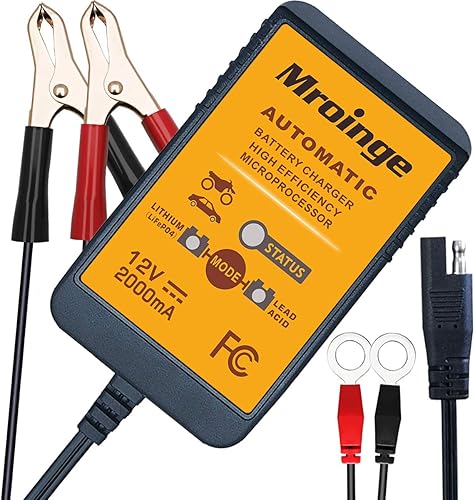
Mroinge MBC022: Best for lead-acid and LiFePO4 batteries up to 85Ah
- 12V, 2A output
- Lead-acid and LiFePO4 modes
- 5-stage smart charging
- 12-foot output cord
- LED status indicators
A 2A Mroinge maintainer with separate lead-acid and LiFePO4 modes and 5-stage charging for batteries up to 85Ah.
Pros
- Separate lithium and lead-acid selection
- Bad battery identification
- 12-foot output cord
- 2-year warranty from Mroinge
Cons
- You must disconnect the battery before changing mode
- 2A is slower than 5A and 25A options
The Mroinge MBC022 suits owners with 12V lead acid or LiFePO4 batteries up to 85Ah. Its 2A output balances charging time and battery care for mid size deep cycle and powersports batteries.
It has two battery type options, so you select 12V lead acid or 12V lithium LiFePO4. That selector matters, because charging profiles differ by chemistry and voltage limits.
Read the warning in the box: disconnect the battery before changing the charge mode. That step is easy to miss when you switch between vehicles.
A 5-stage smart program covers initialization, trickle current, bulk charge, absorption mode and float mode. LED indicators show the charging state and diagnostic information.
Bad battery identification is included, and the box has a 12-foot cord with clips and O-ring terminals. The trade-off is mode switching friction compared with automatic detection on some rivals.
Best deep cycle battery maintainer: high-amp vs low-amp
High-amp maintainers charge faster. Low-amp maintainers cost less in battery stress and suit smaller batteries.
The right choice depends on battery capacity and how soon you need the battery ready.
Low-amp models at 0.75A to 2A suit batteries up to about 40Ah. They work well for winter storage, where you have weeks to top up.
Their slower pace also limits heat and gassing risk during long float periods. That matters in a warm storage bay where a battery can dry out if overcharged.
When low amps are the smarter pick
Choose low amps when the battery is already near full and you only need to offset self discharge. A motorcycle battery stored for a month falls into this group.
A small solar battery in a shed also fits, if you can leave the charger connected.
Low amps also suit gentle recovery for small batteries. The Battery Tender Junior and MOTOPOWER models are built for that pace.
Rushing them with higher current can shorten life on small plates.
When high amps earn their keep
High-amp models at 5A to 25A suit 100Ah and larger batteries. They refill a run-down battery in hours, not days.
Use them when you need the battery this weekend, not next month.
The TowerTop at 25A and the NOCO GENIUS5 at 5A show the two ends of this choice. One suits a large bank, the other a mid size battery that still needs a timely refill.
Check our guide on what amp charger do you need for a deep-cycle battery before you choose. Amp choice also affects cable heating, so clean terminals and firm contact matter more as current rises.
How we compared these maintainers
We compared output amps, charging stages, supported battery types and included cables. We also checked warranty terms and safety features like reverse polarity and spark proofing.
We did not test these units. We checked the specs and features from the product data and compared them against the needs of stored deep-cycle batteries.
What we weighted most
Amps came first, because amps set refill time for a given battery size. A 1A charger and a 25A charger solve different problems, even if both list float mode.
Battery type support came next, because a 6V or lithium mode can decide the pick.
Stage count came after that. More stages can mean finer control, but a simple 4-step program can still float safely.
We looked for clear float or pulse maintenance, not just a high stage count.
Safety and connectors still matter. Spark proofing, reverse polarity protection and fused harnesses reduce damage when you connect in a hurry.
Included ring terminals also save a separate purchase for permanent installs.
Cycle life matters for stored batteries too. Our guide on cycle life of portable power stations explains why full charges and float maintenance protect long-term capacity.
If you want faster refills, our best 12V deep-cycle battery chargers roundup covers higher-amp models. Storage location also affects the pick, since a splash proof charger suits a damp boat shed.
What amps do you need for a deep cycle battery?
Small batteries up to 30Ah
Pick 0.75A to 1A maintainers. The Battery Tender Junior, MOTOPOWER MP00205A and NOCO GENIUS1 fit this range.
They charge slowly, but they are matched to small powersports batteries.
These batteries have limited plate area and limited heat tolerance, so a gentle current protects them while still topping up in a day or two.
Leave extra time in the plan. A small battery that sat flat for months may need several days at 750mA.
Check the status light rather than assuming an overnight refill.
Mid-size batteries from 35Ah to 85Ah
Pick 2A to 5A maintainers. The NOCO GENIUS2, Mroinge MBC022, CTEK MXS 5.0 and NOCO GENIUS5 fit this range.
Recovery time drops from days to overnight.
This range covers many RV house batteries and marine trolling batteries. It also covers larger motorcycle and ATV batteries that need a real refill, not just a top up.
Watch the amp hour ceiling in the specs. The GENIUS2 lists up to 40 amp hours, while the GENIUS5 lists up to 120 amp hours.
Large batteries of 100Ah and up
Pick 10A to 25A chargers. The TowerTop at 25A is the fastest option here.
A 1A maintainer would take far too long for a large bank.
Large banks are common in RVs, off grid cabins and boat house systems. They can accept higher current when they are run down, but they still need a smart profile.
Plan for heat and ventilation with high amps. A 25A charge warms cables and terminals more than a 1A float.
Keep the charger in moving air and check connections during the first hour.
Can a maintainer replace a charger?
For storage, yes
A maintainer is the right tool for a stored battery. It holds the battery at full charge and offsets self-discharge.
That is the main job for RV, marine and solar batteries in storage.
Storage is a low power problem. You only need to replace the energy the battery loses on its own.
A float charger does that with small, controlled pulses.
That gentle approach also reduces water loss in flooded batteries. Overcharging is the main cause of dry cells during storage, and float mode is built to prevent it.
For a run-down battery, no
A 1A maintainer will take days to refill a deeply discharged deep-cycle battery. Use a higher-amp charger first, then switch to float maintenance.
That two-step approach protects battery life.
A run-down battery needs bulk energy first, at the highest safe rate. Float mode cannot do that job quickly, even if it can hold the final charge well.
Desulfation is the middle step. Stored batteries that sat at low charge build sulfate on the plates.
Pulse or repair stages target that buildup before the final float.
Which battery types do these maintainers support?
Lead-acid, AGM and gel
Most models here support flooded, AGM and gel lead-acid batteries. The Battery Tender models, NOCO models, MOTOPOWER, CTEK and Mroinge all list lead-acid support in some form.
AGM and gel batteries are sealed, so overcharging has different risks than with flooded types. Smart chargers limit voltage to prevent gassing and venting.
That is why mode selection matters.
Flooded batteries need electrolyte checks during long storage. A maintainer reduces water loss, but it does not replace periodic inspection.
Top up only with distilled water if the maker allows it.
Lithium LiFePO4
The NOCO GENIUS1, GENIUS2 and GENIUS5 list LiFePO4 support. The Mroinge MBC022 also lists a lithium mode.
Select the correct mode before charging.
Lithium batteries charge to a different voltage profile than lead acid. Using the wrong profile can stop charging early or stress the battery management system.
The mode switch is not a minor detail.
Cold charging is another lithium concern. Lead acid batteries tolerate cold charging better than lithium types in many designs.
Check the battery label before you charge a lithium bank in winter.
Deep-cycle and marine batteries
The NOCO models and TowerTop list deep-cycle and marine support. That matters, because deep-cycle batteries accept charge differently than starting batteries.
Deep cycle batteries are built to be discharged deeply and recharged often. Their plates and separators handle that cycle pattern, but they still sulfate if left flat.
Marine batteries add vibration, moisture and salt air to the storage problem. A charger with sealed housing and good connectors has an advantage in that setting.
The CTEK IP65 spec and NOCO sealed designs speak to that use.
How do you set up a maintainer for winter storage?
Step 1: Check the battery type and voltage
Confirm 6V or 12V, and lead-acid or lithium. Set the maintainer to the correct mode before you connect the clamps.
A wrong mode can damage the battery. It can also stop the charger from recognizing a low battery at all.
Take a photo of the label if the printing is hard to read.
Step 2: Connect positive first, then negative
Attach the positive clamp to the positive terminal, then the negative clamp to the negative terminal or ground point. Keep the cables clear of moving parts and heat sources.
Tighten ring terminals fully if you use them for a permanent install. A loose ring terminal can arc during connection and damage the charger output.
Fused harnesses add protection in that setup.
Step 3: Plug in and check the status light
Plug the maintainer into a grounded outlet. Watch the charge status light until it shows full charge and float mode.
Leave it connected for the season.
Note the date you connected it. That helps you check voltage at a sensible interval instead of guessing.
A monthly check is a good rhythm for most stored batteries.
Step 4: Check monthly
Visit the battery every month or so. Confirm the float light is on and the terminals are clean.
Top up the electrolyte in flooded batteries if the maker allows it. Look for bulging, leaking or a strong sour smell, and stop using the battery if you see those signs.
Step 5: Disconnect in the right order
Unplug the charger before you remove the clamps. Remove the negative clamp first, then the positive clamp.
That order reduces the chance of a short with a wrench or tool.
Store the charger in a dry place with its cables loosely coiled. Sharp bends can damage the output cable over time.
Keep the manual with the charger so the mode settings are easy to find next season.
Verdict: best deep cycle battery maintainer picks
The best deep cycle battery maintainer for most people is the Battery Tender Plus 12V 1.25 AMP, for simple and safe float maintenance. Pick the NOCO GENIUS5 if you have a mid-size battery and want faster charging with 6V and 12V support.
Pick the TowerTop if you have a large 100Ah battery and need a fast refill. Pick the Battery Tender Junior or MOTOPOWER if you only maintain a small powersports battery.
Match the pick to the battery, not to the biggest amp number. A 25A charger is wasteful for a 10Ah motorcycle battery.
A 750mA charger is frustrating for a 200Ah RV bank.
Next, confirm your battery size with our deep cycle battery guide, then match amps to capacity before you order.
Our top 3 picks at a glance
-
1
Best for stored vehicles and simple float maintenance
Battery Tender Plus 12V 1.25 AMP Car
9.7/10 our score
See it on Amazon -
2
Best for small 6V and 12V batteries
NOCO GENIUS1 1A 6/12V Smart Battery Charger
9.6/10 our score
See it on Amazon -
3
Best for large batteries and fast charging
TowerTop 2/10/25 Amp 12V Smart Car Battery
9.6/10 our score
See it on Amazon
Frequently asked questions
What is the best deep cycle battery maintainer for storage?
The best deep cycle battery maintainer for most storage is a smart float maintainer, not a plain trickle charger. It charges the battery, then holds it at a safe float voltage.
Match amps to battery size so charging does not take days.
Can I leave a battery maintainer connected all winter?
Yes, if it has float or pulse maintenance mode. Smart maintainers reduce output at full charge and resume when voltage drops.
Check the battery type setting and keep connections clean and dry.
How many amps does a deep cycle battery maintainer need?
Small batteries suit 0.75A to 2A maintainers. Mid-size batteries suit 4A to 5A models.
Large 100Ah batteries charge much faster at 10A to 25A.
Match amps to battery capacity and your time frame.
Can one maintainer work for lead-acid and lithium batteries?
Some can, if they have separate battery type modes. NOCO and Mroinge models here list both lead-acid and LiFePO4 support.
Select the correct mode before charging, and disconnect the battery if the manual requires it.


