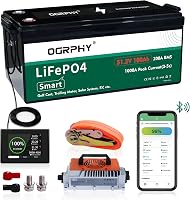
9 Best LiFePO4 Batteries with Bluetooth (November 2026)
The best LiFePO4 batteries with Bluetooth include the Litime 12V 100Ah Trolling Motor LiFePO4 Battery for marine monitoring, the ECO-WORTHY 12V 100AH LiFePO4 Lithium Battery for Group 24 replacement, and the ECO-WORTHY 12V 314AH LiFePO4 Lithium Battery Bluetooth for long off-grid runtime.
On this page (4 sections)
The best LiFePO4 battery with Bluetooth for most 12V systems is the Litime 12V 100Ah Trolling Motor LiFePO4 Battery. It combines phone monitoring, 1280Wh capacity, low-temperature protection and a light 22.2 lb body.
That mix helps on a boat, in an RV or at a small off-grid setup. You can check charge before you leave, instead of guessing at the dock or campsite.
Bluetooth shows voltage, current, capacity and faults. Those readings help you plan a day on the water or a night of lights and fan use with more confidence.
A quick app check after charging or storage also confirms the system is ready. Protection features handle conditions that might otherwise cause damage.
The right pick still depends on space, runtime, charging conditions and whether you need 100Ah, 125Ah, 300Ah or 314Ah. A larger battery stores more energy, but needs more room and more effort to lift.
Weight is a real trade-off with repeated handling. A lighter 100Ah model is easier to carry, while 300Ah and 314Ah units suit fixed installations for long loads.
Charging source matters too. Shore power, solar and generator setups all need to respect low-temperature cutoffs in winter.
Set-up care affects long-term use. Use the correct lithium charger, keep terminals tight and protected, and check the app after installation.
For trolling motors, the Litime size and marine focus make it a strong starting point. Its Group 31 format, IP65 rating and salt resistance suit harsh, wet use.
For RV or solar use, the 1280Wh figure makes runtime comparison simple. You can decide if that meets your needs or if a larger model is worth the extra footprint.
If you need the basics first, read our guide to what is a deep cycle battery. That explains how deep-cycle use differs from starting use.
For chemistry and system planning, see what is LiFePO4 battery chemistry. It helps you match charger settings, protection limits and expansion plans to the battery.
In short, capacity, size, weight and cold-weather limits should guide the choice. Bluetooth adds useful visibility when the rest of the system is planned around it.
Our picks at a glance
-
1
 Best for marine monitoring
Litime 12V 100Ah Trolling Motor LiFePO4 Battery
9.7/10 our score
See it on Amazon -
2
 Best for Group 24 replacement
ECO-WORTHY 12V 100AH LiFePO4 Lithium Battery
9.4/10 our score
See it on Amazon -
3
 Best for long off-grid runtime
ECO-WORTHY 12V 314AH LiFePO4 Lithium Battery Bluetooth
9.2/10 our score
See it on Amazon
- 4
 Check it
Redodo 12V 100Ah Group 24 LiFePO4 Lithium
Best for compact RV power - 5
 Check it
HumsiENK 12.8V 100Ah LiFePO4 Lithium Battery
Best for lightweight installation - 6
 Check it
VATRER POWER 12V 300AH Deep Cycle LiFePO4 Lithium
Best for cold-weather charging - 7
 Check it
DC HOUSE 12V 100Ah Bluetooth LiFePO4 Trolling
Best for fault alerts - 8
 Check it
Power Queen 12V 125Ah LiFePO4 Lithium Battery
Best for extra Group 27 capacity - 9
 Check it
MARSENERGY 12V 100Ah LiFePO4 Lithium Battery
Best for a two-battery setup
The best LiFePO4 batteries with Bluetooth for different setups
The Litime is the strongest all-around choice, while the other batteries fit different capacity, size, monitoring and cold-weather needs.
We compared the stated capacity, Bluetooth functions, protection features, dimensions, weight and intended uses.
That comparison helps narrow the field before you look at price or packaging. It also keeps the focus on fit for your boat, RV, solar setup or backup system.
Some options trade easy carrying for longer runtime. Others trade extra detail in the app for a taller or longer body.
Cold-weather charging is another dividing line between models. A few stop charging at a set threshold, while one adds self-heating for specific conditions.
Litime 12V 100Ah Trolling Motor LiFePO4 Battery: Best for marine monitoring
- Bluetooth phone monitoring
- 1280Wh energy capacity
- 22.2 lb item weight
- Low-temperature charge and discharge protection
Bluetooth status checks, a 1280Wh capacity and marine-focused protection make this the strongest all-around pick for a 12V trolling motor, boat or RV.
Pros
- Bluetooth monitoring
- IP65 waterproof and salt-resistant
- Low-temperature protection
Cons
- Bluetooth activation requires lithium charging equipment
- Not for starting batteries, golf carts or jacks
Litime is the best fit for a marine or trolling-motor setup that benefits from phone-based status checks. Its 100Ah capacity stores 1280Wh, and the standard Group 31 size measures 13 x 6.77 x 8.5 inches.
Bluetooth can show battery status, control discharge and run system checks from a phone. The battery also has low-temperature protection, stopping charging below 32°F and discharging below -4°F.
Its IP65 waterproof and salt-resistant design suits the marine focus in its title and specifications. The 22.2 lb item weight is easier to manage than many larger batteries.
Litime describes this battery for energy storage, not starting batteries, golf carts or jacks. Activate Bluetooth with a lithium-activation or MPPT charger on first use, or after the battery has been switched off.
Choose it when marine monitoring and protection matter most. For a deeper comparison, see our guide to the best LiFePO4 deep-cycle battery.
ECO-WORTHY 12V 100AH LiFePO4 Lithium Battery: Best for Group 24 replacement
- Bluetooth 5.1
- 100A BMS
- 23.2 lb weight
- Low-temperature charge cutoff
This Group 24 battery fits buyers replacing a lead-acid or AGM battery while adding Bluetooth status checks and flexible system expansion.
Pros
- Group 24 size
- Bluetooth troubleshooting
- 100A BMS
Cons
- 3-year warranty
- Use a dedicated lithium charger
ECO-WORTHY suits buyers replacing a Group 24 lead-acid or AGM battery without changing the basic battery size.
Its dimensions are 6.61 x 10.24 x 8.23 inches, and it weighs 23.2 lb.
That footprint makes it a familiar fit for existing trays and boxes. It also keeps lifting manageable for most RV and boat installations.
Bluetooth 5.1 provides phone access to voltage, current, capacity and remaining working life.
Those readings are useful before a trip and during a long day of use. They can also help you spot a problem before it affects your plans.
The built-in 100A BMS protects against overcharge, overtemperature, over-discharge, overcurrent, low temperature and short circuits.
In daily use, that protection supports steadier operation across charging and discharging. It does not remove the need for correct wiring and a compatible charger.
The low-temperature charge cutoff works below 19.4°F.
That makes cold-weather charging planning easier, but you should still follow the charging instructions for your installation.
Expansion supports up to 4P2S, with stated system capacity up to 10.24kWh.
That flexibility suits buyers who may add batteries later as loads grow. It also means earlier planning for cable size, fusing and space is worthwhile.
Its 100Ah size works well for RVs, camping, solar, home energy storage and marine use.
Choose it when Group 24 fit and troubleshooting through an app are more important than maximum capacity.
ECO-WORTHY 12V 314AH LiFePO4 Lithium Battery Bluetooth: Best for long off-grid runtime
- 314Ah capacity
- 4019.2Wh energy storage
- SOC LED display
- 200A BMS
The 314Ah capacity is the clear choice for longer runtime in an RV, home backup setup or off-grid solar system where size and weight are manageable.
Pros
- Largest capacity here
- Bluetooth and LED status display
- 200A BMS
Cons
- Heaviest battery in this roundup
- Larger cabinet needs more installation space
The 314Ah ECO-WORTHY is the best option here for long runtime from one 12V battery.
It stores 4019.2Wh and measures 16.3 x 8.5 x 10.2 inches, so check cabinet space before choosing it.
That size suits a fixed installation far better than a battery you carry often. Measure width, height and the path into the compartment before ordering.
Bluetooth access and the built-in SOC LED display give you two ways to check battery level and status.
The LED screen is handy when you do not want to open an app. The app adds remote detail when you are nearby with your phone.
Its 200A BMS includes high and low voltage, overload and temperature protection.
Low-temperature protection cuts charging below 19.4°F, which helps protect cells during winter charging. Plan charger placement and storage so cold conditions do not leave you without power.
The battery weighs 60.4 lb.
That is a meaningful trade-off for the extra capacity, especially if you need to lift it into an RV compartment or move it during installation.
Expansion supports up to 4P2S or 2P4S, with stated total capacity up to 32.15kWh.
A built-in buzzer can alert you to battery faults.
That alert is useful in a bank where one unit may need attention. It also supports faster checks when several batteries are connected.
Choose it for off-grid, RV, solar or home backup use where long runtime matters more than easy carrying.
Redodo 12V 100Ah Group 24 LiFePO4 Lithium: Best for compact RV power
- Bluetooth 5.0
- Group 24 dimensions
- 22.2 lb weight
- Low-temperature cutoff
A compact Group 24 shape and Bluetooth monitoring suit RV owners who need a manageable 100Ah battery for travel, solar or off-grid use.
Pros
- Lightweight Group 24 design
- Bluetooth control within 10 meters
- 5-year warranty
Cons
- Not a starting or cranking battery
- Requires a dedicated lithium charger
Redodo is a compact 100Ah choice for RVs and boats.
Its Group 24 dimensions are 6.61 x 10.24 x 8.27 inches, and its 22.2 lb weight makes installation easier than larger-capacity options.
That combination is helpful when space is tight or when you need to move the battery by hand. It also fits buyers replacing a Group 24 lead-acid unit.
The Bluetooth 5.0 app shows voltage, current, power and battery capacity.
Those figures help you track energy use during a trip or a day of fishing. They also give a simple way to confirm charge after storage.
It can also manage discharge or power off within the stated 10-meter range.
Remote control is convenient when the battery is inside a compartment. Keep the phone within range so the connection stays reliable.
Redodo includes low-temperature cutoff protection.
That protection helps guard the battery in cold conditions, but it also means charging may stop until temperatures rise. Winter planning should account for that limit.
The battery is described for trolling motors, RVs, solar systems, off-grid use, camping and home backup power.
Expansion supports up to 4S4P for a larger bank.
That headroom suits systems that start small and grow over time. It also requires care with wiring, fusing and matching components.
The battery is not intended for car starting, cranking or golf cart use.
It also needs a dedicated lithium iron phosphate charger for normal operation.
Choose it when you want a lightweight Group 24 battery with a longer stated warranty and broad 12V use.
HumsiENK 12.8V 100Ah LiFePO4 Lithium Battery: Best for lightweight installation
- Bluetooth app monitoring
- 19.7 lb weight
- Group 24 dimensions
- Low-temperature shutdown
At 19.7 lb, this is the lightest single 100Ah battery here. It fits buyers who want Bluetooth data and easier lifting for RV, marine or solar installation.
Pros
- Lightest single 100Ah option
- Bluetooth temperature monitoring
- 5-year warranty
Cons
- Bluetooth app is required for remote status checks
- Confirm terminal and enclosure space before installation
HumsiENK stands out because its single 100Ah battery weighs 19.7 lb.
The Group 24 dimensions are 6.6 x 10.2 x 8.2 inches. That compact size helps where lifting and enclosure space matter.
The lighter weight suits boats, RVs and solar setups. It makes installation and seasonal removal less of a strain.
Its Bluetooth app monitors voltage, temperature and other key data. Temperature detail is useful when charging in warm or cold weather.
The built-in 100A BMS protects against overcharge, over-discharge, overcurrent and short circuits. Correct charger settings and secure terminals remain essential.
Low-temperature shutdown covers a stated operating range of -4°F to 158°F. Charging limits in freezing weather still need attention, so check the manual for exact cutoff behavior.
The battery has an IP65 waterproof rating and supports 4S4P configurations. Sealing helps in wet or dusty settings, while expansion allows a larger system later.
The box includes insulating caps, screws and the battery. Keep caps in place where they prevent accidental contact.
Product data lists it for RVs, boats, off-grid systems, home backup, solar, trolling motors and more. Choose HumsiENK when the lightest single 100Ah option is the priority.
For a wider brand comparison, see the best Renogy lithium battery guide.
VATRER POWER 12V 300AH Deep Cycle LiFePO4 Lithium: Best for cold-weather charging
- Self-heating function
- 300Ah capacity
- APP monitoring
- 200A BMS
The self-heating feature makes this a useful choice when charging may happen below 32°F and the installation can handle its larger 300Ah format.
Pros
- Self-heating while charging
- APP status data
- 300Ah capacity
Cons
- Heavy at 24.8 kg
- Not suitable for golf carts in series
VATRER POWER fits buyers who need 300Ah capacity and may charge in cold weather.
Its self-heating mode activates below 32°F when charging current exceeds 10A, then stops heating at 41°F.
That feature addresses a real winter problem for lithium batteries. It allows charging to continue in conditions that would otherwise trigger a cutoff.
The battery provides APP monitoring for remaining capacity, voltage, current, power, fault alerts and temperature.
Those data points help you follow the heating and charging process from your phone. They also make it easier to confirm the battery is operating as expected.
Its 200A BMS includes overcharge, over-discharge, overcurrent, short-circuit and temperature protection.
That protection works alongside the heating system during cold charging. It also helps guard the battery during normal high-load use.
At 15.12 x 7.64 x 9.76 inches and 24.8 kg, it needs a strong installation plan.
The larger format is better suited to a fixed RV, marine, off-grid or home backup setup than frequent carrying. Secure it well and leave room for terminal access and airflow.
Charging options include a 14.6V lithium charger, solar power or a generator.
The stated charging examples use a 70A charger or solar output of 800W or more. Those examples show that high capacity also means longer charging time.
Choose it when cold-weather charging and long runtime matter more than low weight.
It is not suitable for golf carts connected in series.
DC HOUSE 12V 100Ah Bluetooth LiFePO4 Trolling: Best for fault alerts
- Bluetooth 5.1
- Cell-level data
- Low-temperature charge and discharge cutoff
- Up to 8 batteries in supported configurations
Cell-level information and fault notifications make this a good fit when you want more detail while managing a trolling motor, boat, RV or solar system.
Pros
- Cell-level Bluetooth data
- Fault display page
- Low-temperature protection
Cons
- Taller than some Group 24 options
- Not designed as a starting battery
DC HOUSE is a good fit when fault details matter.
Its Bluetooth 5.1 app can show SOC, voltage, current and data down to a specific battery cell, along with a fault display page and anomaly notifications.
That cell-level view goes beyond a simple charge percentage. It can help you narrow a problem to one battery in a larger setup.
The battery measures 6.6 x 10.2 x 9.2 inches and weighs 23.8 lb.
It is close to Group 24 size, although the 9.2-inch height is taller than some options here.
That extra height matters in low compartments and under seats. Measure the space carefully, including room for cables and terminals.
Low-temperature protection cuts charging below 19.4°F and discharging below -4°F, then recovers after the temperature rises to 32°F.
Those thresholds protect the battery in winter, but they can limit use in freezing conditions. Plan for shelter or warmer charging where possible.
The battery supports boats, RVs, solar systems and trolling motors.
Its existing Group 24-like shape helps it fit familiar trays. The taller body is the main size trade-off to check.
Expansion can reach 4 batteries in series or 4 in parallel, with a maximum of 8 batteries total.
A 4P4S setup is not allowed.
That limit should shape bank design from the start. Matching batteries, cables and fuses becomes more important as the system grows.
Choose DC HOUSE when app-based fault information is more valuable than the smallest cabinet height.
Power Queen 12V 125Ah LiFePO4 Lithium Battery: Best for extra Group 27 capacity
- 125Ah capacity
- 1600Wh energy
- Bluetooth 5.0
- Group 27 size
This Group 27 battery adds capacity over a 100Ah model while keeping Bluetooth controls, low-temperature protection and a 5-year warranty.
Pros
- 1600Wh energy
- Bluetooth discharge control
- 5-year warranty
Cons
- Longer than Group 24 batteries
- Energy-storage battery, not a starter battery
Power Queen adds 125Ah and 1600Wh capacity in a Group 27 body.
Its dimensions are 6.69 x 12.13 x 8.31 inches, and it weighs 25.1 lb. That longer body offers more energy than a 100Ah battery, but needs more tray length, so measure first.
Bluetooth 5.0 shows SOC, voltage, current, power, temperature, reminders, charging status and protection status. Remote discharge control helps when the battery is in a compartment.
The app can control discharge and power off within 10 meters. Keep the phone close for a stable connection during setup.
The self-developed BMS cuts charging below 32°F and discharging below -4°F. Those limits protect the battery in winter but require cold-weather planning.
It suits RVs, boats, trolling motors, solar storage, home energy storage and off-grid use. Extra capacity can reduce recharge frequency, depending on your loads.
Choose it when a Group 27 footprint fits and you want more energy than a typical 100Ah battery.
For a narrower capacity comparison, see the best 200Ah LiFePO4 battery with Bluetooth guide.
MARSENERGY 12V 100Ah LiFePO4 Lithium Battery: Best for a two-battery setup
- 2-pack
- Bluetooth monitoring
- 21 lb per battery
- Group 24 dimensions
The included 2-pack suits buyers planning a larger battery bank and wanting two Group 24-sized LiFePO4 batteries with Bluetooth.
Pros
- Two batteries included
- 21 lb per battery
- Bluetooth monitoring
Cons
- Two-battery setup needs careful wiring
- Use a dedicated 12V LiFePO4 charger
MARSENERGY is the only 2-pack in this roundup. Each 12V 100Ah battery weighs 21 lb and measures 6.54 x 10.16 x 8.46 inches, while the box includes 2 batteries, terminal bolts, a user manual and an after-sales card.
Bluetooth monitoring adds status information to a two-battery setup. The batteries use Group 24 dimensions and can fit Group 24, Group 27 or Group 31 battery boxes according to the product data.
Low-temperature protection cuts charging at 32°F and discharging at -4°F. The BMS also protects against short circuits, over-voltage and abnormal temperature conditions.
MARSENERGY gives charging guidance for a 12V LiFePO4 charger set to 14.6V. Its product data also recommends MPPT for solar charging, while PWM may suit systems below 200W.
Choose this pack when you already plan a larger bank and want two matching batteries. If you need one 12V battery instead, compare the best 12V lithium battery with Bluetooth.
How to choose a Bluetooth LiFePO4 battery
Choose capacity by runtime first.
A 100Ah battery is easier to fit and lift, while 125Ah, 300Ah and 314Ah options store more energy for longer loads. That extra energy can reduce charging frequency for lights, fans and fridges, but adds size, weight and charging time.
Think about normal daily use, not only the longest trip. An oversized battery may still give useful backup margin.
Battery dimensions matter as much as capacity.
Group 24 models are compact, but DC HOUSE is 9.2 inches tall and Power Queen is 12.13 inches long. Those differences can decide fit in an existing tray, even blocking a lid or limiting cable routing.
Measure the compartment, terminal clearance and access path. Leave room for hands, tools and cables, and check how a long or heavy unit will enter the compartment.
Bluetooth range also varies.
Redodo states a 10-meter limit, and DC HOUSE gives 5 to 10 meters. Treat the app as a nearby tool, as walls, metal compartments and distance can weaken the connection.
Stand near the battery when pairing it first. That helps if the app struggles to find the unit.
Look at cold-weather protection before winter use.
Some batteries stop charging below about 19.4°F, while others use a 32°F cutoff. Those cutoffs protect cells but can stop a solar or shore-power charge on a freezing morning.
VATRER POWER adds self-heating when charger and current meet its stated conditions. It does not remove the need to plan for cold storage and safe charging.
A battery management system helps against overcharge, over-discharge, overcurrent, short circuits and temperature problems. It does not replace correct wiring, a compatible charger or safe installation.
Treat the BMS as one layer of protection. Cable size, fusing, terminal protection and charger settings still need to match the bank.
Plan expansion from the start, with space, wiring and charging capacity for added batteries. Intended use is the final filter, so choose the model whose size, limits and monitoring fit the job you will actually ask it to do.
How to set up and care for a Bluetooth LiFePO4 battery
Use a charger made for LiFePO4 batteries and follow the model instructions. Do not assume an AGM, gel or lead-acid charger is suitable.
Charger profiles affect charging and how protection systems respond. The wrong profile can limit charging or cause the BMS to stop operation.
Check the app after installation to confirm voltage, capacity and temperature. Those first readings give a baseline and confirm the phone and battery are communicating.
If Bluetooth does not connect, check for activation charging, the correct app and the stated range. Some batteries need a lithium charger before Bluetooth works, especially after being switched off.
Keep terminals tight and protected from accidental contact. Use supplied caps where instructions call for them, as loose or exposed terminals are a risk in boats and RVs.
Match cable size, fuse and system design to the bank and equipment. Larger banks need more care, and the charger, inverter or trolling motor should suit the voltage and capacity.
Do not use an energy-storage battery as a starter or cranking battery unless the product supports that use. Litime, Redodo, Power Queen, DC HOUSE and MARSENERGY warn against starting use.
Starting loads differ from deep-cycle loads and can damage the battery. Keep cranking and storage roles separate unless designed for both.
Store in a dry place and follow temperature limits. Cold charging can trigger protection, while excessive heat can shorten service life.
Check charge before long storage and follow the manual. Inspect cables, terminals and mounting hardware during maintenance, as vibration can loosen connections over time.
Our score weighs specs, features and buyer feedback against what you are shopping for. We reviewed capacity, dimensions, monitoring tools, protection features and intended uses.
Which LiFePO4 battery with Bluetooth should you choose?
Pick the Litime 12V 100Ah if you want the best balance of Bluetooth monitoring, marine protection, weight and capacity.
Its 1280Wh storage and 22.2 lb body suit a trolling motor, boat or compact RV setup. The IP65 and salt-resistant design also fit wet, harsh conditions.
Choose the ECO-WORTHY 314Ah for the longest runtime from one battery.
Its 4019.2Wh capacity is the largest here, but the 60.4 lb weight and larger case need careful planning. It suits fixed off-grid, RV, solar or home backup installations.
Choose the HumsiENK 100Ah when low weight matters most.
At 19.7 lb, it is the lightest single 100Ah option in this roundup. That makes it easier to carry into a boat or RV compartment.
For cold-weather charging, choose VATRER POWER if its self-heating setup fits your system.
Its 300Ah capacity and heating mode help in freezing conditions, provided the charger meets the stated current requirement. The 24.8 kg weight means it is better fixed in place.
For a larger Group 27 battery, choose Power Queen.
The 125Ah and 1600Wh figures add energy over a 100Ah model in a longer body. Bluetooth control and low-temperature protection add practical value for RV and marine use.
For a planned two-battery bank, choose the MARSENERGY 2-pack.
Two matching Group 24-sized batteries give you more capacity from one purchase. Plan wiring, fusing and charging carefully before connecting them as a bank.
Use the battery's voltage, dimensions, charger needs and intended application as the final checks before ordering.
Our top 3 picks at a glance
-
1
Best for marine monitoring
Litime 12V 100Ah Trolling Motor LiFePO4 Battery
9.7/10 our score
See it on Amazon -
2
Best for Group 24 replacement
ECO-WORTHY 12V 100AH LiFePO4 Lithium Battery
9.4/10 our score
See it on Amazon -
3
Best for long off-grid runtime
ECO-WORTHY 12V 314AH LiFePO4 Lithium Battery Bluetooth
9.2/10 our score
See it on Amazon
Frequently asked questions
What is the best LiFePO4 battery with Bluetooth?
The Litime 12V 100Ah Trolling Motor LiFePO4 Battery is the best overall choice here because it combines Bluetooth monitoring, 1280Wh capacity, low-temperature protection and a 22.2 lb weight. Choose the ECO-WORTHY 314Ah model when longer runtime matters more than compact size.
What does Bluetooth do on a LiFePO4 battery?
Bluetooth lets you view battery information from a nearby phone app. Depending on the battery, that can include voltage, current, capacity, temperature, power, protection status and fault alerts.
Some models also let you control discharge or switch the battery off remotely.
Can you use a LiFePO4 battery with Bluetooth in an RV?
Yes. Several batteries here are described for RV use, including the Litime, ECO-WORTHY, Redodo, HumsiENK, VATRER POWER, DC HOUSE and Power Queen models.
Match the battery voltage, capacity, dimensions, charger and system wiring to your RV before installation.
Do Bluetooth LiFePO4 batteries need a special charger?
Use a charger designed for LiFePO4 batteries and follow the battery instructions. The Redodo and MARSENERGY data specifically call for dedicated lithium charging, while the Litime battery may need lithium activation or an MPPT charger before Bluetooth works on first use.