Best 12V Lithium Deep-Cycle Marine Batteries: Top 9 Picks (November 2026)
The best 12V lithium deep-cycle marine batteries include the SUPER EMPOWER 12V 100Ah LiFePO4 Battery for most marine house loads, the Newport 12V 50Ah Deep Cycle AGM Marine for small boats and kayaks, and the Renogy 12 Volt 100Ah Deep Cycle AGM for AGM solar and marine systems.
On this page (5 sections)
The best lithium marine battery 12V deep cycle pick for most marine house loads is the SUPER EMPOWER 12V 100Ah LiFePO4 Battery. It combines a Group 24 case, 100Ah capacity and a 100A BMS in a practical package.
That mix suits buyers who want one battery for regular onboard loads without a much larger case. It also keeps the familiar Group 24 footprint many battery boxes already accept.
Choose ECO-WORTHY when you need the most capacity from one battery. Its larger case suits reserve over compact size or easy lifting.
Newport and Renogy AGM batteries suit boats already using sealed lead-acid charging equipment. Staying with AGM can avoid changing charger settings.
A marine house battery powers electronics, lighting and other equipment over time, often without shore power. It is not a dedicated starting battery, so confirm you need deep-cycle energy storage first.
Start by listing what you will run and for how long, then match capacity to that need. Check space, terminal type and charger compatibility before choosing a model.
For basic terms, see what is a deep cycle battery. For boat battery types, see what is a marine deep cycle battery.
Our picks at a glance
-
1
 Best for most marine house loads
SUPER EMPOWER 12V 100Ah LiFePO4 Battery
9.5/10 our score
See it on Amazon -
2
 Best for small boats and kayaks
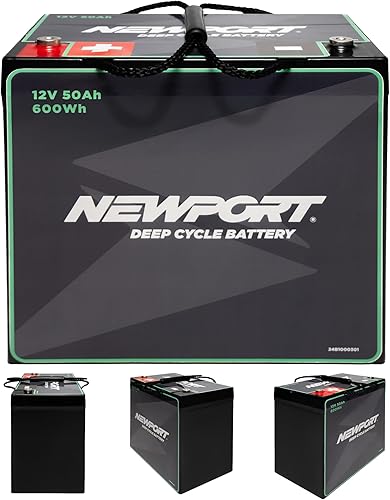
Newport 12V 50Ah Deep Cycle AGM Marine
9.4/10 our score
See it on Amazon -
3
 Best for AGM solar and marine systems
Renogy 12 Volt 100Ah Deep Cycle AGM
9.4/10 our score
See it on Amazon
- 4
 Check it
NERMAK 12V 50Ah LiFePO4 Deep Cycle Battery
Best for compact lithium storage - 5
 Check it
ECO-WORTHY 12V 314AH LiFePO4 Lithium Battery Bluetooth
Best for maximum single-battery capacity - 6
 Check it
ABKpower 12V 20Ah LiFePO4 Battery
Best for small electronics - 7
 Check it
dumfume 2 Packs 12V 150Ah Max LiFePO4
Best for expandable house banks - 8
 Check it
WOXABHSL 2PCS 12V 100Ah LiFePO4 Lithium Battery
Best for two-battery 100Ah systems - 9
 Check it
LIPULS 12.8V 100Ah LiFePO4 Battery
Best for Group 24 replacement
The best lithium marine battery 12V deep cycle picks
The best choice depends on your marine load, available battery space and charging equipment. The products below are ordered by score, with the strongest overall fit first.
SUPER EMPOWER 12V 100Ah LiFePO4 Battery: Best for most marine house loads
- 12.8V 100Ah capacity
- Group 24 size
- 100A BMS
- M8 terminals
This Group 24 LiFePO4 battery gives marine house systems 100Ah of 12.8V storage in a 21.6 lb case. Its 100A BMS and low-temperature charging protection suit mobile and outdoor energy storage.
Pros
- Group 24 fit
- 100A BMS
- Supports up to 4S4P expansion
Cons
- Not for engine starting
- Requires a lithium-compatible charger
SUPER EMPOWER is the best all-around choice for a 12V lithium battery deep cycle marine setup. Its 12.8V 100Ah capacity gives useful house bank storage without the 60.4 lb weight of the largest battery here.
For many boats, 100Ah is a sensible starting point for house loads that run for hours. It gives more reserve than 20Ah or 50Ah models while staying easier to place than a very large battery.
The Group 24 size measures 6.49 x 10.24 x 8.98 in and weighs 21.6 lb. That footprint helps for a drop-in style replacement for a similar lead-acid size.
M8 terminals suit buyers replacing a similarly sized battery, but measure the box first. Small differences in height or terminal position can matter in a tight compartment.
The built-in 100A BMS protects against overcharge, over-discharge, overcurrent, short circuit and temperature issues. It manages its own limits in daily use.
Charging pauses below 32°F, and discharge stops at -4°F before resuming above 41°F. Check those limits before winter trips or storage on an unheated boat.
This battery is for energy storage, not engine starting or cranking. It supports up to 4 in series and 4 in parallel for a larger 51.2V 400Ah setup when the system is designed for it.
Use a lithium-compatible charger in the stated 14.4 to 14.6V range. A non-lithium charger is not recommended, so confirm settings before first use and secure the battery with terminals protected.
Newport 12V 50Ah Deep Cycle AGM Marine: Best for small boats and kayaks
- 12V 50Ah capacity
- Sealed AGM construction
- Marine terminal
- 32 lb weight
The Newport is a sealed AGM battery for trolling motors and compatible 12V marine electronics. Its 50Ah capacity and compact design fit kayaks, inflatable boats, jon boats and other small watercraft.
Pros
- Sealed AGM design
- Made for small marine setups
- Marine terminal
Cons
- Heavier than the lithium picks
- Only 50Ah capacity
Newport is the best fit for a small boat, kayak or compact trolling motor setup needing sealed AGM construction. Its 12V 50Ah capacity provides steady power for compatible 12V marine electronics and trolling motors.
For lighter loads, 50Ah is a practical middle ground between a small electronics battery and a full house bank. It suits use where the motor or devices run for part of a trip.
The battery weighs 32 lb and uses a marine terminal. It is heavier than the 11 lb NERMAK, but AGM suits buyers staying with sealed lead-acid systems.
The sealed design means low-maintenance use without watering or frequent upkeep. That trade-off suits small craft where simple care matters.
Newport describes this battery for kayaks, inflatable boats, jon boats and other small watercraft. Its compact format makes carrying it from vehicle to dock easier than a larger house bank battery.
Plan how you will load and secure it on a kayak or small jon boat. Choose it for small-boat trolling and electronics, not a high-capacity cabin system.
For a broader 12V comparison, see best marine deep cycle battery 12V.
Renogy 12 Volt 100Ah Deep Cycle AGM: Best for AGM solar and marine systems
- 12V 100Ah capacity
- Sealed AGM construction
- 1100A maximum discharge for 5 seconds
- Series support and up to 4P
Renogy gives AGM buyers 100Ah of 12V storage for RV, solar, marine and off-grid use. It supports series connections and up to four batteries in parallel.
Pros
- 100Ah AGM capacity
- Low monthly self-discharge claim
- Broad system use
Cons
- 63.9 lb listed battery weight
- AGM is heavier than LiFePO4
Renogy is the strongest AGM alternative for buyers who need 100Ah of 12V storage for marine, RV, solar or off-grid use. Its sealed AGM construction avoids the lithium-specific charger choice required by the LiFePO4 models.
That makes it appealing when your existing charging equipment is already set for sealed lead-acid batteries. You can keep a familiar setup instead of changing profiles for lithium.
The battery measures 13.1 x 6.9 x 8.6 in. Its listed battery weight is 63.9 lb, so plan the lift and mounting space before choosing it for a boat.
On a small boat, that weight can affect trim and handling, so place it low and secure it well. On a larger vessel, the same weight may be less of a concern.
Renogy supports series connections with no stated limit and parallel connections up to 4P. Matching batteries of the same capacity, voltage and type is important when you expand a bank.
It also lists a maximum discharge current of 1100A for 5 seconds, while the battery's main role remains deep-cycle storage. That figure describes short peaks, not the steady loads a house bank usually sees.
The stated discharge range is -4°F to 140°F, and Renogy describes monthly self-discharge below 3% at 77°F. Low self-discharge helps when the battery sits between trips.
Choose it when familiar AGM charging and a 100Ah capacity matter more than low weight. The trade-off is a heavier case than the lithium models in this group.
NERMAK 12V 50Ah LiFePO4 Deep Cycle Battery: Best for compact lithium storage
- 12.8V 50Ah capacity
- 100A BMS
- M6 terminals
- 4000+ cycle claim
NERMAK is a small 12.8V 50Ah LiFePO4 option for marine, trolling motor, RV, solar and off-grid energy storage. Its 11 lb weight is useful when carrying space and lifting effort matter.
Pros
- Light 11 lb case
- 100A BMS
- Series or parallel expansion
Cons
- 50Ah capacity
- Not a direct substitute for a high-capacity house bank
NERMAK suits a smaller marine setup where low weight matters. The 12.8V 50Ah battery weighs 11 lb, making it easier to move than the 32 lb Newport AGM or the Renogy AGM.
That light case helps on a small boat, in a kayak or in a compartment you reach at an awkward angle. It measures 7.59 x 5.11 x 6.14 in with M6 terminals, leaving more room for cables and hold-downs.
Its 100A BMS protects against overcharge, over-discharge, overcurrent and short circuit. NERMAK states a 4000+ cycle rating and supports up to 4 identical batteries in series or parallel.
Use a LiFePO4 charger rather than assuming an SLA or AGM charger will fully charge it. This battery fits lighter marine storage and trolling motor use when 50Ah matches your expected runtime, while a 100Ah model or larger bank suits longer house-load use.
ECO-WORTHY 12V 314AH LiFePO4 Lithium Battery Bluetooth: Best for maximum single-battery capacity
- 12.8V 314Ah capacity
- 4019.2Wh energy
- 200A BMS
- Bluetooth and SOC LEDs
The ECO-WORTHY offers the largest single-battery capacity here, with Bluetooth monitoring, SOC LEDs and a 200A BMS. It suits large marine house banks where cabinet space and lifting weight are acceptable.
Pros
- 314Ah capacity
- Bluetooth monitoring
- Low-temperature charging cutoff
Cons
- Largest case in this group
- 60.4 lb weight needs careful installation planning
ECO-WORTHY is the best pick when a marine house bank needs the highest capacity from one battery. Its 12.8V 314Ah capacity stores 4019.2Wh, which is far more reserve than the 20Ah, 50Ah and 100Ah models here.
That much storage suits boats where house loads run for long periods between charges. It can support a broader set of onboard devices without needing several smaller batteries.
The battery measures 16.3 x 8.5 x 10.2 in and weighs 60.4 lb. That size can work in a larger boat installation, but it needs more cabinet room and careful lifting than the smaller Group 24 options.
Measure the compartment and the route you will use to carry it inside. A heavy battery is harder to reposition once it is in place.
Bluetooth and SOC LEDs let you check battery status, while the 200A BMS includes high and low voltage, overload and temperature protection. Being able to check charge at a glance helps you plan use during a trip.
Charging cuts off below 19.4°F, so cold-weather charging needs planning. The battery can still be useful in winter, but only when its stated limits are respected.
ECO-WORTHY supports expansion up to 4P2S or 2P4S. That flexibility helps when a single battery is not enough, provided the rest of the system is designed for the larger bank.
Choose it when longer runtime matters more than compact size, and confirm that your marine charger and wiring are designed for its capacity. Capacity alone does not fix a mismatched charger or undersized cables.
ABKpower 12V 20Ah LiFePO4 Battery: Best for small electronics
- 12.8V 20Ah capacity
- 256Wh maximum energy
- 20A BMS
- M5 terminals
ABKpower is the smallest lithium choice for a fish finder, lighting or another modest marine load. The 5 lb battery has a 20A BMS and can expand to 80Ah with four batteries in parallel.
Pros
- Only 5 lb
- Compact size
- Useful for small loads
Cons
- 20Ah capacity
- Not for starting batteries or golf carts
ABKpower is the best compact choice for a fish finder, lighting or another modest marine load. The 12V 20Ah LiFePO4 battery weighs 5 lb and measures 7.17 x 6.69 x 3.03 in.
At that size and weight, portability is the main attraction. You can carry it to a kayak, small boat or dockside setup without much effort.
Its 20A BMS protects against overcharge, over-discharge, short circuit and overheating. The protection level matches the battery's small scale and its intended light-duty use.
The battery stores 256Wh, and up to 4 batteries can connect in parallel for an 80Ah, 12.8V system. That expansion path lets you start with one unit and add more later.
ABKpower includes insulation caps, M5 bolts and a user manual. Those parts help with a clean installation and with protecting the terminals from accidental contact.
The stated operating range is -4°F to 140°F, and the battery is intended for deep-cycle energy storage rather than starting batteries. It should not be used where a cranking burst is required.
Pick this model when your load is small and portability matters. It suits a fish finder, lighting or similar modest equipment better than a large house bank.
A 20Ah battery is not the right starting point for a large boat house bank or long periods of high electrical demand. For those jobs, you need a larger capacity from the start.
dumfume 2 Packs 12V 150Ah Max LiFePO4: Best for expandable house banks
- Two 12V 150Ah batteries
- 100A BMS in each unit
- 4S4P expansion
- Low-temperature cutoff
This two-battery pack gives you a starting point for a larger marine house bank. The batteries can connect in parallel for 300Ah or in series for 24V and support up to 4S4P expansion.
Pros
- Two batteries included
- 300Ah parallel configuration
- Low-temperature protection
Cons
- Not for engine starting or trolling motors
- Each battery weighs 43 lb
dumfume is aimed at buyers building a larger 12V lithium battery deep cycle marine house bank from two matching units. The pack includes two 12V 150Ah batteries, each with its own 100A BMS.
Having two batteries in one pack helps when you want more capacity than a single 100Ah unit. It also gives you a matched pair for a series or parallel setup.
Connect the two batteries in parallel for 300Ah or in series for 24V and 150Ah. Parallel connection adds capacity, while series connection raises voltage for systems designed for it.
The design supports up to 4S4P expansion, but connected batteries should use the same brand, model, capacity and BMS. Matching units help the bank share work evenly.
Each battery measures 10.04 x 7.68 x 9.84 in and weighs 43 lb. Two units will need clear space and a solid mounting plan.
Charging stops below 32°F, while discharge works down to -4°F. In cold weather, you may be able to use power but not recharge until the battery warms above the limit.
These batteries are for marine house loads such as a fridge or coffee maker, not engine starting or trolling motors. That limit matters when you plan what the bank will actually power.
Keep them dry and install them upright with the terminals facing up. Dry, upright placement helps protect the case and keeps connections accessible for checks.
WOXABHSL 2PCS 12V 100Ah LiFePO4 Lithium Battery: Best for two-battery 100Ah systems
- Two 12V 100Ah batteries
- 100A BMS
- 1280W maximum power output
- LiFePO4 cells
WOXABHSL gives buyers two 100Ah LiFePO4 batteries for marine, RV, solar and off-grid systems. The two-module format can make a larger energy setup easier to plan than starting with one battery.
Pros
- Two 100Ah modules
- 100A BMS
- Suitable for marine energy storage
Cons
- Dimensions are given for the two-piece model
- Not every use case needs two batteries
WOXABHSL suits buyers who want two 100Ah lithium modules for a marine, RV, solar or off-grid system. The pack uses two 12V 100Ah LiFePO4 batteries, each with a built-in 100A BMS.
Two modules can make a larger system easier to plan than buying batteries one at a time. You get matching units from the start, which helps when you connect them together.
The battery data gives a 22.05 lb weight per module and states a maximum 1280W power output. Splitting the load across two cases can make each one easier to carry.
The two-piece format can help when one large battery is difficult to carry or position. You can place each module where space allows, as long as cable runs stay short and secure.
The maker states that the batteries use automotive-grade LiFePO4 cells and can support series or parallel use. That flexibility suits systems that need either more capacity or a different voltage.
Their stated applications include ships and trolling motors, but engine-starting requirements should still be checked separately. A stated use does not replace checking your own system's needs.
Choose WOXABHSL when two matching 100Ah units fit your planned system. It is a natural step when one battery would not provide enough reserve.
If you only need one Group 24 replacement, SUPER EMPOWER or LIPULS may be easier to size. A single battery is simpler when capacity and space already line up.
LIPULS 12.8V 100Ah LiFePO4 Battery: Best for Group 24 replacement
- 12.8V 100Ah capacity
- Group 24 dimensions
- 100A smart BMS
- M8 terminals
LIPULS is a Group 24 12.8V 100Ah LiFePO4 battery for RVs, boats, trolling motors, camping and solar systems. Its 100A smart BMS and 22.6 lb weight fit buyers replacing a similar lead-acid footprint.
Pros
- Group 24 size
- 100Ah capacity
- 100A smart BMS
Cons
- Energy storage only
- Check the charging instructions before installation
LIPULS is the best Group 24 replacement alternative for buyers seeking a 12V lithium battery marine setup in a familiar footprint. Its 12.8V 100Ah capacity and 22.6 lb weight make it practical for boats, RVs and camping systems.
That combination suits owners who want to keep the same general battery box layout. It can replace a similar lead-acid footprint without redesigning the compartment.
The battery measures 10.23 x 6.61 x 8.3 in and uses M8 terminals. Those dimensions and terminals help it slot into G24, G27 or G31 style compartments used in many mobile setups.
Its 100A smart BMS protects against overcharging, overcurrent, over-discharging, short circuits and over-temperature conditions. The BMS is the main safety layer during charge and discharge.
LIPULS supports up to 4 batteries in series and 4 in parallel. That allows the bank to grow if your system needs more capacity or a higher voltage later.
The stated applications include 30 to 70 lb thrust trolling motors, RVs, camping, sump pumps and solar systems. Those uses all rely on steady deep-cycle power rather than engine cranking.
This battery is for energy storage and is not suitable for engine starting. Keep that limit in mind when you assign it to a specific job on board.
Check the charging instructions before installation, especially when replacing an AGM or other lead-acid battery. Correct charger settings help the battery reach full charge and work as intended.
How to choose a 12V lithium battery deep cycle marine system
Start with the load, not the battery label. Add the wattage of the gear you expect to run, estimate hours of use, and leave room for charging losses and changing weather.
A 20Ah battery can suit a fish finder or lighting. A 50Ah model fits lighter trolling or marine electronics, while 100Ah batteries offer a better starting point for a marine house bank.
Capacity is only part of the choice. The battery must also fit the compartment, use compatible terminals, match the charger and have a BMS suited to temperature and current needs.
Fix any mismatch on paper rather than after installation. For a Group 24 replacement, compare actual dimensions rather than relying only on the name.
SUPER EMPOWER measures 6.49 x 10.24 x 8.98 in, while LIPULS measures 10.23 x 6.61 x 8.3 in. Two Group 24 batteries can still need different mounting plans.
Check terminal location, not just overall size. A battery can fit the box and still be awkward if terminals face the wrong way.
Think about weight as part of fit. A 60.4 lb battery needs a different lifting plan than a 5 lb or 11 lb unit.
Check charger compatibility early. Lithium models need LiFePO4 settings, while AGM models work with sealed lead-acid charging.
Temperature limits matter too, especially for cold weather charging. Some batteries block charging below freezing, so plan where and when you will recharge.
If you expect to expand, choose a model that supports series or parallel use. Separate house loads from starting duties, as these deep-cycle batteries are for energy storage, not engine cranking.
Lithium versus AGM for marine house loads
Lithium is usually the lighter choice here. The NERMAK weighs 11 lb at 50Ah, while the Newport AGM weighs 32 lb at 50Ah and the Renogy AGM lists 63.9 lb at 100Ah.
That gap matters when you carry batteries to the dock or fit them in a small compartment. Lighter batteries are also easier to position and secure.
AGM can be the better fit when your boat already has suitable AGM charging or you prefer sealed lead-acid chemistry. Staying with AGM avoids changing charger profiles.
Newport provides a compact 50Ah option, and Renogy provides 100Ah for larger systems. Both are sealed for low-maintenance marine use.
AGM also avoids lithium-specific limits such as low-temperature charging cutoffs. That can help boats that charge in cold conditions.
Lithium models need LiFePO4 charging settings. SUPER EMPOWER specifies a 12V LiFePO4 charger with a 14.4 to 14.6V CC/CV profile, and its BMS disables charging below 32°F.
Other lithium models have their own limits, so check the manual for the exact battery. Weight is not the only difference, as capacity, expansion options and temperature behavior also shape the right type.
Choose the chemistry that matches your charger and care habits. For environmental context, read what is environmental impact of lithium batteries before choosing.
How to set up and care for a marine lithium battery
Charge a lithium battery with the charger type and voltage range stated for that model. Do not assume an AGM charger suits it, and do not mix chemistry, voltage or capacity in one bank.
Correct charging helps the battery reach full charge and keeps the BMS from stopping the charge early. It is the first step in a reliable setup.
For series or parallel expansion, use matching batteries and wiring sized for the current. Charge each battery fully first and use the same brand, model, capacity and BMS, with a bus bar for multiple batteries.
Matching units help the bank balance during charge and discharge. Keep the battery dry, secure and protected from accidental terminal contact.
The dumfume battery suits marine house loads but should be kept away from water and is not for engine starting. Install it upright with terminals facing up where that is the stated orientation.
Cold weather needs care. Some batteries block charging below freezing, and limits differ by model, so check the exact range before leaving a boat unattended.
If charging is blocked, bring the battery to a warmer place before trying again. Do not force a charge below the stated limit.
Check connections before each trip and after rough water. Tight, clean terminals help the system work as planned.
Store the battery in a dry, secure place and follow the stated storage charge. Use only the listed charger and settings, and plan expansion before buying the first battery so you can build a matched bank.
Which 12V lithium battery marine option should you choose?
Pick the SUPER EMPOWER for the best balance of Group 24 fit, 100Ah capacity and marine house-load use. It is the natural first choice for regular onboard loads.
Choose ECO-WORTHY when you need 314Ah from one battery. That larger case suits longer runtimes but needs more space and a careful lifting plan.
Choose NERMAK when a light 50Ah lithium battery is easier to carry. Its 11 lb weight fits small boats and compact setups.
Choose Newport or Renogy when AGM fits your charger and installation plan. Newport suits small-boat use at 50Ah, while Renogy gives 100Ah in a sealed AGM case.
For a Group 24 comparison, see best marine deep cycle battery group 24, or compare chemistries in best AGM deep cycle marine battery.
If your main load is a fish finder or lighting, the ABKpower 20Ah is worth a look. Its 5 lb case suits small electronics better than a large house bank.
If you plan a larger bank from two units, look at the dumfume or WOXABHSL packs. Both provide matched batteries for series or parallel use.
Before you buy, check charger settings for any lithium model. Confirm the battery is for house loads, not engine starting, as several models state that limit clearly.
If you also carry portable lithium power equipment, review is it safe to fly with a lithium battery power station before planning air travel.
Our top 3 picks at a glance
-
1
Best for most marine house loads
SUPER EMPOWER 12V 100Ah LiFePO4 Battery
9.5/10 our score
See it on Amazon -
2
Best for small boats and kayaks
Newport 12V 50Ah Deep Cycle AGM Marine
9.4/10 our score
See it on Amazon -
3
Best for AGM solar and marine systems
Renogy 12 Volt 100Ah Deep Cycle AGM
9.4/10 our score
See it on Amazon
Frequently asked questions
What is the best lithium marine battery 12V deep cycle?
The SUPER EMPOWER 12V 100Ah LiFePO4 Battery is the strongest general pick here for marine house loads because it combines 100Ah capacity, Group 24 dimensions, a 100A BMS and low-temperature protection.
Choose ECO-WORTHY for 314Ah capacity, or NERMAK for a lighter 50Ah setup.
Is a 12V lithium battery good for marine house loads?
Yes. A 12V lithium battery can suit marine house loads such as compatible electronics, lighting and other onboard equipment when its capacity, BMS and charging setup match the system.
These energy-storage batteries are not automatically suitable for engine starting, so check each model's stated use before installation.
What size 12V lithium battery do I need for a boat?
Choose capacity from your loads and expected use time. The ABKpower 20Ah suits small electronics, 50Ah models fit lighter systems, and 100Ah or larger batteries provide more reserve for a marine house bank.
Add the watt-hours of your devices and include charging time, temperature limits and usable space.
Can I replace a marine AGM battery with LiFePO4?
You may be able to replace an AGM battery with LiFePO4 when the battery size, voltage, terminals, charger settings and system requirements all match.
LiFePO4 batteries need lithium-compatible charging settings. Do not assume an existing AGM charger is suitable for every lithium battery.
What is the difference between a marine deep-cycle battery and a starting battery?
A deep-cycle battery is built around repeated energy delivery for loads such as electronics or a trolling motor. A starting battery is designed to provide a short burst for engine cranking.
Several lithium picks here state that they are for energy storage only and not for engine starting.
Are lithium marine batteries safe in cold weather?
Cold-weather charging depends on the battery's protection system. SUPER EMPOWER pauses charging below 32°F, while ECO-WORTHY cuts off charging below 19.4°F.
Check the exact temperature limits before winter use, and never charge a lithium battery below its stated charging range.