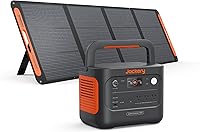
9 Best Solar Panels for DJI Power 1000 (November 2026)
The best solar panels for DJI Power 1000 include the EBL Solar Panel 100W Portable Solar Panel for simple 100W setup, the ZOUPW 450W Portable Solar Panel N-Type 16BB for high-voltage stations only, and the TWELSEAVAN 200W Portable Solar Panel for Power for faster 200W charging.
On this page (8 sections)
- Best solar panels for DJI Power 1000: adapter first, wattage second
- The best solar panels for DJI Power 1000, ranked
- How to compare these solar panels for the DJI Power 1000
- Do I need the DJI solar adapter for third-party panels?
- What wattage should I pick for DJI Power 1000 solar charging?
- Which voltage limit matters most for DJI Power 1000 panels?
- How should I set up and care for a portable solar panel?
- Which pick should you buy for the DJI Power 1000?
The best solar panels for DJI Power 1000 use the DJI MPPT adapter, stay under 30V open-circuit voltage and stay at or under 200W per panel. The EBL 100W is the easiest single-panel choice, the TWELSEAVAN 200W charges faster, and the DJI adapter itself is the key part that makes third-party panels work.
Our score weighs specs, features and buyer feedback against what you are shopping for. We checked voltage, wattage, connectors and included cables before ranking these picks.
A high score does not override a voltage mismatch, so check the adapter limits first.
Our picks at a glance
-
1
 Best for simple 100W setup
EBL Solar Panel 100W Portable Solar Panel
9.7/10 our score
See it on Amazon -
2
 Best for high-voltage stations only
ZOUPW 450W Portable Solar Panel N-Type 16BB
9.4/10 our score
See it on Amazon -
3
 Best for faster 200W charging
TWELSEAVAN 200W Portable Solar Panel for Power
9.4/10 our score
See it on Amazon
- 4
 Check it
SOKIOVOLA 100W Portable Solar Panel MC-4 Foldable
Best for compact carrying - 5
 Check it
DJI Power Solar Panel Adapter Module
Best required adapter for third-party panels - 6
 Check it
DJI Power 1000 V2 100W Foldable Solar
Best bundled station and panel combo - 7
 Check it
MARBERO 100W Portable Solar Panel 100 Watt
Best for cloudy-day top-ups - 8
 Check it
Renogy 200W Portable Solar Panel for Power
Best for light 200W blanket use - 9
 Check it
TWELSEAVAN 150W Portable Solar Panel for Power
Best mid-size 150W compromise
Best solar panels for DJI Power 1000: adapter first, wattage second
The best solar panels for DJI Power 1000 start with the adapter, not the wattage. The DJI Power Solar Panel Adapter Module (MPPT) sets the rules for third-party use: open-circuit voltage under 30V, 200W or less per panel and 400W total with the Power 1000.
That rule changes the buying order. A strong panel with 45.9V open-circuit voltage can be wrong for this station, even if it is excellent for another station.
We put compatibility checks ahead of peak watts in every pick below.
If you want a broader view of how panels are rated, our guide on what is the best solar panel explains wattage, voltage and efficiency in plain terms. For DJI Power 1000 use, voltage fit matters more than the highest watt number.
The best solar panels for DJI Power 1000, ranked
The EBL 100W ranks first for simple setup, while 200W and 150W panels suit buyers who want faster solar charging. The DJI adapter ranks in the middle because it is essential gear rather than a panel.
The ZOUPW 450W scores well on specs but carries a clear compatibility warning for this station.
EBL Solar Panel 100W Portable Solar Panel: Best for simple 100W setup
- 100 watts maximum power
- Monocrystalline silicon
- 23% high efficiency
- IP65 water-resistant
- Adjustable kickstand at 45 degrees
- MC4 to Anderson and DC5521 cables included
A 100W foldable panel with multiple cables and a 45-degree kickstand, suited to steady daytime top-ups for the DJI Power 1000 when voltage checks pass.
Pros
- Multiple cables in the box
- Kickstand aims panel at 45 degrees
- Smart IC protection features
Cons
- 100W is slower than 200W picks
- Confirm DJI adapter voltage limit before use
The EBL Solar Panel 100W Portable Solar Panel suits buyers who want one panel, a kickstand and a cable kit in the box. It is rated at 100 watts maximum power with monocrystalline silicon and 23% efficiency.
Its 45-degree kickstand can help the panel catch more sunlight than lying flat. EBL says the angle can deliver 20% more sunlight than flat placement, which matters on short winter days or when the sun sits low over a campsite.
The box includes an MC4 to Anderson cable, an MC4 to DC5521 cable and three small DC adapters. That range helps with older or smaller devices, but DJI Power use still needs the DJI MPPT adapter and an XT60 conversion path.
Protection features include a smart IC for overcharging, overheating and short-circuit protection. The panel is IP65 water-resistant, which EBL describes as splash protection rather than permission to soak it or leave it under rain.
Choose it for calm, portable top-ups and simple storage. Skip it if you need the fastest possible recharge, because a 200W panel can roughly double the peak input when sunlight and station limits allow.
ZOUPW 450W Portable Solar Panel N-Type 16BB: Best for high-voltage stations only
- 450 watts maximum power
- 25% efficiency
- 45.9V open-circuit voltage
- IP68 waterproof
- 29.5 pounds
- 4-in-1 adapter cable included
A very powerful N-type panel built for large stations with 40V to 60V input, but its 45.9V open-circuit voltage means it does not fit the DJI adapter limits for this post.
Pros
- 450W output for large stations
- 25% efficiency
- IP68 waterproof rating
Cons
- 45.9V open-circuit voltage exceeds DJI adapter limit
- 29.5 pounds is heavy to move daily
The ZOUPW 450W Portable Solar Panel N-Type 16BB is the most powerful panel in this group, but it is not a fit for the DJI adapter rules. It is rated at 450 watts maximum power with 25% efficiency.
Its open-circuit voltage is 45.9V, which sits above the DJI adapter ceiling of under 30V. That single fact should stop DJI Power 1000 buyers from pairing this panel with the DJI MPPT module.
ZOUPW designed this panel for large stations with 40V to 60V input. It lists compatibility with EcoFlow Delta series, Anker C1000 and C1000 Gen2 and Bluetti Elite 100, and it warns against low-voltage units under 30V input.
The panel weighs 29.5 pounds and folds to 30.43 x 34.56 x 3.54 inches. Four kickstands adjust to 45 degrees, and the ETFE coating carries an IP68 rating.
ZOUPW says connectors should not be soaked even with that rating.
Choose it only for a high-voltage station that accepts 45.9V open-circuit voltage. For the DJI Power 1000, choose a 100W, 150W or 200W panel that stays under the adapter ceiling.
TWELSEAVAN 200W Portable Solar Panel for Power: Best for faster 200W charging
- 200 watts maximum power
- 24% efficiency
- 19.8V maximum voltage
- IP65 waterproof
- 15.7 pounds
- MC4 output with DC adapters
A 200W foldable panel with 24% efficiency and a 19.8V maximum voltage, which fits the DJI adapter voltage ceiling when connected through a suitable XT60 adapter.
Pros
- 200W for faster charging
- 19.8V maximum voltage fits DJI adapter limit
- USB-C and USB outputs for small devices
Cons
- Requires proper XT60 conversion for DJI use
- Higher wattage needs more setup space
The TWELSEAVAN 200W Portable Solar Panel for Power suits buyers who want faster charging without jumping to a very large panel. It is rated at 200 watts maximum power with 24% efficiency.
Its maximum voltage is 19.8V, which fits under the DJI adapter ceiling of 30V. That makes voltage fit far better than the 450W pick for DJI Power 1000 use.
The panel weighs 15.7 pounds and folds to 23 x 22 inches. Four adjustable kickstands help you set an angle on uneven ground.
A magnetic handle makes carrying the folded panel easier between a car and a campsite.
It includes a 9.8ft MC4 connector cable and DC adapters for MC4 to Anderson, XT60, 8020, 7909 and 5521 paths. For DJI use, the XT60 path plus the DJI MPPT adapter is the route to check before ordering.
USB-C PD 60W and QC3.0 18W ports also charge phones, tablets and cameras directly. That helps when the power station stays in a tent and small devices need a quick charge.
Choose it for faster solar input and direct device charging. Skip it if you want the lightest possible panel, because 100W picks weigh far less.
SOKIOVOLA 100W Portable Solar Panel MC-4 Foldable: Best for compact carrying
- 100 watts maximum power
- 18V maximum voltage
- IP68 waterproof
- 4.6 pounds
- Folded size 14.69 x 8.67 inches
- 4-in-1 MC4 cable included
A light 100W foldable panel at 4.6 pounds with 18V output, easy to carry for camping and RV use when paired with the DJI adapter and a compatible cable.
Pros
- Very light at 4.6 pounds
- 18V output fits adapter range
- Compact folded size
Cons
- 100W charging speed is modest
- Needs XT60 conversion for DJI Power use
The SOKIOVOLA 100W Portable Solar Panel MC-4 Foldable suits buyers who value low weight above peak speed. It is rated at 100 watts maximum power and weighs only 4.6 pounds.
Its maximum voltage is 18V, which fits the DJI adapter input range of 12V to 30V. Its 4-in-1 MC4 cable covers XT60, DC5521, DC 8mm and Anderson outputs.
The folded size is 14.69 x 8.67 x 1.78 inches, so it stores in a small bag or car pocket more easily than 200W panels. That compact size helps for hiking, bike travel and tight RV storage.
SOKIOVOLA lists an IP68 dustproof and waterproof rating with ETFE material and 95% light transmittance. Keep connectors dry and avoid stepping on the panel, since cracked cells cut output.
The trade-off is speed. A 100W panel cannot match a 200W panel on a sunny day, and a station input limit can cap intake below 100W.
If you mainly top up overnight use, that slower rate may still be enough.
Choose it for light travel and simple cable options. Skip it if you need to refill a drained Power 1000 quickly on short daylight days.
DJI Power Solar Panel Adapter Module: Best required adapter for third-party panels
- MPPT module
- Up to three solar panels
- 12-30V DC input range
- Maximum 400W total with DJI Power 1000
- XT60 interface
- Metal heat dissipation bracket included
This MPPT adapter links non-DJI panels to the DJI Power series through XT60, with a 30V open-circuit ceiling and 400W total cap for the Power 1000.
Pros
- Enables third-party panel use
- Supports up to three panels
- 400W total cap with Power 1000
Cons
- Not a solar panel by itself
- Panels must stay under 30V open-circuit and 200W each
The DJI Power Solar Panel Adapter Module (MPPT) is not a solar panel, but it is the most important accessory in this post for third-party panels. It connects solar panels to the DJI Power series through an XT60 interface.
Its input range is 12V to 30V DC, with a single-channel maximum of 200W and triple-channel maximum of 400W with the DJI Power 1000. One module can connect up to three solar panels.
DJI says panels used with the module should have open-circuit voltage under 30V. Each panel should not exceed 200W, and total output across the module should stay at or under 400W for the Power 1000.
The module works with DJI Power 1000 V2, DJI Power 2000, DJI Power 1000 and DJI Power 500. It includes a metal heat dissipation bracket, screws and a ball-end hex key.
Install the heat dissipation bracket when using solar panels with the module. Keep the operating temperature within -10C to 45C, and route cables so the module does not sit in direct heat or water.
Choose this module before any third-party panel for DJI Power use. Skip it only if your panel is officially recommended by DJI and your station accepts it through a direct DJI cable path.
DJI Power 1000 V2 100W Foldable Solar: Best bundled station and panel combo
- DJI Power 1000 V2 included
- IBCPOWER 100W foldable solar panel included
- 1024Wh LFP battery
- 2600W stable output
- MC4 to XT60 solar power cable included
A bundled DJI Power 1000 V2 with a 100W foldable panel and MC4 to XT60 cable, best for buyers who want the station and a matched panel in one package.
Pros
- Station and panel in one bundle
- MC4 to XT60 cable included
- 1024Wh LFP battery
Cons
- Bundle costs more than buying station alone later
- 100W panel is slower than 200W options
The DJI Power 1000 V2 100W Foldable Solar bundle suits buyers who want the station and a panel together. It includes the DJI Power 1000 V2, a 1024Wh LFP battery and an IBCPOWER 100W foldable solar panel.
The bundle also includes an MC4 to XT60 solar power cable, an AC power cable and a power outlet to SDC power cable. That cable set covers wall charging, car power and solar charging during camping.
The station delivers 2600W stable output and recharges to 80% in 37 minutes through wall power, according to DJI. Solar charging will be slower because the included panel is 100W.
DJI lists a 10-year lifespan for the LFP battery and a 5-year warranty for this generator. A 10ms UPS switch time is listed for home backup use during outages.
The 100W panel is the limit for solar speed in this bundle. Buyers who want faster solar input can add a compatible 200W panel later, but they should stay within the adapter and station input limits.
Choose this bundle for a matched DJI setup with fewer cable questions. Skip it if you already own a Power 1000 station and only need a panel or adapter.
MARBERO 100W Portable Solar Panel 100 Watt: Best for cloudy-day top-ups
- 100 watts maximum power
- 18V output
- 21.5% to 23.5% conversion
- IP68 waterproof panel fabric
- 10 connectors included
- Adjustable stand 0 to 180 degrees
A 100W foldable panel with 10 connectors and an adjustable stand, useful for cloudy-day top-ups and direct USB charging when DJI adapter rules are met.
Pros
- 10 connectors for wide compatibility
- Adjustable stand angle
- Strong cloudy-day output claims
Cons
- Output control box is not waterproof
- 100W limits peak charging speed
The MARBERO 100W Portable Solar Panel 100 Watt suits buyers who want many connector choices and direct USB charging. It is rated at 100 watts maximum power with 18V output.
MARBERO lists conversion efficiency at 21.5% to 23.5% and says the panel can deliver 80W to 100W under full sunlight at an optimal angle. On cloudy days, it claims 65W to 70W output.
The panel weighs 8.5 pounds and folds to about 23 x 19.7 inches. An adjustable stand can angle from 0 to 180 degrees, and MARBERO says that can capture up to 25% more sunlight than laying it flat.
It comes with 10 connector sizes, including MC4 and several DC adapters. That wide set helps with Jackery, EcoFlow, Bluetti, MARBERO and other stations, but DJI use still needs the DJI MPPT adapter and a safe XT60 path.
Direct outputs include USB-A 5V/3A, QC3.0 USB-A, PD3.0 USB-C and DC 18V/5.5A. Those ports can charge phones, tablets, speakers and laptops while the panel feeds a station.
The output control box is not waterproof, even though the panel fabric carries an IP68 rating. Keep that box dry and out of puddles during rain.
Choose it for cloudy-day use and connector variety. Skip it if you need a fully waterproof control box for wet-weather camping.
Renogy 200W Portable Solar Panel for Power: Best for light 200W blanket use
- 200 watts maximum power
- 25% efficiency
- 19.6V maximum voltage
- 8.82 pounds
- IP65-rated
- MC4 output cables only
A light 200W N-type blanket at 8.82 pounds, but it has MC4 output only and the Renogy 4-in-1 adapter cable is sold separately, so DJI use needs extra parts.
Pros
- 200W at only 8.82 pounds
- 25% efficiency
- Folds to 16.14 x 15.35 x 3.07 inches
Cons
- MC4 only, adapter cable sold separately
- Needs DJI MPPT adapter plus XT60 conversion
The Renogy 200W Portable Solar Panel for Power suits buyers who want 200W output in a light blanket format. It weighs 8.82 pounds and folds to 16.14 x 15.35 x 3.07 inches.
Its 16BB N-type cells deliver up to 25% efficiency, which Renogy says can help in limited space or cloudy conditions. Its maximum voltage is 19.6V, which fits under the DJI adapter ceiling.
The panel has an 8-fold design and can lay across a windshield, sit on sunny ground or hang between trees or racks. That flexibility helps truck camping and SUV camping where flat ground is limited.
The catch is cables. This panel has MC4 output cables only, and the Renogy 4-in-1 adapter cable is sold separately.
DJI use therefore needs the DJI MPPT adapter plus a proper MC4 to XT60 conversion.
It also has one USB-C port and two USB-A ports for charging three devices directly. An IP65 rating and ETFE lamination support outdoor use from -10C to 65C.
Renogy backs the panel with a 2-year material and workmanship warranty. Shoulder straps and a handle make short carries easier, but a 200W blanket still needs more setup space than a 100W panel.
Choose it for light 200W charging and flexible placement. Skip it if you want all DJI cables in the box, because extra adapter parts are needed.
TWELSEAVAN 150W Portable Solar Panel for Power: Best mid-size 150W compromise
- 150 watts maximum power
- 25.8% efficiency
- 21.6V maximum voltage
- 8.38 pounds
- IP68 waterproof
- MC4 5-in-1 cable included
A 150W HPBC panel at 8.38 pounds with 25.8% efficiency and 21.6V maximum voltage, landing between 100W and 200W picks for DJI Power 1000 use.
Pros
- 150W middle ground
- 25.8% efficiency
- Light at 8.38 pounds
Cons
- Not as fast as 200W picks
- Needs DJI adapter and XT60 conversion
The TWELSEAVAN 150W Portable Solar Panel for Power sits between 100W and 200W picks in both size and speed. It is rated at 150 watts maximum power with 25.8% efficiency.
Its maximum voltage is 21.6V, which fits under the DJI adapter ceiling of 30V. That makes it a sensible middle option for Power 1000 buyers who want more than 100W without a large 200W blanket.
The panel weighs 8.38 pounds and uses a magnetic folding design with adjustable kickstands. TWELSEAVAN says one person can carry, set up or fold it within 10 seconds without extra tools.
An included MC4 5-in-1 cable covers Anderson, XT60, 8020, 7909 and 5521 paths, and three DC adapters are included. The 9.8ft MC4 cable gives room to place the panel in sun while the station stays in shade.
HPBC cells and a fiberglass layer support durability, and the panel carries an IP68 waterproof rating. TWELSEAVAN says it is not intended for permanent fixed installation and should not be connected in series or parallel.
Choose it for a balanced 150W setup with high efficiency. Skip it if you want the absolute fastest charging, because the 200W TWELSEAVAN panel has higher peak output.
How to compare these solar panels for the DJI Power 1000
The DJI Power 1000 picks compare best by matching voltage first, then wattage, then portability. A panel that breaks the adapter voltage rule is out, no matter how strong its specs look on paper.
We compared maximum power, open-circuit or maximum voltage, efficiency, weight, folded size, waterproof rating and included cables. We also flagged whether a panel needs the DJI MPPT adapter, an XT60 conversion or a separate adapter cable.
| Product | Best for | Maximum power | Connector type | Material type | Our score |
|---|---|---|---|---|---|
| EBL Solar Panel 100W Portable Solar Panel | simple 100W setup | 100 watts | MC4 | Monocrystalline Silicon | 9.7 |
| ZOUPW 450W Portable Solar Panel N-Type 16BB | high-voltage stations only | 450 watts | 9.4 | ||
| TWELSEAVAN 200W Portable Solar Panel for Power | faster 200W charging | 200 watts | 9.4 | ||
| SOKIOVOLA 100W Portable Solar Panel MC-4 Foldable | compact carrying | 100 watts | 9.2 | ||
| DJI Power Solar Panel Adapter Module | required adapter for third-party panels | XT60 | 9.1 | ||
| DJI Power 1000 V2 100W Foldable Solar | bundled station and panel combo | 9.0 | |||
| MARBERO 100W Portable Solar Panel 100 Watt | cloudy-day top-ups | 100 watts | 8.5 | ||
| Renogy 200W Portable Solar Panel for Power | light 200W blanket use | 200 watts | 8.3 | ||
| TWELSEAVAN 150W Portable Solar Panel for Power | mid-size 150W compromise | 150 watts | 8.1 |
For a wider station comparison, our Best Solar Panel For Power Station guide covers panels for other stations. The DJI adapter rules in this post are stricter than many other stations, so do not copy wattage advice from other brands without checking voltage.
Our folding solar panel roundup helps if carry size is your top concern. Most picks here fold, but folded dimensions range from a compact 14.69 x 8.67 inches to a large 30.43 x 34.56 inches.
Do I need the DJI solar adapter for third-party panels?
Yes, third-party panels need the DJI Power Solar Panel Adapter Module (MPPT) for DJI Power use. The adapter connects through XT60 and sets a 30V open-circuit ceiling, a 200W per-panel cap and a 400W total cap for the Power 1000.
DJI says the adapter can connect to the DJI Power series and DJI-certified Zignes solar panels. For other brands, DJI says the MPPT module and a solar panel port to XT60 conversion are necessary.
That conversion step is where many buyers get stuck. An MC4 cable alone does not make a panel DJI-ready.
You need the DJI adapter in the chain, plus a cable that safely reaches the XT60 input.
If you are comparing similar high-voltage panels for another station, our best portable N-type solar panels guide explains why N-type panels often pair with larger stations. For DJI Power 1000 use, check voltage before chasing cell type.
What wattage should I pick for DJI Power 1000 solar charging?
A 100W panel is best for casual top-ups, camping and easy carrying. A 150W panel is a middle choice for buyers who want more input without a large blanket.
A 200W panel is best for faster daytime charging when sunlight is strong.
Wattage is a peak rating under standard test conditions, not a promise for every hour of the day. Angle, shade, heat and cloud cover can cut real output well below the label.
If you are unsure how many panels your setup needs, our guide on how many solar panels do I need to charge a power station breaks down the math. For DJI Power 1000 use, keep each panel at or under 200W and total input at or under 400W through the adapter.
Which voltage limit matters most for DJI Power 1000 panels?
Open-circuit voltage matters most because the DJI adapter requires it to stay under 30V for third-party panels. A panel can have the right wattage and still be wrong if its open-circuit voltage is too high.
The ZOUPW 450W panel is the clear example. Its 45.9V open-circuit voltage exceeds the DJI adapter ceiling, even though its 450W output looks attractive.
By contrast, the TWELSEAVAN 200W panel lists 19.8V maximum voltage, the Renogy 200W lists 19.6V, the SOKIOVOLA 100W lists 18V and the TWELSEAVAN 150W lists 21.6V. Those figures fit the adapter ceiling more safely.
Always read the exact voltage figure for the panel you plan to buy. Do not rely on connector shape alone, since MC4 cables can carry very different voltage ratings.
How should I set up and care for a portable solar panel?
Set the panel where it gets direct sun and angle it toward the sun with kickstands or a stand. Move it as the sun shifts, because a fixed angle can lose output by afternoon.
Keep the surface clean and free of dust, leaves and grass shadows. Partial shade can create hot spots and reduce output across the panel.
Many buyers ask if solar panels are waterproof. Ratings differ: IP65 usually means splash resistance, while IP68 can mean stronger water protection.
Connectors and control boxes often need extra care even when the panel surface is water-resistant.
Store the panel dry, folded and out of pressure. Do not step on it, stack heavy gear on it or fold it against the cell surface in a way that can crack cells.
Which pick should you buy for the DJI Power 1000?
The best solar panel for DJI Power 1000 owners who want one simple panel is the EBL 100W. It pairs 100W output with a kickstand and a useful cable set, and it avoids the speed-versus-size trade-off of larger blankets.
Pick the TWELSEAVAN 200W if you want faster charging and accept a larger setup. Pick the SOKIOVOLA 100W if weight is your top concern.
Pick the TWELSEAVAN 150W if you want a middle option with 25.8% efficiency.
Pick the DJI MPPT adapter first if you are using any third-party panel. Skip the ZOUPW 450W for this station because its 45.9V open-circuit voltage breaks the DJI adapter rule.
For a close comparison with another popular station, read our best solar panels for Anker SOLIX C1000 guide. If you already own a DJI Power 1000, start with the adapter and a 100W to 200W panel that stays under 30V.
Our top 3 picks at a glance
-
1
Best for simple 100W setup
EBL Solar Panel 100W Portable Solar Panel
9.7/10 our score
See it on Amazon -
2
Best for high-voltage stations only
ZOUPW 450W Portable Solar Panel N-Type 16BB
9.4/10 our score
See it on Amazon -
3
Best for faster 200W charging
TWELSEAVAN 200W Portable Solar Panel for Power
9.4/10 our score
See it on Amazon
Frequently asked questions
Do I need the DJI adapter for third-party solar panels?
Yes, if a panel is not officially recommended by DJI, use the DJI Power Solar Panel Adapter Module (MPPT). It connects through XT60 and limits inputs to under 30V open-circuit, 200W per panel and 400W total for the Power 1000.
Can a 450W panel charge the DJI Power 1000?
Not with the DJI adapter described here. The ZOUPW 450W panel has 45.9V open-circuit voltage, which is above the 30V ceiling.
Pick a panel under 30V open-circuit and under 200W per panel for this setup.
What solar panel wattage is best for DJI Power 1000?
A single 100W panel suits casual top-ups and easy carrying. A 200W panel charges faster on sunny days and still fits the adapter when its voltage stays under 30V.
Check your station input limit before choosing.
How many solar panels can I connect to the DJI adapter?
The DJI MPPT module can connect up to three solar panels. Total output is capped at 400W with the DJI Power 1000.
Each panel should stay at or under 200W to protect the module and station.