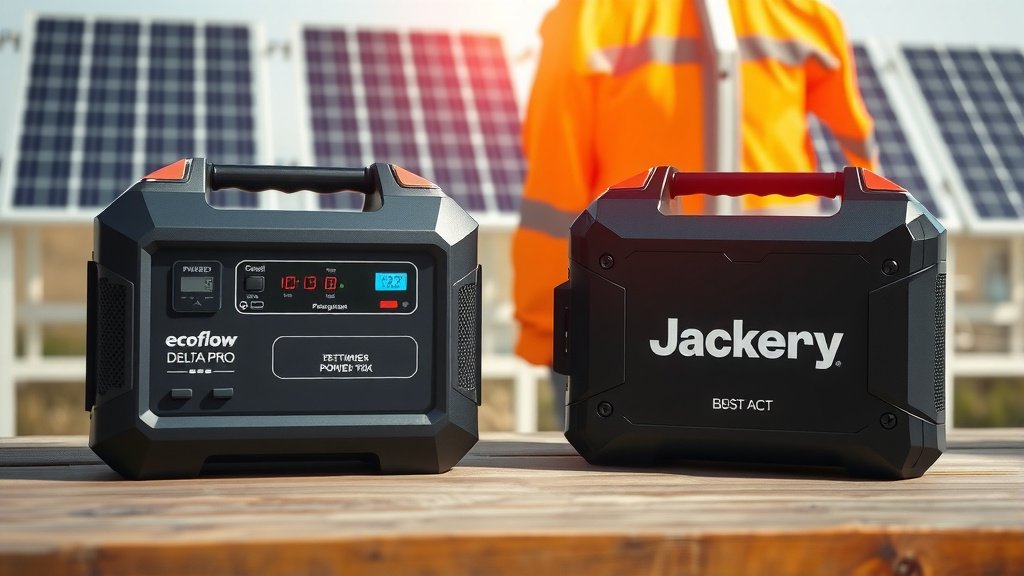
The EcoFlow Delta Pro delivers significantly more power and capacity, making it a better choice for whole-home backup or extended off-grid living, while the Jackery 2000 is a portable workhorse perfect for camping and tailgating.
You’ll find the EcoFlow Delta Pro offers greater expansion options and faster charging, whereas the Jackery 2000 shines with its lighter weight and simpler interface for quick adventures.
TL;DR: Here’s a quick summary if you’re short on time:
- EcoFlow Delta Pro offers massive power and capacity, great for home backup.
- Jackery 2000 is lighter and simpler, ideal for outdoor trips.
- Delta Pro uses LiFePO4 batteries for a longer lifespan.
- The EcoFlow charges much faster than the Jackery.
- Consider your main use: home emergency or portable power for fun?
How Does EcoFlow Delta Pro Compare To Jackery 2000?
When you’re looking for a portable power station, the EcoFlow Delta Pro and Jackery 2000 often pop up. We know you want to choose the right one for your needs, so let’s break down how these two popular options stack up against each other.
Power Output and Capacity: A Tale of Two Titans
This is often where the biggest difference lies. Think of it like comparing a heavy-duty pickup truck to a nimble SUV. The EcoFlow Delta Pro is built for massive power, offering a huge 3600Wh (Watt-hour) capacity. It can even expand up to 25kWh with extra batteries. Its AC output can reach 3600W, surge to 7200W.
On the other hand, the Jackery Explorer 2000 Pro, while powerful in its own right, provides a 2160Wh capacity. It delivers 2200W of continuous AC output with a 4400W surge. It’s certainly robust but not in the same league as the Delta Pro for sheer scale.
What Does This Mean for You?
If you’re powering an entire home during an outage, or running demanding appliances for a long time, the Delta Pro gives you serious staying power. For camping trips, powering tools, or short outages, the Jackery 2000 Pro often has more than enough juice. It simply depends on your ambition!
Battery Chemistry and Lifespan
This detail might seem technical, but it’s really important for long-term value. The EcoFlow Delta Pro uses LiFePO4 (Lithium Iron Phosphate) batteries. Research shows these batteries typically offer 3500 full charge cycles to 80% capacity (EcoFlow). This means a very long life for your investment.
The Jackery 2000 Pro uses NMC (Nickel Manganese Cobalt) batteries. While NMC batteries are efficient, they generally offer around 1000 full charge cycles to 80% capacity (Jackery). You can see the Delta Pro offers a much longer operational life before its capacity starts to diminish significantly.
Charging Speed: Get Back to Full Faster
Nobody likes waiting, especially when you need power! Here, the EcoFlow Delta Pro truly shines. It can charge from 0-80% in about 1.2 hours using its X-Stream AC charging. This is incredibly fast for such a large capacity. You can even combine AC and solar input for even quicker times.
The Jackery 2000 Pro can charge from 0-80% in about 2 hours via AC wall outlet. While good, it’s not quite as rapid as the Delta Pro. If speed is your main concern, the Delta Pro has a clear advantage.
Portability and Design: Carrying Your Power
Portability is key for a “portable” power station, right? The Jackery Explorer 2000 Pro weighs around 43 lbs (19.5 kg). It includes a sturdy handle, making it relatively easy to carry for camping or moving around a job site.
The EcoFlow Delta Pro is a heavier beast, tipping the scales at around 99 lbs (45 kg). It features wheels and an extendable handle, like a suitcase, which helps. Still, it’s not something you’ll casually toss in the car for a quick trip. The Delta Pro is designed to be more stationary, or moved short distances with its built-in wheels.
Expandability and Ecosystem
Do you plan to grow your power system over time? The EcoFlow Delta Pro offers incredible expandability. You can link multiple Delta Pro units together or add Smart Extra Batteries to boost capacity. It also integrates with a Smart Home Panel for seamless home backup (EcoFlow documentation confirms this functionality). This creates a powerful, expandable ecosystem.
The Jackery 2000 Pro is more of a standalone unit. While you can charge it with solar panels, it doesn’t offer the same modular expansion options for increasing capacity or integrating into a home electrical system. It’s a great individual unit, but it doesn’t build out into a larger system.
Smart Features and App Control
Both units offer some smart features, but with different levels of sophistication. The EcoFlow Delta Pro connects to an intuitive app. This allows you to monitor power usage, battery status, and even control AC outlets remotely from your phone. You get a lot of information and control at your fingertips.
The Jackery 2000 Pro has a clear LCD screen displaying vital information. It provides essential data like input/output wattage and battery level. However, it lacks the advanced app control and remote management you find with the Delta Pro.
When Does Each Power Station Make Sense for You?
Choosing between them often comes down to your primary needs. Here’s a quick guide:
- EcoFlow Delta Pro if you need:
- Whole-home backup during outages
- Extended off-grid living or remote cabin power
- Running power-hungry appliances or tools for hours
- A system that can grow with your needs
- The fastest possible charging
- Jackery 2000 Pro if you need:
- Portable power for camping, RV trips, tailgating
- Reliable backup for essential items during short outages
- Power for job sites or outdoor events
- A lighter, more compact unit that’s easy to move
- Simplicity and ease of use
A Side-by-Side Glance
To help you see the differences clearly, here’s a brief comparison table:
| Feature | EcoFlow Delta Pro | Jackery Explorer 2000 Pro |
|---|---|---|
| Capacity | 3600Wh (expandable to 25kWh) | 2160Wh |
| AC Output | 3600W (7200W Surge) | 2200W (4400W Surge) |
| Battery Type | LiFePO4 | NMC |
| Lifespan (to 80%) | 3500+ cycles | 1000 cycles |
| AC Charging (0-80%) | ~1.2 hours | ~2 hours |
| Weight | ~99 lbs (45 kg) | ~43 lbs (19.5 kg) |
| Expandability | Yes (extra batteries, Smart Home Panel) | No |
| App Control | Yes | No |
Noise Levels: A Quiet Companion?
Both units will make some noise when their cooling fans kick in, especially under heavy load. We found that the EcoFlow Delta Pro, with its larger capacity and power output, might have fans running more often or at a higher speed when powering demanding appliances. The Jackery 2000 Pro is generally noted for being relatively quiet for its size. If you’re sensitive to noise, consider the power you’ll be drawing.
Warranty and Support
Warranty coverage gives you peace of mind. EcoFlow typically offers a 3-year warranty for the Delta Pro (EcoFlow official site). Jackery provides a 3-year warranty for the Explorer 2000 Pro, with an optional 2-year extension when purchased from their site. Both brands offer solid support, but it’s always wise to check current terms when buying.
Making Your Choice: A Checklist for You
Ready to decide? Consider these points:
- Are you powering a whole house or just a few camping gadgets?
- How often do you plan to use it? (Consider battery lifespan!)
- Is super-fast charging a must-have for you?
- Will you be moving the unit around often, or will it stay put?
- Do you want to expand your system later on?
- Is remote monitoring via an app important?
Conclusion
Comparing the EcoFlow Delta Pro to the Jackery 2000 Pro shows you’re looking at two different beasts, each excellent in its own habitat. The Delta Pro is the undisputed champion for large-scale, long-duration power needs and home integration, boasting superior capacity, battery life, and charging speed. It’s an investment in serious backup.
The Jackery 2000 Pro, however, remains a fantastic, highly portable option for adventurers, campers, and anyone needing reliable power without the sheer bulk. It’s a workhorse that gets the job done simply and efficiently. Your ideal choice really comes down to your lifestyle, your power demands, and how you envision using your portable energy source. Think about your main goal, and the answer will become clear!
Can I charge both EcoFlow Delta Pro and Jackery 2000 Pro with solar panels?
Yes, both units are designed to be charged by solar panels. Each brand offers its own compatible solar panels, and you can also use third-party panels if they meet the voltage and amperage requirements for your specific model. Solar charging is a great way to stay powered off-grid.
Which unit is better for powering large kitchen appliances during an outage?
For large kitchen appliances like refrigerators, microwaves, or even electric ovens, the EcoFlow Delta Pro is the far superior choice. Its higher wattage output (3600W) and much larger capacity (3600Wh, expandable) are much better suited to handle the high power draw and run times these appliances require compared to the Jackery 2000 Pro.
Do I need an electrician to set up either of these power stations?
For basic usage, neither unit typically requires an electrician. You simply plug your appliances directly into the power station. However, if you plan to integrate the EcoFlow Delta Pro into your home’s electrical system with its Smart Home Panel, professional installation by a qualified electrician is highly recommended for safety and proper function.
Is one unit significantly louder than the other?
While both units will generate some fan noise under heavy loads, the Jackery Explorer 2000 Pro is generally considered to be somewhat quieter due to its smaller power output. The EcoFlow Delta Pro, with its higher capacity and more robust cooling system for handling larger loads, may produce more noticeable fan noise when pushed hard.
Which power station offers better value for money?
Value depends on your needs. The EcoFlow Delta Pro, with its higher price tag, offers superior capacity, expandability, faster charging, and a much longer battery lifespan (LiFePO4), making it a better long-term investment for heavy-duty use. The Jackery 2000 Pro offers excellent value for its price if your needs are more aligned with portable, mid-range power for camping or basic home backup.