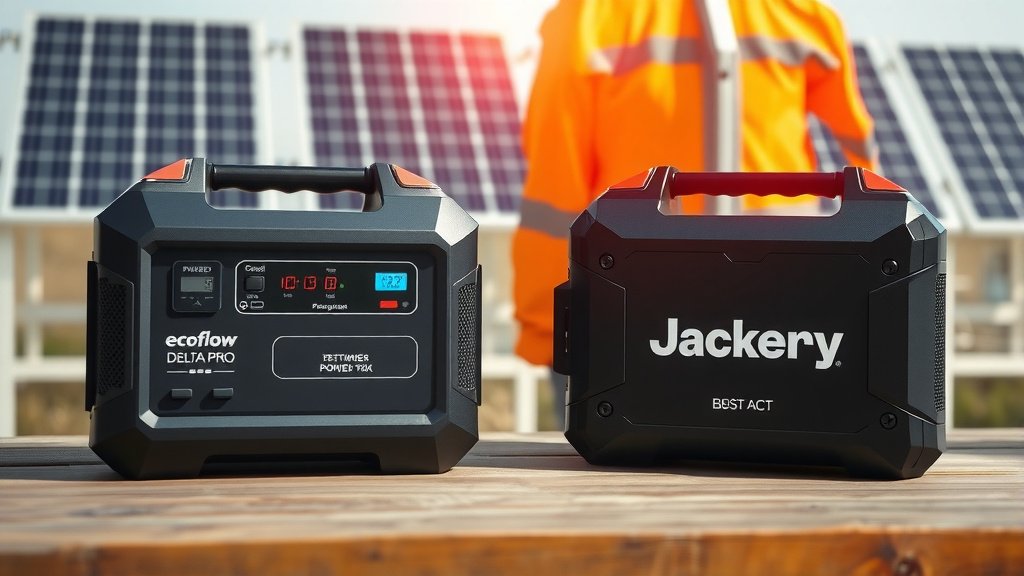
Jackery vs EcoFlow Power Station: Which Is Better? (November 2026)
Choose Jackery for a simpler brand-specific solar setup, or EcoFlow if you want a power station ecosystem with expandable battery options. Compare each model's output, capacity, charging and solar compatibility before choosing a brand.
On this page (8 sections)
- Jackery vs EcoFlow power station: which brand fits your setup?
- What does each power station brand ecosystem include?
- Which brand is better for solar charging?
- How do output and capacity compare?
- Which brand charges faster?
- Which one works better for backup power?
- What should you check before choosing a brand?
- Which power station brand should you choose?
Choose Jackery for a straightforward, brand-specific solar setup, or EcoFlow if expandable battery capacity matters to you. In a Jackery vs EcoFlow power station comparison, the exact model and your planned loads matter more than the logo.
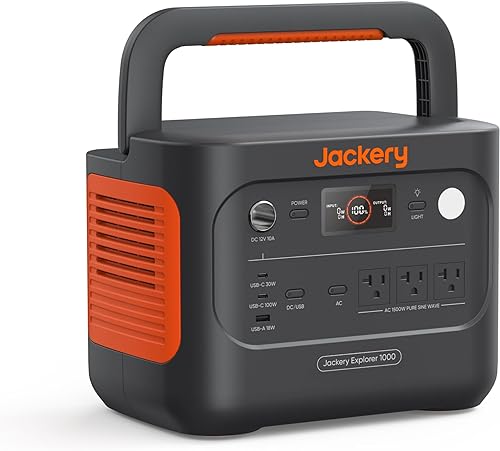
The Jackery Explorer 1000 v2 provides 1,070Wh capacity and 1,500W AC output. EcoFlow's Delta 3 has 1,024Wh capacity, 1,800W AC output and a path to expand capacity with compatible battery packs.
Those figures describe 2 different models, not every unit either brand sells. We compared the features and stated specs available for these options, including solar compatibility, app controls and expansion.

 Best for Jackery capacity
Jackery Explorer 1000 v2 Portable Power Station
Jackery vs EcoFlow power station: which brand fits your setup?
Jackery suits buyers who want to stay within its solar panel ecosystem, while EcoFlow's Delta 3 stands out here for expansion. Match the station to your devices, charging conditions and plans for adding battery capacity.
The Explorer 1000 v2 is a 1,070Wh, 1,500W station with 3 AC ports. Jackery says its one-hour full-charge mode must be enabled in the app; the default full charge takes 1.7 hours.
The Delta 3 is a 1,024Wh, 1,800W station. EcoFlow says it can expand up to 5kWh with compatible packs, and it lists 500W of solar input alongside AC charging.
These differences can matter more than brand reputation. If you're deciding between those particular sizes, see How Does EcoFlow Delta Pro Compare To Jackery 2000? for a separate model-focused comparison.
What does each power station brand ecosystem include?
Jackery's ecosystem centers on its own solar panels for the Explorer 1000 v2, while EcoFlow offers compatible extra batteries for the Delta 3. Check exact compatibility before building a setup around either brand.
Jackery's Explorer 300 also pairs with Jackery panels, but it serves a smaller power need than the Explorer 1000 v2. The compact model has 292Wh capacity and a 300W rated output, which makes it a different class of station.
EcoFlow's Delta 3 supports compatible EcoFlow battery packs, with expansion stated up to 5kWh. That may suit a buyer who wants to start with one station and add capacity later, provided the extra batteries fit the budget and storage plan.
An ecosystem can save guesswork only when its parts match. Confirm panel connectors, supported battery packs, charging methods and any app requirements for the exact model you're considering.
For a closer look at an EcoFlow-focused choice, compare our Best Ecoflow Outdoor Portable Power Station guide. It can help narrow the model before you weigh it against Jackery.
Which brand is better for solar charging?
Choose based on the panel compatibility and input limits of your exact station. The Explorer 1000 v2 is limited to Jackery solar panels, while the Delta 3 accepts up to 500W of solar input.
Jackery describes solar charging for the Explorer 300 with its panels, including an estimated 80% charge in about 2.8 hours with a 100W panel. Actual solar charging depends on sunlight, panel position and other conditions.
EcoFlow says the Delta 3 combines up to 500W solar input with up to 1,500W AC input for a 56-minute full-charge claim. A combined input figure isn't a promise for every setup or weather condition.
Before buying a panel, confirm that its voltage, connector and power fall within the station's requirements. The Best Outdoor Portable Power Station 2026 guide can help compare portable options for different trip and backup needs.
Does Jackery vs EcoFlow solar compatibility affect future upgrades?
It can affect what you can reuse if you later change stations. Jackery states that the Explorer 1000 v2 works only with Jackery solar panels, so a panel from another brand may not be suitable.
EcoFlow's Delta 3 has its own stated solar input limit and compatible battery expansion. Don't assume that a panel or extra battery for another EcoFlow model will work with this station without checking compatibility.
Keep the full system in view: station, panel, cables and any expansion battery. A lower initial capacity may still suit you if the system can grow in a way you plan to use.
How do output and capacity compare?
The Explorer 1000 v2 holds slightly more energy, while the Delta 3 has higher stated AC output. Capacity helps estimate how long a station can supply energy, while output helps determine which devices it can run.
The Jackery Explorer 1000 v2 is rated at 1,070Wh and 1,500W AC output, with a 3,000W surge peak. The EcoFlow Delta 3 is rated at 1,024Wh and 1,800W AC output.
A 46Wh capacity difference is small beside the larger question of how much power your devices draw. Add the wattage of devices you expect to use at the same time and compare it with the station's output rating.
The Jackery Explorer 300 is a separate lower-capacity option for smaller loads. It has 292Wh and 300W rated output, so don't treat it as an equivalent to the 1,000Wh-class choices.
Which should you choose for smaller devices?
The Explorer 300 is the more compact pick for charging devices with modest power needs. Its 7.5 lb weight and 100W USB-C PD port may be useful when carrying a larger station isn't practical.
It has 2 AC outlets, 2 USB-A ports, USB-C and a 120W car port. Jackery describes it for devices such as laptops, drones and cameras, within its 300W total rated output.
Check each device's input needs before packing. A station's total capacity doesn't mean every appliance can run from its outlet.
Which should you choose for higher output?
The Delta 3 offers higher stated AC output than the Explorer 1000 v2, while the Jackery holds slightly more capacity. Choose by the devices' running and startup demands, not by one number alone.
EcoFlow lists the Delta 3 at 1,800W AC output. Jackery lists the Explorer 1000 v2 at 1,500W AC output and a 3,000W surge peak.
Anker's SOLIX C1000 Gen 2 is another comparison point at 2,000W output and 1,024Wh capacity. Its faster charging claim and 10 ms UPS switchover may matter for some setups, while it does not include expansion on this Gen 2 model.
Which brand charges faster?
The stated fast-charge times favor different models and require their specific modes or conditions. Treat them as model claims, then check the charging method you'll actually use.
Jackery says the Explorer 1000 v2 can reach a full charge in one hour when emergency charging is enabled in its app. Its default charging mode is 1.7 hours, intended to optimize battery health.
EcoFlow says the Delta 3 can fully charge in 56 minutes by combining 500W solar input with 1,500W max AC input. Sunlight, temperature and the availability of those inputs affect whether a real setup can reach that rate.
Anker says its C1000 Gen 2 can fully recharge in 49 minutes with UltraFast charging enabled in its app. The maker notes that battery temperature affects the charging speed.
These are not identical charging conditions, so the times don't guarantee a simple brand-wide winner. If you often charge from a wall outlet, compare AC-only times for the models you're considering.
Which one works better for backup power?
Choose the station that can support your essential devices at once and has enough stored energy for the outage plan. Check appliance labels and calculate likely use time before relying on a portable battery for backup.
The Explorer 1000 v2 has 1,070Wh capacity and 1,500W AC output. The Delta 3 has 1,024Wh and 1,800W AC output, and can expand with compatible batteries.
Anker's C1000 Gen 2 lists a 10 ms UPS switchover, which may be useful for supported equipment that needs a quick transition. Confirm that the connected device is suitable for this use and follow its own instructions.
None of these figures guarantees a particular runtime. Device draw, conversion losses, temperature and how many items you run together affect available power.
For an everyday backup plan, separate critical devices from optional ones. A medical device's power needs should be confirmed with its manufacturer or care team before you depend on a portable station.
What should you check before choosing a brand?
Start with your devices, then compare output, capacity, ports, charging and compatible accessories. This order helps you avoid paying for features that don't fit your use.
Write down the devices you want to power, their wattage and how many hours you need them to run. Include startup needs for appliances with motors, and leave a margin instead of planning around the station's maximum output.
Check the ports next. The Explorer 1000 v2 offers three AC ports, two USB-C ports, one USB-A port and a car port; the Delta 3 lists 13 appliance connections across its interfaces.
Then consider carry weight, charging access and ecosystem fit. The Explorer 1000 v2 weighs 23.8 lb, while the Delta 3 weighs 12.5 kg, about 27.6 lb.
If you're comparing a Jackery 1000-class unit with an EcoFlow Delta, read How Does Jackery 1000 Compare To EcoFlow Delta?. For another brand perspective, What Is Difference Between Anker And Jackery Power Station? covers a separate comparison.
Is Jackery a reliable brand?
Judge reliability by the exact model's battery details, warranty terms and support options. The Explorer 300 and Explorer 1000 v2 both describe LFP chemistry and 4,000 charge cycles, but cycle claims don't predict every user's results.
Jackery describes the Explorer 300 as retaining 70% capacity after more than 4,000 cycles. For the Explorer 1000 v2, Jackery states over 70% capacity after 4,000 cycles.
Battery lifespan depends on use and storage conditions, so don't treat cycle figures as a guarantee of a particular service life. See Is Jackery a Reliable Brand? for more context on the brand and what to check.
Which power station brand should you choose?
Pick Jackery if its panel compatibility and model range suit your charging plan; pick EcoFlow Delta 3 if compatible battery expansion is a priority. Choose the station by required output, stored energy and the accessories you can use.
For lighter trips, the Explorer 300 is easier to carry and has 292Wh capacity. For a larger Jackery option, the Explorer 1000 v2 offers 1,070Wh, while EcoFlow's Delta 3 combines 1,024Wh with higher stated output and expansion.
Before you decide, check the exact model's manual for solar compatibility, device limits and charging instructions. Brand fit matters most when it helps you build a setup you'll actually use.
Frequently asked questions
Is Jackery or EcoFlow better for camping?
Either can suit camping, depending on the devices you need to run. The Jackery Explorer 300 weighs 7.5 lb and has 292Wh capacity for lighter charging needs, while the EcoFlow Delta 3 offers 1,024Wh and 1,800W AC output for larger loads.
Check your devices' wattage and your trip's recharge options.
Can you use any solar panel with a Jackery power station?
Solar compatibility depends on the exact model. The Explorer 1000 v2 is compatible only with Jackery solar panels, while the Explorer 300 pairs with Jackery panels.
Check the manual and connector requirements for the power station and panel you plan to use before buying.
Can the EcoFlow Delta 3 add more battery capacity?
The Delta 3 can expand up to 5kWh with compatible EcoFlow battery packs, including Delta 3, Delta Pro 3 and Delta 2 Max packs. Expansion adds equipment and cost, so compare the capacity you need now with the space and setup you want for extra batteries.
Does EcoFlow charge faster than Jackery?
The brands' charging claims vary by model and mode. EcoFlow says the Delta 3 can fully charge in 56 minutes using AC and solar input, while Jackery says the Explorer 1000 v2 can charge in one hour with emergency charging enabled in its app.
Charging conditions affect actual time.
Should I compare brands or individual power stations?
Compare exact models first, since output, capacity, ports, solar input and expansion differ within each brand. Then consider the broader ecosystem, such as compatible panels, extra batteries and app features.
A brand name alone won't tell you whether a station can run your devices.