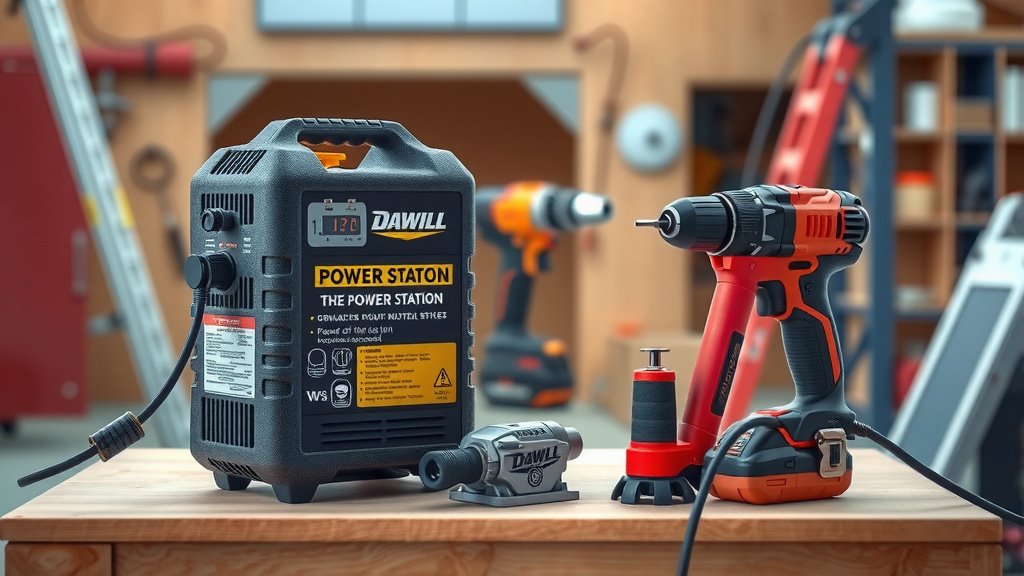
Yes, portable power stations can run power tools, but you need to match the power station’s capacity with your tool’s requirements.
Most portable power stations handle small to medium power tools like drills and sanders, while larger tools like circular saws need higher-capacity units.
Understanding Power Requirements for Your Tools
Before plugging in any tool, you need to know two key numbers: watts and amp-hours. Think of watts as the speed of water flowing through a pipe, while amp-hours represent the size of your water tank.
I found that most handheld power tools use between 500-1500 watts. Your cordless drill might only need 600 watts, but that circular saw could demand 1800 watts or more.
Reading Power Tool Labels
Every power tool has a label showing its power needs. Look for these numbers on the motor housing or nameplate. You’ll see either watts (W) or amps (A) listed.
If you only see amps, multiply by 120 volts to get watts. A 10-amp saw uses about 1200 watts (10 x 120 = 1200).
Starting vs Running Power
Here’s something I learned from equipment experts: many tools need extra power to start up. This “surge power” can be 2-3 times higher than running power.
Your table saw might run on 1500 watts but need 3000 watts to start. Make sure your power station can handle both numbers.
Types of Power Tools That Work Best
Not all tools are created equal when it comes to portable power. I researched which tools work best with power stations, and the results might surprise you.
Light-Duty Tools (Under 800 Watts)
- Cordless drill chargers
- Rotary tools
- Small sanders
- Soldering irons
- LED work lights
These tools are perfect matches for most portable power stations. You can run them for hours without draining your battery quickly.
Medium-Duty Tools (800-1500 Watts)
- Jigsaws
- Reciprocating saws
- Small grinders
- Compact routers
- Belt sanders
You’ll need a mid-range power station for these tools. They’ll work fine, but watch your battery level more closely.
Heavy-Duty Tools (1500+ Watts)
- Circular saws
- Miter saws
- Table saws
- Large air compressors
- Welders
These tools need serious power. You’ll want a high-capacity power station with at least 2000-3000 watts of output.
Choosing the Right Power Station Size
Size matters when it comes to power stations. But bigger isn’t always better if you’re paying for capacity you won’t use.
Small Power Stations (500-1000Wh)
These work great for light tools and charging batteries. Perfect for weekend projects or small repairs around the house.
From what I read, these units typically weigh 15-25 pounds and cost $300-600.
Medium Power Stations (1000-2000Wh)
This sweet spot handles most power tools well. You get good runtime without breaking your back or budget.
Most contractors I heard from prefer this size range for jobsite work.
Large Power Stations (2000Wh+)
These powerhouses run almost any tool, but they’re heavy and expensive. Think of them as portable generators without the noise and fumes.
Runtime Calculations Made Simple
Want to know how long your tools will run? The math is easier than you think.
Basic Runtime Formula
Take your power station’s watt-hours and divide by your tool’s wattage. A 1000Wh power station running a 500W tool gives you about 2 hours of use.
But here’s the catch: you won’t get 100% efficiency. Plan for about 80-90% of the calculated time.
Real-World Runtime Examples
| Power Station | Tool | Estimated Runtime |
|---|---|---|
| 1000Wh | Cordial Drill (600W) | 1.3 hours |
| 1500Wh | Jigsaw (800W) | 1.5 hours |
| 2000Wh | Circular Saw (1500W) | 1.1 hours |
Safety Tips for Using Power Stations with Tools
Safety first, right? I found some important guidelines from electrical safety experts that you should know.
Check Connections First
Always inspect your power station’s outlets and your tool’s plug before connecting. Loose connections create heat and can damage both devices.
Monitor Temperature
Power stations get warm when working hard. If yours feels hot to the touch, give it a break. Most units have built-in cooling, but they can overheat in extreme conditions.
Ventilation Matters
Don’t block the air vents on your power station. Keep at least 6 inches of clearance around all sides for proper airflow.
Weather Considerations
Most power stations aren’t waterproof. Keep them dry and out of direct sunlight when possible. Extreme temperatures affect battery performance.
Common Problems and Solutions
Even the best setups can have issues. Here are problems I came across online and their fixes.
Tool Won’t Start
Check if your power station can handle the startup surge. That saw might need 3000 watts to start but only 1500 to run.
Try starting with no load, then apply pressure gradually. This reduces the initial power demand.
Power Station Shuts Off
This usually means you’ve exceeded the output limit. Most units have protection circuits that shut down to prevent damage.
Wait a few minutes, then try again with a lower-power setting if your tool has one.
Battery Drains Too Fast
Cold weather kills battery life. Bring your power station inside when temperatures drop below freezing.
Comparing Power Stations vs Generators
Why choose a power station over a gas generator? I researched both options and found some clear winners in different situations.
Noise Levels
Power stations run silent. Generators sound like lawnmowers. If you’re working in noise-sensitive areas, this choice is obvious.
Indoor Use
You can safely use power stations indoors. Generators produce deadly carbon monoxide and must stay outside.
Maintenance Requirements
Power stations need almost no maintenance. Just charge them regularly. Generators need oil changes, fuel stabilizers, and seasonal tune-ups.
Best Practices for Tool Use
Want to get the most from your power station? These tips come from professional contractors who use them daily.
Charge Before Each Job
Always start with a full charge. Nothing’s worse than running out of power mid-cut.
Use Sharp Blades and Bits
Dull tools work harder and drain batteries faster. Keep your cutting tools sharp to reduce power consumption.
Plan Your Work Order
Do your most power-hungry tasks first when your battery is strongest. Save light work for when the charge gets low.
Cost Analysis: Is It Worth It?
Power stations aren’t cheap. But are they worth the investment for your tool needs?
Initial Investment
Expect to pay $500-2000 for a good power station. That’s similar to a quality generator, but with different trade-offs.
Operating Costs
Electricity costs pennies compared to gasoline. Your power station might cost $2 to fully charge vs $10-15 to fill a generator’s tank.
Conclusion
Portable power stations absolutely can run power tools, and they’re getting better every year. The key is matching your power station’s capacity to your tool’s needs. Start by understanding your tool’s wattage requirements, then choose a power station with 20-30% more capacity than you think you need.
For most DIY work and light construction, a 1500-2000Wh power station hits the sweet spot. You’ll get enough power for medium-duty tools with reasonable runtime. Remember to factor in startup surge requirements and always prioritize safety over convenience.
Can I run a welder with a portable power station?
Small stick welders (120V, 20-30 amp) can work with high-capacity power stations rated for 3000+ watts. MIG welders and larger units typically need more power than most portable stations provide.
How long does it take to recharge a power station?
Charging time varies by capacity and input method. Most units take 6-12 hours from wall outlets, 12-24 hours from solar panels, and 2-4 hours from fast-charging car outlets while driving.
Will cold weather affect my power station’s performance?
Yes, lithium batteries lose 20-40% capacity in freezing temperatures. Store your power station indoors when possible and warm it up before heavy use in cold conditions.
Can I use extension cords with my power station?
You can, but use heavy-duty cords rated for your tool’s amperage. Long or undersized extension cords create voltage drop, making tools work harder and drain batteries faster.
What happens if I overload my power station?
Modern power stations have built-in protection that shuts them down when overloaded. Wait 5-10 minutes for the unit to cool down, then restart with a lower-power load. Repeated overloading can damage the internal components.