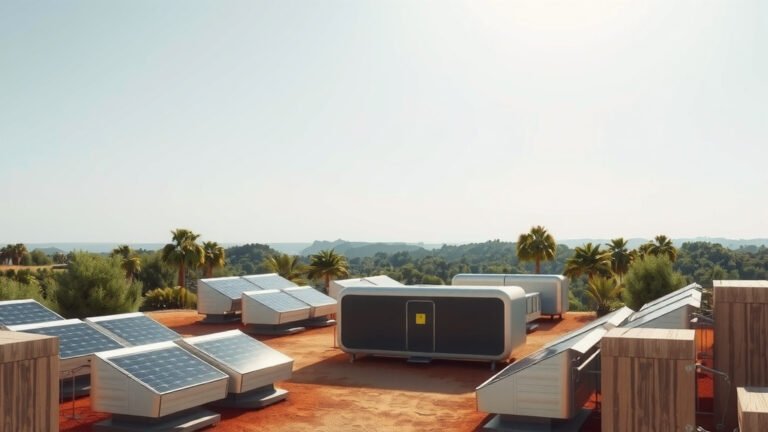
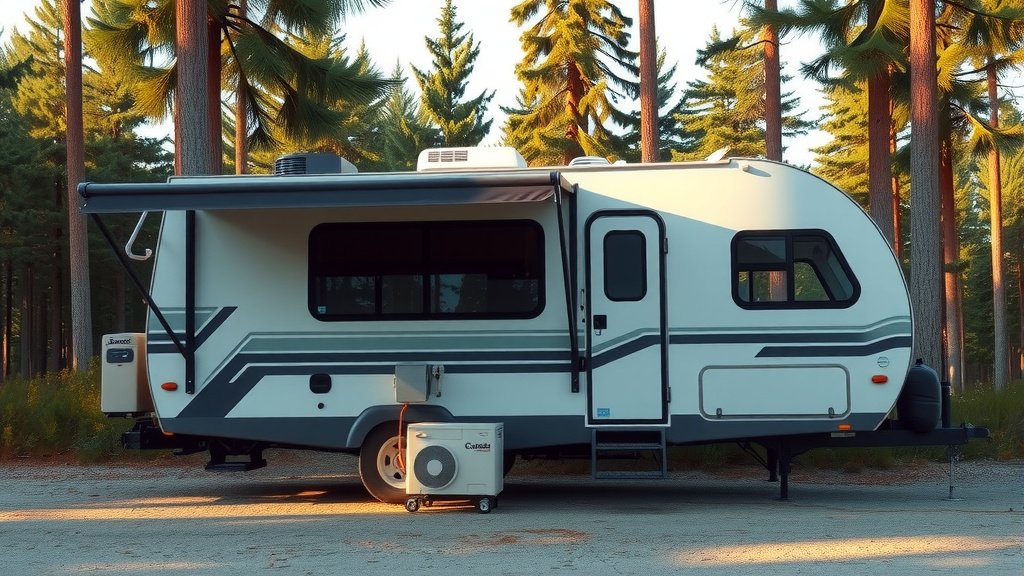
Yes, a solar generator can indeed run an RV air conditioner, providing you select a system with enough power output and battery capacity to match your RV’s AC unit requirements.
You’ll need to carefully calculate the wattage your RV air conditioner draws, considering both its starting and running power, to ensure your solar generator can handle the load.
TL;DR:
- Solar generators can power RV ACs, but proper sizing is key.
- You must match the generator’s power output to your AC’s wattage, especially its surge power.
- Battery capacity is vital for running the AC for extended periods, especially overnight.
- Factors like sunlight, battery health, and AC efficiency all play a role in performance.
- Look for solar generators with high inverter wattage and ample battery storage.
Can Solar Generator Run RV Air Conditioner?
Absolutely, it’s not just a dream! Many RVers are now using solar generators to keep cool on their travels. This setup offers freedom from shore power, letting you enjoy remote campsites with all the comforts of home.
Understanding Your RV Air Conditioner’s Power Needs
Before you buy any solar generator, you need to know what your RV’s air conditioner demands. AC units are notorious for being power-hungry appliances. They have two main power ratings: running watts and starting (or surge) watts.
Running Watts vs. Starting Watts
Running watts are what your AC needs to operate continuously. Starting watts, however, are a quick burst of much higher power needed to kick-start the compressor. This surge can be two to three times higher than the running watts, and your solar generator must be able to handle it.
For example, a typical 13,500 BTU RV AC might run at 1,500-2,000 watts but could surge to 3,000-4,000 watts for a few seconds. If your solar generator’s inverter can’t deliver that surge, your AC simply won’t start. We found that checking both ratings is critical for success.
How Solar Generators Power Your RV
A solar generator isn’t really a “generator” in the traditional sense, like one that burns fuel. It’s more of a portable power station combined with solar panels. Think of it as a giant rechargeable battery bank with an inverter built-in.
Key Components of a Solar Generator
- Solar Panels: These capture sunlight and convert it into DC electricity. More panels mean faster charging.
- Battery: This stores the DC electricity. Battery capacity is measured in Watt-hours (Wh) or Amp-hours (Ah) and determines how long you can run appliances.
- Inverter: This converts the stored DC power from the battery into usable AC power, which is what your RV AC needs. The inverter’s wattage rating is crucial for handling your AC’s surge demands.
Calculating Your RV AC’s Solar Generator Requirements
This is where the rubber meets the road. You need to do a little math to match your generator to your AC. Don’t worry, it’s simpler than it sounds!
Step 1: Find Your AC’s Wattage
Look at your RV AC unit’s label or owner’s manual for its wattage. If it only lists amps and voltage (e.g., 15 amps at 120 volts), multiply them: 15A x 120V = 1,800 watts. Remember to note both running and starting watts.
Step 2: Determine Run Time Needs
How long do you want to run your AC? An hour? Six hours? Overnight? This will dictate the battery capacity (Wh) you need. If your AC runs at 1,800 watts for 5 hours, you need 1,800 W x 5 h = 9,000 Wh of usable battery capacity. Experts often recommend having a bit of a buffer, so aim for more. Many manufacturers suggest conserving power when possible (Department of Energy).
Step 3: Consider Solar Input
To recharge your battery, you need solar panels. The higher the wattage of your panels, the faster they can replenish your battery. On a sunny day, 400-600 watts of solar panels might fully recharge a medium-sized battery in around 6-8 hours, depending on conditions.
Choosing the Right Solar Generator for Your RV AC
Now that you know your needs, let’s look at what features to prioritize in a solar generator. You don’t want to be caught sweating in your RV!
Inverter Size is Paramount
Your solar generator’s inverter must be powerful enough to handle your RV AC’s starting wattage. If your AC surges to 3,500 watts, you’ll need a generator with an inverter rated for at least that much, if not more. Many quality units offer surge capabilities beyond their continuous rating.
Battery Capacity Matters Most
For running an RV AC, a large battery capacity is non-negotiable. Look for models with at least 2,000 Wh (2 kWh) of capacity, and ideally 3,000 Wh or more for longer run times. Remember, you might not use 100% of the battery’s stated capacity to preserve its lifespan.
Input and Output Ports
Ensure the generator has enough output ports (AC outlets) for your needs. Also, check the solar input capacity. A higher solar input rating means you can connect more solar panels, leading to faster recharging times.
Factors Affecting Performance and Efficiency
Even with the right gear, external conditions play a big role. Just like a car’s gas mileage, efficiency varies.
| Factor | Impact on Performance |
|---|---|
| Sunlight Intensity | Direct sun means faster panel charging; clouds reduce output significantly. |
| Temperature | Extreme heat can reduce battery efficiency and solar panel output. |
| Battery Health | Older batteries or those not properly maintained hold less charge. |
| AC Unit Efficiency | Newer, inverter-driven AC units are often more power-efficient. |
| RV Insulation | A well-insulated RV keeps cool longer, requiring less AC run time. |
Tips for Efficient RV AC Use with Solar
To make the most of your solar setup, consider these practical tips. Every little bit helps to extend your cool comfort.
We found that small changes can make a big difference:
- Park in the shade whenever possible.
- Use window covers or reflective insulation to block heat.
- Run your AC during the hottest parts of the day, then switch to fans.
- Pre-cool your RV with shore power if available, before switching to solar.
- Maintain your AC unit for optimal efficiency (clean filters!).
- Consider installing a soft start kit on your RV AC; this significantly reduces the surge wattage needed to start it.
A Checklist for Choosing Your Solar Generator
Ready to make a choice? Use this quick checklist to ensure you’re making a smart investment.
What to look for:
- Inverter output meets or exceeds your AC’s surge watts.
- Battery capacity provides desired run time.
- High solar input wattage for fast recharging.
- Reputable brand with good customer support.
- Portable and durable design for RV life.
- Multiple AC outlets for other appliances.
Conclusion
Running an RV air conditioner with a solar generator is entirely possible and becoming increasingly popular for RV enthusiasts seeking freedom and sustainability. The key is careful planning: understanding your AC’s power demands, choosing a solar generator with sufficient inverter output and battery capacity, and practicing efficient power management. With the right setup, you can enjoy a cool, comfortable RV experience wherever your adventures take you, all powered by the sun. So, yes, you can definitely keep cool with the power of the sun!
Can a 2000W solar generator run an RV air conditioner?
A 2000W solar generator might struggle with an RV air conditioner, especially during startup. Most RV AC units require a surge wattage of 3000-4000W for a few seconds when they first turn on. A 2000W continuous inverter typically won’t handle that initial spike, meaning your AC might not start, or the generator could fault. You’d likely need a larger inverter or a soft start kit on your AC.
How many solar panels do I need to run an RV AC?
The number of solar panels depends on how much battery capacity you have and how quickly you want to recharge it. To efficiently run and recharge for an RV AC, you’ll generally need at least 400-600 watts of solar panels. More panels mean faster recharging, which is critical for keeping up with the high power draw of an AC unit.
What size battery do I need in my solar generator for an RV AC?
For an RV air conditioner, you’ll need a substantial battery capacity. Most RV ACs consume between 1500-2000 watts per hour. If you want to run your AC for 4-5 hours, you’d need a battery with at least 6,000-10,000 Watt-hours (6-10 kWh) of usable capacity. Many experts suggest aiming for more, around 3,000Wh to 5,000Wh per day of AC usage, considering typical daily discharge.
Can a soft start kit help my solar generator run my RV AC?
Absolutely, a soft start kit is a game-changer for running an RV AC with a solar generator! It significantly reduces the massive surge of electricity an AC unit needs to start its compressor. By lowering this starting wattage, a soft start kit can often allow a smaller, more moderately sized solar generator to successfully power your RV air conditioner, preventing frustrating power trips.
Is running an RV AC with a solar generator practical for boondocking?
Running an RV AC with a solar generator is very practical for boondocking, provided you have a sufficiently sized system and manage your power consumption. It allows you to stay cool in remote locations without relying on noisy gas generators or shore power. You will need ample battery storage and sufficient solar panel input to keep your system charged, especially if you plan to run the AC for extended periods or on cloudy days. Many RV owners find this setup offers great comfort and independence.