Battery Maintainer vs Trickle Charger: Storage Guide (November 2026)
A battery maintainer is usually better for storage because it adjusts charging instead of sending a steady current all the time. A trickle charger can suit some batteries, but long-term storage calls for careful voltage control and correct battery compatibility.
On this page (8 sections)
- Battery maintainer vs trickle charger: what is the difference?
- Why is a maintainer better for long-term storage?
- When can a trickle charger make sense?
- Which battery maintainer suits each storage setup?
- How should you choose between 1A, 2A and 5A?
- Does battery chemistry change the choice?
- How do you connect a maintainer for storage?
- What is the final choice for storage?
A battery maintainer is usually better for storage because it adjusts charging instead of sending a steady current all the time. A trickle charger can suit some batteries, but long-term storage calls for careful voltage control and correct battery compatibility.
The key difference in a battery maintainer vs trickle charger comparison is charging control. A maintainer monitors the battery and reduces or changes its output when the battery is charged, while a basic trickle charger may continue delivering a small current.
Storage batteries also vary widely. A vehicle battery, motorcycle battery, RV battery and deep-cycle battery may need different voltage, current and chemistry support.
Battery maintainer vs trickle charger: what is the difference?
A maintainer is built for ongoing connection, while a basic trickle charger is mainly a low-current charger. The exact behavior depends on the charger, so read the operating instructions before leaving either type connected.
A battery maintainer may use several charging stages. It can charge the battery, monitor its condition and switch to a lower maintenance mode when the battery reaches the required charge.
A traditional trickle charger sends a small current at a steady rate. That can help replace gradual losses, but the charger may not respond to temperature, battery condition or changes in voltage.
The names are not always used consistently. Some products called trickle chargers are smart maintainers, while some chargers described as maintainers also include recovery and desulfation functions.
For background on battery types, our guide to what a deep-cycle battery is explains how deep-cycle designs differ from ordinary starting batteries.
Why is a maintainer better for long-term storage?
A maintainer is the better choice when a battery will sit connected for weeks or months. Its charging control reduces the risk of treating a fully charged battery as if it still needs a constant current.
Storage drains can come from vehicle electronics, alarms, temperature changes and natural battery self-discharge. A maintainer helps replace that loss while keeping the battery ready for use.
You still need the right charger. A smart 12V maintainer is not automatically suitable for a 6V battery, lithium battery or large battery bank.
The best battery maintainer charger options show how current, voltage, charging modes and battery chemistry affect the choice.
When can a trickle charger make sense?
A trickle charger can work when you monitor the battery and the charger is designed for that battery. It may be reasonable for occasional charging, shorter storage periods or situations where the instructions permit continuous use.
Don't choose only by the low current number. A small output does not tell you whether the charger switches modes, protects against overcharging or supports your battery chemistry.
A trickle charger may also be too slow for a battery that needs recovery before storage. If the battery is already low, current and charging stages matter more than the word trickle on the box.
For unattended storage, a smart maintainer gives you a clearer fit when it has the voltage, chemistry support and charging control your battery needs.
Which battery maintainer suits each storage setup?
The best choice depends on battery voltage, chemistry, size and how quickly you need to restore charge. The 4 products below cover 12V vehicle batteries, 6V and 12V systems, and different current levels.
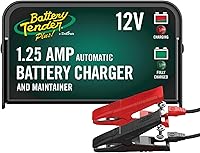
Battery Tender Plus 12V 1.25 AMP Car
The Battery Tender Plus supplies 12V at 1.25A and uses a 4-step charging program with adaptive smart charging. It also provides a float charge for long-term maintenance.
Its two-color LED shows charge status, and charging resumes full charger output if battery voltage drops too far under load. The quick disconnect harness makes it easier to connect and remove the charger between uses.
It includes fused ring terminal and alligator clip accessory cables. Choose it when your battery is a 12V automotive or powersport battery and you want a simple storage setup.
NOCO GENIUS1 1A 6/12V Smart Battery Charger
The NOCO GENIUS1 supplies 1A and supports both 6V and 12V batteries. It works with lead-acid types including AGM, gel, SLA, VRLA, flooded and deep-cycle batteries, plus LiFePO4 batteries up to 30Ah.
An integrated thermal sensor adjusts charging for ambient temperature. It also charges batteries from as low as 1V and includes Force Mode for manually charging completely dead batteries down to 0V.
This model includes battery clamps, integrated eyelet terminals and a 110-inch DC cable. Its lower current suits smaller batteries and patient charging rather than faster recovery.
NOCO GENIUS5 5A 6/12V Smart Battery Charger
The NOCO GENIUS5 supplies 5A and supports 6V and 12V lead-acid and LiFePO4 batteries. It is designed for LiFePO4 batteries up to 120Ah and includes temperature compensation, Force Mode and pulse charging.
The higher current can make it a better fit when a larger battery needs to recover charge before maintenance. It still works as a maintainer after the battery reaches the required charge.
The box includes battery clamps, integrated eyelet terminals, a mounting bracket and screws. Choose this model when 1A or 2A would be too slow for the battery you need to maintain.
NOCO GENIUS2 2A 6/12V Smart Battery Charger
The NOCO GENIUS2 supplies 2A for 6V and 12V lead-acid and LiFePO4 batteries. It is designed for LiFePO4 batteries up to 40Ah and includes temperature compensation, Force Mode and pulse charging.
It includes battery clamps, integrated eyelet terminals, a mounting bracket and screws. The 2A output gives it more charging capacity than the GENIUS1 while keeping it below the GENIUS5.
The GENIUS2 fits drivers, powersports owners and small deep-cycle users who want one charger for 6V and 12V batteries. Confirm the battery's chemistry and capacity before connecting it.
How should you choose between 1A, 2A and 5A?
Choose current based on battery size and how quickly the battery needs to recover, not just on the storage period. A low-current maintainer can suit a small battery, while a larger battery may need more output before maintenance begins.
The GENIUS1 provides 1A, the GENIUS2 provides 2A and the GENIUS5 provides 5A. The Battery Tender Plus sits between the GENIUS1 and GENIUS2 at 1.25A, but it supports 12V batteries rather than both 6V and 12V.
A higher current does not make a charger universally better. It must still match the battery voltage and chemistry, and the battery must be able to accept the charging program.
For a car battery stored through winter, 1.25A or 2A may be a sensible fit when the battery is already healthy. For a larger deep-cycle battery, 5A may be more practical for restoring charge before maintenance.
Does battery chemistry change the choice?
Yes. Confirm whether your battery is lead-acid, AGM, gel, flooded, SLA, VRLA or LiFePO4 before choosing a maintainer.
Battery voltage alone is not enough to prove compatibility.
The Battery Tender Plus is designed for 12V automotive, motorcycle, lawn mower and ATV batteries. The NOCO GENIUS models cover 6V and 12V systems and support lead-acid types plus LiFePO4 within their stated limits.
AGM batteries have different charging needs from some conventional flooded batteries. Our guide to the best battery maintainer for AGM battery use covers that choice in more detail.
Lithium support also has limits. The GENIUS1, GENIUS2 and GENIUS5 list different LiFePO4 capacity ranges, so match the charger to the battery rather than assuming all 3 models have the same reach.
How do you connect a maintainer for storage?
Connect the maintainer to the correct battery terminals, select the correct mode and keep the charger dry and ventilated. Follow the charger and battery instructions for the exact connection order.
Inspect the battery and cables before connecting anything. For replacement leads and connection choices, compare battery maintainer cables and connectors.
Do not use damaged cables, loose terminals or a battery that shows signs of leaking or physical damage.
Use ring terminals when you want a semi-permanent connection, or clamps when you need to move the charger between batteries. If the charger needs more reach, see battery maintainer extension cables rated for your setup.
Keep the cable away from hot, moving or sharp parts.
Place the charger where it will not be covered or exposed to water. Check the status light after connection, then inspect the setup again during long storage.
If you are unsure whether you need a maintainer or a conventional charger, read our battery maintainer vs battery charger comparison before choosing.
What is the final choice for storage?
Choose a smart battery maintainer for unattended storage, then match its voltage, chemistry support and current to the battery. A basic trickle charger is only a good fit when its instructions support the intended storage use and you can monitor the setup.
Choose the Battery Tender Plus for a 12V car, motorcycle, lawn mower or ATV battery. Choose the NOCO GENIUS1 for smaller 6V or 12V batteries, the GENIUS2 for a middle-ground 2A option and the GENIUS5 when a larger deep-cycle or vehicle battery needs 5A.
The right battery maintainer or trickle charger is the one that fits the battery before it fits the storage plan. Confirm the battery label, connect it carefully and check the charger instructions before leaving it in place.
Frequently asked questions
Is a battery maintainer better than a trickle charger?
A battery maintainer is usually better for long-term storage because it monitors the battery and changes its charging behavior as needed. A basic trickle charger may keep sending a steady current, which can be less suitable for a battery left connected for weeks or months.
Can you leave a battery maintainer connected all winter?
You can leave a smart battery maintainer connected for extended storage when the charger is compatible with the battery and installed according to its instructions. Check the battery type, voltage, cable connection and storage conditions before leaving it connected.
Does a trickle charger overcharge a battery?
Some trickle chargers can overcharge a battery if they provide a steady current without switching to a controlled maintenance mode. Read the charger's instructions carefully, and don't assume that the word trickle means safe for indefinite connection.
What is the difference between a battery maintainer and a battery charger?
A battery charger is mainly used to restore charge, while a maintainer is designed to keep a charged battery ready during storage. Many smart units do both, so check the current, voltage, battery chemistry and maintenance modes instead of relying on the name alone.
Which battery maintainer is best for a deep-cycle battery?
The NOCO GENIUS5 is the strongest fit here for a larger deep-cycle battery because it supplies 5A and supports 6V and 12V lead-acid and LiFePO4 batteries. Match the charger to the battery's voltage and chemistry before connecting it.