9 Best Deep-Cycle Battery Testers (November 2026)
The best deep-cycle battery testers include the KONNWEI KW208 12V Car Battery Tester for compact 12V checks, the ANCEL BA101 Car Battery Tester for guided 12V diagnostics, and the TOPDON BT100 12V Car Battery Tester for simple 12V vehicle testing.
On this page (4 sections)
The best deep cycle battery tester for most 12V owners is the TOPDON BT200, because it supports 12V and 24V batteries, including deep-cycle types, with battery, cranking and charging tests. That mix matters when the same tester serves a car battery one week and an RV or boat battery the next.
Choose the OBDResource BR502 for three voltage systems, or Schumacher for a direct load test. Each pick suits a different owner, so the battery in front of you matters more than the screen.
A tester helps separate a low charge from lost performance. A battery that only needs charging may recover, while one with poor health may keep failing after a charge.
Voltage alone can hide weakness. Readings such as CCA, resistance, state of health and state of charge show how a battery may behave on a cold morning or during a long discharge.
No handheld tester replaces correct charging and capacity-test procedures. Results read best when you know how the battery was charged, how long it rested and what load it carried.
For deep-cycle use, daily use patterns matter as much as one reading. RV, marine and solar batteries face repeated draws, so judge results against that routine.
If you are still learning what is a deep cycle battery, cover construction, use patterns and voltage before buying. Those basics show why starter and deep-cycle testers are not always interchangeable.
Construction affects charge acceptance and repeated discharge, so flooded, AGM, GEL, EFB and lithium batteries may need different settings. Voltage choice also affects chargers, inverters, cables and fuses, which makes compatibility more important than features.
For lithium, compare our 12v lithium battery tester guide before choosing a lead-acid tester. Budget makes sense only after chemistry and voltage are sorted, since extra features will not help with the wrong battery.
Keep the routine simple once you have a tester. Connect clean clamps, enter the correct type and rating, and compare results over time to decide whether to charge, replace or check the charging system.
Our picks at a glance
-
1

-
2

-
3
 Best for simple 12V vehicle testing
TOPDON BT100 12V Car Battery Tester
9.5/10 our score
See it on Amazon
- 4
 Check it
MOTOPOWER MP0515A 12V Car Battery Tester Automotive
Best for broad 12V lead-acid coverage - 5
 Check it
OBDResource Car Battery Tester 6V 12V 24V
Best for mixed-voltage batteries - 6
 Check it
Schumacher Electric Battery Load Tester
Best for direct load testing - 7
 Check it
TOPDON BT200 Car Battery Tester
Best for 12V and 24V deep-cycle systems - 8
 Check it
FOXWELL BT705 Car Battery Tester 24V 12V
Best for one-person vehicle checks - 9
 Check it
Car Battery Tester 6V 12V 24V VDIAGTOOL
Best for wide CCA range
Which deep cycle battery tester is best for each job?
The TOPDON BT200 is the best fit when deep-cycle compatibility is the main requirement. The KONNWEI KW208 and ANCEL BA101 are stronger choices for common 12V vehicle batteries, while the OBDResource BR502 and VDIAGTOOL BT500 cover more voltage systems.
KONNWEI KW208 12V Car Battery Tester: Best for compact 12V checks
- 12V batteries
- 100–2000 CCA
- Battery, cranking and charging tests
- Alternator and starter tests
The KW208 covers common 12V lead-acid batteries and 12V lithium batteries, with several vehicle-system checks in one compact tester.
Pros
- Supports several 12V battery types
- Tests cranking and charging systems
- In-vehicle or out-of-vehicle testing
Cons
- Not a 6V or 24V tester
- CCA entry must match the battery
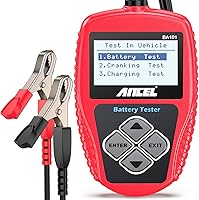
The KONNWEI KW208 12V Car Battery Tester is a compact option for routine 12V checks. It supports 100-2000 CCA regular flooded, AGM flat plate, AGM spiral, gel and 12V lithium batteries.
The tester reports voltage, internal resistance, cold-cranking amps, AH capacity, battery health and charge status. It also performs battery, load, charging and cranking tests, plus alternator and starter checks.
That range helps separate a weak battery from a starter or charging fault when a car starts slowly. Its small size suits a glove box or garage where you will use it often.
Enter the correct battery details and keep clips firmly connected on clean terminals. It is 12V only, so check the label before use on 6V or 24V systems.
ANCEL BA101 Car Battery Tester: Best for guided 12V diagnostics
- 12V batteries over 30Ah
- 100–2000 CCA
- SOH and SOC readings
- Reverse-polarity protection
The BA101 suits 12V lead-acid batteries in vehicles and equipment where clear state-of-health, state-of-charge, cranking and charging results matter.
Pros
- Supports many 12V vehicle types
- Clear black-and-white screen
- 4-in-1 protection
Cons
- Not for lithium batteries
- Not for 6V, 8V or 24V batteries
The ANCEL BA101 Car Battery Tester suits 12V lead-acid batteries over 30Ah in cars, trucks, boats, RVs, ATVs, lawnmowers, golf carts and motorbikes. It supports 100-2000 CCA and common flooded, AGM, GEL and EFB batteries.
Its readings include state of health, state of charge, voltage, current and CCA. State of health speaks to long term condition, while state of charge speaks to how full the battery is right now.
The BA101 also performs cranking and charging-system tests, which helps you check whether a starting problem may involve more than the battery. That added view is valuable when a new battery alone would not fix the fault.
The black-and-white screen has adjustable contrast and a white backlight. That design keeps readings readable in bright sunlight and in a dim garage, which is where many quick checks happen.
The tester draws power from the vehicle battery, so it doesn't need an internal battery or separate charging routine. You can carry it ready to use without wondering whether a spare battery inside the tester is flat.
Choose the BA101 for guided 12V lead-acid checks. Enter the battery type, rating value and temperature as shown on the label for the clearest result.
It isn't for lithium batteries or 6V, 8V and 24V systems, so confirm your battery voltage first. That limit is straightforward, and it helps you avoid using the wrong standard on the wrong battery.
TOPDON BT100 12V Car Battery Tester: Best for simple 12V vehicle testing
- 12V lead-acid batteries
- 100–2000 CCA
- Three testing functions
- Color-coded LED results
The BT100 is a compact 12V tester for common lead-acid batteries in cars, trucks, boats, motorcycles, RVs and other equipment.
Pros
- Small enough for a glove box
- No separate tester charging
- Reverse-polarity and spark-proof clamps
Cons
- 12V only
- Lead-acid battery coverage only
The TOPDON BT100 12V Car Battery Tester is a simple choice for 12V lead-acid batteries from 100-2000 CCA. It supports regular flooded, AGM flat plate, AGM spiral, EFB and GEL batteries.
The BT100 provides state of health, state of charge, voltage, current and rating information. Those figures give a quick base for deciding whether a battery looks serviceable or needs closer attention.
Its 3 testing functions cover battery health, cranking and charging-system checks. That trio lets you move from the battery itself to the wider starting and charging circuit.
The tester powers on after it is properly attached to the battery. You do not need to charge the tester before a check, which makes it easy to grab and use.
Copper clamps include reverse-polarity prevention and spark-proof features, while the compact body fits a glove box or center console. Small size is a real benefit when you want a tester stored in the vehicle.
Choose the BT100 for common 12V vehicles and equipment. It suits owners who want a direct, no fuss routine for cars, trucks, motorcycles, boats and similar gear.
It doesn't provide the 6V or 24V range found on the OBDResource, TOPDON BT200 and VDIAGTOOL models. If your garage mixes voltage systems, that limit should be part of the decision.
MOTOPOWER MP0515A 12V Car Battery Tester Automotive: Best for broad 12V lead-acid coverage
- 100–2000 CCA
- SOH, SOC and internal resistance
- Cranking and charging checks
- Multiple battery standards
The MP0515A focuses on 12V lead-acid batteries and adds internal-resistance, cranking and charging information for routine garage checks.
Pros
- Broad 12V vehicle coverage
- Shows internal resistance
- Checks alternator output status
Cons
- No 6V or 24V coverage in the data
- No detailed included-components list
The MOTOPOWER MP0515A 12V Car Battery Tester Automotive focuses on 12V lead-acid batteries from 100-2000 CCA. It supports regular flooded, AGM flat plate, AGM spiral, GEL and EFB batteries.
It reports state of health, state of charge and internal resistance. Internal resistance is useful because it adds context beyond voltage when you compare batteries that both look charged at rest.
The tester also checks cranking voltage and charging-system health, which can help you compare a weak start with an alternator problem. That comparison matters when the fault sits outside the battery.
MOTOPOWER describes the MP0515A for cars, motorcycles, trucks, RVs, ATVs, SUVs, boats, yachts, mowers and golf carts. That broad vehicle list makes it a fit for households with several 12V machines.
Its battery standards include CCA, BCI, CA, MCA, JIS, DIN and SAE. Multiple standards help when the label on your battery uses a rating format you know well.
Choose it when broad 12V lead-acid coverage and internal-resistance information matter. It gives you a practical garage check without moving into more complex diagnostic gear.
The data does not guarantee 6V or 24V support, so it is best treated as a 12V tool. Check voltage and chemistry before testing, and keep the rating entry matched to the label.
OBDResource Car Battery Tester 6V 12V 24V: Best for mixed-voltage batteries
- 6V, 12V and 24V batteries
- 100–2000 CCA
- 1.8-inch HD screen
- Reverse-connection protection
The BR502 is the flexible pick for owners who work across 6V, 12V and 24V batteries and want voltage, resistance, state-of-charge and state-of-health readings.
Pros
- Covers three voltage systems
- In-vehicle or out-of-vehicle testing
- Results appear in about two seconds
Cons
- No lithium compatibility stated
- CCA-based testing requires correct battery input
The OBDResource Car Battery Tester 6V 12V 24V is the most flexible voltage pick in this roundup. Its BR502 model supports 6V, 12V and 24V batteries from 100-2000 CCA.
It measures voltage, internal resistance, state of charge and state of health. That set lets you separate a battery that is low from one that may be aging.
Results such as Good, Normal or Poor appear on a 1.8-inch HD screen, and the product data says results can appear within two seconds. A quick result helps when you are checking several batteries in one session.
You can test batteries in or out of the vehicle, including a dead battery. In vehicle testing saves the work of removal, while out of vehicle testing can make clamp placement easier.
Reverse-connection protection helps prevent operation when the clips are connected the wrong way. That safeguard is welcome in tight engine bays where access is awkward.
Choose the BR502 for a mixed garage with motorcycles, cars, boats or other 6V, 12V and 24V equipment. One tester for three voltage systems reduces the need for multiple tools.
Confirm the battery chemistry and CCA rating before relying on the result. The right input matters, and a clean, secure connection helps the tester read the battery as it is.
Schumacher Electric Battery Load Tester: Best for direct load testing
- 6V and 12V batteries
- Up to 1,000 CA
- 50A 6V load test
- 100A 12V load test
The Schumacher BT-100 uses a direct load test and analog meter for 6V and 12V batteries in cars, boats, RVs, motorcycles and other equipment.
Pros
- Direct 50A and 100A load tests
- Tests charging system and starter draw
- Works with gas and diesel vehicles
Cons
- Stops at 12V
- Analog readings need more interpretation
The Schumacher Electric Battery Load Tester is the clearest choice when you want a direct load test rather than only conductance readings. The BT-100 tests 6V and 12V batteries up to 1,000 CA.
It applies a 50A load test to 6V batteries and a 100A load test to 12V batteries. A direct load puts demand on the battery, so the reading shows how it responds under stress.
The unit also checks charging-system performance and starter-motor draw. Those extra checks help you place a starting problem in the wider electrical system.
A top-mounted rocker switch and analog meter keep the operation direct. You read the needle where you stand, which suits a traditional bench or garage routine.
The package includes the BT-100 battery load tester and voltmeter plus a user manual. Keep the manual with the tester so the load steps for each voltage stay clear.
Choose Schumacher for a traditional load-testing approach on car, motorcycle, ATV, lawn tractor, boat, light truck and RV batteries. It suits owners who prefer a hands on load test.
Its 12V limit makes it unsuitable for 24V systems. Analog readings also need a little more interpretation than a digital prompt, so take time to read the meter carefully.
TOPDON BT200 Car Battery Tester: Best for 12V and 24V deep-cycle systems
- 12V and 24V batteries
- 100–2000 CCA
- Deep-cycle compatibility
- 99.9% accuracy claim
The BT200 is the clearest match for deep-cycle battery testing in this group because its data includes deep-cycle compatibility alongside 12V and 24V coverage.
Pros
- Supports deep-cycle batteries
- 12V and 24V coverage
- Color display and memory function
Cons
- 100–2000 CCA range may not fit every battery
- Not a 6V tester
The TOPDON BT200 Car Battery Tester is the best direct match for this roundup because its data specifically includes deep-cycle batteries. It supports 12V and 24V batteries from 100-2000 CCA, including regular flooded, AGM and GEL types.
The BT200 performs battery, cranking and charging-system tests. That combination covers the battery itself and the vehicle systems that start and recharge it.
Its 2.4-inch color LCD is designed for sunlight readability, and its memory function can recall the last test. A clear screen helps outdoors, and memory helps when you compare a result with the last check.
TOPDON describes the BT200 as using conductance technology with a 99.9% accuracy claim. Accuracy claims should still be read with the right battery settings, since the input guides the result.
The tester is also designed for cars, SUVs, trucks, RVs, semi-trucks, boats, motorcycles, lawnmowers and golf carts. That range suits owners who maintain more than one kind of vehicle.
Choose it when a deep-cycle battery tester must cover both 12V and 24V systems. It is the clearest match here for deep-cycle use.
Its stated 100-2000 CCA range may not fit every deep-cycle battery, so compare the battery label before testing. Deep-cycle batteries often emphasize amp hours, so that label check deserves extra care.
FOXWELL BT705 Car Battery Tester 24V 12V: Best for one-person vehicle checks
- 12V and 24V systems
- 100–2000 CCA
- 5.9 ft test cable
- 2.8-inch screen
The BT705 gives 12V and 24V lead-acid users a long cable, guided results and a hard case for repeated vehicle maintenance.
Pros
- Long cable supports one-person testing
- Guided GOOD, RECHARGE or REPLACE results
- 24-month warranty description
Cons
- No lithium or deep-cycle compatibility stated
- Not for 6V systems
The FOXWELL BT705 Car Battery Tester 24V 12V suits one-person checks on 12V and 24V lead-acid systems. It supports 100-2000 CCA flooded, AGM, GEL and EFB batteries.
Its 5.9 ft test cable can reach from the battery to the driver's seat. That layout helps you view the tester while starting the vehicle during a cranking check.
A 2.8-inch screen guides you through battery, cranking and charging tests. Guided prompts reduce guesswork when you are new to this kind of tester.
Results are summarized as GOOD, RECHARGE or REPLACE, and the package includes a hard carrying case. A plain summary helps you act without decoding every number first.
The case also keeps the tester and accessories protected and organized. That matters for repeated use in a home garage, repair shop or multi vehicle household.
Choose the BT705 for repeated vehicle maintenance where cable length and storage matter. One person testing is easier when you can see the screen from the seat.
The supplied product data does not state deep-cycle or lithium compatibility, so don't assume either. Treat it as a 12V and 24V lead-acid tester unless your battery label and settings say otherwise.
Car Battery Tester 6V 12V 24V VDIAGTOOL: Best for wide CCA range
- 6V, 12V and 24V batteries
- 5–3000 CCA
- Battery, cranking and charging tests
- 5-in-1 protection
The BT500 covers the widest stated CCA range here, but its data specifically excludes lithium, deep-cycle batteries and golf-cart batteries.
Pros
- 5–3000 CCA range
- Three voltage modes
- Shock-resistant ABS body
Cons
- Not available for deep-cycle batteries
- Not available for lithium batteries
The Car Battery Tester 6V 12V 24V VDIAGTOOL offers the widest stated CCA range in this group, from 5-3000 CCA. The BT500 supports 6V, 12V and 24V regular flooded, AGM flat plate, AGM spiral, GEL and EFB batteries.
It reports voltage, resistance, state of health and state of charge. Those readings help you judge both present charge and longer term battery condition.
The tester also performs cranking and charging-system checks, with a dedicated 6V mode available through the Motorcycle menu. That menu path helps with smaller 6 volt batteries and related equipment.
VDIAGTOOL includes reverse-polarity and short-circuit protection in a shock-resistant ABS body. Protection and a sturdy shell help in tight engine bays and busy garages.
The tester supports cars, trucks, motorcycles, SUVs, ATVs and boats. That list covers many starter battery jobs across three voltage systems.
The key limitation is explicit: BT500 is not available for lithium batteries, deep-cycle batteries or golf-cart batteries. Read that limit carefully before using it on an RV or solar bank.
Choose it for wide-voltage starter-battery coverage, not for a deep-cycle battery bank. Its wide CCA range is a strength, but chemistry limits decide whether it fits your battery.
What should you check before buying a deep cycle battery tester?
Check battery voltage, chemistry, rating range and test method before comparing screens or extra features. A tester must support the battery you own, and its result is only useful when you enter the correct rating information.
Does the tester support your battery voltage?
A 12V battery needs a 12V-capable tester, while a 24V vehicle system needs a model that explicitly supports 24V. The OBDResource BR502, FOXWELL BT705 and VDIAGTOOL BT500 cover 6V, 12V and 24V systems.
The Schumacher tester covers 6V and 12V. The KONNWEI KW208, ANCEL BA101, TOPDON BT100 and MOTOPOWER MP0515A focus on 12V systems.
Does it support the battery chemistry?
Battery chemistry matters because a tester's algorithm and rating choices must match the battery. The TOPDON BT200 includes deep-cycle compatibility, while the VDIAGTOOL BT500 specifically excludes deep-cycle batteries.
KONNWEI includes 12V lithium support. ANCEL excludes lithium batteries, and several other models in this roundup provide lead-acid compatibility without stating lithium support.
For a lithium or LiFePO4 bank, compare our guide to the best LiFePO4 battery testers before choosing a lead-acid-focused model.
Do you need a load test or capacity test?
A load test applies demand and shows how the battery responds during that test. The Schumacher BT-100 is the clearest example here, with stated 50A and 100A load tests for 6V and 12V batteries.
A conductance tester can quickly report voltage, resistance, state of charge, state of health and related battery data. That is useful for screening, but it does not always equal a full amp-hour capacity test.
The KONNWEI KW208 reports AH capacity in its product data. For any model, follow the battery manufacturer's procedure when a capacity result affects replacement or system design.
Should you also monitor the battery over time?
A tester gives you a point-in-time check. A monitor shows how voltage, current and energy change while the battery charges and discharges.
That difference is easy to feel in an RV or boat. A battery may pass a morning test and still run low by evening if daily use is heavier than expected.
If you want continuous tracking, compare a best battery monitor with shunt guide. It explains why a shunt-based monitor can measure current entering and leaving a battery bank more clearly than voltage alone.
Current tells the story that voltage often hides. Watching amps in and amps out helps you see whether charging keeps up with fans, pumps, lights and other loads.
A shunt battery monitor is especially useful when you want to track usage in an RV, boat or off-grid setup. It turns daily use into numbers you can plan around.
It still works alongside periodic battery testing rather than replacing it. The tester checks condition at a moment in time, while the monitor tracks behavior across days and trips.
Use both tools with the same care. Enter the right battery size, keep connections clean and review the trend before you decide to charge more, add capacity or replace a battery.
How do you use a deep cycle battery load tester safely?
Turn off unnecessary electrical loads, confirm the voltage and check that clips are clean and secure before testing. Those steps help produce a result you can trust.
Follow the prompts, enter the correct battery type and rating, and stop if the tester signals a connection problem. A flickering screen or loose clamp can distort the reading.
Test in a ventilated area and avoid sparks near a charging battery. Good airflow and care with tools are basic habits with lead-acid batteries.
Do not treat one low reading as a full diagnosis if the battery is discharged, recently charged or linked to a faulty charging system. For deep-cycle batteries, note how long it rested and what it powered last.
For an RV or power station, also check protection behavior. Our guide to why a power station shuts down under heavy load explains why a shutdown may involve load, battery condition or protection limits.
A shutdown is not always a failure, since it may guard the battery, inverter or connected load. After testing, record the date, battery type, rating and result.
Store the tester dry and keep the clamps clean. That care keeps the next test ready and helps the tool last.
What is the final pick for the best deep cycle battery tester?
The TOPDON BT200 is the best deep cycle battery tester here when you need stated deep-cycle support with 12V and 24V coverage. Pick the KONNWEI KW208 for compact 12V checks, the OBDResource BR502 for 6V through 24V coverage, or Schumacher for a direct 6V and 12V load test.
Choose by battery chemistry and voltage first. Those two choices decide whether the tool can test your battery at all.
Then decide whether you need a direct load test, fast conductance readings, capacity information, vehicle-system checks or a monitor for bank tracking. Each method answers a different question.
A direct load test stresses the battery under demand, while conductance gives a fast screening result. Capacity information helps when amp hours drive system design, and vehicle checks help when the starter or charging circuit may be at fault.
Learn what cycle life of a portable power station means before comparing long-term backup options. Cycle life helps judge how a system may age in daily use.
Match the tester to the battery, then match the routine to the job. That order keeps a quick garage check from becoming a costly wrong guess.
Our top 3 picks at a glance
-
1
-
2
-
3
Best for simple 12V vehicle testing
TOPDON BT100 12V Car Battery Tester
9.5/10 our score
See it on Amazon
Frequently asked questions
What is the best deep cycle battery tester?
The TOPDON BT200 is the strongest match when you need a deep-cycle battery tester because its product data specifically includes deep-cycle batteries and supports both 12V and 24V systems. For 6V, 12V and 24V coverage, consider the OBDResource BR502, but confirm that the battery's chemistry and CCA range fit.
Can a car battery tester test a deep-cycle battery?
Some can, but compatibility varies. TOPDON lists the BT200 for deep-cycle batteries, while VDIAGTOOL specifically excludes deep-cycle batteries from the BT500.
Check the tester's supported battery type, voltage and rating range before connecting it to an RV, marine or solar battery.
What does a deep-cycle battery load tester measure?
A deep-cycle battery load tester checks how the battery responds under an electrical demand. Other testers may also report voltage, internal resistance, state of charge, state of health, cranking performance or charging-system results.
These readings describe battery condition, but capacity testing may need a separate controlled test.
Do I need a tester with a load?
Choose a tester with a load function when you need to see how a battery performs under demand. A conductance tester can provide fast voltage, resistance and health readings, while a direct load tester applies a stated load.
Use the method that matches your battery type and the decision you need to make.
Can these testers measure battery capacity?
Some models report a capacity-related result, but that does not always equal a full amp-hour capacity test. The KONNWEI KW208 reports AH capacity in its data, while other models focus on CCA, voltage, resistance, SOH and SOC.
For a true capacity check, follow the battery maker's test method.