9 Best Flexible Solar Panels (November 2026)
The best flexible solar panels include the Renogy Flexible Solar Panel 100 Watt for curved RV roofs, the Renogy 200 Watt ShadowFlux Flexible Solar Panel for partial shade, and the BougeRV Arch Pro 200W Anti-Shading N-Type Fiberglass for ETFE durability.
On this page (10 sections)
- The best flexible solar panels for RVs, boats and curved roofs
- How the best flexible solar panels compare on weight and bend
- How we compared these flexible solar panels
- What wattage flexible solar panel do you need
- Which flexible solar panels work best for RVs
- Which flexible solar panels work best for boats
- How do flexible solar panels hold up in wind and weather
- What mounting method should you use for flexible solar panels
- How do you size a flexible solar panel kit
- Our verdict on the best flexible solar panels
The best flexible solar panels for most buyers are the Renogy 100 Watt for curved roofs and the Renogy 200 Watt ShadowFlux for shaded roofs.
Both stay light, both bend, and both mount without a rigid frame.
Flexible panels solve a specific problem.
A rigid panel needs a flat, strong mount.
A flexible panel can follow a curve, sit almost flush, and add far less weight to a roof.
That trade matters on RVs, boats, vans and trailers.
Roof load affects handling, and a low profile helps with clearance.
We compared nine bendable options by weight, durability, bend, efficiency and mounting needs.
Start with what is the best solar panel if you want the broader buying context first.
Our picks at a glance
-
1

-
2
 Best for partial shade
Renogy 200 Watt ShadowFlux Flexible Solar Panel
9.6/10 our score
See it on Amazon -
3
 Best for ETFE durability
BougeRV Arch Pro 200W Anti-Shading N-Type Fiberglass
9.4/10 our score
See it on Amazon
- 4
 Check it
Callsun 400W Flexible Solar Panel
Best for high power arrays - 5
 Best for twin panel valueCheck it
- 6
 Check it
Callsun 200W Flexible Solar Panel
Best for stealth van setups - 7
 Check it
Callsun 400W Flexible Solar Panel System
Best for 48V expansion - 8
 Check it
LETSFAB 100W Flexible Solar Panels
Best for portable curved use - 9
 Check it
Topunive 100W 12V Flexible Solar Panel 9BB
Best for 12V basics
The best flexible solar panels for RVs, boats and curved roofs
The table below is not a separate ranking.
It is a quick way to see which panel fits your roof shape, shade pattern and power target.
Our score weighs specs, features and buyer feedback against what you are shopping for.
A score reflects fit for flexible panel buyers, not general quality alone.
How wide is your roof curve
A gentle curve allows almost any panel here.
A tight curve favors the Renogy 100 Watt at 240 degrees, the Renogy ShadowFlux at 270 degrees, and the ECO-WORTHY pair at 270 degrees.
How much shade do you get
Shade from trees, vents, rigging or roof gear changes the pick.
Anti-shading panels help when one section is blocked, but they do not create power from full shade.
How much power do you need
A single 100 watt panel suits a small 12V battery.
Twin 200 watt sets suit a power station or a larger RV bank.
Four panel sets suit cabins and 48V systems.
Renogy Flexible Solar Panel 100 Watt: Best for curved RV roofs
- 100 watts
- 240 degree bend
- 4 pounds
- 0.08 inches thick
- 48 x 21.5 inches
A very light single panel for curved roofs where a rigid panel will not fit.
Pros
- Very light at 4 pounds
- Bends to 240 degrees
- Thin 0.08 inch profile
Cons
- Only 100 watts from one panel
- Needs careful mounting checks on curved surfaces
The Renogy 100 Watt suits a buyer with one curved roof section and a small 12V system.
At 4 pounds and 48 x 21.5 inches, it is the lightest way in this group to add 100 watts.
Its 240 degree bend and 0.08 inch thickness mean it can sit on an airstream style curve or a boat deck without a tall bracket.
Renogy says it is about 70% lighter than a conventional panel of the same wattage.
Specs help in daily use.
The panel is rated to withstand wind up to 2400 Pa and snow loads up to 5400 Pa.
Its IP68 junction box and IP67 connectors help it handle rain and dust.
The trade is power.
One panel gives 100 watts, so a larger bank needs more panels or a higher wattage pick.
If you want more power from fewer mounting points, read about the flexible solar panel 300w options for sizing context.
Choose it for a stealthy, light mount on a curve.
Skip it if you need 200 watts or more from a single panel.
Renogy 200 Watt ShadowFlux Flexible Solar Panel: Best for partial shade
- 200 watts
- 270 degree bend
- 7.7 pounds
- 25% efficiency
- Anti-shading cells
A higher wattage panel with cell level bypass help for shaded roofs.
Pros
- 200 watts in one panel
- Built for partial shade
- 270 degree bend
Cons
- Larger footprint than 100 watt panels
- Heavier than single 100 watt picks
The Renogy 200 Watt ShadowFlux suits a buyer who parks under trees or near buildings.
It delivers 200 watts from a 7.7 pound panel that bends to 270 degrees.
Its ShadowFlux design uses cell level bypass technology with up to 30 bypass diodes.
Renogy says that helps maintain more stable output when part of the panel is shaded by leaves, branches or vents.
Efficiency matters here.
The panel uses N-Type cells at up to 25% conversion efficiency.
At 62.2 x 27.4 inches, it covers more roof than a 100 watt panel, so measure before you assume it fits.
TPO material and glass fiber reinforcement help with vibration and flexing.
The bend is along the long axis, so plan the curve direction before mounting.
The trade is size.
This is not a small panel.
For tight roofs, the best small flexible solar panel guide lists narrower options.
Choose it for shade prone RV and marine roofs.
Skip it for very small decks where a 100 watt panel fits better.
BougeRV Arch Pro 200W Anti-Shading N-Type Fiberglass: Best for ETFE durability
- 200 watts
- 270 degree bend
- 7.94 pounds
- 25% conversion
- ETFE coating
A 200 watt fiberglass panel with ETFE coating and bypass diodes for unstable light.
Pros
- ETFE surface
- Anti-shading design
- Fits curved surfaces to 270 degrees
Cons
- Voltage checks needed for some power stations
- Output varies with sun and angle
The BougeRV Arch Pro 200W suits a buyer who wants ETFE durability with anti-shading help.
It gives 200 watts at 7.94 pounds and bends to 270 degrees.
BougeRV uses N-Type 16BB cells at 25% conversion.
Built-in bypass diodes help keep output more stable in low light or partial shade, which suits roofs with vents and gear.
The ETFE coating is a key point.
BougeRV says ETFE is anti-scratch, self-cleaning and sand-proof compared with PET.
The panel is 2.5mm thick and includes 2.95 feet of pre-attached cable.
Mounting options include hanging holes, adhesive backing and glass glue.
Note that tape and adhesive are not included, so plan that cost and method in advance.
One check matters.
The open circuit voltage is 36V plus or minus 5%, and BougeRV warns it may not match certain power stations.
Check your station input before you buy.
Choose it for outdoor ETFE use on a curved roof.
Skip it if your power station voltage range is tight and unverified.
Callsun 400W Flexible Solar Panel: Best for high power arrays
- 400 watts from 2x200W
- 240 degree bend
- 23.5% efficiency
- ETFE coating
- Series or parallel
A two panel 400 watt set for large off grid systems and large power stations.
Pros
- 400 watts total
- Two panels spread across a roof
- ETFE coating
Cons
- Needs more roof area
- More wiring than a single panel
The Callsun 400W set suits a buyer who needs high power for a large power station or a full time off grid setup. For a framed alternative, compare rigid 400W solar panels.
It provides 400 watts from two 200 watt panels.
Each panel bends to 240 degrees and weighs far less than a rigid 400 watt array.
The ETFE coating and multi-layer bonding help resist hail, yellowing and cracking, according to Callsun.
Callsun says the array can generate up to 2kWh of daily power under ideal conditions.
Treat that as an ideal condition figure.
Real output depends on sun, angle, temperature and controller efficiency.
The white backsheet reflects heat, which Callsun says helps efficiency in hot climates.
It also gives a clean look on white RV and boat roofs.
The trade is wiring and area.
Two panels need two mounting spots and series or parallel wiring to match 12V or 24V needs.
For camping focused buyers, best flexible solar panels for camping covers lighter trip setups.
Choose it for high wattage on a large roof.
Skip it for a small van where one 200 watt panel is enough.
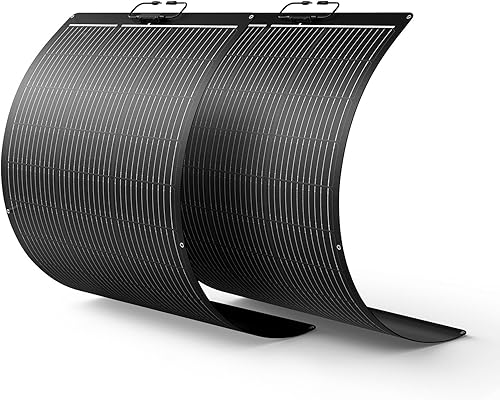
ECO-WORTHY 2pcs 130 Watt: Best for twin panel value
- 260 watts from 2x130W
- 270 degree bend
- 25% efficiency
- IP68 junction box
- 0.1 inch thick
Two mid size panels that split across curved roofs and add up to 260 watts.
Pros
- Two panels for flexible placement
- 270 degree bend
- Pre-drilled holes
Cons
- Two panels to mount and wire
- Combined weight is higher than single panels
The ECO-WORTHY 2pcs 130 Watt set suits a buyer who wants two mid size panels instead of one large one.
Together they give 260 watts, or 130 watts per panel.
Each panel bends to 270 degrees and is only 0.1 inch thick.
ECO-WORTHY says each panel can generate up to 520Wh under 4 hours of full sun, and the pair up to 1040Wh.
Six metal reinforced holes are pre-drilled on each panel edge.
You can fix them with adhesive, silicone, double-sided tape, cable ties or Velcro, which suits non-permanent installs.
The IP68 junction box is sealed with built-in diodes.
A pair of 2.9 foot cables helps with series or parallel connections.
The trade is combined weight and parts.
At 12.6 pounds total, this set is heavier than single panel picks.
For a portable kit alternative, see the Best Portable Solar Panel Kit guide.
Choose it when two smaller panels fit your roof better than one large panel.
Skip it if you want the simplest single panel install.
Callsun 200W Flexible Solar Panel: Best for stealth van setups
- 200 watts from 2x100W
- 240 degree bend
- 23% efficiency
- ETFE coating
- 0.1 inch profile
A low profile two panel set for vans and low clearance roofs.
Pros
- Low 0.1 inch profile
- Two smaller panels fit tight roofs
- ETFE coating
Cons
- Two panels instead of one
- Lower efficiency than 25% picks
The Callsun 200W set suits van life and low clearance roofs.
It gives 200 watts from two 100 watt panels with a 0.1 inch profile.
The all-black design sits nearly flush, which helps with stealth camping and garage clearance.
Each panel bends to 240 degrees for curved van roofs and teardrop trailers.
ETFE coating and multi-layer bonding help resist hail, yellowing and cracking.
Callsun says the set can generate up to 1kWh of daily power under ideal conditions.
Series or parallel wiring lets you scale voltage to 12V or 24V to match a battery bank or power station.
Connection cables and a user manual are included.
The trade is that you mount two panels.
Efficiency is 23%, lower than the 25% picks here.
If you want a cheaper power source for the rest of the system, check the Best Cheap Outdoor Portable Power Station guide.
Choose it for a low, black, flush mount.
Skip it if one panel placement is easier on your roof.
Callsun 400W Flexible Solar Panel System: Best for 48V expansion
- 400 watts from 4x100W
- 240 degree bend
- 23% efficiency
- 12V 24V 48V compatible
- ETFE coating
A four panel system for larger cabins and high voltage battery banks.
Pros
- Four small panels spread wide
- Scales to 48V
- Low profile
Cons
- Most wiring in this group
- Needs a controller that matches the array voltage
The Callsun 400W System suits a cabin or large RV that needs a high voltage array.
It gives 400 watts from four 100 watt panels.
Four small panels spread across a roof better than two large panels.
That helps on long RV roofs, sheds and cabins with vents or obstructions in the middle.
The system is designed for series or parallel wiring up to 48V systems.
Callsun says it can generate up to 2kWh of daily power under ideal conditions with this 4-panel array.
Each panel bends to 240 degrees, has a 0.1 inch profile, and uses ETFE coating.
The all-black look suits van and RV roofs where appearance matters.
The trade is complexity.
Four panels mean more cables, more mounting points and more chances for a wiring mistake.
A high capacity controller is required for 48V use.
For a single panel in the 200 watt class, see best 200w solar panel flexible for a simpler alternative.
Choose it for a large cabin or 48V bank.
Skip it if you want a quick weekend install.
LETSFAB 100W Flexible Solar Panels: Best for portable curved use
- 100 watts
- 25.4% efficiency
- 4.4 pounds
- ETFE coating
- MC4 connectors
A light 100 watt panel with high efficiency cells for curved and portable mounting.
Pros
- 25.4% efficiency
- Light at 4.4 pounds
- Bendable for curved surfaces
Cons
- Only 100 watts
- Narrow shape needs roof planning
The LETSFAB 100W suits a buyer who wants high efficiency in a light, portable panel.
It delivers 100 watts at 4.4 pounds with 25.4% efficiency.
The 20BB N-Type cells and AGC Japan ETFE film help it gather light from different angles.
That matters on curved surfaces where not every cell faces the sun at the same time.
The bendable design fits RVs, boats and camping setups where a rigid panel will not mount.
Pre-installed MC4 connectors and reinforced holes help with a quick install.
At 44 inches long, the shape is narrow.
That can help on a narrow roof section, but it needs planning so the panel does not extend past an edge.
The trade is total power.
One panel gives 100 watts, so a larger system needs more panels.
For 100 watt specific picks, see best flexible solar panel 100w.
Choose it for efficiency and portability.
Skip it if you need a wide panel to cover a large flat area fast.
Topunive 100W 12V Flexible Solar Panel 9BB: Best for 12V basics
- 100 watts
- 23% efficiency
- 4.4 pounds
- ETFE material
- 45 cm minimum bend radius
A simple 12V 100 watt panel for trailers, boats and cabins on uneven surfaces.
Pros
- Light and easy to move
- Clear minimum bend radius
- Series and parallel support
Cons
- 100 watts only
- Lower efficiency than 25% picks
The Topunive 100W suits a buyer who wants a simple 12V panel for an uneven surface.
It gives 100 watts at 4.4 pounds and measures 36.22 x 23.22 inches.
The minimum bend radius is 45cm, or 17.7 inches.
That clear limit helps you check if your curve is too tight before you buy.
9BB A Grade monocrystalline cells give up to 23% conversion efficiency.
Topunive says the narrower busbar spacing lowers microcrack risk compared with 5BB designs.
ETFE on the front and TPT on the back help with heat, water and cleaning.
The IP67 junction box has 2 bypass diodes built in.
The trade is efficiency and power.
At 23% and 100 watts, it trails the 25% and 200 watt picks.
For adhesive mounting help, read best flexible solar panel adhesive.
Choose it for a basic 12V trailer, boat or cabin panel.
Skip it if you want anti-shading tech or higher wattage.
How the best flexible solar panels compare on weight and bend
Weight and bend decide whether a panel fits your roof at all.
A panel that is too heavy or too stiff is the wrong pick, no matter its efficiency.
Weight range in this group
Single 100 watt panels weigh about 4 to 4.4 pounds.
Single 200 watt panels weigh about 7.7 to 7.94 pounds.
Multi panel sets weigh more in total but spread the load.
Bend range in this group
Bend limits run from 240 degrees to 270 degrees.
Check the bend direction too.
Some panels bend along the long axis only.
Thickness
Most picks here are 0.1 inch thick or less.
That low profile helps with clearance and wind, but it also means you must rely on adhesive or holes for hold.
How we compared these flexible solar panels
We compared specs. We checked wattage, weight, size, bend, efficiency, materials and mounting options from maker data.
We looked for panels that fit real RV, boat and van roofs.
A panel with a high wattage but no bend would not make this list.
We also checked voltage and wiring notes.
Series wiring raises voltage, parallel wiring raises current, and your controller must accept the result.
We used buyer patterns only as a signal.
Scores reflect how well each panel matches flexible panel needs, including weight and mounting.
What wattage flexible solar panel do you need
Choose 100 watts for a small 12V battery, 200 watts for a mid size RV bank, and 400 watts for a cabin or large power station. Your controller and battery limits set the ceiling.
100 watt
A single 100 watt panel suits a small battery, a boat cabin, or a starter RV setup.
It is the easiest size to mount on a curve.
For smaller options, see best flexible solar panel 50w.
200 watt
A 200 watt panel or twin 100 watt set suits a power station or a larger RV bank.
It balances power with roof area.
This is the sweet spot for many buyers.
400 watt
A 400 watt set suits a cabin, a large RV, or a 48V system.
It needs more roof area and more wiring.
Plan the layout before you buy.
Which flexible solar panels work best for RVs
For RVs, pick a panel that bends to your roof curve and stays under your roof load limit. Most RV buyers do best with 100 watt or 200 watt picks.
Roof shape
An airstream or rounded roof needs a 240 to 270 degree bend.
A flat Class A roof allows more choices, including multi panel sets.
Shade from roof gear
Vents, antennas and AC units cast shade.
Anti-shading panels help, but moving the panel away from shade helps more.
Mounting method
Adhesive, screws, or both.
Our best flexible solar panels for rv guide covers RV specific layouts.
Which flexible solar panels work best for boats
For boats, pick a light panel with strong water resistance and a bend that matches your deck or cabin top. Marine use adds vibration and salt spray.
Weight
A 4 pound panel is easy to lift on and off a boat.
A 7.7 pound panel needs a second set of hands on a moving deck.
Water rating
Look for IP67 or IP68 junction boxes and connectors.
The Renogy 100 Watt and ECO-WORTHY pair both list IP68 protection.
Deck shape
Boat decks curve in two directions.
Check if the panel bends in the direction you need, not just the maximum bend angle.
For marine layouts, see best flexible solar panels for boats.
How do flexible solar panels hold up in wind and weather
Flexible panels hold up when the mount holds up. The panel surface is only part of the equation.
Wind and snow load
The Renogy 100 Watt is rated for wind up to 2400 Pa and snow loads up to 5400 Pa.
Other makers list different limits, so compare them directly.
Coating
ETFE resists scratches and yellowing better than PET in many designs.
TPO, used on the Renogy ShadowFlux, is chosen for moisture resistance and flex.
Heat
A white backsheet can reflect heat, as on the Callsun 400W set.
Heat lowers output, so airflow under an adhesive mount matters.
What mounting method should you use for flexible solar panels
Use adhesive for a flush, low profile mount and screws for a removable or serviceable mount. Many owners use both.
Adhesive
Adhesive works well on clean, smooth roofs.
It needs cure time and a windward seal.
Our how to mount flexible solar panels guide covers prep steps.
Screws and holes
Pre-drilled holes give a firm hold and allow removal.
Check hole spacing before you drill, and seal every hole.
Car roofs
A car roof is a tight space with a curved shape.
See best flexible solar panel for car roof for car specific sizing.
How do you size a flexible solar panel kit
Size a kit by total watts, then by voltage. Wattage sets your daily energy, and voltage must match your controller.
Series vs parallel
Series raises voltage.
Parallel raises current.
Most kits allow both, but your controller sets the limit.
12V, 24V and 48V
A single panel may suit 12V or 24V.
Two or more in series can suit 48V.
The BougeRV Arch Pro notes this for its 200W panel.
Kits vs panels only
A kit may include cables and a manual.
Some panels include only the panel.
Check what is in the box before you buy.
For kit options, see best flexible solar panel kit.
For a large single panel, see 400w flexible solar panel.
Our verdict on the best flexible solar panels
Pick the Renogy 100 Watt for a light curved roof, the Renogy 200 Watt ShadowFlux for shade, and the Callsun 400W sets for high power. The BougeRV Arch Pro is the ETFE pick for harsh outdoor use.
If you have a small roof, start with a 100 watt panel.
If you have a large roof and a large battery, start with a 200 watt or 400 watt set.
Measure your curve, check your controller voltage, and plan your mount before you order.
That order of steps prevents most fit problems.
For your next step, match the panel to your vehicle in our best flexible solar panels for rv camping guide, or start with the top pick above and check its exact size against your roof.
Our top 3 picks at a glance
-
1
-
2
Best for partial shade
Renogy 200 Watt ShadowFlux Flexible Solar Panel
9.6/10 our score
See it on Amazon -
3
Best for ETFE durability
BougeRV Arch Pro 200W Anti-Shading N-Type Fiberglass
9.4/10 our score
See it on Amazon
Frequently asked questions
What are the best flexible solar panels for a curved RV roof?
The Renogy 100 Watt suits most curved RV roofs because it weighs 4 pounds and bends to 240 degrees. The Renogy 200 Watt ShadowFlux suits larger roofs with shade.
Measure the curve and midpoint height before you choose a panel size.
How do you mount flexible solar panels?
Most owners use adhesive, screws through pre-drilled holes, or a mix of both. Clean both surfaces, plan cable runs, and keep the panel flat enough to avoid sharp bends.
Our guide to how to mount flexible solar panels walks through each method.
Do flexible solar panels work in partial shade?
Some do better than others. Panels with bypass diodes, such as the Renogy ShadowFlux and BougeRV Arch Pro, are built to limit loss when part of the panel is shaded.
Keep more than half the panel in direct sun for best results with high shade tolerance designs.
What size flexible solar panel do I need?
Start with your daily power use and roof area. A single 100 watt panel suits a small 12V setup, while 200 watt and 400 watt sets suit larger battery banks.
Check that your controller and battery accept the voltage and current before you wire panels in series.


