6 Best Generator Transfer Switch Cords (November 2026)
The best generator transfer switch cords include the Champion Power Equipment 25-Foot 30-Amp 250-Volt Generator Power Cord for Manual Transfer Switch (L14-30P to L14-30R) for standard L14-30 home backup, the Suplevel 10ft NEMA TT-30P to L14-30R Generator Transfer Switch Adapter Cord for TT-30 RV-style generator outlets, and the Kanayu 25ft NEMA L5-30P to L14-30R Generator Transfer Switch Adapter Cord for L5-30 outlets with long reach.
On this page (9 sections)
- Best generator transfer switch cords for each outlet type
- How these generator transfer switch cords were compared
- Which generator transfer switch cord should you buy?
- How do I match generator receptacles to transfer switch inlets?
- What length generator transfer switch cord do I need?
- What amp and voltage rating should a 30-amp cord have?
- Are adapter cords safe for home backup?
- When should you choose a kit instead of just a cord?
- Verdict: best generator transfer switch cord pick
The best generator transfer switch cord for most homes is the Champion Power Equipment 25-Foot 30-Amp 250-Volt cord, because it matches the common L14-30 to L14-30 setup and gives you 25 feet of placement room. If your generator outlet is not L14-30, start with plug shape first, not cord length.
A generator transfer switch cord is the link between your generator and your house. It carries power from the generator outlet to an inlet box, then the transfer switch feeds selected circuits inside.
The cord does not choose circuits for you. Your transfer switch and the circuits you turn on decide which loads the generator must carry.
Our score weighs specs, features and buyer feedback against what you are shopping for. We compared plug types, lengths, wire size, voltage and amp ratings, plus what each cord includes.
We also looked at how the cord should behave outdoors. Jacket material, flexibility in cold weather, strain relief and locking connectors all matter when a generator runs for hours in rain, heat or snow.
For setup steps, see how to use transfer switch with generator. If you are still choosing the switch itself, our Best Transfer Switch guide covers the panel side.
Our picks at a glance
-
1
-
2
 Best for TT-30 RV-style generator outlets
Suplevel 10ft NEMA TT-30P to L14-30R Generator Transfer Switch Adapter Cord
9.6/10 our score
See it on Amazon -
3

- 4
 Check it
Kanayu 10ft NEMA 14-50P to L14-30R Generator Transfer Switch Adapter Cord
Best for 14-50 generator outlets - 5
 Best for L14-30 to 50-amp inlet setupsCheck it
- 6
 Best for an all-in-one 10-circuit kitCheck it
Best generator transfer switch cords for each outlet type
The Champion cord wins for standard L14-30 setups. The adapters below win when your generator has a TT-30, L5-30 or 14-50 outlet, so match the plug first.
Length is the next decision after plug fit. A 25-foot cord gives you room to move the generator away from the house, while a 10-foot cord suits a generator that already sits close to the inlet box.
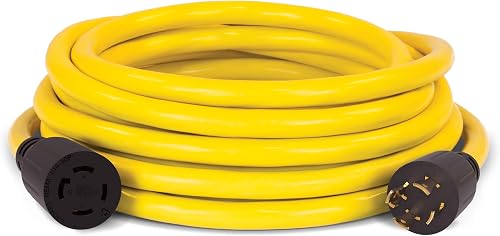
Champion Power Equipment 25-Foot 30-Amp 250-Volt Generator Power Cord for Manual Transfer Switch (L14-30P to L14-30R): Best for standard L14-30 home backup
- 25-foot length
- 30-amp, 125/250-volt rating
- 10-gauge wire
- L14-30P male to L14-30R female
- SJTW outdoor insulation
A long, straight L14-30 to L14-30 cord for generators and transfer switches that already match. It lets you keep the generator at a safer distance from the house.
Pros
- 25-foot reach keeps generator farther from home
- L14-30 locking ends on both sides
- Cold and heat resistant jacket stays flexible
Cons
- Only fits L14-30 generator outlets
- 25 feet is longer than some setups need
Champion suits homes with an L14-30 inlet box and a generator that has a matching L14-30 outlet. Its 25-foot length lets you place the generator away from doors and windows, which helps with exhaust and noise.
The male L14-30P end plugs into the generator and the female L14-30R end connects to the transfer switch inlet. That straight L14-30 to L14-30 layout is the simplest setup in this group and avoids adapters where they are not needed.
The cord is rated for 30 amps at 125/250 volts with 10-gauge wire. That rating fits many portable generators used for home backup, but you still need to check your generator output and selected circuits.
SJTW insulation is service grade, abrasion resistant and weather resistant. Champion says the jacket stays flexible in extreme heat and cold, which matters during winter storms.
The trade-off is fit. This cord does not adapt other outlet types, so a TT-30 or 14-50 generator will need a different cord or adapter.
Suplevel 10ft NEMA TT-30P to L14-30R Generator Transfer Switch Adapter Cord: Best for TT-30 RV-style generator outlets
- 10-foot length
- 30-amp, 125-volt rating
- TT-30P male to L14-30R female
- 10 AWG, 3-conductor cord
- ETL certified
A short adapter for generators with a TT-30 outlet feeding an L14-30 inlet box. It suits RV-style outlets and close generator placement.
Pros
- Solves TT-30 to L14-30 mismatch
- Locking female end helps hold connection
- Flame retardant and UV resistant materials
Cons
- 10 feet only, so placement is limited
- 125-volt use, not full 125/250-volt cords
Suplevel suits generators with a TT-30P outlet, a type common on RV-style machines. It converts that three-prong plug to an L14-30R female connector for your inlet box.
The locking female end helps the connection stay seated at the inlet, and strain relief helps reduce looseness over time. At 10 feet, it works best when the generator sits close to the house.
You get less placement freedom than a 25-foot cord, so plan the generator spot before you buy. That shorter run also means less cord to coil, carry and store when the outage is over.
Suplevel rates it for 30 amps at 125 volts, up to 3750 watts. The STW 10 AWG/3C cord uses molded plugs and pure copper wire, with flame retardant and UV resistant materials.
ETL certification is listed for this adapter. The trade-off is voltage scope.
This is a 125-volt adapter, so choose it for a 120-volt setup rather than a full 125/250-volt transfer switch load.
Kanayu 25ft NEMA L5-30P to L14-30R Generator Transfer Switch Adapter Cord, 30 Amp Locking 3 Prong to 4 Prong Adapter RV Generator to House Inlet Box, STW 10 AWG, ETL Listed: Best for L5-30 outlets with long reach
- 25-foot length
- 30-amp, up to 250-volt rating
- L5-30P male to L14-30R female
- 10 AWG, 3-conductor cord
- ETL Listed
A long adapter for generators with a three-prong L5-30 outlet and a four-prong L14-30 inlet. The yellow jacket is easy to spot in low light.
Pros
- 25 feet for distant generator placement
- Locking ends reduce loose connections
- Bright yellow color for visibility
Cons
- Only fits L5-30 generator outlets
- Adapter use needs careful load checks
Kanayu suits generators with an L5-30 outlet and no L14-30 outlet. Its three-prong L5-30P plug locks into the generator, while the L14-30R female end fits the inlet box.
That pairing solves a common mismatch for RV and portable generators that offer L5-30 as their main 30-amp outlet. At 25 feet, it gives you the same placement distance as a straight L14-30 cord.
That helps if your L5-30 generator must sit far from the inlet box for ventilation. The extra reach also helps you route the cord around corners without pulling tight on either plug.
Kanayu rates it for 30 amps, up to 250 volts and 3750 watts maximum. The 10 AWG/3C cord uses molded plugs, pure copper wiring and flame retardant, UV resistant materials.
The bright yellow jacket helps you spot the cord in low light. The trade-off is that adapter cords still need you to confirm your actual load, because an adapter does not raise generator output.
Kanayu 10ft NEMA 14-50P to L14-30R Generator Transfer Switch Adapter Cord: Best for 14-50 generator outlets
- 10-foot length
- 30-amp cord rating, up to 250 volts
- 14-50P male to L14-30R female
- 10 AWG, 3-conductor cord
- ETL Listed
A short adapter for generators with a 14-50 outlet feeding an L14-30 inlet box. It is a fit fix, so confirm your inlet and load before use.
Pros
- Matches 14-50 outlet to L14-30 inlet
- Grip handle helps push and pull
- Waterproof jacket for outdoor use
Cons
- 10 feet only
- Cord is 30-amp rated, not a 50-amp cord
Kanayu suits generators with a 14-50 outlet feeding an L14-30 inlet box. The 14-50P male plug fits the generator, and the L14-30R female connector fits the inlet.
The four-prong 14-50P plug has a grip handle that helps with pushing and pulling, which can matter when a plug is stiff. At 10 feet, it is made for close placement rather than long runs.
If your generator must sit 20 feet away, this length will not solve that problem. The shorter cord is easier to handle, but placement is fixed by the distance between the generator and the inlet.
The cord is 30-amp rated with 10 AWG construction, even though the 14-50 plug shape comes from 50-amp setups. Kanayu lists up to 250 volts and 7500 watts in its bullet points, while the specs list 3750 watts, so use the lower, safer figure for planning.
The trade-off is capacity. A 14-50 plug shape does not make this a 50-amp cord, so your transfer switch load must stay within 30 amps.
Conntek Transfer Switches Cord/Temp Power Cord, L14-30P 30-Amp 4 Prong Twist Lock Plug to CS6364 50-Amp Twist Lock Female: Best for L14-30 to 50-amp inlet setups
- 25-foot length
- 30-amp, 125/250-volt rating
- L14-30P male to CS6364 female
- STW 10/4 AWG wire
- Weather resistant
A 25-foot twist-lock cord for a L14-30 generator outlet and a CS6364 50-amp female inlet. Check the inlet type closely before you choose it.
Pros
- 25 feet for flexible placement
- Twist-lock ends for secure fit
- Stays flexible in cold weather
Cons
- CS6364 inlet is less common than L14-30
- 30-amp cord, so do not treat it as 50-amp capacity
Conntek suits a narrower setup: an L14-30P generator plug with a CS6364 50-amp female inlet. If your inlet box uses that socket, this cord fills a specific gap.
The CS6364 female is a locking 50-amp connector rated for 125/250 volts, which is different from the L14-30R female used on most other picks here. At 25 feet, it allows distant placement like the Champion cord.
Heavy-duty STW 10/4 AWG wire and a weather resistant jacket support outdoor use. Conntek rates it for 30 amps at 125/250 volts, up to 7500 watts.
The twist-lock design helps hold the connection, and the housing resists chemicals and drop abuse. The cord stays flexible in cold weather and is heat resistant up to 221 degrees in the product description.
The trade-off is inlet compatibility. Most home inlet boxes in this group use L14-30, so check your inlet socket before choosing this cord over a standard L14-30R model.
Connecticut Electric EmerGen Backup Power Manual Transfer Switch Kit 30 Amp, 25 Foot Cord, 10-Circuit, 7500 Watts, EGS107501G2K25 for Portable Generator (with 25 FT Generator Cord): Best for an all-in-one 10-circuit kit
- 30-amp manual transfer switch kit
- 25-foot generator cord included
- 10-circuit capacity
- 7500 watts
- Weatherproof inlet box
A kit with switch, inlet box and cord for buyers who need the full home backup setup. It suits portable generators rated for 30 amps.
Pros
- Includes switch, inlet box and cord
- 10 circuits for essential loads
- Double-throw design blocks back feeding
Cons
- More parts to install than a cord alone
- Needs careful circuit selection
Connecticut Electric suits buyers who need more than a cord. This kit includes a 30-amp manual transfer switch, 25-foot cord and weatherproof inlet box for 10 circuits.
That bundle matters because a cord alone cannot feed your home if you do not already have an inlet box and a transfer switch installed. The 10-circuit design lets you choose essential loads such as lights, refrigerator, fans and selected outlets.
Connecticut Electric lists 7500 watts, with portable generators in the 30-amp class. The switch uses double-throw rocker switches to help prevent back feeding, which protects utility workers and your home wiring.
The outdoor-rated inlet box supports all-weather use, and the included 25-foot cord gives placement room for the generator. The trade-off is install scope.
A kit needs more planning and electrical work than a cord alone, so have an electrician confirm the switch, inlet and circuit choices before you run the generator.
How these generator transfer switch cords were compared
We compared plug fit first, then length, amp rating, voltage rating and wire size. A cord that fits your outlet beats a longer cord that does not connect.
We also checked what each option includes. The Connecticut Electric kit includes switch and inlet parts, while the others are cords or adapters only.
Scores reflect fit for home backup, not just cord quality. A short adapter can score high when it solves a common outlet mismatch, even with less reach.
We used only facts from each product's specs and features. Where a spec conflict appeared, we advised using the lower figure for planning.
How plug fit, length and ratings were weighed
Plug shape came first because the generator end and the inlet end must both match. L14-30 to L14-30 is the standard path, while TT-30, L5-30, 14-50 and CS6364 each need their matching adapter or cord.
Length came next because safe placement depends on distance from doors, windows and air intakes. Ten feet suits close placement, while 25 feet gives more room to move the generator away from the house.
Amp and voltage ratings were checked against the 30-amp class used across this group. Ten-gauge wire appears across the cords, and every pick is listed at 30 amps, even when the plug shape came from a 50-amp family.
We also noted connector details such as locking ends, strain relief, molded plugs and jacket type. Those details affect how well a cord stays seated and how it handles outdoor use over time.
Which generator transfer switch cord should you buy?
Buy the Champion cord if you have L14-30 on both ends. It is the simplest match for a standard manual transfer switch setup.
Buy an adapter if your generator outlet differs. TT-30, L5-30 and 14-50 generators need the matching adapter cord, not a straight L14-30 cord.
Buy the kit if you need the switch and inlet too. A cord alone will not complete a home backup setup you do not already have.
For switch choices, read generator transfer switch vs interlock. For adapter-specific options, see the best generator transfer switch adapter cord guide.
For plug and inlet details, see best generator transfer switch plug. If you need a broader generator overview, start with the gas generator guide.
How do I match generator receptacles to transfer switch inlets?
How do I match generator receptacles to transfer switch inlets?
Match the male plug to your generator receptacle first. Then match the female connector to your inlet box socket.
Use this evidence rule for this post: match generator receptacles to transfer switch inlets with suitable cord ratings. Plug shape alone is not enough.
Check amps and voltage next. A 30-amp cord should not carry a load above 30 amps, even if the plug shape fits.
Twist-lock ends help, but they do not fix a wrong voltage or amp rating. Read both ends before you lock anything in place.
Check the generator manual for the exact receptacle name. Names such as L14-30R, TT-30R, L5-30R and 14-50R describe different shapes and contact layouts.
Check the inlet box label in the same way. An L14-30 inlet needs an L14-30R female end, while a CS6364 inlet needs a CS6364 female end.
Count prongs as a quick visual check, then confirm the printed rating. A four-prong plug can still be the wrong type for your socket.
What length generator transfer switch cord do I need?
Choose 25 feet if safety placement matters. Distance helps you keep exhaust away from windows, doors and air intakes.
Choose 10 feet if the generator sits close to the inlet. Shorter cords are lighter and easier to store, but they limit where the generator can run.
Measure from the inlet box to a safe generator spot outdoors. Add slack for turns, ground routing and plug access.
Do not run a cord through a window or door pinch point. Route it so doors close without crushing the jacket.
Plan for weather during an outage, not just dry daylight. A longer cord can help you place the generator under cover while keeping exhaust clear of the house.
Think about storage and handling as well. A 25-foot 10-gauge cord is heavier to coil and carry than a 10-foot cord, so keep that trade-off in mind.
What amp and voltage rating should a 30-amp cord have?
A 30-amp home backup cord should match your transfer switch rating. Most picks here use 10-gauge wire for 30-amp use.
Voltage matters as much as amps. Some cords are 125-volt only, while others are rated for 125/250 volts.
Check your generator nameplate for output and receptacle voltage. Then check your inlet box and transfer switch labels.
If you plan to power a 240-volt circuit, confirm every part in the chain supports that voltage. An adapter rated for 125 volts will not do that job.
Watts can help you sanity check the load, but amps and voltage are the ratings that must match. The lowest rated part in the chain sets the limit for the whole setup.
Are adapter cords safe for home backup?
Adapter cords are safe when every part matches in plug, amps and voltage. They solve outlet mismatch, but they do not add capacity.
Keep the load within the lowest rating in the chain. That may be the generator, the cord, the adapter or the transfer switch.
Locking connectors and strain relief help prevent loose fits. Still, inspect plugs for heat damage, cuts and bent prongs before each use.
Never back feed a house through a regular outlet. Use a proper inlet box and transfer switch, installed to code.
Store adapter cords with the plugs protected from bends and moisture. A damaged jacket or plug can turn a simple connection into a safety problem.
When should you choose a kit instead of just a cord?
Choose a kit if you do not already have an inlet box and transfer switch. A cord only connects parts that already exist.
The Connecticut Electric kit includes a 10-circuit switch, inlet box and 25-foot cord. That suits buyers starting a home backup setup from scratch.
Plan which circuits matter most before you buy. A refrigerator, lights, fan, phone chargers and medical devices often come first.
Have an electrician confirm the panel work. They can also tell you if a 10-circuit kit fits your home and generator size.
Compare the kit only with other full setups, not with a cord alone. The kit adds switch and inlet parts, so its install work and cost scope are different from a single cord purchase.
Verdict: best generator transfer switch cord pick
Pick the Champion Power Equipment 25-Foot cord if your generator and inlet are both L14-30. It gives you length, a locking fit and a clear 30-amp rating.
Pick Suplevel for TT-30, Kanayu for L5-30 or 14-50, and Conntek for a CS6364 inlet. Each adapter solves one specific mismatch, so plug fit decides the winner.
Pick the Connecticut Electric kit if you need the full setup. It adds switch and inlet parts that a cord alone cannot provide.
Before you order, match receptacles to inlets with suitable cord ratings. Then confirm amps, voltage and length for your safe generator spot.
Our top 3 picks at a glance
-
1
-
2
Best for TT-30 RV-style generator outlets
Suplevel 10ft NEMA TT-30P to L14-30R Generator Transfer Switch Adapter Cord
9.6/10 our score
See it on Amazon -
3
Frequently asked questions
What does a generator transfer switch cord do?
It connects a portable generator to a home inlet box or manual transfer switch. Match the generator plug and inlet socket exactly, then use a cord rated for your amp and voltage load.
Can I use an adapter cord with a transfer switch?
Yes, when the adapter matches your generator outlet and your inlet. Confirm voltage, amps and plug shape first, and keep the total load within both the generator and cord ratings.
How long should a transfer switch cord be?
Long enough to place the generator in a safe, well ventilated spot outdoors. A 25-foot cord gives more placement choice than a 10-foot cord, but longer cords add weight and storage space.
Do I need an electrician for a transfer switch?
A licensed electrician should handle the transfer switch and inlet installation. They can confirm circuit choices, grounding and local code steps before you run the generator.