Are EcoFlow Solar Panels Waterproof?
Yes, most EcoFlow solar panels are waterproof or water resistant at the panel surface, but the rating depends on the model. The solar charging cables and connectors need extra care in rain.
On this page (10 sections)
- Are EcoFlow solar panels waterproof for rain?
- What do IP67 and IP68 ratings mean?
- Are EcoFlow solar panels waterproof in snow and hail?
- How do you protect EcoFlow solar charging connections?
- Which EcoFlow panels are best for wet weather camping?
- What should you do before using an EcoFlow panel in the rain?
- Can snow, wind, or dust damage a waterproof panel?
- Are EcoFlow solar panels waterproof compared with other brands?
- How do you dry and store a wet solar panel?
- Final thoughts on EcoFlow solar panels waterproof use
Yes, EcoFlow solar panels are generally built to handle rain, and many models carry IP67 or IP68 ratings for the panel itself. The panel surface, cables, and controller may have different ratings.
Protect the connection to your power station. Rain is common during camping, RV travel, and home backup use, so placement matters as much as the rating.
Are EcoFlow solar panels waterproof for rain?
Yes, EcoFlow solar panels can handle rain in most normal outdoor use, because the panel face and frame are sealed for weather exposure. Every part of the system is not equally protected.
A panel sits outside to collect sunlight, so its face, backsheet, and frame shed water. The charging cable, adapter, junction box, and station input are separate parts with separate ratings.
Check the exact rating for your model before a trip. A panel paired with a DELTA or RIVER unit may be sealed while the station input still needs to stay dry.
Our score weighs specs, features and buyer feedback against what you're shopping for. Here we compared panel ratings, cable types, and setup needs.
What do IP67 and IP68 ratings mean?
IP67 and IP68 are standard codes for dust and water protection, and water resistance is the second number. IP68 is higher than IP67, but both are limited by time and depth.
IP67 generally means dust tight and able to handle brief immersion in shallow water under test conditions. IP68 generally means dust tight and able to handle immersion under maker-set conditions, often deeper or longer.
Those tests apply to the tested part, not every cable plugged into it. A sealed panel can be paired with a splash resistant cable, so read each rating.
Learn more in our guide to What Is Waterproof Rating For Solar Generator?. It separates panel, station, and cable ratings.
Are EcoFlow solar panels waterproof in snow and hail?
Some EcoFlow panels can handle snow, light hail, and cold rain, but the rating depends on the model and materials. Wind and impact can still cause damage.
Snow adds weight and can block light until it melts. Hail can crack a surface or loosen a frame, especially at high speed or on a corner.
Check whether your panel uses ETFE, glass, fiberglass, or an aluminum backsheet, as each handles impact and flex differently. Corner protection and a sturdy frame help in travel.
Bring the panel inside for severe storms, even with a strong water rating. Water resistance and impact resistance are not the same.
How do you protect EcoFlow solar charging connections?
Protect connections by keeping plugs, adapters, and the station input dry and off the ground. The panel can get wet, but wet connectors are the weak point.
Run cable so water cannot pool around the plug or drip into the station port. Use a cover, dry box, or station flap in rain, and keep spare adapters in a dry bag.
Connect before rain starts when you can, so you avoid handling plugs in a downpour. If a connector gets wet, dry it with a clean cloth and let it air out before reuse.
Never force a wet or dirty connector into the port, and do not leave a cable end in a puddle. Dirt and water in a plug can cause poor connection or damage.
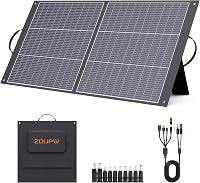
The ZOUPW panel below shows why separation matters, with an IP67 panel body and controller and cables that need dry handling.
Which EcoFlow panels are best for wet weather camping?
The best panel for wet weather camping is one with a sealed surface, stable kickstand, and cables you can keep dry. It should also pack down small for your car, tent, or RV bin.
A foldable panel moves under cover fast when rain turns heavy, and a carry case helps packing. Kickstands let you re-angle toward the sun after clouds pass.
For wattage, voltage, and connector basics, start with what is the best solar panel. Compare EcoFlow options in best ecoflow solar panels and match voltage and current to your station.
For lighter designs, see Best Solar Panel For Camping. A lighter panel is easier to move when weather changes.
How does the ZOUPW 100W panel handle rain?
The ZOUPW 100W panel uses IP67 ETFE coating on the panel face, so rain and splashes are not a problem for the surface. Its zippered pocket helps protect the controller and cables.
It folds to 24.13 x 21.06 x 1.77 inches and weighs 9.48 lb, so it moves into a tent or car easily. Two kickstands set the angle at 45 degrees to catch more sun.
ZOUPW lists 23.5% efficiency with Grade A+ monocrystalline cells and a 5-in-1 cable with XT60 for EcoFlow DELTA and RIVER models. The 10 ft cable lets you keep the station under cover.
Its USB-C and USB-A ports should stay dry. Charging speed depends on your station input limit, so a 100W panel will not push past its rated input.
How does the Renogy 400W panel handle wet weather?
The Renogy 400W panel carries IP67 waterproofing with ETFE coating and fiberglass reinforcement. It suits RV, marine, off-grid cabin, and emergency backup use.
It folds to 33.7 x 27.95 in, weighs 30.2 lb, and includes a carry case, so it is larger and heavier than a 100W panel. That size gives 400W for high-capacity stations.
Parallel wiring reduces loss from partial shading when clouds or tree shadows pass. Renogy warns to avoid submerging connectors and to inspect the panel after delivery or heavy use.
If an issue appears, follow Renogy solar panel troubleshooting steps.
It has MC4 output cables only, and the Renogy 4-in-1 adapter is sold separately. Renogy lists compatibility with EcoFlow DELTA 3 and DELTA 3 Max with matching voltage and current.
What should you do before using an EcoFlow panel in the rain?
Before rain use, check the panel rating, cable rating, and station input limits. Those checks show what can get wet and what must stay dry.
Read the manual for your panel and station, and note the IP rating for panel, cable, and adapter. If one part has no rating, treat it as splash resistant only.
Confirm the connector matches your station, because a wrong adapter can waste output or fail to connect. XT60 and other station-specific cables are common for RIVER and DELTA models.
Dry connectors before connecting, and cap unused ports when rain is likely. A clean, dry plug makes a better connection and lowers corrosion risk.
For DELTA 3, see best ecoflow delta 3 solar panels. For DELTA 2, use best solar panel for ecoflow delta 2.
For RIVER 3, see best solar panel for ecoflow river 3.
Can snow, wind, or dust damage a waterproof panel?
Yes, wind, snow load, and dust can damage a panel even if it is waterproof. Water sealing does not stop impact, bending, or abrasion.
Strong wind can lift a foldable panel or snap a kickstand if it is not weighted or tied down. Snow can block light and stress hinges, folds, and corners.
Dust and grit can scratch ETFE or glass, especially if you wipe with a dry cloth or drag it on rough ground. Rinse with clean water first, then wipe with a soft cloth.
Store the panel flat or folded as directed and use its case in travel. Avoid stacking heavy gear on it and keep cables away from sharp edges.
The EcoFlow bundle below shows why storage matters, with an adjustable carry case and a high water rating.
Are EcoFlow solar panels waterproof compared with other brands?
EcoFlow panels compare well with other portable brands on water ratings, but compare model by model. Some rivals also offer IP67 or IP68 panels, and cables across brands are less protected.
The EF ECOFLOW bundle pairs a 400W foldable panel with a DELTA Pro station, and the panel carries an IP68 rating. Check the included solar charge cable rating before relying on it in heavy rain.
EcoFlow lists a 22.4% conversion rate in that bundle, with a single panel recharging the power bank in 11 hours. With three 400W panels, it drops to 3.5 hours, though results vary with sun and input limits.
That bundle is heavier than a small camping panel, as it is made for home backup, RV use, and longer outages. For wet weather camping, a lighter panel may move under cover faster.
How do you dry and store a wet solar panel?
After rain, wipe the panel with a soft cloth and let all connectors dry fully. Store it folded, clean, and dry.
Rinse off dirt with clean water, then pat dry without scrubbing. Dry cable ends, adapters, and controller ports with a dry cloth and leave them to air out.
Check plugs for grit, bent pins, or water drops before your next connection. Clean a dirty connector gently and let it dry again before use.
Fold only when dry, and use the carry case if included. Store cables without tight bends and keep adapters in a dry bag.
Final thoughts on EcoFlow solar panels waterproof use
EcoFlow solar panels waterproof ratings cover the panel surface on most models, but cables and inputs need separate care. Read the IP rating for each part, keep connectors dry, and move the panel under cover in severe weather.
Pick the ZOUPW 100W panel for a light foldable option for camping and emergency use. Pick the Renogy 400W panel for higher output for a DELTA 3 or similar station if you can handle its weight and size.
Pick the EF ECOFLOW DELTA Pro bundle for a station and panel set for home backup, RV travel, and longer outages. Match voltage, current, and connectors to your station before you order.
Frequently asked questions
Can EcoFlow solar panels get wet?
Yes. Most EcoFlow solar panels can handle rain on the panel surface, and many carry IP67 or IP68 ratings.
Keep cables, junction boxes, and power station inputs dry when you can, and wipe connections before you plug them in.
Are EcoFlow solar charging cables waterproof?
Not all of them. Some solar connectors have sealed designs, while other cables and adapters are only splash resistant.
Check the rating for your exact cable, keep plugs off wet ground, and never plug in wet connectors.
Can you leave a solar panel out in the rain?
You can leave many panels out in light rain, but check the manual for your model first. Position the panel securely, keep the controller and cables dry, and bring it inside when storms, hail, or high wind are likely.
Does waterproof mean you can submerge a solar panel?
No. Waterproof ratings describe limited exposure, not unlimited underwater use.
IP67 and IP68 ratings allow brief immersion under set conditions, but connectors and controllers often have lower ratings.