Jackery HomePower 3600 Plus Review: Worth It? (October 2026)
The Jackery HomePower 3600 Plus suits essential home backup if 3,584Wh and 3,600W output fit the loads you plan to run. Its solar bundles add a charging option, while the EcoFlow and Jackery 5000 Plus offer different capacity and backup approaches.
On this page (9 sections)
- What does the Jackery HomePower 3600 Plus review find?
- Who should consider this home backup station?
- How much power and runtime can you expect?
- What do the power and capacity numbers mean?
- How should you evaluate solar bundles?
- What does expansion change?
- How does it compare with the alternatives?
- What should you check before buying?
- Is the Jackery HomePower 3600 Plus worth considering?
The Jackery HomePower 3600 Plus is a home backup power station with 3,584Wh capacity and 3,600W AC output. It fits buyers who want substantial portable battery capacity, multiple charging methods and a wheeled design, but the right choice depends on which circuits and appliances you need to support.
Its 240V and 7,200W figures apply when units are run in parallel. For solar buyers, compare the exact bundle contents and charging setup, then decide whether the base station or an expansion path better fits your outage plan.
What does the Jackery HomePower 3600 Plus review find?
The HomePower 3600 Plus stands out for 3,600W output, expandable capacity and mobility, with charging options for AC, solar, a gas generator or a hybrid AC and DC input. We compared its stated features with two alternatives for different backup priorities.
Jackery HomePower 3600 Plus Power Station: Best for rolling essential backup

- 3,584Wh capacity
- 3,600W AC output
- Expandable capacity
- Wheels and telescopic handle
A high-output home backup station with a wheeled case, four charging methods and expandable capacity. Consider it when you want to move the unit between a storage spot and the room where essential loads are connected.
Pros
- 3,600W output
- Capacity can expand
- Supports solar, AC, hybrid AC and DC, and gas-generator charging
- Wheels and telescopic handle
Cons
- Base capacity is 3,584Wh
- The 240V and 7,200W output figures apply in parallel
- Home connection requires compatible transfer equipment
Jackery describes the unit as a 3,584Wh station that can expand to 21kWh per unit or 43kWh with multiple units. It also says parallel operation can provide 7,200W and dual voltage at 120V and 240V, so those figures should not be read as the output of a single standalone unit.
The case weighs 77.2 lb and measures 15.2 x 12.2 x 19.3 inches. Wheels and a telescopic handle can help with rolling it between storage and use areas, but the weight still matters for stairs, thresholds and lifting into a vehicle.
The HomePower 3600 Plus product is sold as a power station; solar bundles are separate configurations to compare. Before buying, confirm which panels, cables and other accessories come with the bundle you're considering.
Who should consider this home backup station?
Consider the HomePower 3600 Plus if you want a portable battery for chosen household loads and plan to move it on wheels. It can suit a backup setup where you have identified the equipment to run and how you'll connect it safely.
It may also fit buyers who value several ways to recharge. Jackery gives stated charging times of 2.5 hours by AC, 4 hours by solar, 2.5 hours by gas generator, and 2 hours using hybrid AC and DC charging.
It's less compelling if your priority is automatic backup for sensitive devices, a substantially larger base battery or a system connection you haven't planned. Compare the best portable power station for whole home backup by capacity, output, circuit needs and connection method.
How much power and runtime can you expect?
Runtime depends on the actual wattage and duration of the loads, plus conversion losses and operating conditions. Capacity and output answer different questions: watt-hours describe stored energy, while watts describe the rate a station can supply power.
A simple planning estimate divides usable watt-hours by the load's watts. For example, a steady 500W load would use 500Wh each hour, so 3,584Wh represents a theoretical maximum of just over 7 hours before accounting for losses or reserve capacity.
That example is only a rough calculation, not a guaranteed runtime. Appliances cycle on and off, motors can need extra starting power, and some loads may be unsuitable for the station or its connection setup.
List essential devices and find their running and startup requirements in their manuals or on their labels. Add the hours you expect to use each one, then check whether the combined load stays within the station's output and energy limits.
If you want backup for a full home, start by deciding which circuits matter and whether a portable station can support them. The guide to whether a solar generator can power a house explains the load and setup questions that shape that decision.
What do the power and capacity numbers mean?
The HomePower 3600 Plus has 3,600W AC output and 3,584Wh capacity as a single unit. These figures help you screen appliances, but they don't replace checking each device's requirements.
A 3,600W output limit is about how much power can be delivered at a given time. A 3,584Wh battery capacity is about the amount of energy stored, so a high-draw appliance can use that energy quickly.
Jackery's 7,200W and 240V figures are for parallel operation. If you expect to use those capabilities, confirm the compatible configuration and equipment rather than assuming one station provides them on its own.
Jackery also describes 6,000 cycles and a 10-year lifespan. Those are company claims; actual battery life depends on use, temperature, charging habits and the conditions in the warranty and manual.
How should you evaluate solar bundles?
Choose a solar bundle by checking which panels and connections are included, their compatibility and the expected recharge conditions. Bundle names alone don't tell you whether a kit includes the panel count, cables or accessories you need.
Jackery gives a 4-hour solar charging time for the HomePower 3600 Plus. Treat it as a stated charging estimate, since sunlight, panel placement and operating conditions affect real charging.
Compare the panel input requirements with the bundle's panel output and connectors. Also consider where you'll place panels, how long the sun reaches that spot and whether you can protect the cables and station from weather.
A solar generator uses a battery, power electronics and an energy source such as solar panels. The plain-language guide to how a solar generator works can help you understand which parts belong in the bundle and which are separate.
If the solar kit is important to your choice, check the bundle's exact contents before ordering. Make sure the panel configuration supports the charging plan you have in mind, rather than assuming every HomePower package is identical.
What does expansion change?
Expansion can increase stored energy and the time available for selected loads, but it doesn't automatically make every setup suitable for whole-home backup. Jackery gives expansion figures of up to 21kWh per unit and 43kWh across multiple units.
More capacity is useful for longer outages or loads that run for many hours. It won't solve a mismatch between your appliances' power draw and the system's output, nor confirm that your wiring or connection method is appropriate.
The Jackery Solar Generator 5000 Plus review covers a different Jackery system with a larger stated base capacity and output. Compare the capacity, output and weight together if you're deciding between the two.
For a home with significant loads, also consider whether a transfer switch or other compatible connection equipment is required. A qualified electrician can advise on safe connections to home circuits and local code requirements.
How does it compare with the alternatives?
The HomePower 3600 Plus offers more base capacity than the EcoFlow DELTA 3 Ultra Plus in the supplied product details, while the EcoFlow highlights fast UPS switching. The Explorer 5000 Plus provides more base capacity and rated output, with a much heavier unit.
EF ECOFLOW DELTA 3 Ultra Plus 3072Wh: Best for UPS-style device backup
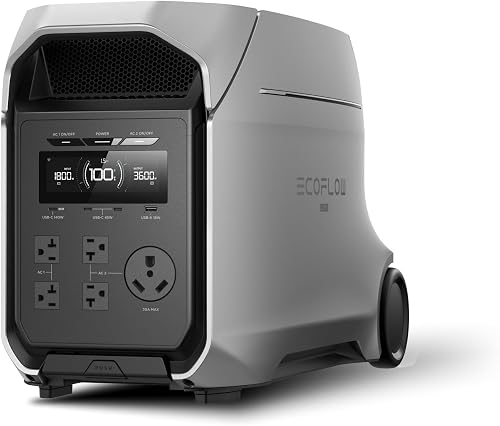
- 3,072Wh capacity
- 3,600W continuous output
- Expandable to 11kWh
- UPS switching under 10ms
A strong alternative if automatic UPS switching for computers, routers or medical equipment is a priority. Its stated capacity is lower than the HomePower 3600 Plus before expansion.
Pros
- UPS switching under 10ms
- Expandable to 11kWh
- Six charging methods
- 25dB stated operating noise
Cons
- 3,072Wh base capacity
- 240V output isn't specified in the available details
- Expansion requires extra batteries
The EcoFlow DELTA 3 Ultra Plus has 3,072Wh capacity and 3,600W continuous output, and it can expand to 11kWh. Its stated UPS switching time is under 10 milliseconds, which may matter if you want backup for devices such as computers, routers or medical equipment.
Jackery Explorer 5000 Plus Power Station: Best for larger home loads

- 5,040Wh capacity
- 7,200W rated power
- Expandable to 60kWh
- 120V and 240V support
The larger Jackery option brings more base capacity and rated power for buyers planning to support bigger household loads. Its greater weight makes placement and movement a bigger part of the decision.
Pros
- 5,040Wh base capacity
- 7,200W rated power
- Supports 120V and 240V
- Expandable to 60kWh
Cons
- 134.5 lb weight
- Solar panels are optional
- Transfer switch pairing is a separate consideration
The Explorer 5000 Plus has 5,040Wh capacity, 7,200W rated power and support for 120V and 240V. At 134.5 lb, it's substantially heavier than the HomePower 3600 Plus, so consider whether you'll keep it in one place.
Jackery's solar generator whole-house guide can help you think through system size and home loads. For a brand comparison, see how Geneverse solar generators compare with Jackery.
What should you check before buying?
Check the loads, connection plan, bundle contents and storage location before choosing the HomePower 3600 Plus. These details affect whether the system will work for your intended outage routine.
- Write down each essential appliance and its running and startup wattage.
- Estimate how many hours each load will run per day.
- Confirm whether the devices need 120V or another supply arrangement.
- Check what equipment is needed to connect the station to household circuits.
- Compare the solar panel bundle's contents and compatibility.
- Measure doorways, thresholds and storage space for a 77.2 lb unit.
The station's wheels and telescopic handle make rolling part of the design. Still, plan how you'll manage steps and uneven surfaces, and store it where you can reach it without blocking an exit.
Jackery includes built-in cables, the HomePower 3600 Plus and a user manual. Confirm the exact bundle contents for any solar package, since included components may differ between configurations.
Is the Jackery HomePower 3600 Plus worth considering?
The HomePower 3600 Plus is worth considering if 3,584Wh, 3,600W output and a rolling 77.2 lb format fit your essential-load plan. Its charging choices and stated expansion options add flexibility, while solar bundle details deserve a close check.
Choose the HomePower 3600 Plus if mobility and multiple recharge methods matter. Pick the EcoFlow if under-10ms UPS switching is central to your plan, or compare the Explorer 5000 Plus if you need more base capacity and rated output and can accommodate its weight.
Frequently asked questions
How much capacity does the Jackery HomePower 3600 Plus have?
The Jackery HomePower 3600 Plus has 3,584Wh of base capacity. Jackery says it can expand to 21kWh per unit or 43kWh with multiple units; check the required expansion equipment and plan your expected loads before relying on those larger figures.
Can the HomePower 3600 Plus power a whole house?
It can support selected household loads, but whole-house backup depends on the appliances, their starting demands, total energy use and how the system connects to home circuits. Its 3,600W output and 3,584Wh capacity are useful planning figures, not a promise that every home load can run together.
Does the Jackery HomePower 3600 Plus include solar panels?
The power station is a separate product, and solar bundles may pair it with panels. Compare the exact bundle contents, panel input compatibility and charging expectations before choosing a kit, since panel output depends on conditions and the bundle configuration.
How does the HomePower 3600 Plus compare with the Explorer 5000 Plus?
The Explorer 5000 Plus has 5,040Wh capacity and 7,200W rated power, compared with 3,584Wh and 3,600W for the HomePower 3600 Plus. It weighs 134.5 lb, so the extra capacity comes with a substantial increase in unit weight.