Best 24V LiFePO4 Batteries: Top 9 Picks (November 2026)
The best 24V LiFePO4 batteries include the dumfume 2 pack 24V 100Ah LiFePO4 Lithium for paired 100Ah storage, the dumfume 24V 314Ah LiFePO4 Battery for Trolling for high-capacity storage, and the SUPER EMPOWER 25.6V 100Ah LiFePO4 Lithium Battery for marine system expansion.
On this page (5 sections)
The best 24V LiFePO4 battery for most storage systems is the dumfume 24V 100Ah, with 2.56kWh of stated energy in each battery. Choose the 314Ah dumfume for more capacity in one enclosure, the VEVOR for a 200Ah step, or the MEYULMOL if Bluetooth monitoring matters.
We compared capacity, voltage, physical format, BMS rating and stated connection options. A battery marked 24V may have a nominal voltage of 25.6V, so match the battery to your charger and system before buying.
Our picks at a glance
-
1
 Best for paired 100Ah storage
dumfume 2 pack 24V 100Ah LiFePO4 Lithium
9.3/10 our score
See it on Amazon -
2
 Best for high-capacity storage
dumfume 24V 314Ah LiFePO4 Battery for Trolling
9.2/10 our score
See it on Amazon -
3
 Best for marine system expansion
SUPER EMPOWER 25.6V 100Ah LiFePO4 Lithium Battery
9.1/10 our score
See it on Amazon
- 4
 Check it
dumfume 24V 100Ah LiFePO4 Lithium Battery Built-in
Best for a single 100Ah battery - 5
 Check it
Redodo 24V 100Ah Marine LiFePO4 Battery
Best for a four-battery marine bank - 6
 Check it
VEVOR 24V 200Ah LiFePO4 Lithium Battery 4000+
Best for a 200Ah single-battery setup - 7
 Check it
MEYULMOL 24V(25.6V) 100Ah Mini LiFePO4 Lithium Battery
Best for app monitoring - 8
 Check it
Nermak 2 Pack 12V 10Ah Lithium Ion
Best for small 12V devices - 9
 Check it
GOLDENMATE 12V 20Ah LiFePO4 Lithium Battery
Best for compact 12V backup
Which 24V LiFePO4 battery fits each storage need?
The dumfume 100Ah options fit many 24V storage plans, while the larger dumfume and VEVOR units hold more energy in one enclosure. Pick by usable system capacity, space and installation weight.
dumfume 2 pack 24V 100Ah LiFePO4 Lithium: Best for paired 100Ah storage
- Two 24V batteries
- 2.56kWh per battery
- 100A BMS
- Supports up to 2S4P
This two-battery pack suits a system plan that calls for matched 24V units. Each battery is rated at 2.56kWh and supports up to 2S4P connections.
Pros
- Two 24V units in one pack
- 100A BMS
- Supports series and parallel connections
Cons
- Charging below 32°F is prohibited
- Each battery weighs about 41 lb
The two-battery dumfume pack gives you two 25.6V, 100Ah batteries, each rated at 2.56kWh. That format can suit a setup that needs multiple matching batteries, though you should plan for the footprint and weight of both units.
The stated connection limit is up to 2S4P. The pack weighs about 41 lb per battery, and its charging temperature needs attention: performance requires 5°C or higher, while the brand guidance says not to charge below 32°F.
Check your charger and system compatibility with dumfume before building around a multi-battery configuration. This is the most flexible pick here when you want a pair of 100Ah units from the start.
dumfume 24V 314Ah LiFePO4 Battery for Trolling: Best for high-capacity storage
- 314Ah capacity
- 8,038.4Wh stated energy
- 200A BMS
- IP65 rating
Its 314Ah capacity and stated 8,038.4Wh of energy suit larger storage needs in one battery. The 112.44 lb weight calls for a planned installation.
Pros
- Largest stated capacity in this group
- 200A BMS
- IP65 rating
Cons
- Heavy at 112.44 lb
- Requires room for its larger enclosure
The 314Ah dumfume is the high-capacity choice, with 8,038.4Wh of stated energy and a 200A BMS. Its 25.19 x 9.64 x 8.86 in footprint is compact for the capacity, but the 112.44 lb weight needs a stable, accessible mounting spot.
The manufacturer gives a recommended 40–100A charge current and says charging below 32°F is blocked. Those limits are useful when planning a solar or off-grid setup, but the charger still needs a LiFePO4 profile and a compatible voltage.
Choose this unit when fewer battery enclosures and a larger capacity matter more than easy lifting. Confirm the available space and support surface before installation.
SUPER EMPOWER 25.6V 100Ah LiFePO4 Lithium Battery: Best for marine system expansion
- 25.6V nominal voltage
- 2,560Wh rated energy
- 100A BMS
- Supports up to 2 batteries in series
This 25.6V, 100Ah battery is aimed at compatible marine and storage systems. Its stated expansion options allow up to 2 batteries in series and 4 parallel strings.
Pros
- Clear dimensions for installation planning
- 100A BMS
- Supports series and parallel expansion
Cons
- Charging pauses below 32°F
- Not intended for engine starting
The SUPER EMPOWER is a single 25.6V, 100Ah battery with 2,560Wh of rated energy and a 100A BMS. Its dimensions are 20.94 x 8.13 x 8.56 in, making them straightforward to compare with an existing battery bay.
It supports up to two batteries in series and four parallel strings, according to its stated expansion options. Charging pauses below 32°F, and the brand describes it for auxiliary power and energy storage rather than engine starting.
Consider this pick for a compatible marine or RV system where one 100Ah enclosure is enough today and expansion may matter later. Confirm the system voltage and charger profile first.
dumfume 24V 100Ah LiFePO4 Lithium Battery Built-in: Best for a single 100Ah battery
- 25.6V, 100Ah
- 2.56kWh stated energy
- 100A BMS
- Supports up to 2S4P
This single battery offers the same stated capacity and energy as the paired dumfume option, with one enclosure to fit and wire. It supports up to 2S4P expansion.
Pros
- Single-battery format
- 100A BMS
- Supports up to 2S4P
Cons
- Charging temperature should be at least 41°F
- Dimensions should be checked against the available space
The single dumfume 100Ah battery has 2.56kWh of stated energy and a 100A BMS. Its 20.91 x 8.11 x 8.56 in dimensions help with bay checks, and the 41.67 lb weight is easier to plan around than the 314Ah model.
It supports up to 2S4P connections and uses a recommended 29.2V LiFePO4 charger. Dumfume also says charging temperature should be at least 41°F, so cold-weather storage and charging need planning.
This is a practical choice when you want one battery now and may expand the bank later. If your target is specifically a smaller 50Ah unit, compare our best 24V 50Ah LiFePO4 batteries.
Redodo 24V 100Ah Marine LiFePO4 Battery: Best for a four-battery marine bank
- Four 25.6V 100Ah batteries
- 100A BMS per battery
- M8 terminals
- 5-year warranty
The four-pack is suited to buyers planning a larger battery bank from matching units. The pack may arrive in separate shipments.
Pros
- Four matching 24V batteries
- 100A BMS per unit
- M8 terminal bolts included
Cons
- Four batteries need substantial installation space
- Items may arrive at different times
Redodo’s package contains four 25.6V, 100Ah batteries. Each unit is listed at 44.7 lb and 20.95 x 8.15 x 8.5 in, so the total bank needs room for four enclosures and safe access to each one.
The stated configuration supports building a 48V system with two 24V batteries, and expanding to eight units for 48V 400Ah. The package includes M8 terminal bolts and insulating caps, and the brand recommends using its specified lithium charger.
This pick makes most sense when you already plan a multi-battery installation. For a single 24V battery, the four-pack may be more capacity and space than you need.
VEVOR 24V 200Ah LiFePO4 Lithium Battery 4000+: Best for a 200Ah single-battery setup
- 200Ah capacity
- 25.6V
- 100A maximum discharge current
- Built-in 100A BMS
The 200Ah capacity puts this between the 100Ah batteries and the 314Ah option. Its 76.5 lb weight and larger dimensions matter when planning placement.
Pros
- 200Ah capacity in one enclosure
- Built-in 100A BMS
- Stated 4000+ cycles
Cons
- Heavier than the 100Ah options
- 100A maximum discharge current
The VEVOR 200Ah gives you a middle capacity between the 100Ah and 314Ah options. It has a 25.6V rating, 100A maximum discharge current and a built-in 100A BMS.
At 76.5 lb and 20.47 x 9.65 x 8.66 in, it is heavier and wider than the 100Ah units. Its 100A maximum discharge current is also a key system limit to compare against inverter and appliance demand.
Choose it when 100Ah is too little but a 314Ah battery is more than you need. Check the full electrical limits and supported connections for your intended setup.
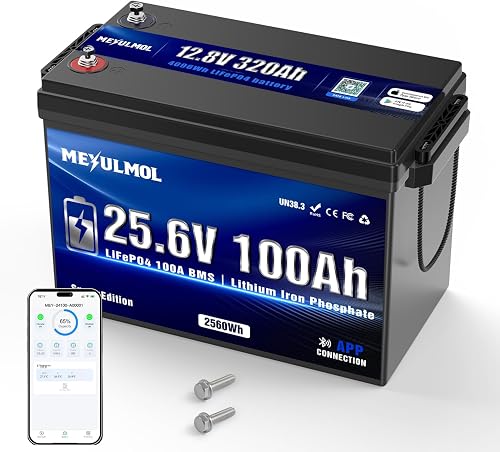
MEYULMOL 24V(25.6V) 100Ah Mini LiFePO4 Lithium Battery: Best for app monitoring
- 25.6V, 100Ah
- Built-in Bluetooth app monitoring
- 100A BMS
- Low-temperature protection
Bluetooth app monitoring shows capacity, voltage, current and operating temperature. Consider it when monitoring matters, and confirm its physical dimensions before planning a tight space.
Pros
- App monitoring for key battery readings
- 100A BMS
- Supports 2S4P expansion
Cons
- Dimensions are not stated
- Charging pauses below 32°F
The MEYULMOL 100Ah battery’s distinguishing feature is its Bluetooth app monitoring for capacity, voltage, current and operating temperature. It is a 25.6V battery with a 100A BMS and stated 2S4P expansion support.
The maker describes its design as mini, but dimensions are not stated here. Confirm the exact enclosure size before choosing it for a tight compartment, and check the app requirements in the manual.
Choose this option when seeing battery readings on a phone is useful for your setup. The claimed charging cutoff is 32°F, so confirm how the battery handles your expected winter conditions.
Nermak 2 Pack 12V 10Ah Lithium Ion: Best for small 12V devices
- Two 12.8V 10Ah batteries
- Built-in 10A BMS
- F2 terminals
- Series and parallel connection supported
These two 12.8V batteries are not a ready-made 24V 100Ah option, but they may suit a small compatible system. Nermak says up to four identical batteries can be connected in series.
Pros
- Two batteries included
- Small dimensions
- Series connection supported
Cons
- Only 10Ah per battery
- Not a starter battery
The Nermak pair is included as a small 12V option, not as a ready-made 24V storage battery. Each battery is 12.8V and 10Ah, with a built-in 10A BMS and F2 terminals.
Nermak says up to four identical batteries can be connected in series, but these units have only 10Ah capacity each. The brand also says they are not starter batteries and recommends a LiFePO4 charger.
Consider this pack for small compatible 12V devices such as lighting or a fish finder. For a 24V 100Ah system, choose one of the larger batteries above instead.
GOLDENMATE 12V 20Ah LiFePO4 Lithium Battery: Best for compact 12V backup
- 12.8V, 20Ah
- Built-in 20A BMS
- IP67 rating
- Supports series or parallel connection
This compact 12V battery fits smaller backup and lighting uses, rather than a typical 24V storage system. Its 12.8V output and 20Ah capacity should match the intended device.
Pros
- Light at 5.95 lb
- IP67 rating
- Built-in 20A BMS
Cons
- 12.8V battery, not a standalone 24V unit
- Continuous discharge is stated at up to 10A
GOLDENMATE’s 12.8V, 20Ah battery is a compact option for small 12V backup or lighting loads. It weighs 5.95 lb, measures 7.13 x 2.99 x 6.61 in and has an IP67 rating.
It has a built-in 20A BMS, while the stated continuous discharge is up to 10A. This is not a standalone 24V battery, so only consider it if your device or approved battery arrangement matches its voltage and capacity.
Choose it for a compact 12V use, not as a substitute for a 24V 100Ah storage unit. The battery supports series and parallel configurations, but follow the maker’s limits.
How do 24V battery capacities compare?
Capacity in amp-hours is only useful alongside voltage: a 25.6V 100Ah battery stores 2.56kWh, while the 314Ah dumfume states 8,038.4Wh. Compare energy, not just the amp-hour number, when the system voltage differs.
Browse LiFePO4 deep-cycle batteries for other formats.
A single 100Ah battery can be easier to place than a much larger unit, but multiple batteries add wiring and installation space. The Redodo pack contains four units, while the VEVOR provides 200Ah in one enclosure.
A 24V label also does not guarantee every 24V device is compatible. Check the battery's nominal voltage, allowed charging voltage and discharge limits against the equipment.
For a general explanation of battery chemistry and use, see our deep-cycle battery buying guide. If your system calls for more voltage, compare the best 48V LiFePO4 batteries and the best 48V 100Ah LiFePO4 batteries.
What physical format should you choose?
Choose a battery format that fits the compartment, mounting surface and installation weight, with room to reach terminals and wiring. Compare stated dimensions before buying and leave space for the connections and any required ventilation or service access.
The 100Ah batteries here are around 41–45 lb each and roughly 21 in long. The 200Ah VEVOR is 76.5 lb, while the 314Ah dumfume is 112.44 lb, which can make handling and mounting a larger job.
The MEYULMOL mini model has no stated dimensions here, so ask for the exact enclosure measurements if space is tight. For portable systems that use removable packs instead of fixed batteries, see our guides to the best replacement battery pack and the best extra battery pack.
What should you check before connecting a 24V LiFePO4 battery?
Check the battery voltage, charger profile, continuous current needs, connection limits and temperature rules before wiring a system. A 25.6V nominal battery may need different charging settings than equipment designed around another battery chemistry.
Match the inverter or load to the battery’s discharge limit. For example, the VEVOR states a 100A maximum discharge current, while the 314Ah dumfume has a 200A BMS.
Use the same model and capacity when combining batteries, and follow the manufacturer’s wiring instructions. Don't assume two batteries can be wired in series or parallel just because both are called 24V.
Cold-weather charging limits also vary. Some options here pause or block charging below 32°F, and the single dumfume 100Ah specifies a minimum 41°F charging temperature.
Which 24V LiFePO4 battery should you choose?
Choose the single dumfume 100Ah for a balanced 2.56kWh option, the 314Ah dumfume when one high-capacity enclosure fits your plan, and the VEVOR when 200Ah is the target. Pick the Redodo pack only when a four-battery bank suits your space and system design.
For an expansion plan that moves to 48V, compare the best 48V 200Ah LiFePO4 batteries alongside your inverter and charging equipment. Our score weighs specs, features and buyer feedback against what you're shopping for.
Our top 3 picks at a glance
-
1
Best for paired 100Ah storage
dumfume 2 pack 24V 100Ah LiFePO4 Lithium
9.3/10 our score
See it on Amazon -
2
Best for high-capacity storage
dumfume 24V 314Ah LiFePO4 Battery for Trolling
9.2/10 our score
See it on Amazon -
3
Best for marine system expansion
SUPER EMPOWER 25.6V 100Ah LiFePO4 Lithium Battery
9.1/10 our score
See it on Amazon
Frequently asked questions
Is a 24V LiFePO4 battery actually 24 volts?
Many batteries sold for 24V systems have a nominal voltage of 25.6V. Check the battery voltage and the voltage range accepted by your charger, inverter, or other equipment before connecting it.
A compatible 24V system should be designed for the battery’s actual charging and operating limits.
How much energy does a 24V 100Ah LiFePO4 battery store?
A 25.6V battery rated at 100Ah stores 2,560Wh, or 2.56kWh, based on voltage multiplied by amp-hours. Actual usable energy depends on the system, settings, and discharge limits.
Check the appliance load and expected runtime before sizing a battery bank.
Can you connect 24V LiFePO4 batteries in series or parallel?
Some models support series, parallel, or both, but the allowed configurations vary. Use matching batteries and follow the maker’s connection limits, charging instructions, and wiring guidance.
Do not assume that two batteries can be combined simply because they share a 24V label.
Can you charge a 24V LiFePO4 battery in cold weather?
Charging limits depend on the battery. The dumfume 100Ah options specify minimum charging temperatures of 32°F or 41°F, while the SUPER EMPOWER battery pauses charging below 32°F.
Check the manual for your model and keep the battery within its allowed charging temperature.