9 Best LiFePO4 Batteries for Solar Power (November 2026)
The best LiFePO4 battery for solar power include the HyperPS for solar lights and small devices, the DaranEner Daran Portable Power Station 89.6Wh LiFePO4 for portable solar charging, and the SUPER EMPOWER 12V 100Ah LiFePO4 Battery for most 12V solar systems.
On this page (8 sections)
- The LiFePO4 batteries for solar in this roundup
- How the best LiFePO4 batteries for solar compare
- How we compared these LiFePO4 solar batteries
- What size LiFePO4 battery do you need for solar?
- Which voltage is best for a solar battery: 12V, 24V or 48V?
- What BMS and low-temp protection should a solar LiFePO4 battery have?
- How do you set up and charge a LiFePO4 solar battery?
- Verdict: which best LiFePO4 battery for solar should you buy?
The best LiFePO4 battery for solar power for most buyers is the SUPER EMPOWER 12V 100Ah, because it fits standard 12V boxes, holds 1280Wh and uses a 100A BMS with low-temp protection.
If you need more storage, the ECO-WORTHY 12V 314Ah holds 4019Wh.
If your inverter is 48V, the Cubix100 is made for that system.
Start by finding the voltage your system already uses.
A 12V battery will not work with a 24V inverter, and a 48V rack battery will not drop into an RV 12V box.
Match the battery to the inverter and solar controller first.
Size comes second.
Our score weighs specs, features and buyer feedback against what you are shopping for.
We compared capacity, voltage, BMS protection, weight, size and expansion options across these 9 picks.
Our picks at a glance
-
1

-
2
 Best for portable solar charging
DaranEner Daran Portable Power Station 89.6Wh LiFePO4
9.7/10 our score
See it on Amazon -
3
 Best for most 12V solar systems
SUPER EMPOWER 12V 100Ah LiFePO4 Battery
9.5/10 our score
See it on Amazon
- 4
 Check it
Nermak 2 Pack 12V 10Ah Lithium Ion
Best for small 12V loads - 5
 Check it
ECO-WORTHY 12V 314AH LiFePO4 Lithium Battery Bluetooth
Best for large 12V off-grid storage - 6
 Check it
ECO-WORTHY Cubix100 48V 100Ah LiFePO4 Lithium UL9540
Best for 48V home solar storage - 7
 Check it
dumfume 24V 100Ah LiFePO4 Lithium Battery Built-in
Best for 24V solar systems - 8
 Check it
dumfume 12V 150Ah Max LiFePO4 Battery
Best for compact 12V capacity - 9
 Check it
Dyness 12V 100Ah LiFePO4 Lithium Battery
Best for a two-pack 12V bank
The LiFePO4 batteries for solar in this roundup
These 9 picks cover small light cells, a portable power station, and full deep cycle batteries from 12V to 48V.
The right pick depends on your system voltage and how much energy you use each day.
HyperPS: Best for solar lights and small devices
- 20-pack of 3.2V 400mAh cells
- 14430 size, 14 x 43 mm
- Rechargeable, about 1500 cycles claimed
- Made for solar panel lights and small appliances
A 20-pack of small 3.2V cells for solar lights, toothbrushes, shavers and flashlights. This is a small format cell, not a full solar bank battery.
Pros
- 20 cells in one pack
- Small 14430 format for compact lights
- Rechargeable for repeated use
Cons
- Too small for home solar storage
- Not a AA-size replacement
- Low capacity per cell
HyperPS suits solar lights, toothbrushes, shavers and flashlights, not a home solar bank.
Each cell is 3.2V and 400mAh in a 14430 size, 14 x 43 mm.
That small format runs compact devices that need a rechargeable cell.
The pack has 20 cells, so you can refresh several lights at once.
HyperPS says the cells support about 1500 recharge cycles with minimal power loss.
That helps if you run solar lights nightly and want low-cost replacements.
It is shorter than AA and does not fit as a AA replacement.
Check the exact size before you buy.
The 400mAh capacity means each cell covers short duty cycles rather than long stored energy.
Standby use in a light can stretch across a night, but a single cell will not run a fridge or a router for long.
For a solar setup that stores power for a house, RV or cabin, choose one of the larger deep cycle batteries below instead, since those store watt-hours in the thousands rather than a quarter of an amp-hour.
DaranEner Daran Portable Power Station 89.6Wh LiFePO4: Best for portable solar charging
- 89.6Wh LiFePO4 pack
- 100W output, 200W peak
- 7 output ports including AC and USB-C
- Solar, AC, USB-C and car charging
A pocket-size 100W power station with a LiFePO4 pack, AC sockets and solar charging. It suits phones, laptops and small devices, not large home loads.
Pros
- Portable at 2.54 lb
- AC, USB-C, USB-A and DC ports
- Can charge from solar, wall, USB-C or car
Cons
- 89.6Wh is small for home backup
- Solar panel is not included
- Devices must stay under 100W total
The DaranEner power station suits camping, backup for small devices and portable solar charging.
It holds 89.6Wh and outputs 100W, with 200W peak.
That size runs phones, laptops, small TVs and other devices under 100W total.
It has 7 output ports, including 2 AC sockets, USB-C, USB-A and DC ports.
You can charge it from solar, wall power, USB-C or a car.
A solar panel is not included, so add a panel that matches the input limits.
At 2.54 lb, it fits in a backpack.
DaranEner says the LiFePO4 pack supports 3500+ life cycles.
The LED display shows remaining power, which helps you plan a charge before the battery empties.
AC output shuts off near 10 percent charge to protect the pack, while USB and DC can still draw the last portion.
This is a portable power station, not a large home battery, so choose a deep cycle battery if you need overnight power for a fridge or lights.
SUPER EMPOWER 12V 100Ah LiFePO4 Battery: Best for most 12V solar systems
- 12.8V 100Ah, 1280Wh
- 100A BMS
- Group 24 size, 21.6 lb
- Supports 4S4P expansion
A Group 24 12V 100Ah deep cycle battery for RV, marine and solar storage. Its drop-in size and low-temp charging cutoff make it a strong first 12V pick.
Pros
- Fits most standard battery boxes
- 100A BMS with low-temp cutoff
- Expandable to 51.2V 400Ah
Cons
- Not for engine starting
- Needs a LiFePO4 charging profile
- Charging stops below 32 F
SUPER EMPOWER suits 12V RV, marine and solar storage where a standard Group 24 box fits.
It holds 12.8V 100Ah, or 1280Wh, and weighs 21.6 lb.
That is a practical starting size for a small solar bank.
The built-in 100A BMS protects against overcharge, over-discharge, overcurrent, short circuit and temperature extremes.
Charging pauses below 0 C, and discharge stops at -20 C.
That low-temp cutoff protects cells in cold weather.
It supports up to 4 in series and 4 in parallel, for a 51.2V 400Ah bank.
Use a LiFePO4 charger profile or a solar controller in lithium mode.
The M8 terminals and Group 24 footprint help it replace a lead acid battery in the same box.
It is for energy storage only, not engine starting.
If you need more than 1280Wh at 12V, a 150Ah or 314Ah model gives headroom without changing voltage.
Nermak 2 Pack 12V 10Ah Lithium Ion: Best for small 12V loads
- 2-pack of 12V 10Ah batteries
- Built-in 10A BMS per battery
- 2000+ cycles claimed
- Up to 4 in series
Two small 12V 10Ah LiFePO4 batteries for lighting, fish finders, scooters and small solar or wind setup. Capacity is modest, so it suits light loads.
Pros
- Two batteries included
- Light and compact for small loads
- Built-in BMS protection
Cons
- Only 10Ah per battery
- Not for starting or large motors
- Limited run time for home loads
Nermak suits light loads such as LED lighting, a fish finder, a scooter, a 12V router or small solar and wind power.
The 2-pack gives you two 12V 10Ah batteries, each with a built-in 10A BMS.
Each battery lists 2000+ cycles.
Nermak says the BMS protects against overcharge, over-discharge, overcurrent and short circuit.
Low self-discharge helps with storage between uses.
Capacity is the trade-off.
At 10Ah per battery, run time is short for larger loads.
Up to 4 identical batteries can connect in series.
The F2 terminals and compact case suit small wiring in a boat, scooter or solar light setup.
Use a LiFePO4 charger, since a standard lead-acid charger may not charge it fully.
It is not a starter battery.
For a fish finder or a single light, that small capacity is often enough, while a home load will drain the pair quickly and needs a 100Ah class battery instead.
ECO-WORTHY 12V 314AH LiFePO4 Lithium Battery Bluetooth: Best for large 12V off-grid storage
- 12.8V 314Ah, 4019Wh
- 200A BMS
- Bluetooth monitoring and SOC display
- Low-temp charging protection
A large 12V 314Ah battery with Bluetooth and a 200A BMS for off-grid, RV and home backup. It holds far more energy than a 100Ah battery.
Pros
- 4019Wh capacity
- Bluetooth and LED status display
- Expandable up to 32.15kWh
Cons
- Heavy at 60.4 lb
- Large footprint
- Needs a large solar array to refill fast
ECO-WORTHY suits off-grid cabins, RVs and home backup where 12V storage needs to be large.
It holds 12.8V 314Ah, or 4019Wh, with a 200A BMS.
That is about three times the energy of a 100Ah battery.
Bluetooth lets you monitor status in the ECO-WORTHY app.
An LED screen shows battery level and status.
Low-temp protection cuts off charging below -7 C.
A buzzer alerts you to faults.
It weighs 60.4 lb and measures 16.3 x 8.46 x 10.24 in, so plan space and lifting.
It supports expansion up to 4P2S or 2P4S for 32.15kWh.
The higher BMS rating supports larger inverters and higher current draws than a 100A model.
You will need a solar array large enough to refill it in a day or two.
That sizing work matters, since a large battery paired with a small panel can stay partly charged for days in cloudy weather.
ECO-WORTHY Cubix100 48V 100Ah LiFePO4 Lithium UL9540: Best for 48V home solar storage
- 48V 100Ah, 5120Wh
- Server rack design
- UL9540 and UL1973 listed
- Bluetooth and WiFi monitoring
A 48V 100Ah rack battery for home energy storage with inverters. It is built for stationary home use, not for RV or portable use.
Pros
- 5120Wh for home backup
- Rack design with inverter communication
- Can parallel up to 32 units
Cons
- Very heavy at 103 lb
- Needs a 48V inverter system
- Not portable
The Cubix100 suits a 48V home solar system with an inverter, not a 12V RV setup.
It holds 51.2V 100Ah, or 5120Wh, in a server rack case.
That format fits a cabinet or rack in a utility room.
ECO-WORTHY lists UL9540, UL1973 and CEC listings.
CAN and RS485 communication let it talk to compatible solar inverters.
Bluetooth and WiFi let you monitor status in the app.
It weighs 103 lb, so it is a stationary pick.
You can parallel up to 32 units for up to 163.8kWh.
The kit includes parallel cables, communication cables, grounding wires and terminal covers.
The rack height of 5.63 in per unit helps stack a system vertically rather than spreading batteries across a floor.
Choose this only if your inverter and chargers are 48V.
A 12V or 24V inverter will not use this battery, and mixing it with lower voltage batteries in one bank is not an option.
dumfume 24V 100Ah LiFePO4 Lithium Battery Built-in: Best for 24V solar systems
- 25.6V 100Ah, 2560Wh
- 100A BMS
- 41.7 lb
- Supports 2S4P expansion
A 24V 100Ah battery for RV, cabin and solar storage. The higher voltage means less current for the same power than a 12V system.
Pros
- 2560Wh capacity
- 100A BMS protection
- Up to 8 batteries in 2S4P
Cons
- Needs 24V inverter and charging gear
- Not for starting engines
- Charging needs 41 F or warmer
dumfume suits a 24V solar, RV or off-grid system where you want higher voltage than 12V.
It holds 25.6V 100Ah, or 2560Wh, and weighs 41.7 lb.
A 24V system needs less current for the same power, which can mean smaller cables.
The 100A BMS protects against overcharge, over-discharge, overcurrent, high temperature and short circuits.
dumfume lists up to 4,000+ cycles at 100% depth of discharge.
It supports 2S4P, for up to 8 batteries.
Use a compatible 29.2V LiFePO4 charger.
Keep charging temperature at 5 C or above, since the BMS blocks cold charging.
The long case at 20.91 x 8.11 x 8.56 in needs a tray or cabinet that fits its length.
Match your inverter and solar controller to 24V before you buy.
That voltage match matters more than the extra capacity, since a 24V battery cannot serve a 12V inverter even though it holds more watt-hours.
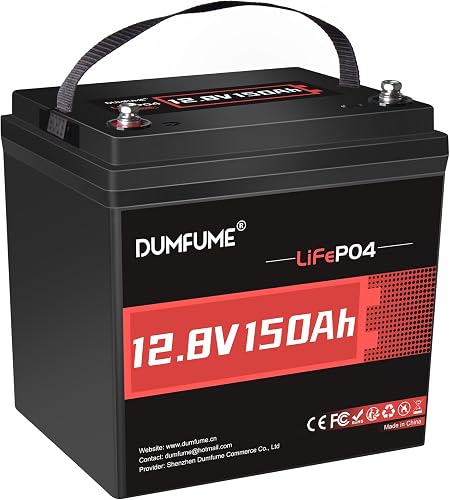
dumfume 12V 150Ah Max LiFePO4 Battery: Best for compact 12V capacity
- 12.8V 150Ah, 1920Wh
- 100A BMS
- IP65 waterproof
- Supports up to 4S4P
A compact 12V 150Ah battery with 1920Wh and IP65 waterproofing. It gives more capacity than 100Ah models in a smaller case.
Pros
- 1920Wh capacity
- Compact case for tight spaces
- IP65 waterproof design
Cons
- Not for engine starting
- Needs charging at 41 F or warmer
- Lower score than larger 12V picks
dumfume 150Ah suits 12V RV, camper van and solar systems where space is tight.
It holds 12.8V 150Ah, or 1920Wh, in a case 10.04 x 7.68 x 9.84 in.
That gives 50% more capacity than a 100Ah battery in a compact case.
The 100A BMS protects against overcharge, over-discharge, short circuit and overheating.
The case is IP65 waterproof.
dumfume lists over 4,000 cycles to 80% capacity.
It supports series and parallel connections up to 4S4P.
Battery performance needs temperatures of 5 C or higher for charging.
The Group 31 format fits boxes built for larger lead acid batteries, which helps in a camper van build.
It is for energy storage, not engine starting.
Choose it if you want more 12V capacity without a large case.
It sits between a 100Ah battery and a 314Ah battery in both energy and footprint, so it can be a middle step when a 100Ah bank runs short by a few hours each night.
Dyness 12V 100Ah LiFePO4 Lithium Battery: Best for a two-pack 12V bank
- 12V 100Ah, 2-pack
- Group 31 size
- 100A BMS, IP65
- Low-temp charging protection
A two-pack of 12V 100Ah Group 31 batteries for RV, solar and off-grid use. Two batteries give a larger bank at the start.
Pros
- Two batteries in one pack
- Group 31 size for larger boxes
- IP65 and low-temp protection
Cons
- Two batteries need space and wiring
- Not for starting
- Charging stops below 32 F
Dyness suits RV, solar and off-grid buyers who want two batteries at once.
The 2-pack gives you two 12V 100Ah batteries in BCI Group 31 size.
Each battery weighs 25.3 lb.
A+ grade cells and a 100A BMS give protection against overcharge, over-discharge, overcurrent, overheating and short circuits.
The rating includes IP65 waterproofing.
Low-temp protection stops charging below 0 C and resumes at 5 C.
You can connect up to 4 in series and 4 in parallel for a 20.48kWh bank.
That needs space, cables and a plan for wiring.
The Group 31 dimensions at 13 x 6.77 x 8.42 in suit larger battery boxes than a Group 24 case.
Use a LiFePO4-specific charger at about 0.2C for best health.
It is not for starting.
Two batteries in parallel double the amp-hours at 12V, which suits an RV or cabin that needs a full day of stored energy, while a single battery may suit a smaller nightly load.
How the best LiFePO4 batteries for solar compare
The SUPER EMPOWER 12V 100Ah is the safest first pick for a standard 12V system.
The ECO-WORTHY 314Ah wins on capacity.
The Cubix100 wins only if your system is already 48V.
| Product | Best for | Voltage | Capacity | Size | Our score |
|---|---|---|---|---|---|
| HyperPS | solar lights and small devices | 3.2V | 400mAh per cell | 1.69 x 0.55 in | 9.7 |
| DaranEner Daran Portable Power Station 89.6Wh LiFePO4 | portable solar charging | 89.6Wh | 9.7 | ||
| SUPER EMPOWER 12V 100Ah LiFePO4 Battery | most 12V solar systems | 12.8V | 100Ah | 9.5 | |
| Nermak 2 Pack 12V 10Ah Lithium Ion | small 12V loads | 12.8V | 10Ah per battery | 9.4 | |
| ECO-WORTHY 12V 314AH LiFePO4 Lithium Battery Bluetooth | large 12V off-grid storage | 12.8V | 314Ah | 9.2 | |
| ECO-WORTHY Cubix100 48V 100Ah LiFePO4 Lithium UL9540 | 48V home solar storage | 51.2V | 100Ah | 8.7 | |
| dumfume 24V 100Ah LiFePO4 Lithium Battery Built-in | 24V solar systems | 25.6V | 100Ah | 8.5 | |
| dumfume 12V 150Ah Max LiFePO4 Battery | compact 12V capacity | 12.8V | 150Ah | 10.04 x 7.68 x 9.84 in | 8.3 |
| Dyness 12V 100Ah LiFePO4 Lithium Battery | a two-pack 12V bank | 12.8V | 100Ah per battery | 8.0 |
Capacity covers a wide range here.
HyperPS cells are 400mAh each.
The DaranEner station is 89.6Wh.
Nermak batteries are 10Ah each.
The main solar banks range from 100Ah to 314Ah at 12V, 100Ah at 24V and 100Ah at 48V.
Voltage is the first filter.
Small cells are 3.2V.
Most deep cycle picks are 12.8V.
One pick is 25.6V and one is 51.2V.
Mixing voltages in one bank is not an option.
BMS protection matters for solar use.
The larger batteries list 100A or 200A BMS protection, low-temp charging cutoff and protection against overcharge and short circuit.
Check those details for cold climates.
Weight and size set real limits.
A 100Ah 12V battery is about 21 to 25 lb.
The 314Ah model is 60.4 lb.
The 48V rack battery is 103 lb.
Measure your battery box or rack before you order.
Expansion helps if your needs grow.
Several models support series and parallel wiring.
Match brand, model, capacity and BMS, and charge each battery fully before you connect them.
What the compare table does not show
The table lists headline capacity and voltage, but it does not tell you how cold charging works for each model.
Some batteries block charging below 0 C, while the 314Ah model lists a -7 C cutoff.
That difference matters for winter solar charging in an unheated shed or RV bay.
Check the low temp detail in each write-up before you decide for a cold climate.
How we compared these LiFePO4 solar batteries
We compared specs, features and buyer feedback for each model.
We checked voltage, capacity, BMS protection, size, weight and expansion limits.
We did not test them.
We looked for deep cycle use, since solar storage needs repeated cycles.
We checked cycle claims, depth of discharge notes and charging profiles.
We also checked low-temp charging protection for cold climates.
We mapped each product to a real use.
Small cells and the power station suit portable or small loads.
The 12V, 24V and 48V batteries suit RV, cabin and home systems.
We scored fit for solar storage, not just raw capacity.
We set scores from specs and features against the search for a solar battery.
A high score does not mean a product fits every system.
Voltage mismatch alone can rule out a pick.
We also checked what is included.
Some picks are batteries only.
The power station includes cables but no solar panel.
The rack battery includes cables and covers.
Plan for panels, controllers and inverters separately.
Included items affect cost and setup time.
A battery only pick needs a controller, cables and a charger.
A kit with cables still needs a panel and an inverter.
Factor those parts into your budget before you buy.
What size LiFePO4 battery do you need for solar?
Add up your daily use in watt-hours, then add room for cloudy days.
For example, a 100W load for 4 hours is 400Wh.
A 1280Wh 12V 100Ah battery covers that with room for losses.
Small loads need small batteries.
Lighting, a fish finder or a router can run on 10Ah batteries.
A fridge, lights and phones together need 100Ah or more.
Home backup needs the most capacity.
The 314Ah ECO-WORTHY holds 4019Wh.
The 48V Cubix100 holds 5120Wh.
Larger banks need larger solar arrays to refill them.
Depth of discharge also matters in sizing.
Many LiFePO4 batteries can discharge deeper than lead acid, but the BMS will still cut power at a low charge level.
Plan to use most of the listed capacity, but keep a small buffer for cloudy days.
How to estimate your daily watt-hours
List each load in watts.
Multiply watts by hours per day.
Add the totals.
Then divide by your system voltage to get amp-hours.
When 100Ah is enough
A 12V 100Ah battery holds about 1280Wh.
That suits an RV, a small cabin or backup for lights and small devices for a night.
It is a common starting size.
When to move to 150Ah or 314Ah
Choose 150Ah for more 12V capacity in a compact case.
Choose 314Ah for off-grid or home backup where one day of use is more than 2000Wh.
Check space and weight first.
Our best deep cycle battery for solar guide breaks down sizing in more detail.
If you are new to this, start with what is a deep cycle battery to learn how deep cycle storage differs from a starter battery.
Which voltage is best for a solar battery: 12V, 24V or 48V?
Pick the voltage your inverter and solar controller already use.
That choice matters more than brand.
A battery at the wrong voltage will not work in your system.
12V is common for RVs, vans and small cabins.
It works with many small inverters and chargers.
Cables carry more current at 12V, so size them correctly.
24V is a middle option for larger RV and cabin systems.
It needs less current for the same power.
The dumfume 24V 100Ah is built for that middle ground.
48V suits home systems with large inverters.
It needs less current and supports large banks.
The Cubix100 is made for 48V home storage, not for a 12V RV.
Higher voltage also affects expansion.
Four 12V batteries in series make a 48V bank, but that wiring needs matching batteries and careful connections.
A native 48V rack battery avoids that series wiring for a home system.
12V for RV and small cabin solar
12V batteries drop into standard boxes.
Group 24 and Group 31 sizes are common.
The SUPER EMPOWER and Dyness picks use those sizes.
24V for larger RV and cabin systems
24V systems use less current than 12V for the same power.
That can help with larger loads.
You need a 24V inverter and a 24V solar controller.
48V for home backup and off-grid cabins
48V systems are for stationary home storage.
They support large inverters and large banks.
Rack batteries like the Cubix100 fit this use.
If you want a kit that includes panels, see our best deep cycle battery with solar panel picks.
For charging gear, our best deep cycle battery solar charger guide covers controller and charger options.
What BMS and low-temp protection should a solar LiFePO4 battery have?
Look for a BMS that protects against overcharge, over-discharge, overcurrent and short circuit.
Those protections are standard on the larger picks here.
A 100A BMS suits most 12V banks in this roundup.
Low-temp charging protection matters in cold climates.
Charging below freezing can damage LiFePO4 cells.
Several picks block charging below 32 F and resume at 41 F.
Cell balancing helps a bank last longer.
The BMS balances cells during use and charging.
That helps keep capacity even across the pack.
Temperature ratings differ by model.
Discharge often works at colder temperatures than charging.
That split is normal, since charging a cold lithium cell is the risky step.
Check both numbers if you park the battery outdoors.
What a 100A BMS means in daily use
A 100A BMS limits current to about 100 amps.
That covers most 12V solar loads in this group.
The 200A BMS on the 314Ah model supports higher current.
Why low-temp cutoff matters
Solar charging often happens on cold, sunny mornings.
That is when cells are coldest.
A cutoff stops damage, but you may need to warm the battery before charging.
When to check terminal covers
Exposed terminals can short if a tool touches them.
The rack battery includes terminal covers.
Our best LiFePO4 battery terminal covers guide covers this small safety step.
How do you set up and charge a LiFePO4 solar battery?
Use a solar controller or charger set to a LiFePO4 profile.
Set the voltage for your battery size.
A 12V battery, a 24V battery and a 48V battery need different settings.
Charge each battery fully before first use.
Some batteries ship at partial charge for safe transport.
A full charge also helps the BMS balance the cells.
Connect batteries in series to raise voltage.
Connect them in parallel to raise capacity.
Use identical batteries, and charge them fully before you connect them.
Cable length and fuse placement matter as much as voltage.
Short, thick cables reduce voltage drop at high current.
A fuse near the positive terminal protects the bank from a short.
Series vs parallel wiring
Series adds voltage.
Parallel adds amp-hours.
Most models here allow both, up to stated limits.
Check the limit for your model before you wire a bank.
Solar controller settings to check
Confirm the controller is set to lithium mode.
Confirm the voltage matches your battery.
Confirm the current limit fits your panel array and battery.
Storage and care between seasons
Store batteries in a dry, ventilated, room-temperature space.
Charge them every few months during long storage.
Keep terminals clean and covered.
For small batteries that float in the sun, a maintainer can help.
Our best solar battery maintainer guide covers that use.
If you are comparing chemistries for a power station, read Is Lifepo4 or Nmc Battery Better for a Power Station?.
For power stations that use LiFePO4 packs, see What Is LiFePO4 Battery In Solar Generator?.
Verdict: which best LiFePO4 battery for solar should you buy?
Pick the SUPER EMPOWER 12V 100Ah if you need a standard 12V solar battery.
Pick the ECO-WORTHY 12V 314Ah if you need large 12V off-grid storage.
Pick the Cubix100 only if your system is 48V.
Pick the dumfume 24V 100Ah for a 24V cabin or RV system.
Pick the dumfume 12V 150Ah for compact 12V capacity.
Pick the Dyness 2-pack if you want two 100Ah batteries at once.
Pick HyperPS for solar lights and small devices.
Pick the DaranEner station for portable power under 100W.
Pick Nermak for small 12V loads like lighting and fish finders.
Match voltage first, then size by your daily watt-hours.
That order will save you from buying a battery that does not fit your system.
Our top 3 picks at a glance
-
1
-
2
Best for portable solar charging
DaranEner Daran Portable Power Station 89.6Wh LiFePO4
9.7/10 our score
See it on Amazon -
3
Best for most 12V solar systems
SUPER EMPOWER 12V 100Ah LiFePO4 Battery
9.5/10 our score
See it on Amazon
Frequently asked questions
What size LiFePO4 battery do I need for solar?
Start with your daily watt-hours. Add up your loads in watts and the hours you run them, then add room for cloudy days.
A 12V 100Ah battery holds about 1280Wh before losses.
If that is less than one day of use, move to 150Ah, 200Ah or 314Ah models.
Can I mix 12V, 24V and 48V batteries in one system?
No. Keep one system voltage.
Your solar controller, inverter and chargers must match the battery voltage.
You can add identical batteries in series or parallel within the limits stated for that model, but do not mix voltages.
Do I need a special charger for LiFePO4 solar batteries?
Yes. Use a charger or solar controller set to a LiFePO4 profile, with the correct voltage for your battery.
A lead-acid setting may stop too early or charge at the wrong voltage.
Check the battery guide for the exact profile.
Can LiFePO4 batteries charge in cold weather?
Most models here block charging below 32 F to protect the cells. Discharge works at colder temperatures, but charging does not.
In winter, bring the battery indoors or warm the space before you charge it.
Are LiFePO4 batteries good for repeated solar cycles?
Yes. LiFePO4 chemistry is chosen for deep cycle solar use because it handles repeated charge and discharge cycles well.
Models here list thousands of cycles.
Use a correct LiFePO4 profile and avoid charging below freezing.