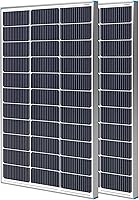
9 Best Rigid 400W Solar Panels (November 2026)
The best 400w rigid solar panels for off-grid mounting include the Callsun N-Type 16BB 400W Bifacial Solar Panel for 60V power stations and RV roofs, the HQST 400W Solar Panel for long service life, and the Renogy 400W Solar Panel ShadowFlux for partial shade.
On this page (9 sections)
- How we compared these rigid 400W solar panels
- The best rigid 400W solar panels in detail
- Compare the best 400W rigid solar panels side by side
- How many watts do you need for a fixed off grid system?
- How should you wire rigid panels in series or parallel?
- Is bifacial worth it on a rigid roof mount?
- How do shade tolerance and cell type affect daily output?
- What size and weight limits should you check before mounting?
- Verdict: which rigid 400W solar panels should you buy?
The best 400w rigid solar panels for most buyers are the Callsun pair at the top of this list, because you get 400W from two compact 200W bifacial panels that suit 60V power station inputs. The Renogy ShadowFlux pair suits shady roofs, and a single JJN 425W panel suits a large home rooftop.
Fixed mounting changes the buying logic. Rigid panels stay in place for years, so frame strength, mounting holes and shade tolerance matter more than folding convenience.
Size and efficiency matter on a tight RV roof. A panel must clear vents and hatches, while higher efficiency helps fit more watts in the space left.
If you are still deciding on panel type, start with what is the best solar panel before you narrow to 400W. That guide separates fixed roof panels from portable and flexible options.
Our picks at a glance
-
1
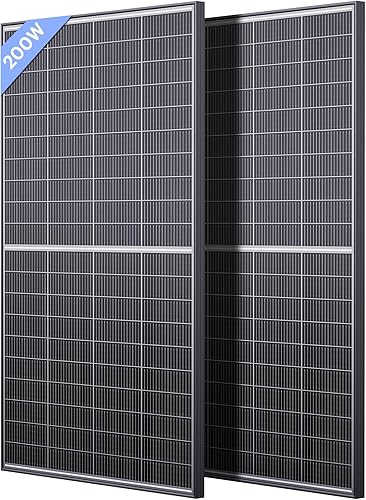 Best for 60V power stations and RV roofs
Callsun N-Type 16BB 400W Bifacial Solar Panel
9.6/10 our score
See it on Amazon -
2

-
3
- 4
 Check it
Ecosonique Technology 400W Portable Solar Panel for Power
Best portable 400W option - 5
 Check it
Renogy Solar Panels 400 Watt N-Type
Best for Class B vans - 6
 Check it
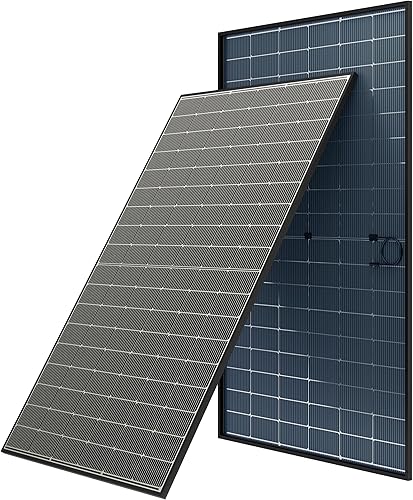
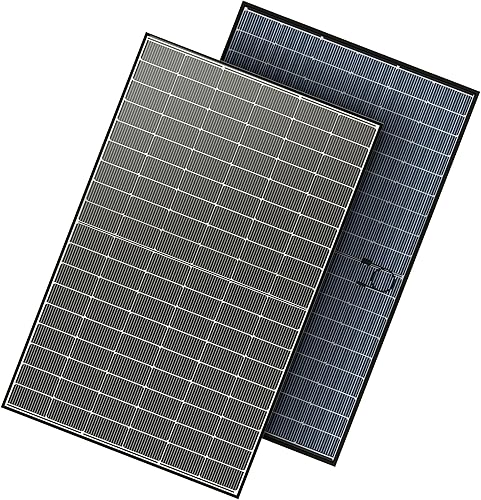
JJN Bifacial 2Pcs 425 Watt N-Type Solar
Best for high total wattage - 7
 Check it
JJN Bifacial 425 Watt N-Type Solar Panel
Best single large panel - 8
 Check it
DOKIO 400W 31V Monocrystalline Solar Panel
Best simple single 400W panel - 9
 Check it
AeternaSol 400 Watt Solar Panel
Best compact bifacial pair
How we compared these rigid 400W solar panels
We compared specs, features and buyer feedback against what a fixed-mount buyer needs. Our score weighs efficiency, size, weight and long term output claims.
We checked each panel's stated wattage, efficiency, dimensions and weight. We also checked cell type, bifacial design, shade features and waterproof ratings.
Buyer patterns helped where specs tied.
Wattage alone did not decide the order. A 425W single panel and an 850W pair rank lower for many buyers because size and weight limit where they can be mounted.
A 400W pair ranks higher for RV and van buyers because it splits power across two manageable panels.
We also checked wiring limits in the product data. Series pairs raise voltage, parallel pairs raise current, and single large panels can push controller limits in a different way.
That detail matters for 12V battery banks and for portable power stations with a stated solar input range. For plug-in setups, see our 400W plug-in solar system guide.
No panel here was tested hands on. Claims about service life and warranties are labelled with the brand that makes them.
What we did not count
We did not add price, rating or test claims that were not in the product data. We also did not treat a bifacial gain claim as a promise for every roof, because rear capture depends on clearance and reflection below the panel.
The best rigid 400W solar panels in detail
Callsun N-Type 16BB 400W Bifacial Solar Panel: Best for 60V power stations and RV roofs
- 2 x 200W N-Type 16BB panels
- 25.6% efficiency
- Bifacial transparent backsheet
- Dual-module anti-shade design
- 51.3 x 30.3 x 1.4 in per panel
- 23.8 lb per panel
Two compact 200W bifacial panels pair in series to 400W for RV, van, marine and rooftop off-grid systems, with shade tolerance built into each panel.
Pros
- High 25.6% efficiency
- Series pair suits 60V input limits
- Bifacial rear capture
- Pre-drilled mounting holes
Cons
- Two panels to mount and wire
- Rear gain needs reflective ground or roof clearance
This suits RV, van, marine and rooftop buyers who want 400W without one oversized panel. Each panel is 51.3 x 30.3 inches and 23.8 lb, so two panels fit many Class B roofs and leave room for other gear.
The 1.4 inch thickness is thicker than some rivals, so check mount height and roof load.
The pair connects in series to reach 400W at 47.48V, with 54.62V open circuit voltage and 8.43A operating current. That fits many portable power stations with 60V class inputs, so the MPPT controller can work in a stronger voltage range.
Each panel uses N-Type 16BB cells at 25.6% efficiency, with a low temperature coefficient of -0.30%/K for hot climates.
Bifacial rear capture adds energy from reflected and diffuse light through a transparent backsheet. The dual-module design splits each panel into two sections, so shade on one section does not stop the other from generating.
The trade-off is two panels to mount and wire, plus rear gain that needs clearance.
HQST 400W Solar Panel: Best for long service life
- 2 x 200W N-Type 16BB panels
- Up to 25.4% efficiency
- 30-year service life at 87.4% output
- 30.1 x 46.3 x 1.2 in per panel
- 20.17 lb per panel
- IP65 waterproof
A lighter pair of 200W N-Type panels for Class B vans and tight roofs, with Grade A+ EL-tested cells and stronger low light response.
Pros
- Lightest pair here at 20.17 lb per panel
- 30-year stated service life
- Low light performance
- Fewer mounts than 100W panels
Cons
- Two panels to mount
- IP65 rather than IP68
This suits Class B van owners who care about weight and long term output. Each panel is 30.1 x 46.3 inches and 20.17 lb, the lightest pair here at about 40 lb total.
That lower weight helps on small van roofs and makes lifting and aligning panels safer during install.
HQST uses N-Type 16BB Grade A+ cells at up to 25.4% efficiency, with all cells EL tested for microcracks and hidden defects. It says the panel delivers 87.4% output after 30 years, longer than the 25 year claims on other picks.
The 16BB design improves current collection versus older 9BB or 5BB layouts, which helps reduce hot spots and resistance.
Low light response helps on cloudy days and early mornings, when N-Type cells tend to hold output better. Fewer mounts than four 100W panels also means fewer cables and fewer parallel connection losses.
The frame is rated for 2400 Pa wind and 5400 Pa snow loads, with IP65 waterproof protection.
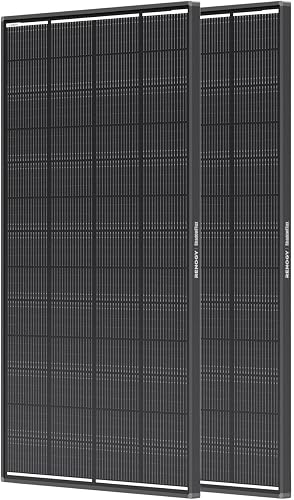
Renogy 400W Solar Panel ShadowFlux: Best for partial shade
- 2 x 200W ShadowFlux panels
- 25% high-efficiency N-Type cells
- Anti-shading ShadowFlux technology
- IP67-rated design
- 23.8 lb per panel
- 36.5V maximum voltage
Two 200W panels built around ShadowFlux anti-shading, aimed at roofs and boats where trees, rigging or vents cast moving shadows.
Pros
- Anti-shading design for spots and patches
- Compact versus traditional PERC
- IP67-rated
- 25-year power output warranty at 80%
Cons
- Best results need over half the panel in sun
- MPPT controller recommended
This suits boats, RVs and roofs where shade moves across the panel through the day. Renogy's ShadowFlux technology aims to keep generating when spots, lines or patches of shade hit cells, from leaves and bird droppings to rigging, vents and branches.
Each 200W panel uses N-Type 16BB cells at 25% efficiency. The pair is 7% smaller and 10% more compact than traditional PERC panels, which helps on space limited roofs.
The stated maximum voltage is 36.5V, with 6.86A capacity, so controller input range should be checked before wiring. Renogy recommends an MPPT controller with at least 50V input and over 10A charging current.
The IP67 design resists rain, snow, dust and small hail, with encapsulation against water vapour. Renogy backs it with a 5 year materials warranty and a 25 year power output warranty at 80%.
Best results need over half the panel in direct sun.
Ecosonique Technology 400W Portable Solar Panel for Power: Best portable 400W option
- 400W foldable 6-fold design
- 23.5% conversion rate
- 40V maximum voltage
- 20.3 lb in hand-carry form
- Folded size 26 x 22 x 3 in
- MC4 cable included
A foldable 400W panel for power stations rather than a fixed roof, with kickstands and cables for camping and backup use.
Pros
- Folds for transport and storage
- Kickstands for sun angle
- Cables included for common power stations
- Light to carry
Cons
- Not a rigid fixed-mount panel
- Lower efficiency than N-Type rigid picks
This suits campers and backup buyers who need 400W without permanent mounting. It folds to 26 x 22 x 3 inches and 20.3 lb, so it carries like a suitcase and stores in a car boot or closet.
That format targets power stations rather than a fixed roof.
The 23.5% conversion rate and 40V output suit EcoFlow, Jackery, Bluetti and Anker power stations. A 3 m MC4 cable and a 0.5 m MC4 adapter cable for XT60, Anderson and DC8020 connections are included, which covers common inputs without extra parts.
The 10A amperage capacity and 158°F upper temperature rating also help with controller matching.
Six angle kickstands help you chase the sun through the day by tilting the folded sections. Auto-restart resumes charging after an interruption, and smart protection adds safer use.
The trade-off is clear: this is portable, not rigid.
Renogy Solar Panels 400 Watt N-Type: Best for Class B vans
- 2 x 200W N-Type panels
- 25% cell efficiency
- 16BB cell technology
- 49.7 x 30.1 x 1.2 in per panel
- IP67
- Low temperature coefficient for hot climates
A compact 400W pair aimed at Class B vans, with 24V system suitability and steady output in hot weather.
Pros
- 7.5% smaller and 11.7% lighter than predecessor
- Works in 12V and 24V systems
- Hot climate performance
- 25-year 80% output warranty
Cons
- Two panels to mount
- Charge controller and battery still needed
This suits Class B van and cabin buyers who want a proven brand in a compact pair. Each panel is 49.7 x 30.1 inches, 7.5% smaller and 11.7% lighter than its predecessor.
That smaller footprint helps on vans where roof space is tight and every inch competes with fans, vents and skylights.
The 25% cell efficiency and 16BB design reduce microcrack risk and support better conversion in heat. Renogy says the panel suits 12V and 24V systems, including lithium, AGM and deep cycle batteries.
The stated maximum voltage is 37.44V, with a 24V output listing, so the 24V label refers to system suitability rather than panel voltage.
A low temperature coefficient helps output stay steadier in hot weather. Renogy states degradation of no more than 1% in year one and 0.4% each year after, with 80% output after 25 years.
Check controller voltage first, since Renogy states a maximum PV input of at least 40V for a single panel.
JJN Bifacial 2Pcs 425 Watt N-Type Solar: Best for high total wattage
- 2 x 425W panels, 850W total
- 25% high efficiency
- Bifacial transparent backsheet
- N-Type 16BB cells
- 44.7 x 67.8 in per panel
- 94.6 lb total
Two large 425W bifacial panels for rooftops and ground mounts where roof space allows, reaching 850W in total.
Pros
- Highest total wattage here
- Bifacial rear capture up to 25% more
- UL 61730
- 30-year transferable power output warranty
Cons
- Very large and heavy
- Needs large roof or ground mount
This suits home rooftop and farm buyers with space for large panels. Each panel is 44.7 x 67.8 inches, and the pair weighs 94.6 lb in total.
That size needs a large clear roof area or a ground mount, with two people for safe lifting.
Together they deliver 850W, almost double a 400W pair. Bifacial capture can add up to 25% more energy than conventional panels under reflective conditions, through a transparent backsheet.
The output voltage is listed at 31.05V, with 13.78A capacity, so a controller must accept the combined current in your chosen wiring layout.
N-Type 16BB cells reduce shade impact compared with older 9BB and 10BB designs. The black corrosion resistant frame and junction box are rated for 2400 Pa wind and 5400 Pa snow loads, with IP65 junction box and IP68 connectors.
JJN provides a 30 year transferable power output warranty.
JJN Bifacial 425 Watt N-Type Solar Panel: Best single large panel
- Single 425W panel
- 25% high efficiency
- Bifacial transparent backsheet
- N-Type 16BB cells
- 44.7 x 67.8 in
- 51.6 lb
One large 425W bifacial panel for a home rooftop or farm mount, simpler to wire than a pair but harder to handle.
Pros
- Single panel wiring
- 425W from one unit
- UL 61730
- 30-year power output warranty
Cons
- 51.6 lb and about 68 in long
- Needs wide roof space
This suits a single panel home rooftop or ground mount where you want fewer wires. It delivers 425W from one panel at 25% efficiency, so wiring is simpler than a pair and there are fewer branch connections to check.
The bifacial transparent backsheet captures front and rear light. JJN says rear gain can reach 25% more efficiency in suitable reflective conditions, which suits light roofs, raised mounts and ground mounts with reflective ground.
The panel uses N-Type 16BB cells, which reduce shade impact versus older 9BB and 10BB designs.
At 44.7 x 67.8 inches and 51.6 lb, this panel needs wide roof space and careful handling. Pre-drilled holes help with rails and tilt mounts, and the frame is rated for 2400 Pa wind and 5400 Pa snow loads.
JJN provides a 30 year transferable power output warranty.
DOKIO 400W 31V Monocrystalline Solar Panel: Best simple single 400W panel
- Single 400W panel
- 31V output, 37.08V maximum
- 3 m MC4 leads
- 67.8 x 44.6 x 1.2 in
- 49.4 lb
- Pre-drilled mounting holes
One straightforward 400W monocrystalline panel with long built-in leads for sheds, greenhouses and cabins.
Pros
- One panel, fewer connections
- Long 3 m leads
- Replaces four 100W panels
- Mounting friendly holes
Cons
- Lower efficiency stated than N-Type picks
- Heavy at 49.4 lb
This suits sheds, greenhouses and cabins where one simple panel is easier than a pair. It delivers 400W at 31V output from a single 67.8 x 44.6 inch frame, with 37.08V maximum voltage and 13.24A capacity.
One panel means one mount location, one set of leads and fewer wiring choices to get wrong.
Built-in 3 m MC4 leads reach farther than short lead panels. That can remove extension cables and extra joints between panel and controller, which reduces connection points that can loosen over time.
The panel also replaces four 100W panels, so there is less hardware to buy and wire across a roof.
Pre-drilled holes align with common Z-brackets, rails and tilt mounts for sheds and greenhouses. The tempered glass and aluminium frame with sealed junction box suit outdoor rain and splashes in yard settings.
The trade-off is lower stated efficiency than the N-Type picks and a 49.4 lb lift.
AeternaSol 400 Watt Solar Panel: Best compact bifacial pair
- 2 x 200W bifacial panels
- 25.6% high efficiency
- N-Type 18BB cells
- 52.76 x 26.38 x 1.18 in per panel
- IP68 waterproof
- Standard MC4 plugs
Two narrow 200W bifacial panels for Class B vans and tight roofs, with IP68 sealing and MC4 expansion.
Pros
- Narrow format for tight roofs
- Bifacial gain up to 15% in reflective conditions
- IP68 waterproof
- Easy expansion with MC4
Cons
- Fewer buyer reports than established brands here
- Two panels to mount
This suits Class B vans and tight roofs where a narrow panel fits better. Each panel is 52.76 x 26.38 inches, slimmer than most pairs here, which can help where roof width is the limit.
That narrow shape changes how you space mounts, so measure rails and walk paths before you order.
The 25.6% efficiency and N-Type 18BB cells match the top score on paper. The stated maximum voltage is 25.18V per panel, with 23.04V output and 10.05A capacity, so series and parallel choices need care with controller limits.
A+ monocrystalline silicon and 18 busbars aim to limit microcrack risk and degradation.
Bifacial design can add up to 15% more energy under optimal reflective conditions, and IP68 sealing helps in rain, humidity and marine use. Standard MC4 plugs make expansion simpler.
The trade-off is fewer buyer reports than Renogy or HQST.
Compare the best 400W rigid solar panels side by side
| Product | Best for | Maximum power | Efficiency | Size per panel | Our score |
|---|---|---|---|---|---|
| Callsun N-Type 16BB 400W Bifacial Solar Panel | 60V power stations and RV roofs | 400 watts | 25.6% | 51.3 x 30.3 x 1.4 in | 9.6 |
| HQST 400W Solar Panel | long service life | 200 watts per panel | 25.4% | 9.5 | |
| Renogy 400W Solar Panel ShadowFlux | partial shade | 400 watts | 25% | 9.4 | |
| Ecosonique Technology 400W Portable Solar Panel for Power | portable 400W option | 400 watts | 23.5% | 9.1 | |
| Renogy Solar Panels 400 Watt N-Type | Class B vans | 400 watts | 25% | 49.7 x 30.1 x 1.2 in | 9.0 |
| JJN Bifacial 2Pcs 425 Watt N-Type Solar | high total wattage | 850 watts | 25% | 44.7 x 67.8 in | 8.9 |
| JJN Bifacial 425 Watt N-Type Solar Panel | single large panel | 425 watts | 25% | 8.8 | |
| DOKIO 400W 31V Monocrystalline Solar Panel | simple single 400W panel | 400 watts | 8.2 | ||
| AeternaSol 400 Watt Solar Panel | compact bifacial pair | 200 watts per panel | 25.6% | 52.76 x 26.38 in | 7.8 |
The table shows the main split in this list. Pairs of 200W panels dominate for RV and van roofs, while single 400W and 425W panels suit larger roofs and ground mounts.
Total wattage is not the only column that matters, because weight and footprint decide whether a panel can be fitted at all.
Efficiency also varies by a small margin that still matters. The Callsun and AeternaSol pairs list 25.6%, HQST lists 25.4%, and the Renogy and JJN picks list 25%.
On a tight roof, that gap can decide how many watts fit in the same area. On a large roof, wiring and warranty may matter more.
How to read the size column
A panel that is about 68 inches long needs a clear run of roof in that direction. A pair of 200W panels at about 46 to 52 inches each can split across a roof in more layouts.
Measure both length and width, and leave room for mounts at the edges.
How to read the weight column
Weight matters for roof load and for safe lifting. Two 200W panels at about 20 to 24 lb each are easier to carry than one 425W panel at 51.6 lb.
Check your roof limit and plan help for any lift over 40 lb.
How many watts do you need for a fixed off grid system?
One 400W pair suits many RVs, vans and cabins, because it charges a battery bank in a few good sun hours. Larger homes and farms often need 800W or more.
Start with daily use in watt-hours, not just peak watts. Add up a normal day first, and include losses from the controller, wiring and battery charging.
Then size the battery bank for at least one cloudy day. Panels refill the bank, but they do not replace storage for night use.
Season also matters for fixed mounts. Winter days are shorter and sun angles are lower, so size for the low season rather than the best day.
If you are comparing smaller roof options, our best rigid solar panel 100w guide shows how four 100W panels compare with one 400W pair. For broader framed options, see best rigid solar panels.
Do you need one panel or a pair?
One panel means fewer wires and one mount. A pair of 200W panels means easier lifting and more layout choices on a small roof.
A pair can also split around a vent or hatch, while one large panel must avoid that obstacle completely.
What about panels over 400W?
Single 425W panels and 850W pairs suit large roofs. They need stronger mounts and controllers that accept higher voltage or current.
Check controller input limits before you assume a larger panel is a simple upgrade.
How should you wire rigid panels in series or parallel?
Series wiring raises voltage, and parallel wiring raises current. Your controller sets the limit for both choices.
For a 12V system, parallel wiring often gives smoother charging. Series wiring needs a controller with a high enough input voltage.
Cold weather can raise open circuit voltage, so leave headroom below the controller maximum.
The Callsun pair is built for series use at about 54.6V open circuit, which fits 60V power station inputs. The Renogy ShadowFlux pair needs an MPPT controller.
The DOKIO single panel lists 37.08V maximum, which suits a different controller range than a series pair.
If you want panels and hardware together, check best 400w solar panel kit to see what a bundled setup includes.
Which wiring suits a portable power station?
Series wiring suits many 60V class power stations. Check the stated solar input limit before you connect two panels.
The Callsun pair at 54.62V open circuit is designed for that range, while a parallel pair would stay at single panel voltage.
Which wiring suits a 12V battery bank?
Parallel wiring often suits 12V banks. It keeps voltage lower and adds current from each panel.
That choice can simplify controller selection, but it needs thicker wiring for higher current.
Is bifacial worth it on a rigid roof mount?
Bifacial panels capture light from front and rear, so they can add energy over a reflective roof or ground mount. Gain is not automatic on every roof.
A light colored roof with mounting clearance gives the best rear capture. A dark flat roof with no gap gives little rear gain.
Snow, sand and light gravel can help, but snow can also cover the front of the panel.
The Callsun, JJN and AeternaSol picks use bifacial design. The HQST and Renogy picks focus on efficiency and shade tolerance instead.
Neither approach is wrong, because the best choice depends on your roof surface and mount height.
What roof conditions help bifacial panels?
Light roofs, raised mounts and snowy ground help rear capture. Snow reflects strongly, but it can also cover the front.
A tilt mount on a ground array often gives more rear gain than a flush RV roof.
When should you skip bifacial?
Skip it for a flush dark roof with no clearance. A standard high efficiency panel may be simpler and cheaper to mount.
If rear light cannot reach the backsheet, you pay for a feature you cannot use.
How do shade tolerance and cell type affect daily output?
N-Type 16BB cells are common here because they convert light efficiently and reduce hot spot risk. Shade still cuts output on any panel.
ShadowFlux and dual-module designs limit shade loss. They help when a vent, mast or tree branch blocks part of a panel.
The Callsun dual-module design splits each panel into two sections, while Renogy ShadowFlux targets spots, lines and patches across the cell layout.
Keep over half the panel in direct sun where you can. No shade feature replaces good placement.
A panel in full sun on a lower efficiency model can still beat a shade tolerant panel placed in part shade.
Are N-Type panels better than older cell types?
N-Type cells here offer up to 25.6% efficiency and strong low light response. They also tend to degrade more slowly over years, with stated degradation limits in several product listings.
How should you handle a shady roof?
Move the mount point first, then choose a shade tolerant panel. A panel in full sun often beats a shade tolerant panel in shade.
Check moving shadows through the day, not just at noon.
What size and weight limits should you check before mounting?
Measure length, width and roof clearance before you order. A panel that is 68 inches long needs a clear run of roof.
Weight matters for RV roofs and for lifting panels safely. Two 200W panels are easier to carry than one 425W panel.
Wind load also rises with panel area, so mounts must suit the full size of the frame.
For a lower wattage comparison, see Best 400W Solar Panel for single panel ratings. For camping use, see Best Solar Panel For Camping.
How much roof space does a 200W panel need?
Most 200W panels here are about 46 to 52 inches long. Leave space for mounts, wiring and walking access.
A panel that fits on paper can still fail on a real roof if a vent sits in the middle.
How heavy is too heavy for an RV roof?
Pairs here range from about 40 lb to 48 lb total. Check your roof load limit and use help for lifts over 40 lb.
The JJN pair at 94.6 lb total is in a different class and suits a home roof or ground mount.
Verdict: which rigid 400W solar panels should you buy?
Buy the Callsun pair for the best overall fixed mount, buy HQST for long service life, and buy Renogy ShadowFlux for shade. Buy JJN for a large home roof, and buy DOKIO for one simple panel.
For a Class B van, the HQST and Renogy pairs offer the best mix of size and weight. For a portable power station with a 60V input, the Callsun series pair matches the wiring limit in the product data.
For a boat or a roof with moving shade, ShadowFlux is the clearest fit. For a home rooftop with wide clear space, the JJN 425W single panel or 850W pair gives the most watts per panel, with bifacial capture as a bonus where reflection reaches the rear.
Match the panel to your roof space, controller limit and battery size before you compare extra features. The best 400w rigid solar panels are the ones that fit your mount, wiring and daily power needs without forcing a controller upgrade.
Our top 3 picks at a glance
-
1
Best for 60V power stations and RV roofs
Callsun N-Type 16BB 400W Bifacial Solar Panel
9.6/10 our score
See it on Amazon -
2
-
3
Frequently asked questions
How many 400W rigid panels do I need for an RV?
Start with your daily watt-hour use and battery size, then match panel wattage to your charge controller limit. One 400W pair suits many Class B vans and small RVs.
Larger coaches may need two pairs, so check roof space, controller input and battery capacity before adding panels.
Can I wire 400W rigid panels in series or parallel?
Yes, and the choice changes voltage or current. Series raises voltage while current stays near one panel, and parallel raises current while voltage stays near one panel.
Check your controller maximum input voltage and current before choosing, especially for 12V systems.
Do bifacial rigid panels work on a roof?
Bifacial panels can capture rear light on a roof if there is clearance and reflective material below. Gain depends on roof color, mounting height and ground reflection.
On a flat dark roof with little gap, expect little rear gain, so treat bifacial as a bonus rather than a promise.
What does 400W mean on a rigid panel?
400W is the lab rating under Standard Test Conditions with ideal sun and temperature. Real output falls with heat, angle, shade, wiring loss and controller efficiency.
That drop is normal and does not mean the panel is defective, so compare panels by efficiency and size as well as wattage.