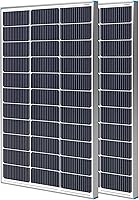
9 Best Rigid 100W Solar Panels (November 2026)
The best rigid 100w solar panels include the Renogy Solar Panels 100W 2PCS for mini van expansion, the Renogy Solar Panels 200 Watt N-Type for Class B vans, and the HQST 100W 12V Solar Panel for square roofs.
On this page (9 sections)
- The best rigid 100W solar panels, ranked
- How do these rigid 100W panels compare?
- How many watts do you need for a 12V battery system?
- Is a 100W rigid panel or a 200W rigid panel better?
- What do efficiency and BB cell design mean?
- How do you mount a rigid solar panel?
- How do you wire rigid panels in series or parallel?
- What size rigid panel fits your roof?
- Which rigid panel should you buy?
The best rigid solar panel 100w for most buyers is the Renogy 2PCS set, because you get two 100W N-Type panels at 25% efficiency for 12V battery systems.
A single 100W panel from HQST, JJN or Rvpozwer fits ledges and small roofs where two panels will not fit.
Rigid panels stay fixed in place.
That makes them a fit for RV roofs, marine decks, cabins, barns and sheds.
Flexible panels suit curved surfaces.
Framed rigid panels suit flat mounts and long service outdoors.
If you are still deciding what type fits your load, start with what is the best solar panel.
That guide explains panel types in plain terms.
Then return here to compare framed options.
Our score weighs specs, features and buyer feedback against what you are shopping for.
We compared size, efficiency, cell design, weather ratings and panel count.
We did not test panels.
Our picks at a glance
-
1

-
2

-
3

- 4
 Best for 2-piece 100W setsCheck it
- 5
 Best for simple single panelsCheck it
- 6
 Check it
JJN Bifacial 200 Watt Solar Panel
Best for bifacial output - 7
 Check it
EF ECOFLOW 2PCS 100W 12V Solar Panels
Best for EcoFlow kits - 8
 Best for 18BB single panelsCheck it
- 9
 Check it
Rvpozwer 200 Watt Solar Panel 18BB
Best for 200W 18BB value
The best rigid 100W solar panels, ranked
The Renogy 2PCS leads because pair buying is simple.
HQST follows for a single square panel.
The rest split by single versus pair, 100W versus 200W, and 23% versus 25% efficiency. For a larger plug-in setup, see 400W solar panel system options.
Renogy Solar Panels 100W 2PCS: Best for mini van expansion
- 2 x 100W N-Type panels
- 25% conversion efficiency
- 16BB cell technology
- IP67 rating
- 34.1 x 22.8 x 1.2 in per panel
Two compact 100W N-Type panels for 12V systems, suited to tight roofs and expandable setups.
Pros
- Two panels in one set
- 25% N-Type efficiency
- Compact and lighter design
Cons
- Needs roof space for two panels
- Mounting hardware not listed as included
The Renogy 2PCS suits a mini van, truck camper or small trailer where you want room to add power later. Each panel is 34.1 x 22.8 x 1.2 inches and rated 100W.
Two panels give 200W for 12V battery systems. Renogy says the N-Type cells reach 25% conversion efficiency, which is 2 points above the 23% panels here.
The 16BB design is meant to cut hot spot and microcrack risk. Renogy also cites a low temperature coefficient of -0.29%/C, so output falls less in heat.
The pair is 11% smaller and 8% lighter than its predecessor, per Renogy. That helps on tight roofs and on vans where weight adds up fast.
The frame is corrosion-resistant aluminum alloy, over 1.1mm thick in the description. The glass is low-iron tempered glass, and Renogy rates the panel IP67.
Specs list 5.31A, 22.79V maximum and a 5-year material and workmanship warranty. Trade-off is that two panels need two clear mounting spots, so measure roof length and walk paths first.
Renogy Solar Panels 200 Watt N-Type: Best for Class B vans
- 200W N-Type panel
- 16BB 25% efficiency
- 24V system panel
- IP67 rating
- 49.7 x 30.1 x 1.2 in
One larger 200W N-Type panel that replaces two 100W panels where roof length allows.
Pros
- 200W from one panel
- Smaller and lighter than prior models
- Works with 12V and 24V battery systems
Cons
- Long 49.7 in footprint
- Not a 100W panel for exact match setups
This Renogy 200W panel suits Class B vans and larger RV roofs where one 200W panel beats two 100W panels. It is 49.7 x 30.1 x 1.2 inches and weighs 23.4 pounds.
That long shape needs a straight roof run. Renogy rates it at 25% efficiency with 16BB N-Type cells, so power per area matches the Renogy 100W pair.
It is listed as a 24V system panel, with 37.44V maximum and 6.85A. Renogy says it works with 12V and 24V battery systems, including lithium, AGM and deep-cycle batteries.
Renogy says this size is 7.5% smaller and 11.7% lighter than prior models. That matters when you lift it onto a van roof alone.
The frame and glass are built for outdoor use, and Renogy rates it IP67. Renogy also cites low degradation and a 10-year output commitment, with 25-year 80% output.
Trade-off is that it is not a 100W panel. If you plan a 100W array, this changes your controller, wiring and roof math.
HQST 100W 12V Solar Panel: Best for square roofs
- 100W 12V panel
- 9BB Grade A+ cells
- 23% efficiency
- IP65 connectors and junction box
- 31.8 x 27.5 x 1.18 in
One square 100W panel built for limited roof areas and simple mounting.
Pros
- Square shape fits confined roofs
- Pre-drilled mounting holes
- 2400Pa wind and 5400Pa snow load ratings
Cons
- 23% efficiency, below 25% N-Type picks
- Single panel only
The HQST suits a small roof where shape matters more than the last 2 points of efficiency. It is 31.8 x 27.5 x 1.18 inches, so its near-square form can fill a space a long panel cannot.
HQST rates it at 23% efficiency. The cells are 166mm Grade A+ cells with 9BB design, and HQST says it uses 100% EL testing to check for cracks.
The panel is a 12V, 100W monocrystalline module, model HSP100DL-36. That makes it a clean single-panel choice for a small battery bank.
The frame is anti-corrosion aluminum alloy. HQST gives 2400Pa wind load and 5400Pa snow load ratings for harsh sites.
Connectors and the junction box are IP65 rated for rain and splashes. HQST also cites 5-year product assurance and 80% output retention after 25 years.
Pre-drilled holes on the back help with mounting, and HQST says it works with HQST Z brackets and tilt mounts, sold separately. Trade-off is that 23% trails the 25% N-Type picks.
Rvpozwer 100W Solar Panel: Best for 2-piece 100W sets
- 100W 18BB N-Type panels
- 25% conversion efficiency
- 12V/24V use
- Pre-drilled back holes
- 2400Pa wind and 5400Pa snow loads
A 2-piece 100W N-Type option with 18BB cells and a framed rigid build.
Pros
- 18BB N-Type design
- 25% efficiency
- Two-panel flexibility
Cons
- Packed dimensions are not panel dimensions
- Panel count wording needs care
This Rvpozwer 2-piece option suits buyers who want 18BB N-Type cells at 100W per panel. It is listed for 12V/24V use, with a 20.52V maximum and 4.87A per panel specs.
The frame is electroplated aluminum with tempered glass. Rvpozwer rates it at 25% conversion efficiency, matching the 16BB Renogy tier.
The 18BB design is the main selling point here. Rvpozwer says it improves cell strength and service life compared with 5BB or 10BB designs.
Rvpozwer gives 2400Pa wind and 5400Pa snow load ratings. It says service life can exceed 30 years, with a 3.2mm tempered glass and TPT backsheet build.
Pre-drilled holes on the back help with bracket mounting. That suits RV, boat, marine, trailer and farm roofs.
Trade-off is that the size listed is a packed size, not a clear panel footprint, so measure the actual panel before roof planning. Note the cap of 3 panels in parallel or 3 in series.
JJN 100 Watt Solar Panels: Best for simple single panels
- 100W monocrystalline panel
- 10BB cells
- 23% efficiency
- IP65 junction box, IP67 connectors
- 38.2 x 22.7 x 1.2 in
A straightforward single 100W rigid panel for RV, home and off-grid charging.
Pros
- Single panel, no pairing needed
- Pre-drilled mounting holes
- Solar panel only keeps setup simple
Cons
- 10BB design, not 16BB or 18BB
- 23% efficiency
The JJN 100W suits a buyer who wants one simple rigid panel with no pairing math. It is 38.2 x 22.7 x 1.2 inches and weighs 13.7 pounds.
The black frame is aluminum, with monocrystalline silicon and tempered glass. JJN rates it at 23% efficiency with 10BB cells.
It is listed as a 12V panel, with 20.8V maximum, 17.5V output and 6.42A. That voltage range suits common 12V charge controllers.
JJN says it can make up to 500Wh per day with 5 hours of direct sun. At 100W, that gives a simple daily estimate for sizing.
The junction box is IP65 rated and connectors are IP67 rated. JJN gives 2100Pa wind and 5100Pa snow load ratings, a bit below the 2400Pa and 5400Pa tier.
Pre-drilled holes help with mounting, and the listing is solar panel only. Trade-off is that 10BB and 23% place it below the 16BB and 18BB 25% picks.
JJN Bifacial 200 Watt Solar Panel: Best for bifacial output
- 200W bifacial panel
- 16BB N-Type cells
- 25%+ efficiency
- Transparent backsheet
- 30.3 x 1.18 x 53.7 in
A 200W bifacial panel that can make power from front and back.
Pros
- Bifacial design
- 16BB N-Type cells
- Black corrosion-resistant frame
Cons
- 200W, not 100W
- Needs rear light to use bifacial gain
This JJN bifacial panel suits roof setups where rear light can reach the back of the panel. It is a 200W panel with a transparent backsheet, so front and rear can both make power.
JJN rates it at 25%+ efficiency with 16BB N-Type cells. That puts it in the top efficiency tier here, above the 23% panels.
It is 30.3 x 1.18 x 53.7 inches in listed size and weighs 23.2 pounds. Specs list 28.1V maximum, 23.4V output and 9.12A, so check controller voltage limits.
The frame is black corrosion-resistant aluminum. JJN gives 2400Pa wind and 5400Pa snow load ratings for exposed roofs.
Connectors are IP67 rated and the junction box is IP65 rated. JJN cites a 10-year workmanship warranty and over 88.9% output at 30 years.
Pre-drilled holes help with mounting. Trade-off is that bifacial gain needs light behind the panel, so a flat RV roof mount will use little of it.
EF ECOFLOW 2PCS 100W 12V Solar Panels: Best for EcoFlow kits
- 2 x 100W 12V panels
- 23% conversion efficiency
- IP68 waterproofing
- Pre-drilled holes
- 38.6 x 23 x 1.2 in per panel
Two 100W rigid panels aimed at EcoFlow Power Kits and similar 12V setups.
Pros
- Two panels included
- IP68 waterproofing
- Fits EcoFlow ecosystem
Cons
- Mounting accessories sold separately
- 23% efficiency
The EcoFlow pair suits buyers already in the EcoFlow Power Kits ecosystem. It includes two 100W 12V rigid panels, model EF-SG-M100.
Each panel is 38.6 x 23 x 1.2 inches and weighs 13.6 pounds, per EcoFlow. The pair total is 200W rated power.
EcoFlow rates it at 23% conversion efficiency. That is below the 25% N-Type tier, but it fits a whole EcoFlow system.
EcoFlow says each panel makes about 400 to 500Wh per day, based on sun. It also cites 35 to 45Ah per day under the same conditions.
The panels are IP68 waterproof. EcoFlow says they are dustproof and ready for heavy rain and wind.
Pre-drilled holes make mounting easier, but mounting accessories are sold separately. EcoFlow says the panels fit its Power Kits and ecosystem, with MC4 connectors listed.
Trade-off is brand fit versus peak efficiency. If you do not use EcoFlow gear, a 25% pair may give more per area.
Rvpozwer 100W Solar Panel: Best for 18BB single panels
- 100W 18BB N-Type panel
- 25% efficiency
- IP68 junction box
- MC4 connector
- 18.11 x 1.18 x 39.76 in packed
One 100W 18BB N-Type panel with IP68 junction box protection.
Pros
- 18BB N-Type cells
- 25% efficiency
- IP68 junction box
Cons
- Packed size, not clear panel size
- Single panel only
This Rvpozwer single panel suits buyers who want one 100W panel with 18BB N-Type cells. It is listed with an MC4 connector and a 20.52V maximum voltage, at 4.87A.
The frame is electroplated aluminum, with 3.2mm tempered glass, EVA film and a TPT backsheet. That build suits rigid roof mounts.
Rvpozwer rates it at 25% efficiency. The 18BB N-Type design is shared with the Rvpozwer 2-piece and 200W listings.
The junction box is IP68 rated. Rvpozwer says it resists dust, rain, snow and low-pressure water rays.
Rvpozwer gives 2400Pa wind and 5400Pa snow load ratings. It lists a temperature range of -40C to 85C for outdoor use.
Pre-drilled holes on the back help with brackets, and diodes are pre-installed in the junction box. Trade-off is that the listed size is a packed size, so footprint is not clear.
You also get one panel, not a pair, and the cap is 3 in parallel or 3 in series.
Rvpozwer 200 Watt Solar Panel 18BB: Best for 200W 18BB value
- 200W 18BB N-Type panel
- 25% efficiency
- 12V 200W panel
- IP68 waterproofing
- 26.38 x 1.18 x 52.76 in
One 200W 18BB N-Type panel for buyers who need more power per panel.
Pros
- 200W from one panel
- 18BB N-Type design
- IP68 rating
Cons
- 200W, not 100W
- Long panel needs roof planning
This Rvpozwer 200W panel suits buyers who want 200W from one 18BB N-Type panel. It is listed as a 12V 200W panel, with 20.52V maximum and 9.75A.
Rvpozwer says it makes about 1000Wh per day with 5 to 6 hours of light. That is double the 100W daily estimate used elsewhere here.
Rvpozwer rates it at 25% efficiency. It uses 18BB technology for higher conversion and longer service life than 10BB or 12BB cells, per Rvpozwer.
The frame is corrosion-resistant electroplated aluminum. Rvpozwer gives 2400Pa wind and 5400Pa snow load ratings.
It rates the panel IP68 for waterproofing, with 3.2mm tempered glass and a TPT backsheet. Rvpozwer cites lab life of more than 30 years and a 10-year warranty service.
Pre-drilled holes on the back help with brackets. Trade-off is that it is 200W, not 100W, and the long shape needs roof planning.
It scores lower here because fit for a 100W search is weaker, not because the specs are weak.
How do these rigid 100W panels compare?
The table below shows the shared specs we compared.
Use it to spot the real splits: panel count, watts per panel, efficiency and size.
| Product | Best for | Power | Efficiency | Size | Our score |
|---|---|---|---|---|---|
| Renogy Solar Panels 100W 2PCS | mini van expansion | 100 watts per panel | 25% | 34.1 x 22.8 x 1.2 in | 9.7 |
| Renogy Solar Panels 200 Watt N-Type | Class B vans | 200 watts | 25% | 49.7 x 30.1 x 1.2 in | 9.5 |
| HQST 100W 12V Solar Panel | square roofs | 100 watts | 23% | 31.8 x 27.5 x 1.18 in | 9.4 |
| Rvpozwer 100W Solar Panel | 2-piece 100W sets | 100 watts per panel | 25% | 18.11 x 2.36 x 39.76 in packed | 9.1 |
| JJN 100 Watt Solar Panels | simple single panels | 100 watts | 23% | 38.2 x 22.7 x 1.2 in | 8.9 |
| JJN Bifacial 200 Watt Solar Panel | bifacial output | 200 watts | 25% | 30.3 x 1.18 x 53.7 in | 8.7 |
| EF ECOFLOW 2PCS 100W 12V Solar Panels | EcoFlow kits | 100 watts per panel | 23% | 38.6 x 23 x 1.2 in | 8.6 |
| Rvpozwer 100W Solar Panel | 18BB single panels | 100 watts | 25% | 18.11 x 1.18 x 39.76 in packed | 8.5 |
| Rvpozwer 200 Watt Solar Panel 18BB | 200W 18BB value | 200 watts | 25% | 26.38 x 1.18 x 52.76 in | 8.0 |
We compared the specs, not measured output.
Efficiency splits the group into 25% and 23% tiers.
Cell design splits 18BB, 16BB, 10BB and 9BB options.
A higher busbar count can help current flow across a cell.
That can reduce stress and help with microcracks over time.
Size matters as much as watts.
A 49.7-inch 200W panel will not fit where a 31.8-inch square panel fits.
Measure your roof before you fall for a watt number.
Weather ratings also split the group.
Several panels cite 2400Pa wind and 5400Pa snow loads.
IP65, IP67 and IP68 ratings cover connectors and junction boxes, not whole-panel submersion.
Check which part carries the rating before you compare.
Warranty terms also differ in the data.
Some listings cite 5-year material and workmanship cover.
Others cite longer output or workmanship terms.
Read the exact wording, since output cover and material cover are not the same thing.
How many watts do you need for a 12V battery system?
A 100W panel suits small loads and trickle charging.
It can help offset lights, fans and phone charging.
It will not run a large fridge or air conditioner all day.
Two 100W panels give about 200W in strong sun.
That suits more daily use on an RV or cabin.
Your charge controller must handle the total watts and current.
One 200W panel gives the same rated watts as two 100W panels.
It uses less wiring.
It needs one long clear space.
Start with battery size in amp-hours and your daily loads.
Then add panel watts with headroom for cloudy days.
Heat and shade cut output below the rating.
When cloudy days change the math
Cloudy days cut panel output well below the label.
N-Type listings in this group cite better low-light use, but they still lose power in cloud.
That is why a 100W panel is a poor match for heavy daily loads.
Add watts, or plan to drive, shore charge or run a generator.
Do not size a system for full sun only.
A battery that is empty after two dull days is a design fault, not a panel fault.
Is a 100W rigid panel or a 200W rigid panel better?
A 100W panel is better when roof space is tight or you want to add panels in stages.
You can start with one and add a second later.
Matched panels keep wiring simple.
A 200W panel is better when you want 200W now and have a long roof run.
One panel means fewer wires and fewer roof holes.
It also means one larger bracket set.
The Renogy 200W N-Type and the JJN bifacial 200W both make 200W in one frame.
The Rvpozwer 200W 18BB does the same.
Each needs more length than a 100W panel.
If your search is for a 100W rigid solar panel, stay with 100W sizes unless your roof clearly fits a 200W panel.
See our best rigid solar panels guide for the wider framed-panel field.
When a single 200W panel wins
A 200W panel wins on wiring and mounts.
You run one cable pair instead of two.
You drill fewer roof holes.
It also wins when a roof has one long strip and no cross space.
A Class B van roof is a common case.
When two 100W panels win
Two 100W panels win on fit.
You can split them around vents, fans and AC units.
You can also start with one and add the second later.
They win when you want to match an existing 100W panel.
Mixing sizes in one string can limit output.
What do efficiency and BB cell design mean?
Efficiency is the share of sunlight a panel turns into power.
A 25% panel makes more power from the same area than a 23% panel.
That gap matters on small roofs.
BB means busbar.
More busbars can mean better current flow and less stress on thin cells.
This group has 9BB, 10BB, 16BB and 18BB designs.
N-Type cells are the newest type here.
Renogy 16BB and Rvpozwer 18BB panels use N-Type cells.
HQST and JJN 100W use lower BB counts and 23% efficiency.
BB count alone does not tell the whole story.
Frame strength, glass, connectors and mounts also shape service life.
Read the full spec set, not one number.
25% N-Type panels
The 25% tier includes the Renogy 2PCS, the Renogy 200W, both Rvpozwer 100W options and the Rvpozwer 200W.
The JJN bifacial 200W is also in the 25%+ tier.
These panels suit buyers who want the most power per square inch.
They are the best fit for tight roofs.
23% panels
The 23% tier includes HQST 100W, JJN 100W and the EcoFlow pair.
These panels can still charge 12V systems well.
Choose them for shape, brand fit or single-panel ease.
Do not pay a premium for the last 2 points if fit is your main need.
How do you mount a rigid solar panel?
Most panels here have pre-drilled holes on the back.
Z brackets bolt to the panel and to the roof.
Tilt mounts add angle for ground or shed use.
Measure hole spacing before you order brackets.
A bracket that fits one brand may not fit another.
Check the bracket manual for roof types.
Seal every roof hole.
Use sealant suited to your roof material.
Check screws twice a year, or more after storms.
Keep panels clear of shade.
A vent, AC unit or tree branch can cut output from a whole string.
Walk the roof layout before you drill.
If your system ties into a home panel, read how to connect solar to electrical panel.
RV and cabin systems usually charge batteries, not a home panel.
How do you wire rigid panels in series or parallel?
Series wiring adds voltage.
Parallel wiring adds current.
Your charge controller sets the limit for both.
Series suits long cable runs and higher-voltage controllers.
Parallel suits mixed light on separate panels.
Each type has limits you must respect.
Do not exceed the controller's max input voltage.
Do not exceed its max current.
Read both limits before you wire.
Match panels in a string.
Same watt, same voltage and same cell type is the safest rule.
The 200W panels here are not a match for 100W panels in one string.
Rvpozwer notes a limit of 3 panels in parallel or 3 in series for its panels.
Treat that as a hard cap for those models.
Other brands may set different caps.
What size rigid panel fits your roof?
Measure length, width and clear space between vents.
Subtract space for brackets and walk paths.
Then compare with panel size.
The HQST square panel is 31.8 x 27.5 inches.
The Renogy 2PCS panels are 34.1 x 22.8 inches each.
The Renogy 200W is 49.7 x 30.1 inches.
Long panels need straight runs.
Square or shorter panels fit around roof gear.
Two panels can split around an AC unit.
Weight also matters on thin roofs.
Panel weights here range from about 10 to 24 pounds, depending on the model.
Check your roof load limit.
If you plan a larger home array, compare our best 400w rigid solar panels guide.
For a mixed 100W view, see our Best 100W Solar Panel roundup.
Which rigid panel should you buy?
Buy the Renogy 2PCS if you want two 100W panels with 25% N-Type efficiency.
It is the best match for expandable 12V systems.
Consider the HQST if you want one square 100W panel for a small roof.
Consider the Renogy 200W N-Type if you want 200W in one panel for a Class B van.
Consider the Rvpozwer 18BB options if you want 18BB cells at 25% efficiency.
Consider the EcoFlow pair if you already use EcoFlow Power Kits.
Consider the JJN 100W if you want a simple single panel.
Consider the JJN bifacial 200W only if rear light can reach the panel.
For brand context, read Is Renogy or Ecoflow Better for Solar Setups?.
That guide helps if your battery or station brand drives your choice.
Revisit the best rigid solar panel 100w choice with your roof in mind.
Measure first, then match watts, voltage and mounts.
That order saves money and roof holes.
Our top 3 picks at a glance
-
1
-
2
-
3
Frequently asked questions
How many 100W rigid panels do I need?
Start with your battery capacity and daily use, then match panel watts to your charge controller limits. Two 100W panels give about 200W in good sun, while one panel suits small loads.
Add panels only if your controller and wiring allow the extra current.
Are N-Type panels better for rigid 100W use?
N-Type panels in this group reach 25% efficiency, above the 23% panels. Renogy and Rvpozwer use 16BB or 18BB N-Type cells.
That means more power from the same area in good sun, with the usual loss from heat, shade and dirt.
Can I mix 100W and 200W rigid panels?
Avoid mixing different panel sizes in one string unless your controller manual allows it. Different voltages and currents can limit the whole string.
It is simpler to buy matched panels and wire them in series or parallel as the manual describes.
What mounts do rigid panels need?
Most panels here have pre-drilled holes on the back for Z brackets or tilt mounts. Those brackets are often sold separately.
Check hole spacing and roof material before you order, and seal roof holes as the bracket maker directs.
Do rigid panels need a charge controller?
Yes. A panel makes DC power that a battery cannot take directly.
A PWM or MPPT controller regulates charge for 12V or 24V battery systems.
Size the controller for total panel watts, voltage and battery type.