How to Connect Solar to an Electrical Panel
To connect solar to an electrical panel, you connect panels to a grid-tied inverter, then wire that inverter into your breaker panel through a dedicated breaker, with permits and inspection in most places. You do not wire solar panels straight into household wiring.
On this page (10 sections)
- How do solar panels connect to an electrical panel, step by step?
- What equipment do you need between panels and the panel?
- Grid-tied, off-grid, or hybrid: which connection fits your home?
- How do you size panels for a home electrical panel?
- Series or parallel: how does panel wiring change voltage and current?
- How do you connect solar panels to a power station, and how is that different?
- What permits, inspections, and utility rules apply?
- When should you hire a licensed electrician or solar installer?
- How do you know the connection is working correctly?
- How to connect solar to electrical panel: final checklist
To connect solar to an electrical panel, panels feed a grid-tied inverter, and that inverter is wired into your breaker panel through its own breaker and disconnect. The panel never receives raw panel voltage.
It receives clean alternating current (AC) that matches your home wiring.
Solar panels make direct current (DC), while your home runs on AC. The inverter translates between them.
Permits, inspections, and utility approval usually sit between the parts list and switch-on.
How do solar panels connect to an electrical panel, step by step?
The path is panels, to inverter, to disconnect, to dedicated breaker, to panel. Each step has a distinct job.
- Panels on the roof or ground send DC through wiring to the inverter.
- A grid-tied inverter converts DC to AC and matches grid frequency and voltage.
- A disconnect switch lets you isolate the solar system from the panel.
- A dedicated breaker feeds inverter output into a spare slot or a subpanel.
- An inspector and your utility confirm the install before it runs in parallel with the grid.
Wiring runs in conduit, with sizes set by current, length, and code. Grounding and surge protection guard against lightning and faults.
What equipment do you need between panels and the panel?
You need panels, a grid-tied inverter, a disconnect, a dedicated breaker, wiring, and utility approval. Off-grid setups also need a charge controller, batteries, and a standalone inverter.
A grid-tied inverter converts DC, limits voltage, and shuts down during an outage so it does not feed a dead grid. That shutoff is called anti-islanding, and utilities require it.
A charge controller only regulates DC for batteries in off-grid systems. Mounting hardware, roof flashing, and a labeled disconnect complete the list.
For background on panel types, our guide to what is the best solar panel helps you compare cell types before you size an array.
Grid-tied, off-grid, or hybrid: which connection fits your home?
Grid-tied fits most homes, off-grid fits remote sites, and hybrid fits homes that want backup. Panels look the same, but the connection point changes.
Grid-tied systems send power to your panel and export extra to the utility. Net metering, where offered, credits that export.
The system stops during an outage unless you add batteries and a hybrid inverter.
Off-grid systems never join the utility. Panels charge batteries through a charge controller, and a standalone inverter feeds your wiring.
Hybrid systems use a hybrid inverter and batteries while staying connected, so they can run loads during an outage and still export when the grid is up.
How do you size panels for a home electrical panel?
Size the array from your annual electricity use, roof space, and shading, not from a panel count alone. Match yearly production to yearly use, then adjust for budget and roof limits.
Look at 12 months of electric bills to find kilowatt-hours used. Your installer models sun hours, roof angle, and shade to estimate production per panel.
South-facing roofs in the northern hemisphere usually produce the most.
Panel wattage matters here. A 200W panel and a 400W panel cover different roof areas for the same total.
Our explainer on what can a 200w solar panel power shows how 200W panels scale.
Which panels suit a home roof tied to a panel?
Rigid panels suit most home roofs because they hold shape, mount flat, and handle wind loads with rated hardware. Flexible panels suit curved surfaces, but usually produce less per square foot.
The Callsun set pairs two 200W N-type panels in series to reach 400W, with 47.48V Vmp and 54.62V Voc. Each panel measures 51.3 x 30.3 x 1.4 inches and weighs 23.8 lb.
The bifacial backsheet can capture rear light under suitable mounting, and the dual-module parallel design limits loss when one section is partly shaded.
It has 25.6% conversion efficiency, a low temperature coefficient of -0.30%/K, and a 25-year performance commitment with at least 84.5% rated output after 25 years.
Series or parallel: how does panel wiring change voltage and current?
Series adds voltage, parallel adds current, and the inverter limits both. A wrong mix can exceed that limit or waste power in shade.
In series, panels connect positive to negative, using solar panel connectors. Voltage rises while current stays near one panel level.
Series suits long roof runs, but shade on one panel can limit the string.
In parallel, panels connect positive to positive. Current rises while voltage stays near one panel level.
Parallel suits mixed roof angles but needs heavier wire. Keep string voltage under the inverter limit on the coldest day, since voltage rises as temperature drops.
How do you connect solar panels to a power station, and how is that different?
A power station takes DC through its solar input, so it is simpler than a home tie-in. For ground setups, a portable solar panel stand with wheels helps reposition panels.
You plug panels into a charge input, not a breaker. See how to connect solar panels to a power station for input limits and cables, and how to connect solar panels to a portable power station for portable units.
Home use is stricter, with AC wiring, a dedicated breaker, grounding, permits, and utility approval. Power station use only needs DC input limits, connector fit, and charge rates.
Which smaller panels suit portable or backup use?
Smaller panels suit portable power because they fit in a van, on a boat, or on a trailer roof. They also suit a shed or small subpanel where space is tight.
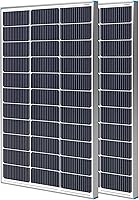
The Renogy 2PCS set gives two 100W panels, 200W total, each 34.1 x 22.8 x 1.2 inches and 14.3 lb total for the set. Each panel is 100W maximum power, 22.79 volts maximum voltage, and 5.31 A.
For faults or low output, use Renogy solar panel troubleshooting steps.
It reaches 25% conversion efficiency with 16BB N-type cells, an IP67 rating, and a -0.29%/℃ temperature coefficient.
That compact size helps on a mini van roof, trailer, or small shed. You can run the pair in series for higher voltage or parallel for higher current, within controller limits.
The Renogy 200W panel is a single unit, 49.7 x 30.1 x 1.2 inches and 23.4 lb, with 200W maximum power, 37.44 volts maximum voltage, and 6.85 A. It reaches 25% cell efficiency with 16BB N-type cells, works with 12V and 24V battery systems, and is 7.5% smaller and 11.7% lighter than previous models.
For a home tie-in, one 200W panel is rarely enough alone. It helps as part of a larger array, or for small off-grid backup through a charge controller and inverter.
What permits, inspections, and utility rules apply?
Most places require a building permit, an electrical permit, and utility approval before a grid-tied system runs. Check city, state, and utility rules before you order.
Your utility may require an interconnection agreement, a bidirectional meter, and a specific disconnect. The city may require structural roof checks, grounding details, and labeled wiring.
An inspector confirms the work matches the approved plan.
Fire code adds setbacks from roof edges and access paths for firefighters. Those rules can change panel layout even when the electrical design is sound.
Never backfeed a panel without anti-islanding protection. Backfeed can energize lines utility crews expect to be dead.
That is why grid-tied inverters shut down in an outage.
When should you hire a licensed electrician or solar installer?
Hire a pro when the work touches your breaker panel, the utility meter, or the grid connection. That covers most home tie-ins.
Licensed work also covers roof penetrations, structural checks, and code-compliant grounding. Many utilities and insurers require licensed installation for grid-tied systems.
Some states limit who can do panel work.
You can still do useful prep yourself. Clear roof access, gather 12 months of bills, note shade from trees or chimneys, and get quotes at the same array size.
Compare quotes by production estimate, equipment, and warranty, not panel count alone.
Ask each installer to show the panel-to-inverter-to-panel diagram. If a quote skips the disconnect, breaker, or permit steps, it is not complete.
How do you know the connection is working correctly?
Check inverter production, meter export or import, and that the breaker stays on under load. Those checks cover most issues.
On a sunny day, production should rise with sun, fall with clouds, and drop to zero at night. A steady zero points to a tripped breaker, disconnected switch, or fault.
Check the meter or utility app. Grid-tied systems often export at peak sun.
If there is no change on a clear day, check the disconnect and breaker first. Frequent trips may mean undersizing or wrong wire size, so do not upsize the breaker.
Call your installer instead.
How to connect solar to electrical panel: final checklist
Use this checklist before switch-on. It keeps the order safe and inspection-friendly.
- Confirm your system type: grid-tied, off-grid, or hybrid.
- Confirm panel voltage, current, and string length against inverter limits.
- Confirm the disconnect, dedicated breaker, grounding, and wiring sizes.
- Get permits, utility approval, and inspection scheduling in writing.
- Have a licensed pro complete or verify all panel and grid work.
- Test production on a sunny day and check the meter for export.
For choosing panels, start with our guide to the best type of solar panel. For rigid roof panels, see best rigid solar panels.
Pick grid-tied for the simplest home connection, hybrid for backup, and off-grid only where there is no utility service.
Frequently asked questions
Can you connect solar panels directly to an electrical panel?
No. Solar panels make direct current, while a home panel uses alternating current.
A grid-tied inverter converts the power safely and synchronizes it with utility power, and a disconnect shuts the system down when needed.
What equipment sits between panels and the panel?
Panels feed a charge controller or inverter, then a disconnect, then a dedicated breaker in your electrical panel. Grid-tied systems use a grid-tied inverter, while off-grid systems use an inverter and battery bank.
Do you need a permit to connect solar to your home?
Most cities and utilities require a permit, utility approval, and an inspection before a grid-tied system can run. Rules vary, so check your local building department and electric utility before you buy or install equipment.
Is it safe to do this wiring yourself?
Panels can make power in daylight even with the breaker off, and backfeed can hurt utility workers. Many homeowners hire a licensed electrician for panel work, and some places require licensed work for grid interconnection.