9 Best EcoFlow Solar Panels (November 2026)
The best EcoFlow solar panels for power stations include the Renogy 400W Portable Solar Panel for Power for high power in a small fold, the EF ECOFLOW Solar Generator Delta 3 Classic (best as a complete solar bundle), and the ZOUPW 450W Portable Solar Panel N-Type 16BB for large 40V to 60V stations.
On this page (8 sections)
- EcoFlow solar panels compared by size, voltage and weight
- Best EcoFlow solar panels by station
- How we compared these EcoFlow solar panels
- What is the best solar panel for EcoFlow
- How many watts do you need for EcoFlow solar panels
- Foldable, rigid or flexible: which EcoFlow format fits you
- How do I set up EcoFlow solar panels safely
- Verdict: best EcoFlow solar panels
The best EcoFlow solar panels for most buyers are the EF ECOFLOW 220W Portable Solar Panel and the Renogy 400W blanket, because they pair high efficiency with a carry weight you will actually use.
Large DELTA owners should look at 400W and 450W options. Small RIVER owners should stay near 100W to 160W.
Wattage is only part of the choice. Voltage, connector type and folded size decide whether a panel works with your station at all.
A powerful panel that exceeds your solar input limit will be clipped to that limit, and a panel with the wrong connector will not plug in without an adapter.
Our picks at a glance
-
1
 Best for high power in a small fold
Renogy 400W Portable Solar Panel for Power
9.7/10 our score
See it on Amazon -
2
 Best as a complete solar bundle
EF ECOFLOW Solar Generator Delta 3 Classic
9.6/10 our score
See it on Amazon -
3
 Best for large 40V to 60V stations
ZOUPW 450W Portable Solar Panel N-Type 16BB
9.4/10 our score
See it on Amazon
- 4
 Check it
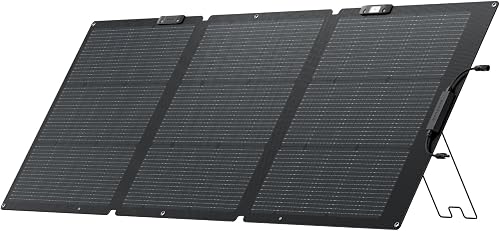
EF ECOFLOW 220W Portable Solar Panel
Best for EcoFlow balance of power and weight - 5
 Check it
Ecosonique Technology 400W Portable Solar Panel for Power
Best for 400W foldable value - 6
 Check it
EF ECOFLOW 160 Watt Portable Solar Panel
Best for light EcoFlow camping use - 7
 Check it
Renogy Flexible Solar Panel 100 Watt
Best for curved RV and boat surfaces - 8
 Check it
MHPOWOS 110W Portable Solar Panel for Power
Best for a light first panel - 9
 Check it
EF ECOFLOW 2PCS 100W 12V Solar Panels
Best for fixed RV or power kit mounting
EcoFlow solar panels compared by size, voltage and weight
The table below shows the key trade-off in one view. High wattage helps large stations, while low weight helps camping and road trips.
Voltage is the filter you should check first. Compare the 21.5V EcoFlow 220W panel with the 39.2V Renogy blanket and the 45.9V ZOUPW panel.
That voltage spread explains why some panels fit a RIVER station and others only fit a large DELTA station. Weight tells a second story: the Renogy blanket carries 400W at 16.09 lb, while the ZOUPW carries 450W at 29.5 lb.
Folded size tells a third story about storage. For an RV system with higher total solar needs, see our 1000W RV solar panel kit.
A panel that folds to 16.54 x 15.83 x 4.13 inches fits a different vehicle than one that folds to 30.43 x 34.56 x 3.54 inches.
Renogy 400W Portable Solar Panel for Power: Best for high power in a small fold
- 400W maximum power
- 25% efficiency
- 16.09 lb blanket
- 16.54 x 15.83 x 4.13 in folded
- MC4 output
A 400W foldable blanket at 16.09 lb with 25% efficiency and a 16.54 inch folded length. It suits large EcoFlow stations and tight campsites where space matters.
Pros
- High 400W output
- Light 16.09 lb blanket
- Folds to 16.54 x 15.83 x 4.13 in
- 25% efficiency
Cons
- MC4 output only
- 4-in-1 adapter sold separately
The Renogy 400W blanket is the top pick here for buyers who want 400W without carrying a rigid suitcase.
It weighs 16.09 lb and folds to 16.54 x 15.83 x 4.13 inches, so it fits in an SUV, van or camper with far less space than most 400W panels.
Its 25% efficiency and N-Type cells help it produce more power from the same sunlight. That efficiency matters on hazy mornings and late afternoons when light is weaker.
Renogy says you can fold along the widest seams to run at 300W, 200W or 100W when space is tight, with no tools needed. That partial fold option suits a windshield, sunny ground, or a hang between trees.
It also includes two shoulder straps, which helps when you carry it from a vehicle to a campsite. The panel uses 16BB N-Type cells at 400 watts and 39.2 volts.
It is listed as UL 61730 certified, with a two year material and workmanship warranty. The trade-off is the connector: output is MC4 only, and the 4-in-1 adapter is sold separately.
Renogy lists compatibility with EcoFlow DELTA 3 and DELTA 3 Max, plus other stations that meet its requirements. Against the other 400W pick here, this blanket is lighter and folds smaller.
EF ECOFLOW Solar Generator Delta 3 Classic: Best as a complete solar bundle
- DELTA 3 Classic with 220W panel
- 1024Wh capacity
- 1800W output
- 220W bifacial panel
- 25% panel efficiency
A complete bundle with the DELTA 3 Classic power station and a 220W bifacial panel. The panel is rated at up to 25% efficiency with N-Type cells.
Pros
- Station and panel in one kit
- 1024Wh capacity
- 1800W output
- 220W solar recharging in 5.8 hours per maker
Cons
- Station and panel ship separately
- Heavier to carry than a panel alone
This bundle suits buyers who want a station and a panel together rather than shopping for each part.
The DELTA 3 Classic has 1024Wh capacity and 1800W output, with 3600W surge and X-Boost up to 2600W per the maker. Its LiFePO4 battery cells are rated for more than ten years of daily use.
The included 220W bifacial panel is rated at up to 25% efficiency with N-Type cells. EcoFlow says the 220W panel recharges the station in 5.8 hours in good sun.
That is a realistic midday target for camping or home backup, not a promise for cloudy days. The station also offers ultra fast AC charging, reaching 80 percent in 45 minutes with X-Stream charging.
It has a sub 10ms UPS function for sensitive electronics such as PCs and servers, plus 100W USB-C output in the highlights. The main trade-off is that the station and panel ship separately, so they may arrive on different days.
You also carry the station weight as well as the panel, which makes this a basecamp or home choice rather than a backpacking choice. For new buyers, the bundle removes guesswork about connector pairing.
ZOUPW 450W Portable Solar Panel N-Type 16BB: Best for large 40V to 60V stations
- 450W maximum power
- 25% efficiency
- 45.9V open-circuit voltage
- 29.5 lb
- IP68 waterproof
- 4-in-1 adapter cable
The highest wattage here at 450W, built for high-capacity stations with 40V to 60V input. It weighs 29.5 lb and folds to 30.43 x 34.56 x 3.54 inches.
Pros
- Highest 450W output
- 25% efficiency
- IP68 waterproof
- Includes 4-in-1 cable
Cons
- 29.5 lb carry weight
- Not for low-voltage stations under 30V
The ZOUPW 450W panel is for buyers with large stations who want the fastest solar input in this guide.
It delivers 450W at 25% efficiency with N-Type 16BB cells and a 45.9V open-circuit voltage. ZOUPW says it is designed for high-capacity stations with 40V to 60V input.
It weighs 29.5 lb, which is noticeably more than the 400W blanket above. The fiberglass structure and four kickstands adjustable to 45 degrees help with solo setup on RV and overlanding trips.
The panel folds to 30.43 x 34.56 x 3.54 inches and includes ground stakes and a storage bag. Its ETFE coating and sealed lamination give IP68 protection against rain, dust and marine spray, though the maker says not to soak connectors.
Smart bypass diodes help the panel keep output when part of it is shaded by trees or debris. The maker claims up to ten percent more power in cloudy conditions compared with traditional P-Type panels.
It ships with a 13.12 foot 12AWG extension cable and a 4-in-1 adapter for XT60, Anderson, DC7909 and DC8020. The key limit is voltage: ZOUPW warns it is not compatible with low-voltage units under 30V input.
It also carries a 36 month warranty and a thirty day money back guarantee. Confirm your EcoFlow input is 46V or higher before you connect it.
EF ECOFLOW 220W Portable Solar Panel: Best for EcoFlow balance of power and weight
- 220W maximum power
- 25% efficiency
- Bifacial design
- 15.4 lb
- IP68 waterproof
- 30 to 60 degree bracket
A 220W bifacial panel at 15.4 lb with 25% efficiency and IP68 protection. The 30 to 60 degree adjustable bracket helps you aim it at the sun.
Pros
- 220W output at 15.4 lb
- Bifacial design
- 25% efficiency
- IP68 waterproof
Cons
- Less power than 400W options
- MC4 connector needs the right cable
The EcoFlow 220W bifacial panel is the balanced pick for DELTA 2, DELTA 3 and similar stations.
It produces 220W at 25% efficiency and weighs only 15.4 lb, so it is much easier to carry than 400W suitcases. The bifacial design collects light from both sides, and EcoFlow claims up to 28% more energy from that dual-sided design.
That rear side gain is strongest over bright ground such as sand, snow or light concrete. The 30 to 60 degree adjustable bracket and integrated solar angle guide help you keep the panel square to the sun.
IP68 protection and an ETFE coating cover rain and dust in camp use. The panel uses tempered glass and ETFE materials at 21.5 volts maximum voltage with an MC4 connector.
Its folded dimensions are compact enough for a car trunk, and the bag is included in the box. Our separate guide on ecoflow solar panels waterproof explains what that rating does and does not cover.
The trade-off is speed. At 220W, a large 1kWh to 2kWh station will take several hours in full sun.
If you want faster charging, step up to a 400W panel.
Ecosonique Technology 400W Portable Solar Panel for Power: Best for 400W foldable value
- 400W maximum power
- 23.5% efficiency
- 40V maximum voltage
- 20.3 lb
- 6-fold design
- 26 x 22 x 3 in folded
A 400W six-fold panel at 20.3 lb with 23.5% efficiency. It folds to 26 x 22 x 3 inches and includes a 3m MC4 cable plus a 0.5m MC4 to XT60 cable.
Pros
- 400W output
- Folds to 26 x 22 x 3 in
- Includes MC4 cables
- 23.5% efficiency
Cons
- 20.3 lb, heavier than the Renogy blanket
- 40V needs a compatible station input
The Ecosonique 400W panel suits buyers who want 400W in a six-fold suitcase at a mid-range position.
It weighs 20.3 lb and folds to 26 x 22 x 3 inches, with a 23.5% conversion rate and a 40V maximum voltage. The six-angle kickstand helps you aim it through the day.
It includes a 3m MC4 cable and a 0.5m MC4 to XT60, Anderson and DC8020 cable, so setup is simpler than panels that make you buy adapters. The Oxford fabric and CPC lamination are listed as tear-resistant, dustproof and waterproof, with IP65 protection in the highlights.
It is rated for extreme temperatures from -4°F to 158°F and is described as semi-flexible for durability. Auto-Restart Tech resumes charging after interruptions, with smart protection features listed by the maker.
The trade-off is weight and voltage. At 20.3 lb it is heavier than the 16.09 lb Renogy blanket, and 40V will not suit every small station.
Its efficiency at 23.5% is also lower than the 25% claims on the Renogy and ZOUPW panels.
If your EcoFlow station accepts a 40V input, this is a strong 400W option. If you want the lightest 400W carry, the Renogy pick above wins.
EF ECOFLOW 160 Watt Portable Solar Panel: Best for light EcoFlow camping use
- 160W maximum power
- 25% efficiency
- 12.3 lb
- IP68 waterproof
- Solar to XT60i cable included
A 160W panel at 12.3 lb with 25% efficiency and IP68 protection. It sets up in 40 seconds per the maker, with a 30 to 60 degree bracket.
Pros
- Only 12.3 lb
- 25% efficiency
- IP68 waterproof
- XT60i cable included
Cons
- 160W is slow for large stations
- 21.4V limits some pairings
The EcoFlow 160W panel suits camping, road trips and smaller RIVER stations.
It delivers 160W at 25% efficiency and weighs only 12.3 lb. EcoFlow says setup takes 40 seconds, with a 30 to 60 degree adjustable bracket and solar angle guide.
IP68 protection and an ETFE coating help in rain and dust. The box includes a solar to XT60i charging cable, a bag and a quick start guide, so you can connect it to many EcoFlow stations without buying a cable first.
That included cable is a practical advantage over MC4 only panels that need adapters. The panel uses monocrystalline silicon, aluminum and ETFE materials at 21.4 volts maximum voltage and 9.6 amps capacity.
Its dimensions of 22.5 x 23.6 inches folded make it easy to store beside other camping gear. The trade-off is output: at 160W, expect slow charging on a large DELTA station.
It is best as a light travel panel or as a second panel for a small station. For RIVER 3 owners, see best solar panel for ecoflow river 3.
Renogy Flexible Solar Panel 100 Watt: Best for curved RV and boat surfaces
- 100W maximum power
- 22% efficiency
- 43 x 22.9 x 0.8 in
- 5.3 lb
- Bends within 240 degrees
- IP67 junction box
A flexible 100W panel at 5.3 lb that bends within 240 degrees. It measures 43 x 22.9 x 0.8 inches and suits curved RV, van and boat surfaces.
Pros
- Bends within 240 degrees
- Only 5.3 lb and 0.8 in thin
- Pre-drilled mounting holes
- 22% efficiency
Cons
- Fixed mounting, not a foldable suitcase
- 100W output is modest
The Renogy flexible 100W panel is different from every suitcase here.
It is 5.3 lb, 0.8 inches thin and bends within 240 degrees, so it fits curved RV roofs, van roofs and boat surfaces where a rigid panel will not sit flat. It measures 43 x 22.9 inches.
Renogy rates it at 22% efficiency with half-cut PERC cells. It can provide an average of 500 Watt-hours per day depending on sun availability, per the maker.
Pre-drilled mounting holes and 2.3 feet of connector cable make installation faster. The panel is rated to withstand up to 5400 Pa snow load and 2400 Pa wind load.
Its junction box and solar connectors carry an IP67 waterproof rating. The all black, glare free appearance suits marine and cabin use where a large suitcase would be impractical.
The trade-off is that this is a fixed-mount panel, not a portable suitcase you can move to follow the sun. At 100W, it is a trickle charging and off-grid supplement rather than a fast station charger.
For general portable kits, see best portable solar panel kit.
MHPOWOS 110W Portable Solar Panel for Power: Best for a light first panel
- 110W maximum power
- 23.5% efficiency
- 20V output
- 4.5 kg
- IP67 waterproof
- Folds to 23.46 x 21.25 x 1.57 in
A 110W foldable panel at 4.5 kg with 23.5% efficiency. It folds to 23.46 x 21.25 x 1.57 inches and includes a cable to Anderson, XT60, DC7909 and DC5521.
Pros
- Light foldable design
- 23.5% efficiency
- IP67 waterproof
- Multi-connector cable included
Cons
- 110W charges large stations slowly
- 20V output needs checking against input limits
The MHPOWOS 110W panel is a light first panel for camping, fishing and RV trips.
It weighs 4.5 kg and folds to 23.46 x 21.25 x 1.57 inches, with 23.5% efficiency from monocrystalline silicon. The IP67 waterproof rating covers rain on the panel itself.
It includes a solar extension cable to Anderson, XT60, DC7909 and DC5521, which covers most portable stations. Two kickstands let you set it on flat ground without tools.
Thickened handles are listed for carrying, which helps when you move it between a tent and a vehicle. MHPOWOS notes that some stations have a maximum input limit below 110W, so check your station before you order.
The trade-off is power. At 110W and 20V output, this is a slow charger for anything larger than a small station.
It works best as a lightweight backup panel or for keeping a small station topped up during a weekend trip.
It includes an 18 month warranty and a manual in the box. For camping use, compare it with best solar panel for camping.
EF ECOFLOW 2PCS 100W 12V Solar Panels: Best for fixed RV or power kit mounting
- 2 panels at 100W each
- 23% efficiency
- 38.6 x 23 x 1.2 in per panel
- 13.6 lb per panel
- IP68 waterproof
- MC4 connector
Two rigid 100W panels at 23% efficiency, each 38.6 x 23 x 1.2 inches and 13.6 lb. They suit RV roofs, marine use and EcoFlow power kits with pre-drilled holes.
Pros
- Two panels for 200W total
- 23% efficiency
- IP68 waterproof
- Pre-drilled mounting holes
Cons
- Rigid panels, not portable suitcases
- Mounting accessories sold separately
The EcoFlow two-pack of 100W rigid panels suits fixed mounting rather than portable camping.
Each panel is 38.6 x 23 x 1.2 inches and 13.6 lb, with 23% efficiency and IP68 waterproofing. Together they provide 200W for RV roofs, marine use and EcoFlow power kits.
EcoFlow says each panel can produce an average of 400 to 500 Watt-hours per day depending on sun availability. Pre-drilled holes make mounting easier, though mounting accessories are sold separately.
The panels use MC4 connectors and monocrystalline silicon modules. They are designed to fit EcoFlow power kits and ecosystem systems, including battery and farm setups.
The trade-off is portability. These are rigid panels, so you cannot fold them into a car or move them to chase the sun.
Choose them for a permanent RV or farm battery setup where a suitcase would be awkward.
If you want a panel you can carry, the foldable 110W, 160W or 220W picks above are better.
Best EcoFlow solar panels by station
The best solar panel for EcoFlow depends on your station input, not just on watts.
Large DELTA stations accept higher voltage and more watts, while small RIVER stations clip or reject high-voltage panels. Check your manual for the solar input range, maximum watts and connector.
Large DELTA stations
For DELTA 3, DELTA Pro and similar large stations, 400W to 450W panels give the fastest recharge. The Renogy 400W blanket at 39.2V and the ZOUPW 450W panel at 45.9V are built for that class.
See best solar panels for ecoflow delta pro and best ecoflow 400w solar panels for delta pro 3 for model-specific picks.
Mid-size DELTA 2 and DELTA 3 Classic
The EcoFlow 220W panel at 21.5V is a safer match for many mid-size stations. It gives 220W without the voltage risk of a 40V panel.
See best solar panel for ecoflow delta 2 and best ecoflow delta 3 solar panels before you pair a high-voltage panel.
Small RIVER stations
For RIVER 3 and other small stations, stay near 100W to 160W and check the voltage limit. The EcoFlow 160W panel at 21.4V and the MHPOWOS 110W panel at 20V are easier fits than 40V suitcases.
A best ecoflow portable solar panel guide can help you narrow the small-station choices.
How we compared these EcoFlow solar panels
We compared wattage, voltage, weight, folded size and included cables across all nine picks.
We checked whether each panel lists EcoFlow compatibility, what connector it uses, and whether an adapter is included or sold separately. We also checked efficiency claims, waterproof ratings and mounting options.
A 25% efficiency claim at 220W produces less total power than a 23.5% claim at 400W, so we ranked by total usable power first, then by carry weight. We did not test these panels.
Specs, efficiency and compatibility come from the product data and maker descriptions. Use the voltage and connector checks in this guide to confirm fit with your exact station model.
What we weighted most
Voltage fit came first because a panel outside the input range may not charge at all. Wattage came next because it sets recharge time in full sun.
Weight and folded size came after that because they decide whether you will carry the panel at all. Cable inclusion mattered for total cost and setup time.
What is the best solar panel for EcoFlow
The best solar panel for EcoFlow is the one whose voltage and watts fit your station input, then whose weight you will carry.
A 450W panel is not better if your station caps solar input at 200W. Start with your station manual, then pick the largest panel that fits inside those limits.
Connector type matters next. Many EcoFlow stations use XT60 or XT60i for solar, while most panels here output MC4.
Check whether a cable is included.
The EcoFlow 160W panel includes an XT60i cable, while the Renogy 400W blanket needs a separate 4-in-1 adapter. For a general buying framework, read what is the best solar panel before you compare brands.
EcoFlow solar panels waterproof
Many panels here carry IP67 or IP68 protection for the panel surface. That means rain and dust protection, not permission to soak connectors or submerge the station.
Keep the junction box and ports as dry as you can. If you camp in heavy rain, the IP68 EcoFlow 220W and 160W panels are strong picks.
For connector care in storms, use the ecoflow solar panels waterproof guide linked above.
How many watts do you need for EcoFlow solar panels
You need enough watts to refill your station in the sun hours you have.
A 100W panel is fine for a small station on a weekend trip. A 400W panel is better for a 1kWh to 2kWh station you want back to full by afternoon.
Real output will be lower than the nameplate in heat, shade, low sun angle and long cables. Renogy notes that real-world output varies with sun angle, temperature, shade, cable length and input limits.
100W to 220W for travel
Travel panels at 110W to 220W weigh 8.5 lb to 15.4 lb here. They fit in a car, charge a small station in a day of good sun, and are easy for one person to set up.
The best 200w solar panel for ecoflow category sits in this sweet spot.
400W to 450W for fast charging
Panels at 400W to 450W charge large stations much faster in full sun. They weigh 16.09 lb to 29.5 lb in this guide, so they suit car camping, RV and home backup more than hiking.
See the ecoflow 400w portable solar panel review and the ecoflow 220w solar panel review for detail on those formats.
Foldable, rigid or flexible: which EcoFlow format fits you
Format decides where you can use the panel. Foldable suitcases move with you, rigid panels stay mounted, and flexible panels fit curved roofs.
Foldable panels in this guide range from the 110W MHPOWOS at 23.46 x 21.25 inches folded to the 450W ZOUPW at 30.43 x 34.56 inches folded. Fold them to follow the sun, then pack them away at night.
Rigid panels such as the EcoFlow two-pack of 100W panels are best for permanent RV or marine mounting. The flexible Renogy 100W panel bends within 240 degrees for curved surfaces, but it is not a portable suitcase.
How do I set up EcoFlow solar panels safely
Set up the panel square to the sun, on stable ground, with cables clear of water.
Use kickstands or stakes in wind, and keep connectors off wet ground where you can. Re-aim the panel every few hours if you want the most power.
Connect the panel to the station before you unfold it fully, then check that the station shows a solar input. If input is zero, check the connector, voltage range and whether the panel is in shade.
For DELTA 3 Classic owners, the best ecoflow delta 3 classic solar panel guide covers that model's input limits. Cleaning the panel with a soft cloth and plain water helps maintain output over time.
Verdict: best EcoFlow solar panels
Pick the Renogy 400W blanket if you want the most power at the lowest carry weight, at 400W and 16.09 lb.
Pick the EcoFlow 220W panel if you want a lighter 15.4 lb panel with IP68 protection and a 25% efficiency claim. Pick the ZOUPW 450W panel only if your station accepts 40V to 60V input.
Pick the EcoFlow 160W or MHPOWOS 110W panel for small stations and light camping. Pick the rigid EcoFlow two-pack or the flexible Renogy 100W panel for fixed mounting.
Check your station solar input voltage, maximum watts and connector before you order. For DELTA 3 owners, start with best ecoflow delta 3 solar panels.
Our top 3 picks at a glance
-
1
Best for high power in a small fold
Renogy 400W Portable Solar Panel for Power
9.7/10 our score
See it on Amazon -
2
Best as a complete solar bundle
EF ECOFLOW Solar Generator Delta 3 Classic
9.6/10 our score
See it on Amazon -
3
Best for large 40V to 60V stations
ZOUPW 450W Portable Solar Panel N-Type 16BB
9.4/10 our score
See it on Amazon
Frequently asked questions
How do I know if a solar panel fits my EcoFlow station?
Check three numbers before you buy. Match the panel voltage to your station solar input range.
Match watts to the station maximum solar input.
Then match the connector, usually MC4 or XT60.
A 400W panel at 39V to 40V fits many large DELTA models but not small RIVER units with lower limits.
Are EcoFlow solar panels waterproof?
Many EcoFlow panels in this guide carry IP68 protection for the panel surface. That covers rain and dust, not soaking the connectors or the power station.
Keep cables and ports dry where you can, and check the waterproof guide linked below for connector care.
How many watts do I need for camping?
For a small camping station, 100W to 220W is a practical starting range. A 110W panel suits light use, while 220W refills a mid-size station faster in full sun.
For a large DELTA station at home or in an RV, 400W to 450W cuts recharge time in good sun.


