9 Best Propane Generator Hoses and Regulators (November 2026)
The best propane generator hoses and regulators include the GasSaf 15FT 2 Stage Propane Regulator for steady pressure, the GasSaf 5FT Two Stage Propane Regulator for close tank placement, and the DPB 6Ft Propane Regulator with Stainless Steel for checking tank level.
On this page (9 sections)
- How to match a propane hose to your generator
- The best propane generator hoses for every setup
- How these propane hoses were compared
- What pressure does a propane generator need?
- Which connections fit your tank and generator?
- How long should a propane generator hose be?
- Regulator hose or extension hose: which do you need?
- How do you set up and care for a propane hose?
- The verdict on the best propane generator hose
The best propane generator hose depends on your inlet, your tank valve and your hose length. For most dual fuel generators, the GasSaf 15FT 2 Stage Propane Regulator is the strongest all-around pick because it pairs a long 15 foot hose with two-stage regulation at 11 inch water column.
Champion and Westinghouse owners should check their brand-specific options first.
Our score weighs specs, features and buyer feedback against what you are shopping for. We compared hose length, regulator type, tank and appliance connections, pressure output and included adapters.
Every pick here solves a different part of the same problem.
If you are still deciding between fuels, start with our gas generator guide and our comparison of propane generator vs gas generator. Those pages help you confirm propane is the right fuel before you choose a hose.
Our picks at a glance
-
1

-
2
 Best for close tank placement
GasSaf 5FT Two Stage Propane Regulator
9.6/10 our score
See it on Amazon -
3
 Best for checking tank level
DPB 6Ft Propane Regulator with Stainless Steel
9.4/10 our score
See it on Amazon
- 4
 Check it
Champion 12-Foot Propane Hose Extension Kit
Best for Champion generators - 5
 Check it
REDPANT 24 Feet 3/8" Propane Hose Extension
Best for long hose runs - 6
 Check it
Westinghouse 15-Foot Natural Gas Hose with Adapter
Best for home natural gas - 7
 Check it
Alloxity 12FT Propane Hose with Regulator
Best for quick connect heaters - 8
 Check it
ATKKE 12 Feet Propane Hose with Regulator
Best for hand-tight connections - 9
 Check it
CALPOSE 12FT 2 Stage Propane Regulator
Best for larger tanks
How to match a propane hose to your generator
Match the tank connection, the appliance connection and the pressure need before you look at length. A hose with the wrong end will not seal, no matter how good the regulator is.
Check your tank valve first. Most modern tanks use QCC1, also called Type 1, and tighten by hand.
Older tanks may use POL, which threads differently. Then check the generator inlet.
Common options here are a 3/8 inch female flare and a 3/8 inch quick connect.
Most portable generators need low pressure gas at about 11 inch water column. A two-stage regulator steadies that output better than a single-stage design when tank pressure changes.
Extension hoses without a regulator only add length, so they need a regulated supply upstream.
The best propane generator hoses for every setup
The picks below run from regulated hoses for direct tank-to-generator use to brand-specific extensions and a home natural gas option. Read the trade-off under each one, because the right choice is mostly about connections.
GasSaf 15FT 2 Stage Propane Regulator: Best for steady pressure
- 15 feet
- Two-stage regulator
- 11 inch WC outlet
- Up to 180,000 BTU per hour
- QCC1 handwheel
- 3/8 inch female flare
- CSA certified
A 15 foot two-stage hose and regulator with a QCC1 tank handwheel and 3/8 inch female flare appliance end, for generators, RVs, grills and heaters.
Pros
- Long 15 foot reach
- Two-stage regulation
- Fits 5 to 40 lb tanks
Cons
- Long hose needs storage space
- Needs a 3/8 inch flare appliance inlet
This GasSaf hose suits dual fuel generator owners who want one hose to cover tank placement and steady pressure. The 15 foot length lets you set a 20 lb or 40 lb tank where it is safe and convenient, instead of crowding it beside the generator.
Its two-stage regulator holds an outlet pressure of 11 inch water column, with a maximum output of up to 180,000 BTU per hour. GasSaf says the two-stage design steadies flow and cuts pressure swings compared with a single-stage regulator.
The tank end is a QCC1 handwheel for 5 to 40 lb tanks, and the appliance end is a 3/8 inch female flare nut.
The regulator body is zinc alloy and CSA certified. That matters for cold weather use and corrosion resistance on an outdoor setup.
The trade-off is length. Fifteen feet is generous for a work site, and you will need a place to coil and store it.
It also needs a 3/8 inch female flare inlet, so confirm your generator before ordering.
GasSaf 5FT Two Stage Propane Regulator: Best for close tank placement
- 5 feet
- Two-stage regulator
- 11 inch WC outlet
- QCC1 and Type 1 connections
- 3/8 inch female flare nut
- Solid brass
- Excess flow protection
A shorter 5 foot two-stage regulator hose for generators and RV appliances where the tank sits close to the unit.
Pros
- Short, tidy run
- Two-stage regulation
- Solid brass construction
Cons
- Only 5 feet of reach
- Less placement flexibility than longer options
This shorter GasSaf hose suits generators that sit right next to their tank. At 5 feet, it keeps the run tidy and avoids excess hose to coil, route or trip over at a campsite or job site.
It uses the same two-stage regulation as the 15 foot model, with an outlet pressure of 11 inch water column. GasSaf says two-stage regulation stabilizes output flow better than a single regulator.
The tank end fits QCC1 and Type 1 connections, and the appliance end is a 3/8 inch female flare nut.
The fittings are solid brass, which GasSaf links to a secure, sealed connection. The hose also has excess flow protection, an extra safety feature on a regulated unit.
Choose this over the 15 foot version if your tank always stays close. Choose the longer hose if you ever need to move the tank for safety, storage or RV layout reasons.
The 5 foot limit is the only real drawback here.
DPB 6Ft Propane Regulator with Stainless Steel: Best for checking tank level
- 6 feet
- Stainless steel braided hose
- 11 inch WC output
- Tri-color tank gauge
- 3/8 inch female flare
- QCC1 connection
- Fits 5 to 40 lb tanks
A 6 foot regulator hose with a stainless steel braid and a tri-color gauge that shows green, yellow and red tank levels, including in the dark.
Pros
- Built-in tank gauge
- Stainless steel braid
- Glow in the dark gauge
Cons
- 6 foot length is fixed
- Gauge shows tank pressure, not exact fuel volume
This DPB hose suits buyers who want to check fuel level without disconnecting anything. Its tri-color gauge shows green for sufficient gas, yellow for low gas and red when supply is nearly exhausted, and it glows in the dark.
The 6 foot hose uses a stainless steel braid over a rubber layer, with brass fittings. The integrated regulator holds a fixed output of 11 inch water column.
It fits QCC1 tanks from 5 to 40 lb and appliances with a 3/8 inch female flare fitting, including LPG generators.
The gauge is the main reason to pick this model over a plain regulated hose. You can glance at it during a long run, at night or in a compartment, and plan a tank swap before the generator stops.
The trade-offs are fixed length and gauge limits. Six feet will not reach a tank stored far from the unit.
A pressure gauge also shows tank pressure, not an exact amount of fuel, so treat yellow as your cue to refill soon.
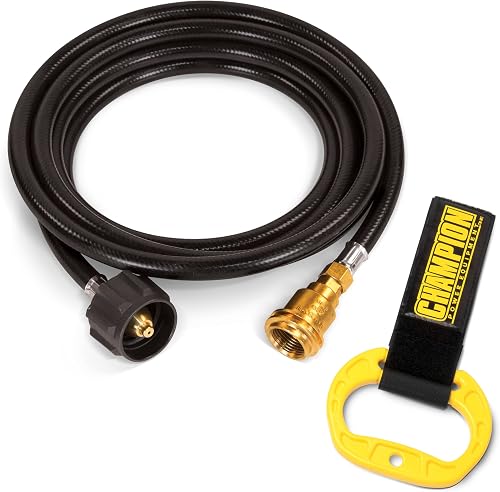
Champion 12-Foot Propane Hose Extension Kit: Best for Champion generators
- 12 feet
- ACME Type 1 male and female connectors
- No tool installation
- For Champion dual fuel generators
- Storage strap and handle
- 1-year limited warranty
A 12 foot extension kit made for Champion dual fuel generators, with ACME Type 1 connectors and a storage strap and handle.
Pros
- Made for Champion dual fuel units
- No tools needed
- Storage strap included
Cons
- Extension only, no regulator included
- Limited to matching Champion connections
This Champion kit suits owners of Champion dual fuel generators who need more reach. The extra 12 feet lets you connect an LPG tank to the generator without dragging a heavy tank across an RV site or work area.
It uses ACME Type 1 male and female connectors and installs with no tools. Champion says it can be used with any Champion dual fuel generator, and the hose is 1/4 inch in diameter.
A storage strap and handle help you coil, carry or hang the hose between uses.
Champion backs the kit with a 1-year limited warranty. That brand support is a real plus if you want one maker to stand behind the generator and its propane connection.
The key limit is scope. This is an extension kit, not a hose with a regulator, so it relies on the regulated supply your setup already has.
It is also made for Champion connections, so check that your generator matches before ordering.
REDPANT 24 Feet 3/8" Propane Hose Extension: Best for long hose runs
- 24 feet
- 350 PSI high pressure hose
- 3/8 inch
- 6 brass adapters
- Wrench and sealing tape
- Stainless steel braid
- Storage strap
A 24 foot high pressure extension with six brass adapters, a wrench and sealing tape, for placing a tank well away from an appliance.
Pros
- Very long 24 foot run
- Six adapters included
- High pressure rating
Cons
- High pressure extension, not a regulator hose
- Long length needs careful storage
This REDPANT extension suits long runs where a standard hose cannot reach. At 24 feet, it is the longest option here, so you can keep a tank in a fixed RV compartment or storage spot while the generator stays outside.
It is a 350 PSI high pressure hose with a stainless steel braid and solid brass fittings. Six brass adapters cover common flare and NPT combinations, and the kit adds a wrench and a roll of sealing tape.
REDPANT says to run a soapy water leak test before use and to keep the hose away from open flame and hot surfaces.
Use this as an extension in a regulated system, not as a replacement for a regulator hose. That distinction drive the whole buying choice for this pick.
The trade-offs are storage and setup time. Twenty-four feet of hose needs space to coil, and six adapters mean more connections to seal.
If your run is shorter, a 12 or 15 foot regulated hose is simpler and often safer to manage.
Westinghouse 15-Foot Natural Gas Hose with Adapter: Best for home natural gas
- 15 feet
- 1/2 inch diameter
- Quick connect adapter
- For Westinghouse tri fuel generators under 14,500 running watts
- CSA certified
- Solid brass fittings
A 15 foot natural gas hose with a quick connect adapter for Westinghouse tri fuel generators hooked to a home gas line.
Pros
- No tank refilling
- Quick connect adapter
- 15 foot positioning range
Cons
- Natural gas only, not propane tanks
- Only for matching Westinghouse models
This Westinghouse hose suits home backup with a tri fuel generator and a home natural gas line. It removes the tank entirely, so there is no refueling, no fuel storage and no emergency fuel runs during an outage.
The 15 foot hose has a 1/2 inch diameter and a quick connect adapter that stays on the generator intake. The hose clicks on and off with no tools.
Westinghouse says it works with all Westinghouse tri fuel generators rated under 14,500 running watts.
The hose is CSA certified, with reinforced layers, a weather-resistant outer layer and solid brass fittings. Westinghouse backs it with a 30-day limited warranty.
The limits are fuel and brand. This is a natural gas hose, not a propane tank hose, so it will not help if you run on bottled propane.
It is also only for matching Westinghouse models, and it needs a home gas supply line to connect to.
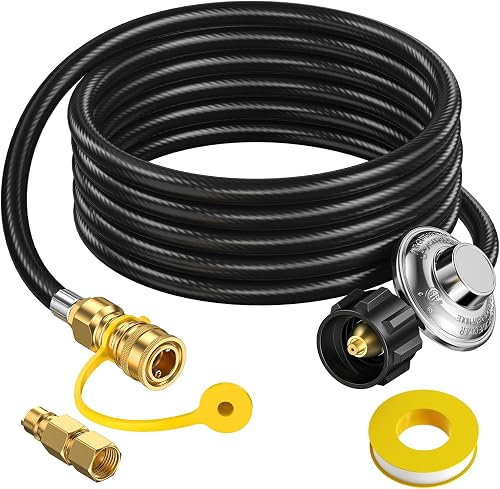
Alloxity 12FT Propane Hose with Regulator: Best for quick connect heaters
- 12 feet
- Built-in regulator
- 3/8 inch quick connect disconnect
- 3/8 inch female flare adapter
- Fits 5 to 40 lb tanks
- 0.38 inch outside diameter
A 12 foot hose with a regulator and both 3/8 inch quick connect and female flare options, for generators, heaters and grills.
Pros
- 12 foot length
- Regulator included
- Two appliance connection options
Cons
- Check your inlet matches one of the two ends
- Less detailed pressure specs than two-stage options
This Alloxity hose suits buyers whose appliance inlet type is not yet clear. It offers both a quick connect and a female flare option, which covers more generator and heater inlets than most picks here.
At 12 feet, it gives enough reach to move a tank away from the generator for safety or storage. It has a built-in regulator and fits 5 to 40 lb tanks.
The 3/8 inch female flare adapter also suits grills, heaters and other portable appliances.
This is a practical pick when you own several propane devices and want one hose that can move between them. Check that each appliance inlet is either a 3/8 inch female flare or a 3/8 inch female quick connect.
The trade-off is less detail on pressure than the two-stage options. If your generator manual states an exact pressure need, compare it with the two-stage hoses first.
For general dual fuel use, this flexible connection setup is its main strength.
ATKKE 12 Feet Propane Hose with Regulator: Best for hand-tight connections
- 12 feet
- Built-in regulator
- QCC1 and Type 1 connection
- 3/8 inch quick connect
- Hand wheel tank connection
- Brass fittings
A 12 foot hose with a built-in regulator, a QCC1 hand wheel for the tank and a 3/8 inch quick connect for the appliance.
Pros
- Hand-tight tank connection
- 12 foot reach
- Built-in regulator
Cons
- Needs a matching 3/8 inch quick connect inlet
- Confirm your generator inlet type before ordering
This ATKKE hose suits users who want a hand-tight tank connection and a quick release at the appliance. The QCC1 hand wheel lets you connect to a 20 lb tank without a wrench, and the 3/8 inch quick connect releases at the generator end.
At 12 feet, it gives you room to place the tank outside a window, tent or work area while the appliance stays inside the work zone. The built-in regulator reduces tank pressure for safe use, which ATKKE notes also helps prevent oil leaching that can clog heaters.
The hose uses brass fittings and is listed as a replacement for common heater hose assemblies, including F271803. It also suits portable generators with a matching inlet.
The main caution is inlet fit. ATKKE notes that some generators use different LPG hose connections, so confirm your inlet is a 3/8 inch male quick connect plug.
It also takes 30 to 90 seconds for propane to fill the hose and reach the pilot light on first setup.
CALPOSE 12FT 2 Stage Propane Regulator: Best for larger tanks
- 12 feet
- Two-stage regulator
- 11 inch WC outlet
- Up to 160,000 BTU per hour
- POL and 3/8 inch female flare connectors
- Zinc alloy regulator
- Brass connectors
- Fits 5 to 100 lb tanks
A 12 foot two-stage regulator hose with POL and 3/8 inch female flare ends, rated for 5 to 100 lb tanks and up to 160,000 BTU per hour.
Pros
- Two-stage regulation
- Fits tanks up to 100 lb
- 12 foot reach
Cons
- POL tank connection, not QCC1
- Check tank valve type before ordering
This CALPOSE hose suits larger tank setups that the QCC1 picks do not cover. It fits 5 to 100 lb tanks through a POL connection, so it is the option to check when your tank valve is the older threaded type.
Its two-stage regulator delivers 11 inch water column at up to 160,000 BTU per hour. CALPOSE says two-stage regulation reduces pressure fluctuations and keeps supply steady.
The regulator is zinc alloy, and the connectors are brass, for weather resistance and service life.
The 12 foot length improves placement over a short hose and adds distance between tank and appliance. The appliance end is a 3/8 inch female flare nut.
The trade-off is connection type. POL is not the same as QCC1, and the two will not interchange.
Confirm the valve on your tank before ordering, and confirm your generator accepts a 3/8 inch female flare inlet.
How these propane hoses were compared
We compared hose length, regulator type, pressure output, tank connection, appliance connection and included parts. That order matters, because a hose that cannot connect to your tank or generator cannot do its job.
Two-stage regulator hoses scored highest for steady low pressure output. Brand-specific extensions scored well for fit and support, even though they add length rather than regulation.
The natural gas option scored on its own terms, because it targets a different fuel setup entirely.
We also weighed practical details like gauges, storage straps, hand-tight connections and adapters. Those small parts affect daily use more than a spec sheet suggests.
If your generator is dual fuel and you want hoses made for that setup, our guide to the best dual fuel generator propane hose breaks that category down further. Honda owners should also read can a Honda generator run on gasoline and propane? before ordering.
What pressure does a propane generator need?
Most portable propane generators need low pressure gas at about 11 inch water column. A regulator steps tank pressure down to that level and holds it steady as the tank empties.
Two-stage regulators do that job in two steps, which helps them keep output steadier through tank pressure changes. Single-stage regulators are simpler and often fine for small loads, but two-stage designs are the safer default for generators that run for hours.
Extension hoses without a regulator do not change pressure at all. They only add length between a regulated source and the appliance.
Do not connect a high pressure hose straight to a low pressure inlet. That mismatch can damage the appliance and creates a leak risk.
When in doubt, pick a hose with a built-in regulator and match its stated output to your generator manual.
Which connections fit your tank and generator?
Your tank valve decides the first end. QCC1, also called Type 1, fits most modern 5 to 40 lb tanks and tightens by hand.
POL fits older tanks and threads on differently.
Your generator inlet decides the second end. The two common types here are a 3/8 inch female flare, which threads on, and a 3/8 inch quick connect, which clicks on and off.
QCC1 and Type 1 tank connections
These are the most common option in this roundup. The GasSaf, DPB, Alloxity and ATKKE hoses all use QCC1 or Type 1 tank ends.
If your tank valve has a large hand wheel, you likely have this type.
POL tank connections
POL is the older threaded valve type. The CALPOSE hose uses POL and fits tanks up to 100 lb.
Check your tank valve photo or manual before choosing it, because QCC1 and POL parts will not fit each other.
Female flare and quick connect appliance ends
Female flare inlets thread on with a nut. Quick connect inlets click on and off.
Some hoses here offer one, some offer both. Match the end to the inlet, not to the hose length you want.
How long should a propane generator hose be?
Use the shortest length that lets you place the tank safely. Longer is not automatically better, because extra hose needs storage and routing.
Short hoses for tanks beside the generator
Five and six foot hoses suit a tank that sits right next to the unit. The GasSaf 5 foot model and the DPB 6 foot model keep the setup tidy for camping and home use.
Medium hoses for flexible placement
Twelve foot hoses are the sweet spot for most buyers. They let you move a tank away from heat, noise or a work area without needing an extension.
Several picks here use this length.
Long hoses and extensions for fixed tanks
Fifteen foot hoses suit RVs and generators with a fixed tank spot. The 24 foot REDPANT extension is for the longest runs, where the tank stays put and the generator moves.
Regulator hose or extension hose: which do you need?
A regulator hose connects a tank straight to your generator and steps pressure down. An extension hose only adds length downstream of a regulator.
If your generator manual says it needs regulated low pressure gas and you have no regulator yet, buy a regulator hose. If your setup already has a regulator and you only need more reach, an extension is enough.
Champion owners can use the Champion extension kit with a regulated supply. Westinghouse owners on home gas should use the natural gas hose instead of any propane tank hose.
If you are converting a gasoline-only generator, our best gas generator propane conversion kit guide covers that route. For a generator built for both fuels from the start, our Best Propane Hybrid Generator picks are worth a look.
How do you set up and care for a propane hose?
Set up a propane hose by connecting the tank end first, then the appliance end, then opening the tank valve slowly. Check every connection with a soapy water solution before you start the generator, and watch for bubbles that signal a leak.
Route the hose away from hot surfaces, sharp edges and vehicle traffic. Keep it out of heat from the generator exhaust, and avoid kinks that restrict flow.
Coil it loosely for storage, and hang it where it will not get crushed.
Inspect the hose and fittings before each season, and after any drop or rough storage. Look for cracks, cuts, stiff spots and loose fittings.
Replace a damaged hose rather than trying to repair it.
If you want to understand how the generator itself works once fuel reaches it, read how does a solar generator work? for the power side of your setup, even though your fuel source here is propane.
The verdict on the best propane generator hose
Pick the GasSaf 15FT 2 Stage Propane Regulator if you want the best all-around propane hose for a dual fuel generator. It combines 15 feet of reach, two-stage regulation and the most common QCC1 and female flare connections.
Pick the GasSaf 5 foot model if your tank always sits close. Pick the DPB if a tank gauge matters to you.
Pick the Champion extension if you own a Champion dual fuel unit. Pick the Westinghouse hose if you run on home natural gas.
Before you order, confirm your tank valve type and your generator inlet type. That one check prevents most returns and keeps your setup safe.
Our top 3 picks at a glance
-
1
-
2
Best for close tank placement
GasSaf 5FT Two Stage Propane Regulator
9.6/10 our score
See it on Amazon -
3
Best for checking tank level
DPB 6Ft Propane Regulator with Stainless Steel
9.4/10 our score
See it on Amazon
Frequently asked questions
What size propane hose do I need for a generator?
Match the hose to your generator inlet, tank valve and the distance between them. Most low pressure generator inlets here use a 3/8 inch female flare or a 3/8 inch quick connect.
Choose 5 to 6 feet for a tank beside the unit, 12 feet for more placement freedom, and 15 feet or more when you need to move the tank well away.
Do I need a regulator on a propane generator hose?
Most portable propane generators need regulated low pressure gas at about 11 inch water column. Tank pressure is far higher, so a hose with a built-in regulator is the safer choice unless your generator manual says it has its own regulator.
Extension hoses without a regulator are for adding length between a regulated supply and the inlet.
What is the difference between QCC1 and POL tank connections?
QCC1, also called Type 1, is the hand wheel connection used on most modern 5 to 40 lb propane tanks. POL is an older threaded tank valve type.
These are not interchangeable, so check the valve on your tank before you order.
Most picks here use QCC1, and the CALPOSE model uses POL.
How long should a propane generator hose be?
Use the shortest hose that lets you place the tank safely away from the generator. A 5 or 6 foot hose works when the tank sits beside the unit.
A 12 foot hose gives room to move the tank outside a work area.
A 15 foot hose or a 24 foot extension suits RVs and generators where the tank stays in a fixed spot.