Can You Charge a Lithium Battery with a Regular Charger?
Usually, no. A regular charger is safe for a lithium battery only when its voltage, charging profile, and battery chemistry match the battery maker's requirements.
On this page (9 sections)
- Can you charge a lithium battery with a regular charger?
- What must match between the battery and charger?
- Why can a lead-acid charger be risky for lithium?
- Which charger works with both lead-acid and lithium batteries?
- Can a regular 12V car charger charge a lithium battery?
- When does a higher-current charger help?
- How should you connect a lithium battery charger?
- Can a 36V lithium battery use a 12V charger?
- What is the safest choice for charging lithium batteries?
You can charge a lithium battery with a regular charger only when the charger is specifically compatible with that battery's chemistry, voltage, and charging profile. A standard lead-acid charger should not be connected to a lithium battery just because both batteries are labeled 12V.
Lithium batteries, especially LiFePO4 batteries, need charging behavior that differs from flooded, AGM, gel, and other lead-acid batteries. Check the battery manual, charger manual, and battery management system requirements before making the connection.
Can you charge a lithium battery with a regular charger?
A regular charger is suitable only if it has a lithium mode or is confirmed for that lithium battery type. Voltage matching alone is not enough because the charger also controls charge stages, voltage limits, and maintenance behavior.
A lead-acid charger may use desulfation, repair, or long-term float features. Those functions are intended for lead-acid batteries and may not suit lithium cells.
A charger that supports both battery types should have a clear selector or operating mode. Choose the lithium or LiFePO4 setting when charging a compatible 12V lithium battery, and never use a lead-acid mode unless the battery maker specifically allows it.
For background on battery types, see what is a deep cycle battery. Deep-cycle labels describe how a battery is used, but they don't identify its chemistry or prove charger compatibility.
What must match between the battery and charger?
The battery chemistry, nominal voltage, charging voltage, and charging method must all match. Confirm each item before you connect clamps or ring terminals.
Start with chemistry. Lithium-ion batteries, LiFePO4 batteries, AGM batteries, flooded lead-acid batteries, and gel batteries don't all use the same charging profile.
Next, compare voltage. A 12V battery and a 12V charger may still be incompatible if the charger is designed for a different battery chemistry.
A 36V battery also needs a charger intended for 36V use, not a 12V charger with a higher current rating.
Finally, check how the charger behaves after the battery reaches full charge. A charger designed to maintain lead-acid voltage indefinitely may not be appropriate for lithium storage.
Read the battery maker's charging instructions before relying on a general guide. If you need a purpose-built option, compare these best lithium battery chargers by chemistry and voltage.
Why can a lead-acid charger be risky for lithium?
A lead-acid charger can be risky when its charge stages or maintenance voltage don't match the lithium battery. A battery management system may stop charging, but that safety circuit should not be treated as permission to use any charger.
Lead-acid chargers often include desulfation or repair modes. These modes can apply charging behavior that a lithium battery was not designed to receive.
Some chargers also enter a float or pulse-maintenance stage after reaching full charge. Whether that stage is acceptable depends on the lithium battery's design and instructions.
Never turn on repair, desulfation, engine-start, or winter modes for a lithium battery unless the battery documentation explicitly supports that function. The safest choice is a charger with a lithium setting that you can select before charging.
Which charger works with both lead-acid and lithium batteries?
The Battery Tender Junior 12V, 800mA Battery Charger and Maintainer for Lead Acid and Lithium Batteries - Switchable Battery Charger for Powersports - 022-0199-DL-WH supports 12V lead-acid batteries, including AGM, flooded, and gel types, plus LiFePO4 batteries through a selectable mode.
Its 800mA current rating suits small charging and maintenance tasks rather than fast recovery of a large battery. It has alligator clips and fused ring terminals, and its dimensions are 4.4 x 2.9 x 2.15 inches.
The charger includes spark-proof lead connection and reverse-polarity detection. Select the correct battery type before charging, then follow the connection order in the manual.
Choose it when you maintain compatible 12V powersports batteries and want a selectable lead-acid or lithium mode. If you need a charger for a car battery, compare the best lithium battery charger for a car and confirm the battery chemistry first.
Can a regular 12V car charger charge a lithium battery?
A regular 12V car charger can charge a lithium battery only if it supports the battery's chemistry. A charger designed for automotive lead-acid batteries is not automatically compatible with a 12V LiFePO4 battery.
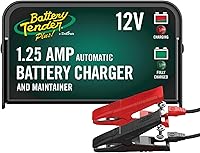
The Battery Tender Plus 12V 1.25 AMP Car & Motorcycle Battery Charger and Maintainer is designed for 12V automotive, motorcycle, lawn mower, and ATV batteries. Its product information identifies adaptive smart charging and a 4-step charging program, but the details do not identify a lithium charging mode.
It includes fused ring terminal and alligator clip accessory cables, a quick disconnect harness, and a two-color charge-status LED. Its dimensions are 2.9 x 2.15 x 4.4 inches, and it weighs 1.5 lb.
Use this charger for the compatible battery types identified by Battery Tender. Don't connect it to a lithium battery unless the battery and charger instructions confirm that the charging profile is suitable.
For a lithium-specific brand search, see the best Renogy lithium battery charger. Match the charger to the battery's voltage and chemistry instead of choosing by connector shape alone.
When does a higher-current charger help?
A higher-current charger helps when the battery supports that current and you need faster charging. It does not make an incompatible charger safe for lithium use.
The TowerTop 2/10/25 Amp 12V Smart Car Battery Charger, Fully Automatic Battery Maintainer with Engine Start, Auto Desulfator, Battery Repair, Winter Mode, for AGM, STD, Gel, Deep Cycle Batteries provides 2A, 10A, 25A, and automatic current settings.
Its listed compatible devices are AGM, deep-cycle, gel, and STD batteries. The charger also includes desulfation, repair, engine-start, and winter modes, so it should not be used with a lithium battery unless TowerTop and the battery maker specifically confirm compatibility.
The charger has a 12V output, a 25A maximum charging current, battery clamps, and an LCD screen. Its dimensions are 7.68 x 10.04 x 4.92 inches.
Choose it for compatible 12V lead-acid charging when adjustable current and battery-repair functions matter. Do not select a higher amp setting to compensate for a chemistry mismatch.
How should you connect a lithium battery charger?
Turn off the charger, confirm the battery type, and connect the positive and negative leads to the correct terminals. Keep the battery and charger in the conditions required by their manuals.
A basic safe sequence is:
- Confirm that the charger supports the battery chemistry and voltage.
- Inspect the battery, cables, and connectors for damage.
- Turn the charger off or unplug it before attaching the leads.
- Connect positive to positive and negative to negative, following the manual.
- Select the lithium or LiFePO4 mode if the charger has one.
- Start charging and monitor for unusual heat, swelling, smell, or errors.
- Stop charging if anything appears abnormal.
Don't charge a damaged, swollen, wet, or unusually hot battery. Don't bypass the battery management system, alter the charger, or leave an uncertain setup unattended.
If your battery is in a vehicle, also review whether a portable power station can charge a car battery. A portable power station is not automatically a lithium battery charger for every vehicle battery.
Can a 36V lithium battery use a 12V charger?
No. A 36V lithium battery needs a charger designed for its voltage and battery chemistry.
A 12V charger cannot provide the correct charging profile for a 36V battery.
Check the battery label and manual for the required charger output. A charger with the right connector can still be wrong if its output voltage or chemistry setting does not match.
For that use case, compare the best 36V lithium battery chargers. Confirm the complete battery system voltage, not just the voltage printed on an individual cell or component.
What is the safest choice for charging lithium batteries?
The safest choice is a charger made for your battery's exact chemistry and voltage. A dual-mode charger can work when its lithium setting is clearly identified and the battery instructions approve that charger type.
Pick the Battery Tender Junior when you need a compact 12V charger with selectable lead-acid and LiFePO4 modes. Pick the Battery Tender Plus for compatible 12V automotive and powersports batteries when a 1.25A maintenance charger fits the job.
Pick the TowerTop for compatible 12V lead-acid batteries when adjustable current and repair modes matter.
For any charger, match chemistry first, voltage second, and current third. If the battery manual does not confirm compatibility, stop and choose a lithium-specific charger instead.
Frequently asked questions
Can I charge a lithium battery with a lead-acid charger?
Only if the charger has a lithium or LiFePO4 mode that matches the battery's voltage and charging requirements. A lead-acid-only charger may use a different charge profile, float behavior, or recovery process.
Check the battery and charger manuals before connecting them.
What happens if you use the wrong charger on a lithium battery?
The charger may fail to charge, charge incorrectly, or send a profile the battery management system does not expect. In some cases, the battery can become hot or damaged.
Stop if the battery swells, smells unusual, becomes hot, or shows an error.
Can a 12V lithium battery use any 12V charger?
No. The 12V label does not prove that two devices are compatible.
The charger must support the battery chemistry, charging voltage, and charge stages.
A 12V charger designed for lead-acid batteries is not automatically suitable for a 12V LiFePO4 battery.
Is a lithium battery charger better than a regular charger?
A lithium-compatible charger is the safer choice because its charging profile matches the battery chemistry. Some chargers support both lead-acid and LiFePO4 batteries through a selectable mode, which can be useful if you maintain more than one battery type.