
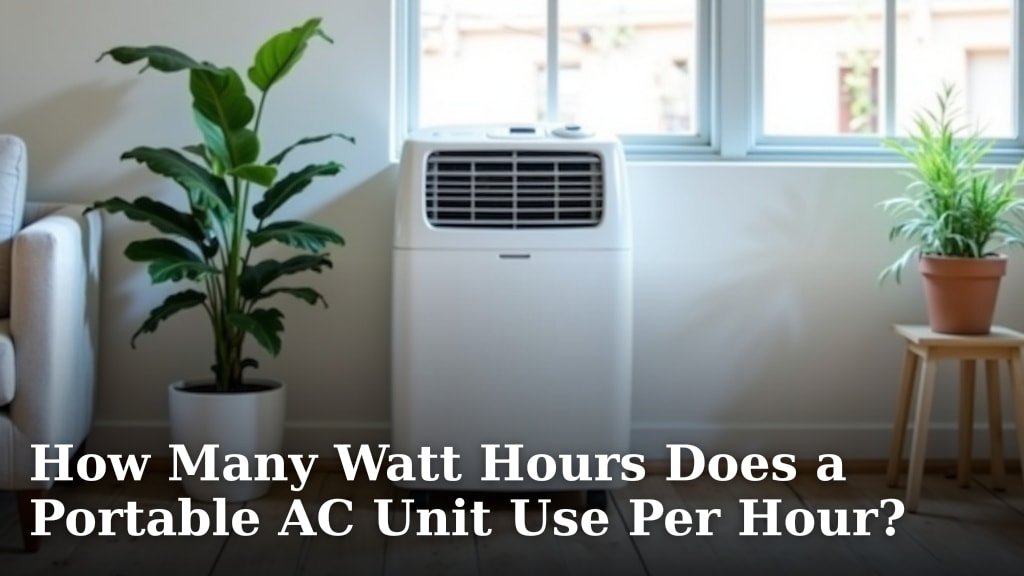
A portable AC unit typically uses between 500 to 1,500 watt hours (Wh) per hour of operation. This wattage can vary quite a bit depending on the size, cooling capacity, and energy efficiency of the specific unit you’re using to keep your space comfortable.
Understanding your portable AC’s energy consumption is key to managing your electricity bills. Factors like the BTU rating (British Thermal Units) and the appliance’s energy star rating play a big role. We’ve found that higher BTU units generally draw more power, but efficiency ratings can offer some surprising savings.
Here’s a quick rundown:
- Watt hours per hour is the key metric.
- Units range from 500 to 1,500 Wh generally.
- BTU and energy efficiency are the main drivers.
- Check your unit’s label for exact specs.
Let’s dive a little deeper into what influences your portable AC’s power draw and how you can estimate your specific unit’s usage.
Understanding Your Portable AC’s Watt Hour Consumption
So, you’re wondering how much power your portable air conditioner actually drinks? It’s a smart question to ask, especially when you’re trying to keep your cool without a sky-high electricity bill. We’ve found that the answer isn’t a single number, but rather a range. Generally, you can expect a portable AC unit to use between 500 and 1,500 watt hours (Wh) per hour.
This isn’t a one-size-fits-all scenario. Many factors contribute to this number. Think of it like choosing a car; a small compact car won’t use as much gas as a large SUV, right? Your portable AC is similar. Its size, cooling power, and how efficiently it’s built all play a big role in how many watt hours it pulls from the wall socket each hour it’s running.
The Role of BTU Rating in Energy Use
When you’re looking at portable AC units, you’ll often see a rating called BTU. This stands for British Thermal Units, and it’s a measure of how much heat the unit can remove from a room in one hour. A higher BTU rating means the AC is more powerful and can cool a larger space.
Naturally, more power means more electricity is needed. We found that portable AC units typically range from 5,000 BTUs for smaller rooms to 14,000 BTUs or even higher for larger spaces. A 5,000 BTU unit might sip power, perhaps around 450-500 Wh per hour. On the other hand, a powerful 14,000 BTU unit will likely be closer to the 1,300-1,500 Wh mark.
It’s like comparing a small fan to a powerful industrial blower. The BTU rating is your first clue to the unit’s potential energy demands. Always check this rating against the size of the room you need to cool. Over-sizing your AC doesn’t just cost more upfront; it also means higher electricity bills.
Energy Efficiency Matters More Than You Think
While BTU tells you the cooling muscle, energy efficiency tells you how well the unit uses that muscle. This is where the Energy Star label comes into play. An Energy Star certified appliance is designed to use less energy than standard models, often by 10% or more.
We found that even two units with the same BTU rating can have different watt hour consumption. This is thanks to the efficiency rating. A unit with a higher Energy Efficiency Ratio (EER) will typically use fewer watt hours per hour than a less efficient model with the same BTU. Think of it as getting more cooling power for your buck – or rather, for your watt hours.
When you’re comparing models, don’t just look at the BTU. Check the Energy Guide label. This yellow tag provides important information about the unit’s estimated yearly energy consumption and operating cost. It’s your best friend in making an informed decision.
Where to Find Your Portable AC’s Wattage Information
The most accurate way to know how much power your specific portable AC uses is to check its nameplate or label. You’ll usually find this on the back or side of the unit. It’s a small sticker that contains all the vital statistics.
Look for terms like “Watts (W)” or “Amps (A)” and “Volts (V)“. If you see the wattage directly listed, that’s your answer for watt hours per hour. For example, if it says “1200W,” that means it uses 1200 watt hours per hour when running at full capacity.
If you only see Amps and Volts, don’t worry! You can easily calculate the wattage. The formula is simple: Watts = Volts × Amps. So, if your unit is rated at 120V and 5A, then 120V × 5A = 600 Watts. This means it uses approximately 600 watt hours per hour.
| AC Unit Size (BTU) | Estimated Watt Hours (Wh) Per Hour | Typical Energy Star Rating |
|---|---|---|
| 5,000 – 6,000 BTU | 400 – 600 Wh | Yes |
| 8,000 – 10,000 BTU | 700 – 1000 Wh | Yes/No |
| 12,000 – 14,000 BTU | 1100 – 1500 Wh | No/Limited |
This table provides a general idea. Keep in mind that actual usage can vary based on settings and room conditions.
Understanding Different Operating Modes
Many portable AC units have different modes, like “cool,” “fan,” and “dehumidify.” These modes do not use the same amount of power. The “cool” mode, where the compressor is actively working to lower the temperature, will use the most energy.
The “fan” mode simply circulates air and uses significantly less power. It’s comparable to a regular standing fan. The “dehumidify” mode also engages the compressor but often runs at a lower intensity than full cooling. We found that dehumidifying mode can use roughly half the energy of the cooling mode, but this varies by model.
Also, consider the thermostat setting. When your AC reaches the desired temperature, it doesn’t necessarily shut off completely. Many units cycle their compressor on and off to maintain that temperature. This means the average watt hour usage over time will be lower than its maximum rating. If you set it to a cooler temperature, the compressor will run longer, consuming more energy.
Factors That Increase Your Portable AC’s Energy Use
Besides the unit’s inherent specs, several environmental and usage factors can cause your portable AC to work harder and use more watt hours. Think of these as making your AC sweat!
Room Size and Insulation
If you’re trying to cool a room that’s larger than the AC unit’s BTU rating is designed for, it will struggle. The compressor will run much longer to try and meet your temperature setting. This means higher watt hour consumption. Poor insulation is another culprit. Leaky windows, drafty doors, or uninsulated walls allow cool air to escape and warm air to enter. Your AC has to work overtime to compensate.
Sunlight and Heat Sources
Direct sunlight pouring into a room can drastically increase the temperature. This forces your AC to work much harder. Similarly, heat-generating appliances like computers, televisions, or even lamps can add to the thermal load. We found that minimizing direct sunlight with blinds or curtains and being mindful of other heat sources can lead to noticeable energy savings.
Ambient Temperature and Humidity
On extremely hot and humid days, your portable AC has a tougher job. It needs to remove both heat and moisture from the air. Higher outdoor temperatures mean more heat for the unit to fight against. High humidity makes the air feel warmer and can make the AC work harder to dehumidify. These conditions will inevitably increase the watt hours used per hour.
Tips for Reducing Your Portable AC’s Energy Footprint
You want a cool room, but you don’t want to break the bank. Fortunately, there are several smart strategies you can employ to keep your portable AC’s energy use in check.
- Seal the deal: Ensure windows and doors are properly sealed. Use draft stoppers or weather stripping to prevent cool air from escaping.
- Block the sun: Keep blinds, curtains, or shades closed during the hottest parts of the day, especially on sun-facing windows.
- Strategic placement: Position your AC near a window for easier exhaust hose setup, but avoid placing it in direct sunlight.
- Smart temperature settings: Don’t set the thermostat lower than necessary. Every degree lower can mean a significant increase in energy use. Try setting it a few degrees higher than you think you need and see if you’re comfortable.
- Regular maintenance: Clean or replace the air filter regularly. A clogged filter restricts airflow, making the unit work harder. Many sources, like the Department of Energy, recommend checking filters monthly.
- Use other cooling methods: When possible, use the fan mode or even just open windows at night if the outdoor temperature is cooler.
By implementing these tips, you can help your portable AC run more efficiently, using fewer watt hours and saving you money on your electricity bill. It’s about working smarter, not harder, to stay comfortable!
Conclusion
You’ve learned that portable AC units typically consume between 500 to 1,500 watt hours per hour, a figure influenced heavily by BTU rating and energy efficiency. We’ve seen how checking your unit’s label, understanding different operating modes, and being mindful of environmental factors can help you accurately estimate energy use. By implementing simple tips like sealing drafts and managing sunlight, you can significantly reduce your AC’s energy footprint. Now, take that knowledge and apply it to your specific unit. Check its label today and start making informed choices to stay cool and save money!
Frequently Asked Questions
How can I find the exact wattage of my portable AC unit?
The most reliable place to find your portable AC’s exact wattage is on the nameplate or label, usually located on the back or side of the unit. This sticker will list the power consumption in Watts (W) or provide Amps (A) and Volts (V) so you can calculate it.
Does the fan-only mode use a lot of energy compared to cooling?
No, fan-only mode uses considerably less energy than cooling mode. When the compressor isn’t running, the unit is essentially just circulating air, similar to a regular fan, resulting in much lower watt hour consumption per hour.
Will my portable AC use the same wattage all the time?
Your portable AC’s wattage will vary. It uses its maximum wattage when the compressor is actively cooling. However, when it cycles on and off to maintain your set temperature, the average hourly consumption will be lower than its peak rating.
Can running my portable AC on a hotter setting save energy?
Yes, running your portable AC on a slightly higher temperature setting can save energy. The AC won’t need to work as hard or run its compressor as often to maintain the desired temperature, thus reducing overall watt hours used.
How does humidity affect my portable AC’s energy usage?
High humidity means your portable AC has to work harder to remove moisture from the air, in addition to cooling it. This extra effort, particularly when dehumidifying, can increase the watt hours the unit uses per hour compared to operating in dry conditions.
