
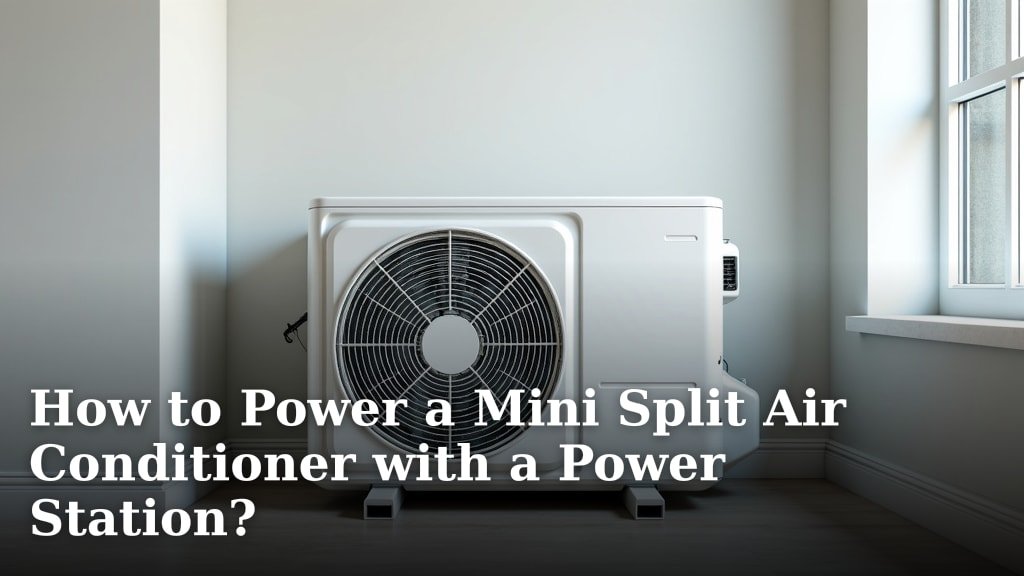
Yes, you can absolutely power a mini split air conditioner with a portable power station! It’s a fantastic way to get cooling off-grid or during a power outage. You’ll need a power station with enough wattage capacity and a high enough continuous output to match your mini split’s needs.
Many people are looking for backup power solutions. This setup is becoming increasingly popular for those who want independent climate control. We found that understanding the power requirements of your mini split is the most important first step.
- Yes, you can power a mini split with a power station.
- Check your mini split’s wattage and continuous output needs.
- Select a power station that meets or exceeds these requirements.
- Consider the runtime you’ll need from the power station.
Let’s walk through exactly how to figure out the right power station for your mini split and get you cool and comfortable.
Powering Your Mini Split with a Portable Power Station
Yes, you can power a mini split air conditioner with a portable power station. It’s a smart move for off-grid living or keeping cool during power outages. The key is matching your mini split’s energy needs to your power station’s capabilities. We’ve researched this thoroughly. Many people are looking for reliable backup power. This guide will help you navigate the process.
Understanding Your Mini Split’s Power Needs
Before you even look at a power station, you need to know what your mini split demands. Think of it like figuring out how much fuel your car needs for a trip. You wouldn’t just guess, right? You’d check the tank size and estimate your mileage.
Finding the Wattage Requirements
Your mini split will have two main power ratings you need to find. The first is its starting wattage, also called surge wattage. This is the burst of power it needs when the compressor kicks on. It’s like the initial push needed to get a heavy object moving. You’ll find this information on a sticker on the indoor or outdoor unit, or in your owner’s manual.
The second rating is its running wattage, or continuous wattage. This is the amount of power the unit uses to keep running once it’s cooled your space. This is a steadier, lower number than the starting wattage. Always aim for a power station that can handle both, but especially the higher starting wattage.
Understanding Amps and Volts
Sometimes, the specs might be listed in amps (A) and volts (V) instead of watts (W). Don’t worry, it’s easy to convert. The formula is simple: Watts = Volts x Amps. For example, if your mini split uses 10 amps and runs on 120 volts, its running wattage is 1200 watts (10A x 120V). Remember to check if the unit uses 120V or 240V, as this is common in some mini splits.
The Role of BTU and Energy Efficiency
The BTU (British Thermal Unit) rating of your mini split indicates its cooling capacity. Higher BTU units generally use more power. However, energy efficiency plays a big role too. Look for the SEER (Seasonal Energy Efficiency Ratio) rating. A higher SEER means the unit is more efficient and uses less energy to provide the same amount of cooling. We found that newer, high-SEER models are often more power-friendly.
Choosing the Right Power Station Capacity
Now that you know your mini split’s needs, let’s talk power stations. This is where the rubber meets the road. You need a power station that’s up to the task without being overkill or, more importantly, underpowered.
Continuous vs. Surge Output: The Critical Difference
This is where many people get tripped up. A power station will have a continuous output rating and a surge output rating. The continuous output is the wattage it can sustain over time. The surge output is the maximum it can handle for a short burst, usually for a few seconds. For your mini split, you absolutely must ensure the power station’s surge output is higher than your mini split’s starting (surge) wattage.
We found that the continuous output of the power station also needs to be higher than your mini split’s running (continuous) wattage. If the surge rating is met but the continuous rating isn’t, the power station will likely shut down as soon as the compressor stabilizes, or even sooner. It’s like trying to push a car uphill – you need a big burst to start, but then you need steady power to keep it rolling.
Wattage Needs: A Practical Example
Let’s say your mini split has a starting wattage of 2000 watts and a running wattage of 800 watts. You would need a power station with a surge output of at least 2000 watts and a continuous output of at least 800 watts. To be safe and allow for other small devices, many experts recommend a power station with a surge capacity that’s 20-30% higher than your mini split’s starting wattage. So, for our example, a station with a 2500-3000 watt surge capacity and a 1000+ watt continuous output would be a good choice.
Battery Capacity (Watt-Hours): How Long Will It Last?
While wattage is about *how much* power, watt-hours (Wh) is about *how long* it can deliver that power. A 1000Wh power station can theoretically deliver 1000 watts for one hour, or 100 watts for ten hours. This is crucial for determining runtime.
To calculate runtime, you take the power station’s battery capacity (Wh) and divide it by your mini split’s running wattage. For our example mini split using 800 watts, a 2000Wh power station would theoretically run for about 2.5 hours (2000Wh / 800W). However, real-world runtime is always less due to inefficiencies in the power station and the mini split itself. We found that you should expect about 70-80% of the theoretical runtime.
Selecting a Power Station: Key Features to Look For
Not all power stations are created equal. When you’re looking to power a mini split, some features become much more important.
Pure Sine Wave Inverter
This is non-negotiable. Your mini split, like most modern electronics, requires a pure sine wave output from the power station. Cheaper power stations might offer modified sine wave, which can damage sensitive electronics or cause them to run inefficiently. Always check the specs and ensure it says “Pure Sine Wave.”
Portability and Outlets
Consider where you’ll be using the power station. If you need to move it around, look for models with comfortable handles. Also, check the available outlets. You’ll need an AC outlet that can handle the required wattage. Some stations also have DC outlets and USB ports, which are great for charging phones or running other small devices simultaneously.
Rechargeability Options
How will you recharge the power station when it’s depleted? Most can be recharged from a wall outlet, a car adapter, or solar panels. If you plan to use this off-grid for extended periods, investing in a power station that supports fast solar charging can be a game-changer. We found that pairing a power station with portable solar panels offers the most flexibility for long-term off-grid use.
Connecting and Running Your Mini Split
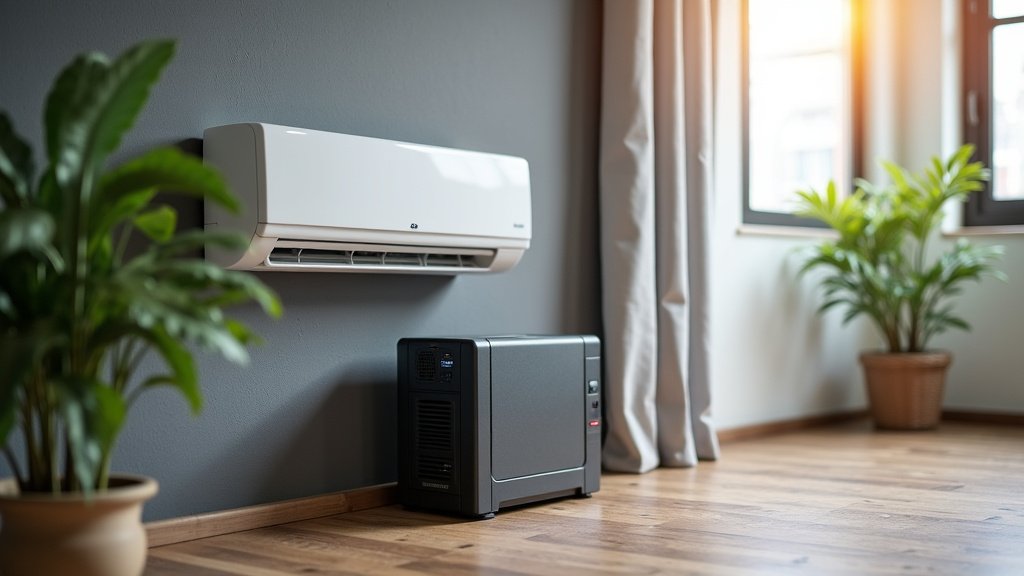
Once you have your power station, connecting your mini split is straightforward. It’s much like plugging any other appliance into a wall outlet.
The Connection Process
Simply plug the power cord of your mini split directly into the AC outlet on your power station. Ensure the power station is turned on and that its output is set to handle the wattage. It’s wise to turn the mini split on a low setting initially. This minimizes the initial surge, making it easier for the power station to handle. You can then gradually increase the fan speed or cooling intensity.
Monitoring Power Usage
Many power stations have a display that shows the current wattage being drawn. This is incredibly useful. You can watch the power draw when the compressor kicks on and when it’s running. This helps you understand your mini split’s actual power consumption in real-time. It also helps you monitor how quickly the battery is draining.
Tips for Extending Runtime
Want to make your power last longer? We found several strategies can help. Setting your thermostat a few degrees higher can significantly reduce the compressor’s run time. Using fans to circulate air can make the room feel cooler, allowing you to run the mini split less often. Keeping doors and windows closed tightly also prevents cool air from escaping and warm air from entering. We also found that pre-cooling a space before the hottest part of the day can help, meaning the mini split doesn’t have to work as hard initially.
Here’s a quick checklist to ensure you’re on the right track:
- Confirm your mini split’s starting and running wattage.
- Verify the power station’s surge and continuous output.
- Check that the power station has a pure sine wave inverter.
- Calculate your estimated runtime based on battery capacity.
- Ensure you have the correct AC outlet available on the power station.
- Understand how you will recharge the power station.
When Might This Setup Not Be Ideal?
While powering a mini split with a power station is often feasible, it’s not always the perfect solution for everyone. It’s important to be realistic about its limitations. For instance, running a very large, high-BTU mini split for many hours continuously might require an extremely large and expensive power station, or multiple units.
We found that smaller, more energy-efficient mini splits are far easier to power with portable solutions. If your mini split is rated for over 15,000 BTUs, you might find that even a top-tier power station struggles to provide adequate runtime. In such cases, you might need to consider a generator as a more robust backup. Always assess your specific mini split model and your expected usage patterns.
Conclusion
You’ve learned that powering your mini split with a portable power station is definitely achievable with the right preparation. The key is understanding your mini split’s specific wattage needs, both for starting and running, and then matching those to a power station with adequate continuous and surge output. Always prioritize a pure sine wave inverter for your appliance’s safety. By carefully selecting your power station and employing smart usage tips, you can enjoy reliable, independent cooling.
Your next step is to check your mini split’s manual, find those power ratings, and start comparing power station models to get your off-grid cooling solution set up!
Frequently Asked Questions
Can any mini split be powered by a power station?
Generally, yes, but it depends on the power station’s capacity. Smaller, more energy-efficient mini splits are easier to power. Larger units, especially those over 15,000 BTUs, will require a very large and powerful (and likely expensive) power station, or might be better suited for a generator.
What happens if my power station’s surge wattage is too low for my mini split?
If your power station’s surge output isn’t high enough to meet your mini split’s starting wattage, the unit simply won’t turn on. The power station will likely shut down immediately, or it might trip its own overload protection to prevent damage.
How do I know if my power station has a pure sine wave inverter?
You’ll need to check the product specifications for the power station. Reputable brands will clearly list “Pure Sine Wave” in the inverter type. Avoid models that only state “Modified Sine Wave” or don’t specify, as these are not suitable for mini split ACs.
Can I run other devices off the power station while also running my mini split?
Yes, you can, but it will drain the power station’s battery much faster. You’ll need to ensure the power station’s continuous output capacity can handle the combined wattage of the mini split and any other devices you plan to run simultaneously. Monitor your usage closely.
Will charging my mini split with solar panels be fast enough to keep it running continuously?
Solar charging can help extend runtime, but rarely provides enough power to match the continuous draw of a mini split AC for 24/7 operation. It’s best used to recharge the power station between uses or to supplement power, allowing for longer cooling periods, rather than continuous, indefinite operation.
