How to Use a Battery Maintainer on a Car
To use a battery maintainer on a car, connect it to the battery, plug it into a suitable outlet, and check its charging light. Keep the vehicle parked, follow the maintainer's instructions, and disconnect power before removing the battery leads.
On this page (9 sections)
- What does a battery maintainer do on a car?
- How do you connect a battery maintainer to a car?
- How do you use a quick-disconnect cable?
- How can you extend a NOCO maintainer?
- How do you check that the maintainer is working?
- Where should you place the charger and cables?
- What should you do before storing the car?
- What are the most common mistakes?
- How do you choose the right setup?
To use a battery maintainer on a car, connect the correct leads to the battery, plug in the maintainer, and confirm its status light. Keep the car parked, follow the charger's instructions, and disconnect the power before removing the battery connections.
A maintainer is useful when a vehicle sits for long periods. It supplies controlled charging as needed instead of leaving a basic charger running at full output.
Before choosing one, learn what is a deep cycle battery if you are comparing battery types. A parked car usually needs a maintainer matched to its battery voltage and the charger's instructions.
What does a battery maintainer do on a car?
A battery maintainer keeps a compatible battery charged during storage or infrequent use. It can help reduce the chance of a weak battery after a car sits, but it cannot repair a damaged battery.
A maintainer normally connects to the battery through ring terminals or clamps. Some models use a quick-disconnect harness, so you can leave the vehicle-side connection in place and attach the charger when needed.
A maintainer is different from a charger designed for fast recovery. Our guide to battery maintainer vs battery charger explains which job each type is meant to handle.
How do you connect a battery maintainer to a car?
Park the car, switch it off, and keep the maintainer unplugged while you attach the leads. Work in a dry, ventilated area with the cables clear of belts, fans, exhaust parts, and sharp edges.
Use this general order:
- Park the car where the battery and outlet are easy to reach.
- Turn off the ignition and remove the key or key fob from the vehicle.
- Check the battery and cables for visible damage or leakage.
- Attach the positive lead to the positive battery terminal.
- Attach the negative lead to the approved negative connection.
- Confirm that both connections are secure and cannot touch moving parts.
- Plug in the maintainer and check its charging indicator.
- Disconnect the maintainer from the outlet before removing the battery leads.
Your vehicle manual and charger instructions take priority if they show a different connection point. Don't connect a charger to a battery that is cracked, leaking, swollen, or visibly damaged.
Which maintainer suits a parked car?
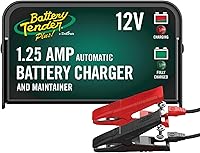
The Battery Tender Plus 12V 1.25 AMP Car & Motorcycle Battery Charger and Maintainer is suited to readers who want a 12V maintainer with a 1.25A current rating for a car that sits unused.
It has a 4-step charging program, adaptive smart charging, a two-color charge-status light, and a quick-disconnect harness. It includes fused ring terminal and alligator clip accessory cables.
Its title identifies it for automotive, motorcycle, and ATV batteries, and its compatible devices include cars, motorcycles, lawn mowers, and ATVs. The product is 2.9 in deep, 2.15 in wide, and 4.4 in high.
The 1.25A output is intended for charging and maintaining rather than rapid recovery. A large or deeply discharged battery may need more time or a different charger.
For more options, compare our guide to the best battery maintainer charger.
How do you use a quick-disconnect cable?
Use a quick-disconnect cable only when its connector matches the maintainer. Attach the vehicle-side harness once, route it away from heat and moving parts, and connect the charger when the car is parked.
A quick disconnect can make storage easier because you don't need to reach the battery terminals every time. It does not remove the need to check the battery, cable, outlet, and charger before use.
When is a 12-foot extension useful?
The Battery Tender 12 Foot Extension SAE Cable helps when the charger cannot reach the car's battery connection. It adds 12 ft of reach and uses male-to-female SAE quick-connect plugs.
The cable is designed for Battery Tender Junior, Plus, 2-Bank, 4-Bank, 5-Bank, and 10-Bank chargers. It is not for Battery Tender products with hard-wired clips, 6V Battery Tender Plus units, or units with white quick-disconnect plugs.
Check the connector before ordering. A cable's length solves a reach problem only when the charger and vehicle-side connection use the matching plug.
How can you extend a NOCO maintainer?
Use a matching NOCO X-Connect extension when your charger and battery connection use that system. Connect the extension between the compatible charger and its battery accessory without adding tools or wiring.
Who needs the NOCO 10-foot extension?
The NOCO GC004 X-Connect 10-Foot Extension Cable for GENIUS suits drivers who use compatible NOCO GENIUS chargers and need 10 ft between the charger and battery connection.
It works with GENIUS1, GENIUS2, GENIUS2X2, GENIUS2X4, GENIUS5, and GENIUS10, plus G750, G1100, G3500, G7200, and G4. It has X-Connect connectors, 16 AWG wire, snap-fit caps, and a maximum current of 20A at 12V.
The cable is also described for indoor and outdoor use, but the full setup still needs protection from rain, standing water, heat, and vehicle movement. It is not compatible with NOCO Boost or Boost X jump starters, and the charger is sold separately.
How do you check that the maintainer is working?
Use the charger's indicator light and the battery's condition as your first checks. A status light can show whether the unit is charging or maintaining, but it does not replace the charger's instructions.
Check that the outlet works and that the charger is receiving power. Inspect the connection for looseness, unusual heat, damaged insulation, or corrosion before leaving the car connected.
If the light shows an error, the battery voltage is too low, or charging does not begin, unplug the unit and review the manual. Don't keep resetting a charger connected to a battery that appears damaged.
A smart maintainer may resume stronger charging if battery voltage drops under load. That behavior does not guarantee that the battery is healthy or that the car will start after storage.
Where should you place the charger and cables?
Place the charger on a dry, stable surface with airflow, and route the cable away from moving or hot parts. Keep the connection protected from water and make sure the cable cannot be pinched by the hood, trunk lid, or door.
Measure the distance before choosing an extension. For a Battery Tender setup, use the best battery maintainer for cars guide to compare car-focused options.
For a NOCO setup, use only a compatible X-Connect cable. If you are considering a power station instead of a wall outlet, read Can You Use a Portable Power Station to Charge a Car Battery? first.
A solar setup has different connection and placement concerns. See Can A Solar Generator Charge In A Car? before using one near a parked vehicle.
What should you do before storing the car?
Clean and inspect the battery area, confirm the maintainer matches the battery, and plan a dry connection point. Remove unnecessary electrical loads from the car and make sure the vehicle is safely parked.
Choose a charger with the right voltage and connector system. A 12V maintainer is not automatically suitable for every battery chemistry or voltage, so follow the vehicle and charger instructions.
If you want a model with automated charging behavior, compare the best smart battery maintainer. If cable reach is the main problem, review the best battery maintainer with quick disconnect guide.
What are the most common mistakes?
The most common mistakes are using the wrong connector, plugging in before checking the leads, routing cables near moving parts, and leaving a damaged battery connected.
Don't use the Battery Tender extension with incompatible Battery Tender units. Don't use the NOCO extension with Boost or Boost X jump starters.
Don't assume a maintainer will fix a battery that cannot hold a charge. If the battery repeatedly loses charge after proper maintenance, have the vehicle and battery checked by a qualified technician.
How do you choose the right setup?
For how to use a battery maintainer on a car, choose based on battery compatibility, connection type, charging output, and cable reach. A Battery Tender Plus suits a 12V car battery when its 1.25A output and included connection options fit your vehicle.
Choose the Battery Tender 12 ft extension when you already use a compatible Battery Tender charger and need more distance. Choose the NOCO GC004 when you use a compatible NOCO GENIUS or listed earlier NOCO charger with X-Connect accessories.
Connect the system with the charger unplugged, check the indicator, and inspect the setup before leaving the car parked. That routine keeps the process simple and makes cable or battery problems easier to spot.
Frequently asked questions
How long should you leave a battery maintainer on a car?
A battery maintainer can stay connected while a compatible car is parked for storage, provided you follow the charger's instructions and keep the setup dry and ventilated. Charging time depends on the battery's condition, the maintainer's output, and the vehicle.
Check the status light before leaving it connected.
Can a battery maintainer charge a completely dead car battery?
A maintainer may not recover a deeply discharged or damaged battery. Check the charger's instructions for its minimum operating voltage and charging behavior, and use a suitable charger or professional service when the battery will not accept a charge.
Never use a maintainer as a substitute for jump-starting.
Do you connect the positive or negative cable first?
Connect the leads exactly as the charger instructions show. In a typical battery connection, the positive lead goes to the positive battery terminal and the negative lead goes to the designated negative connection, but vehicle layouts vary.
Switch off and unplug the charger before removing either lead.
Can you use a battery maintainer outside?
Use a battery maintainer outdoors only when its instructions allow that location and the charger, outlet, connections, and battery remain protected from rain and standing water. Keep cords away from hot, moving, or sharp vehicle parts.
A dry garage or covered area is easier to control.