Are Solar Panels Waterproof?
Yes, solar panel surfaces are built to handle rain, but the full charging setup is not automatically waterproof. The panel face, frame, and sealed cells are made for outdoor weather, while controllers, cables, connectors, and power stations still need dry placement and protection.
On this page (10 sections)
- Are solar panels waterproof in rain and splashes?
- How does a waterproof rating actually work?
- Which parts of a solar setup need rain protection?
- Can you leave a portable panel out overnight in rain?
- Are folding panels as waterproof as rigid panels?
- What should you check before buying waterproof solar panels?
- How do you set up a panel for a rainy day?
- Which panels in this guide suit wet-weather use?
- How do you care for a panel after rain?
- What mistakes should you avoid with waterproof solar panels?
Yes, solar panel surfaces are built to handle rain, but the full charging setup is not automatically waterproof. The panel face, frame, and sealed cells are made for outdoor weather, while controllers, cables, connectors, and power stations still need dry placement and protection.
That split matters for camping, RV trips, and emergency backup. For a home solar setup, see how to connect solar to an electrical panel.
A panel can keep working in a shower while a wet controller or a power station in a puddle creates the real risk.
Are solar panels waterproof in rain and splashes?
Solar panels are waterproof against normal rain because the cells sit behind glass or a sealed front sheet. Rain that hits the front should run off without reaching the cells, as long as the panel, frame, and back sheet are not cracked.
Splashes from below are a different test. Water pooling under a panel or spraying up from a puddle can reach a rear junction box that top rain never touches.
Portable folding panels add hinges, folds, and fabric edges. Those joints can handle rain, but they are not the same as a rigid panel bolted to a roof.
If you want a panel for wet trips, start with our guide to the best waterproof portable solar panels. A stated rating helps, but you still need to protect the parts that plug into the panel.
How does a waterproof rating actually work?
A waterproof rating tells you the kind of water contact a product is designed to tolerate, not that it can sit underwater. Ratings describe splashes, sprays, jets, or immersion, and each level has a different limit.
An IP65 rating covers dust and water jets from a distance. That is stronger than splash-only protection, but it still does not mean you should soak the panel or leave it in a flooded campsite.
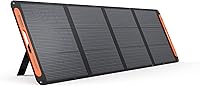
The EBL panel below uses IP65 and ETFE material, and EBL says it protects from splashing while telling users not to place it under rain or soak it in water.
Read the exact wording with the number. Some makers use “water-resistant” for splash protection and “waterproof” for stronger sealing, while others swap those words loosely.
A rating also describes the product as sold, not after damage. A cracked front sheet or loose connector cap can reduce protection fast.
Which parts of a solar setup need rain protection?
The panel face is the most rain-ready part, while the controller, plugs, and power station need dry shelter. Cables sit in between, because sealed connectors handle splashes better than open ports.
A charge controller converts panel power for a battery or power station. It often has buttons, vents, displays, or terminal screws not meant to sit in rain.
The DOKIO kits below include a standalone PWM controller, so keep that controller shaded and dry while the panel stays in the sun.
USB ports and small gadget plugs also need care. Water in a USB port can short the circuit or corrode contacts, even if the panel is fine.
Route cables so water runs off instead of into a plug. Loop a drip edge before a connector and keep extension cords out of puddles.
Can you leave a portable panel out overnight in rain?
You can leave many portable panels out in light rain, but you should not leave the whole setup exposed without checking the ratings. The panel may tolerate rain while the controller or power station stays under a canopy.
Overnight rain brings wind, cooler temperatures, and more grit. A panel laid flat can collect water and dirt that slows draining, while a tilted panel sheds water faster.
Morning is the time to check the setup. Wipe water off the panel face, dry connectors before you unplug them, and look for grit in folds or around the frame.
For camping where rain is likely, plan the site before you arrive. Pick a spot where the panel can face the sun and the power station can stay under an awning.
Our best solar panel for camping guide helps you match panel size and weight to that kind of trip.
Are folding panels as waterproof as rigid panels?
Folding panels can handle rain, but folds and hinges make sealing more complex than a rigid panel. A rigid panel has one continuous frame and face, while a folding panel has seams and edges that flex every time you carry it.
That does not make folding panels a poor choice for wet weather. It means you should buy one with a clear weather rating, keep folds clean, and avoid forcing the panel flat in a puddle.
The EBL 100W panel uses laminated construction and ETFE material with an IP65 water-resistant rating.
The DOKIO 100W and 200W kits take a different approach. They include a separate controller, so the panel can sit in the sun while the controller stays dry.
The 100W model folds to 19 x 26 x 0.5 in and weighs 6 lb, while the 200W model folds to 20 x 27 x 1.1 in and weighs 9.7 lb.
What should you check before buying waterproof solar panels?
Check the rating, front material, connector types, and whether the controller is separate or built in. Those four points show how a panel handles rain and what you must shelter.
Start with exact rating wording, like IP65 and its limits for splashes or jets. If a maker only says weather resistant, ask what contact that covers.
Next, confirm included cables and adapters. The EBL 100W includes an MC4 to Anderson cable, an MC4 to DC5521 cable, and three small barrel adapters.
The DOKIO kits use SAE, XT60, DC, and alligator clip options across the models, so match plugs to your setup.
Also check your power station input limit. The DOKIO 100W warns some stations cap at 60W, and the 200W warns of 100 to 150W caps.
A panel cannot push more than the input accepts.
For size and type help, our guide to solar panels covers power, portability, and compatibility.
How do you set up a panel for a rainy day?
Put the panel in the sun, keep the controller and power station dry, and route cables so water cannot run into plugs. That order protects electronics while the panel does the outdoor work.
Set the panel where rain can drain instead of pooling. A slight tilt helps, and kickstands make it easier.
The EBL panel has 2 kickstands holding it at 45 degrees, which EBL says can catch more sunlight than a flat panel.
Keep the controller under a canopy or in a dry bag. The DOKIO kits include a 9.84 ft cable, so the panel can sit in direct sun while the controller stays shaded.
Check each connection before powering up. Push plugs in fully, close caps on unused ports, and keep USB cables off wet ground.
Match the panel to your station input first. Our picks for the best solar panels for DJI Power 1000 show how input limits shape that choice.
Which panels in this guide suit wet-weather use?
The EBL 100W panel has the clearest stated water rating here, while the DOKIO kits suit buyers who want a separate controller they can shelter. All three can work in rain with the right setup, but they solve different problems.
The EBL 100W panel is built for portable use with a stated IP65 water-resistant rating and ETFE material. EBL says the rating protects from splashing and warns against placing it under rain or soaking it in water, so treat left-out use as a caution case.
Its 2 kickstands hold a 45 degree angle, and included cables cover several connector types.
The DOKIO 100W kit suits RVs, vans, tents, and emergency backup where weight matters. It folds to 19 x 26 x 0.5 in, weighs 6 lb, and includes a standalone PWM controller with protection against reverse polarity, overcharge, overload, and short-circuit.
The DOKIO 200W kit suits larger loads on boats, trailers, and RVs. It folds to 20 x 27 x 1.1 in and weighs 9.7 lb, with the same separate controller and a 9.84 ft cable.
Check your station input before buying, since DOKIO notes caps of 100 to 150W on some models.
How do you care for a panel after rain?
Dry the panel, check the plugs, and store it unfolded until moisture is gone. That routine prevents grit, corrosion, and mildew from turning a wet trip into a repair job.
After rain, wipe the front with a soft cloth and let the panel air dry in shade. Shake water out of folds on folding models, then check frame corners, hinges, and cable ends for sand or leaves.
Dry every connector before you unplug it. If water reached a USB port, DC plug, or controller terminal, let it dry fully and look for corrosion before reconnecting.
For a deeper look at ratings for the rest of your power setup, see what is the waterproof rating for a solar generator. Panel and generator ratings use the same code language, so learning one helps you read the other.
What mistakes should you avoid with waterproof solar panels?
Do not confuse a rain-ready panel with a fully waterproof charging kit. Most mistakes come from that mix-up, including wet controllers, soaked plugs, and panels left in puddles.
Avoid leaving the power station or battery on the ground in rain because the panel is out in it. Avoid plugging a wet USB cable into a phone or light, submerging a panel to wash it, or folding a wet folding panel into a closed bag.
Do not ignore damage to the face, frame, or cable. A crack or torn edge can let water reach parts sealed at the factory.
If you compare newer cell types, read our guide to the best portable solar panel N type. Cell type affects efficiency and size, but it does not replace a clear water rating or a dry plan for the electronics.
Frequently asked questions
Are solar panels waterproof?
Solar panel faces and frames are weather resistant and made for rain, but that does not make every part of a charging kit waterproof. Keep the controller, power station, and battery connections dry, and use a stated water rating as a guide instead of a promise to soak the panel.
Can I leave a portable solar panel in the rain?
Many portable panels can stay out in light rain while charging, but you should check the stated rating and the instructions for your model. Move the controller and power station under cover, keep cables from sitting in puddles, and dry the panel before folding it for storage.
Do controllers and cables need rain protection?
Yes. Controllers, USB ports, exposed connectors, and power station inputs are usually the parts that need protection from direct rain.
Place them under a canopy or in a dry case, route cables so water cannot run into plugs, and disconnect the setup if water starts pooling around the electronics.