Best 48V Lithium Battery Chargers: Top 9 Picks (November 2026)
The best 48V lithium battery chargers include the OGRPHY 48V Lithium Golf Cart Battery Conversion (best complete golf cart conversion), the DC HOUSE Metal Case 48V 100Ah Lithium for metal-case golf cart protection, and the KAISAL Lithium Battery Charger 48 Volt/58.4V 18A for large LiFePO4 banks.
On this page (5 sections)
- The best 48V lithium battery chargers by use
- How to match a 48V charger to your battery
- Safe setup and care for a 48V lithium charger
- Which 48V lithium battery charger should you choose?
- Before you buy any of them, match the chemistry, final charge voltage, allowed current and connector to your battery. That check will tell you more than any score on this page.
The best 48V lithium battery charger for most large LiFePO4 banks is the KAISAL 58.4V 18A charger. It combines a 0V wake-up mode, M8 terminal, 16 ft cable and IP67 case, while the OGRPHY and DC HOUSE kits include the battery as well as the charger.
That works for large LiFePO4 systems because charging current matters as much as final voltage. An 18A charger refills a large bank in a more practical time than a small e-bike charger, and the longer cable gives more freedom for mounting.
The M8 terminal suits direct wiring in a golf cart, RV, boat or off-grid setup. A small barrel plug would be the wrong tool for that job.
The IP67 case helps if the charger lives outdoors or in a compartment that sees spray and dust. You still need ventilation and a dry connection point.
A 48V label alone does not tell you which charger to buy. Many 48V lithium-ion e-bike batteries use 54.6V charging, while 48V or 51.2V LiFePO4 batteries commonly use 58.4V.
The final charge voltage must match, not just the nominal battery label. Chemistry is the other clue, because LiFePO4 and lithium-ion do not always want the same charging profile.
Current is the third clue. A 2A e-bike charger and a 20A LiFePO4 charger may both say 48V, but they serve very different battery sizes.
Connection style is the fourth clue. E-bike plugs, M8 terminals, ring terminals and Anderson connectors each point to a different installation.
For guidance, see charging lithium with a regular charger.
That guide helps you separate a charger problem from a battery problem. Check the original charger label, not just the battery label.
If you are still learning what is a deep cycle battery, start with chemistry, voltage and BMS limits before comparing speed. Deep cycle batteries are built for repeated discharge and recharge, but safe recharging still depends on exact chemistry.
Speed should come last. A faster charger only helps if the battery, wiring and connector accept that current every time.
Use this roundup in that order. First match chemistry and final voltage, then check current and connector, then compare case protection, cable length and warranty.
That approach steers golf cart owners toward OGRPHY or DC HOUSE kits, LiFePO4 bank owners toward KAISAL, Xnvua, LiTime or FORM, and e-bike owners toward the 54.6V models.
Our picks at a glance
-
1
 Best complete golf cart conversion
OGRPHY 48V Lithium Golf Cart Battery Conversion
9.7/10 our score
See it on Amazon -
2
 Best for metal-case golf cart protection
DC HOUSE Metal Case 48V 100Ah Lithium
9.6/10 our score
See it on Amazon -
3
 Best for large LiFePO4 banks
KAISAL Lithium Battery Charger 48 Volt/58.4V 18A
9.0/10 our score
See it on Amazon
- 4
 Check it
hyleton 48V Lithium Battery Charger
Best for 48V e-bike batteries - 5
 Check it
Beleeb C20 Adjustable Battery Charger 12V 24V
Best for mixed-voltage battery work - 6
 Check it
Xnvua 58.4V 20A LiFePO4 Battery Charger 48V
Best for fastest LiFePO4 charging - 7
 Check it
LiTime 48V 18A Lithium Battery Charger
Best for outdoor charging - 8
 Check it
FORM 48V Lithium LiFePO4 Battery Charger
Best for onboard golf cart charging - 9
 Check it
Brokeir UL Certified 54.6V 2A Fast Electric
Best for simple e-bike replacement
The best 48V lithium battery chargers by use
The right pick depends on your battery chemistry, charging voltage and connection style. OGRPHY and DC HOUSE are complete golf cart upgrades, while KAISAL, Xnvua, LiTime and FORM are charger-only choices for larger LiFePO4 systems.
Start with the battery you already own, not the charger you want to buy. If your pack is a 48V lithium-ion e-bike battery, the 54.6V models fit that job.
If your pack is a 48V or 51.2V LiFePO4 system, look at the 58.4V chargers instead.
Connection style then narrows the list further. M8 terminals suit direct battery wiring, ring terminals suit an onboard golf cart install, and Anderson connectors suit flexible or temporary setups.
Golf cart owners replacing a whole battery system have a different shopping list from owners who only need a replacement charger. The complete kits solve the battery and charger together, while charger-only units assume your battery is already in place.
Use the sections that follow by your use case, not by score alone. The best charger is the one that matches your chemistry, voltage, connector and mounting plan.
OGRPHY 48V Lithium Golf Cart Battery Conversion: Best complete golf cart conversion
- 48V 100Ah LiFePO4 battery
- 58.4V 18A onboard charger
- 200A BMS
- Touch monitor and Bluetooth monitoring
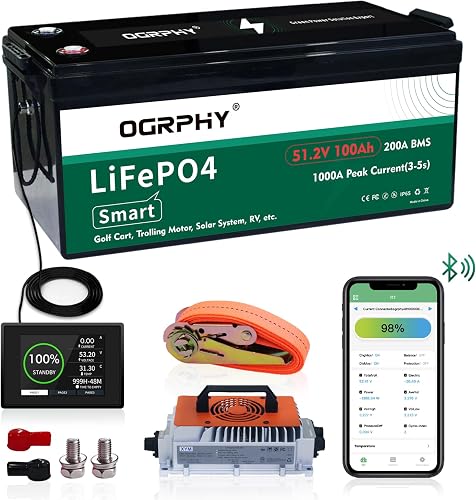
This is a full 48V golf cart conversion kit rather than a charger alone. It includes a 100Ah LiFePO4 battery, 58.4V 18A charger, touch monitor and 200A BMS.
Pros
- Complete conversion kit
- Touch monitor and Bluetooth BMS
- 58.4V 18A charger included
Cons
- Heavier than a charger-only option
- Requires careful installation
OGRPHY is the strongest all-in-one choice for a golf cart conversion. The kit includes a 48V 100Ah LiFePO4 battery, a 58.4V 18A charger, a touch monitor, screen stand, M8 terminals and a retention strap.
Its 200A BMS supports up to 200A continuous discharge, with higher peak-current figures stated for short periods. The battery is rated at 5.12kWh, and OGRPHY says a 3kW golf motor can travel 30 miles under its test conditions.
The charger is designed for in-vehicle installation and can connect through the cart's original charging port. Its 0V charge function may help wake a low-voltage LiFePO4 battery after BMS protection.
Bluetooth monitoring and the included touch screen give you two ways to view battery information. The complete kit weighs 88.1 lb and measures 10.6 x 20.4 x 8.6 in, so check the compartment before installation.
Choose OGRPHY when you need the battery and charger together. Follow the safety instructions closely, turn off the battery switch before cable work and use professional installation if the wiring is unclear.
DC HOUSE Metal Case 48V 100Ah Lithium: Best for metal-case golf cart protection
- 48V 100Ah lithium battery
- 48V 18A charger
- Metal case and fixtures
- Bluetooth app and LCD monitor
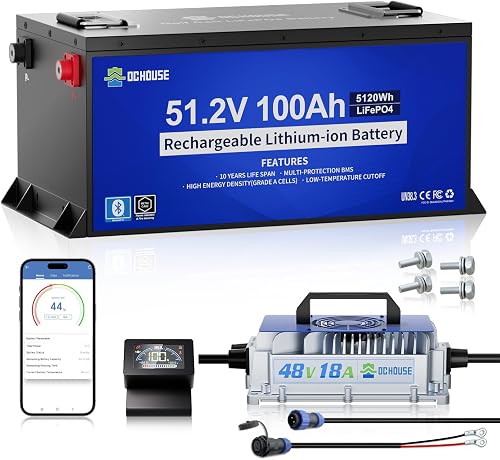
The DC HOUSE package combines a 100Ah golf cart battery with an 18A charger, monitor and metal case. It suits buyers replacing a golf cart battery system and charger together.
Pros
- Metal case
- 18A charger included
- App and LCD monitoring
Cons
- Battery kit weighs 99 lb
- Fit may require battery compartment checks
DC HOUSE suits golf cart owners who want a 100Ah battery, charger and monitoring hardware in one package. Its metal case and metal fixtures are a key difference from plastic-cased battery kits.
The package includes a 48V 100Ah battery, 48V 18A charger, battery monitor and Bluetooth LCD monitor. DC HOUSE states that the charger provides 900W charging and can fully charge the battery in 5.5 hours.
The 200A BMS supports a stated 250A current for 30 seconds and a 670A peak for 0.5 seconds. Those figures describe short-duration output, not a continuous 670A load.
The case measures 11.1 x 19.9 x 9.2 in and the kit weighs 99 lb. DC HOUSE notes that golf cart battery compartments vary, so measure the available space before planning the conversion.
Choose this kit if case protection and wireless monitoring matter. The charger and battery ship separately, so account for that when checking delivery.
KAISAL Lithium Battery Charger 48 Volt/58.4V 18A: Best for large LiFePO4 banks
- 58.4V 18A output
- 0V charging wake-up mode
- IP67 waterproof case
- M8 terminal and 16 ft cable
KAISAL is a charger-only choice for 48V or 51.2V LiFePO4 batteries. Its 18A output, 0V wake-up mode and IP67 case fit golf carts, RVs, boats and off-grid systems.
Pros
- 0V wake-up mode
- IP67 waterproof case
- 16 ft cable
Cons
- Designed for LiFePO4 batteries
- M8 connection may not fit every system
KAISAL is the best charger-only choice for a large 48V or 51.2V LiFePO4 bank. Its 58.4V 18A output can charge a 100Ah LiFePO4 battery in about 5 hours under the stated conditions.
The charger includes an M8 terminal for direct battery connection, a 16 ft cable and four mounting holes. The 3.3 lb body measures 23 x 12.4 x 4.5 in.
A 0V wake-up mode can reactivate a low-voltage battery after BMS cut-off. The charger also uses temperature control, automatic shutoff and protection against overvoltage, overcurrent, overheating, short circuits, reverse connection and no-load conditions.
Its IP67 die-cast aluminum case is suited to outdoor systems such as golf carts, boats, RVs and solar setups. For an RV, compare lithium battery chargers for RVs.
Confirm that your battery uses the correct LiFePO4 arrangement before connecting it.
Choose KAISAL for a strong mix of charging speed, cable length and weather protection. For more general options, compare it with our guide to the best lithium battery charger.
hyleton 48V Lithium Battery Charger: Best for 48V e-bike batteries
- 54.6V 2A output
- UL certification
- Three connector types
- 100–240V input
The hyleton uses the 54.6V charging voltage expected by many 48V lithium-ion e-bike batteries. Its 2A output and several connector options make it a compact replacement charger.
Pros
- UL certified
- Several connector options
- 100–240V input
Cons
- Not for 48V LiFePO4 batteries
- Not for golf carts or lead-acid batteries
hyleton targets a different kind of 48V battery. Its 54.6V 2A output is for 48V lithium-ion e-bike batteries, not 48V LiFePO4 packs, golf carts or lead-acid batteries.
Three connector styles are built in: 5.5 x 2.5 mm or 5.5 x 2.1 mm DC plugs, a 12 mm 3-pin plug and an 18 mm XLR plug. Confirm your battery port before ordering.
The charger accepts 100–240V input and uses a V0-rated fire-resistant plastic enclosure. hyleton includes protection against overvoltage, overcurrent, short circuits and overheating.
Its 2A output is appropriate for the e-bike batteries named in the product information, including 7.8Ah through 20Ah capacities. A green light indicates standby or full charge, while red indicates charging.
Choose hyleton for a 48V e-bike replacement charger. If you need a charger for a car or auxiliary battery instead, see the best lithium battery charger car guide.
Beleeb C20 Adjustable Battery Charger 12V 24V: Best for mixed-voltage battery work
- 12V, 24V, 36V and 48V settings
- Adjustable current
- Lead-acid and lithium support
- Pulse high-voltage maintenance mode
Beleeb is the flexible option for households or shops that work with several battery voltages. At 48V it provides up to 6A, so it is slower than the dedicated 18A and 20A chargers.
Pros
- Four voltage settings
- Adjustable current
- Supports several battery types
Cons
- Slower at 48V
- Voltage must be selected correctly
Beleeb is the most flexible choice when one charger must handle several battery voltages. It supports 12V, 24V, 36V and 48V, with maximum current figures of 12A, 10A, 8A and 6A respectively.
It works with lead-acid, SLA, AGM, GEL, lithium and LiFePO4 batteries. The voltage selector must match the battery, so check the setting before every connection.
Normal mode is intended for routine charging. Its H mode uses a high-voltage pulse for maintenance or equalizing work, and the lower rate is recommended for that use.
At 48V, the 6A maximum is slower than the dedicated 15A, 18A and 20A models here. That trade-off makes sense if you maintain several voltage systems but is less appealing for one large battery bank.
Choose Beleeb for mixed-voltage work in a garage, workshop or vehicle collection. Don't leave a lithium or LiFePO4 battery without a BMS connected for long periods.
Xnvua 58.4V 20A LiFePO4 Battery Charger 48V: Best for fastest LiFePO4 charging
- 58.4V 20A output
- 0V charging mode
- M8 terminal, alligator clips and Anderson connector
- Cooling fan
The Xnvua has the highest charging current in this group at 20A. It suits compatible 48V or 51.2V LiFePO4 banks when you want faster charging and need flexible connection options.
Pros
- 20A charging current
- 0V charging mode
- Three connection options
Cons
- Not for lead-acid batteries
- Not for 15-cell 48V LiFePO4 batteries
Xnvua offers the highest charging current in this roundup at 20A and 58.4V. It is designed for 48V or 51.2V LiFePO4 batteries, not lead-acid batteries or 15-cell 48V LiFePO4 batteries.
That 20A figure is the main reason to choose it. For a compatible large LiFePO4 bank, it can cut charging time compared with 15A or 18A options, if the battery BMS allows that current.
Check the allowed charge current before planning daily use around the highest output. A fast charger does not make an undersized pack safer.
Connection choices cover different installations: M8 terminal, alligator clips and Anderson connector. The M8 suits fixed installs, clips suit bench or temporary use, and the Anderson suits systems already wired for that plug.
A 0V charging mode can help restore a battery after BMS protection. It is a recovery feature, not a fix for a damaged, swollen or overheated pack.
Protections cover low voltage, overvoltage, overcurrent, overheating, output short circuit and reverse polarity, with full-charge automatic stopping. The fan and vortex housing improve heat dissipation, and the body measures 8.66 x 4.72 x 5.12 in.
Keep fan vents clear during charging. Inspect clips, terminals and cable jacket before each session, and stop for qualified help if the battery stays hot, swells or will not respond normally.
LiTime 48V 18A Lithium Battery Charger: Best for outdoor charging
- 58.4V 18A output
- IP65 protection
- Three-stage charging
- Anderson connector and mounting holes
LiTime combines an 18A output with IP65 protection, a carry handle and mounting holes. It is a practical fit for outdoor LiFePO4 charging where dust and light water exposure are concerns.
Pros
- IP65 protection
- 18A output
- Portable and mountable
Cons
- For LiFePO4 batteries
- No charger-only connector fit guarantee
LiTime fits outdoor LiFePO4 charging where a protected case and flexible mounting matter. Its 58.4V 18A output works with 48V or 51.2V LiFePO4 batteries in golf carts, boats, RVs and energy storage systems.
The 18A output is a practical middle ground. It is faster than a 15A onboard unit for a large bank, while matching the current level used by several other LiFePO4 chargers here.
The IP65 case is waterproof and dustproof, with a sealed connector cap. The die-cast aluminum housing includes a carry handle and mounting holes for fixed installation.
That mix suits a charger that moves between a garage, boat and RV. The handle helps with carrying, and the mounting holes help when you want it fixed in one place.
Keep the connector capped when not in use. Avoid leaving the unit in standing water even with a waterproof rating.
Its three-stage charging includes activation, constant-current and constant-voltage stages. Activation matters after a battery has sat unused or hit BMS protection, while constant voltage matters near the end when current should taper.
LiTime also includes an Anderson connector and an active cooling fan. Keep vents unblocked during longer charges and listen for airflow changes.
The charger measures 9.23 x 4.41 x 5.08 in and weighs 5.1 lb. It is portable enough for a garage or vehicle, while mounting holes suit a fixed point.
For a fixed install, plan the cable route before drilling. Choose LiTime when outdoor protection and portability matter more than an IP67 case.
For chemistry details, read what is LiFePO4 battery chemistry. Check the chemistry label before ordering, because an IP65 case cannot correct a wrong charging voltage.
FORM 48V Lithium LiFePO4 Battery Charger: Best for onboard golf cart charging
- 15A onboard charging
- Ring terminals
- IP67 waterproof rating
- Maintenance mode
FORM is made for mounting on a golf cart and connecting through ring terminals. Its 15A output and maintenance mode suit buyers who want a charger that can stay connected between uses.
Pros
- Onboard design
- IP67 rating
- Maintenance mode
Cons
- Golf-cart focused
- Ring terminals require direct installation
FORM is made for an onboard golf cart installation. Its 15A output and ring terminals connect directly to the main battery positive and negative terminals at the ends of the battery series.
You mount the charger on the cart and charge through the cart instead of carrying a separate unit to the battery. That direct wiring is the point of this design.
The charger uses a maintenance mode after the LiFePO4 pack reaches full charge. That suits a cart that stays connected between outings and can top off instead of drifting down.
FORM gives it an IP67 rating, WeatherShield internal coating, a cooling fan and battery-sensing technology. The body measures 5.25 x 10 x 3 in.
The low, flat body helps it fit where a taller charger would not. The compartment still needs airflow around the vents.
Battery sensing helps the charger respond to the pack instead of pushing a fixed charge. That matters on an onboard unit that may stay connected for long periods.
This is not a portable bench, boat or solar charger. Check terminal tightness, cable routing and clearance, and turn off the battery switch before connecting or disconnecting leads.
Choose FORM for a compact onboard unit with maintenance charging. For a broader chemistry comparison, see the best LiFePO4 battery charger guide.
Get professional installation help if cart wiring looks old, damaged or unclear.
Brokeir UL Certified 54.6V 2A Fast Electric: Best for simple e-bike replacement
- 54.6V 2A output
- UL certified model
- Five universal connectors
- Automatic stop at full charge
Brokeir is another 54.6V 2A option for 48V lithium e-bike batteries. Five connector options help when your replacement needs a different plug style.
Pros
- Five connector options
- UL certified model
- Automatic full-charge stop
Cons
- Not for lead-acid batteries
- Not for 48V LiFePO4 banks
Brokeir is a simple 54.6V 2A option for 48V lithium-ion electric bikes and scooters. It uses the same general charging voltage as other 48V e-bike chargers in this roundup.
The charger includes 5 universal connectors, including DC 5.5 x 2.1 mm and 5.5 x 2.5 mm plugs, a 12 mm aviation plug and a Cannon-style connector. Check the connector shape before use.
Its CC-CV charging mode automatically stops when the battery is full. Protection includes overvoltage, overcurrent, short circuit, over-temperature, reverse connection and fuse protection.
Brokeir lists a 100–240V input range and a 2A output. It is not for lead-acid batteries, so don't use it as a replacement for a golf cart charger unless the battery type and output match exactly.
Choose Brokeir when connector variety matters for a 48V e-bike. For a charger that supports a different LiFePO4 voltage, compare the best 24V lithium battery chargers.
How to match a 48V charger to your battery
Match the charger's final output voltage to the battery chemistry before comparing amps. A 54.6V charger suits many 48V lithium-ion e-bike batteries, while 58.4V is the common target for 48V or 51.2V LiFePO4 batteries.
Is your battery lithium-ion or LiFePO4?
Battery chemistry determines the charging profile. hyleton and Brokeir are for 48V lithium-ion e-bike batteries, while KAISAL, Xnvua, LiTime, FORM and the OGRPHY charger are aimed at LiFePO4 systems.
That split is the most important step in the whole process. The same nominal 48V label can hide two different charging voltages, and the wrong one can fail to charge or create a safety risk.
If the label only says 48V lithium, confirm the battery's final charge voltage before connecting anything. A charger with the wrong output can fail to charge or create a safety risk.
Look at the original charger label first. Its output voltage is usually the clearest clue, and the connector shape is the next clue.
Then check the battery label for chemistry and cell arrangement. A 15-cell 48V LiFePO4 pack, for example, is not the same as a 16-cell 51.2V pack, even though both are sold as 48V.
Current comes after voltage. A battery that allows 20A charging can use a 20A charger in a sensible time, while a pack built for lower current needs a slower charger.
Connection style comes last, but it still matters. The right voltage with the wrong plug is still the wrong charger for daily use.
For a golf cart conversion, also check compartment size and cable routing before you order. A charger that fits the battery may still not fit the cart.
For an RV, boat or solar bank, check the wiring, fuse and connector ratings as well. The charger is only one part of the charging path.
Get the chemistry, final voltage, allowed current and connector right, and the shortlist becomes much smaller.
What charging current do you need?
Higher amperage can reduce charging time when the battery's BMS supports it. The 6A 48V setting on Beleeb is slower but more flexible, while Xnvua's 20A output is faster for a compatible LiFePO4 bank.
Don't choose current by charger speed alone. Check the battery's allowed charging current and the wiring, connector and fuse setup.
Which connection should you use?
M8 terminals and ring terminals suit direct installations on golf carts, RV systems and larger battery banks. Anderson connectors and alligator clips make temporary or flexible connections easier.
E-bike chargers use smaller barrel, aviation or XLR-style plugs. Match the plug size and polarity, not only the voltage printed on the charger.
Safe setup and care for a 48V lithium charger
Use the battery recommended charger and inspect cables before every session. Keep ventilation around fan-cooled units, protect connectors from moisture, and stop charging if you see heat damage, swelling or a damaged cable.
Look for frayed jackets, bent terminals, loose screws and connectors that feel hot after a charge. Keep chargers away from bedding, paper and other items that could block airflow.
Turn off the battery switch before connecting or disconnecting cables on a golf cart conversion. Check terminal tightness, cable routing and battery compartment clearance before energizing a new system.
A loose terminal can create heat under load. Tighten and route cables first, then switch the system on and watch the first charge closely.
Use only a LiFePO4 charger for a LiFePO4 battery, and only the final voltage your battery requires. A lead-acid charger or a 54.6V e-bike charger is not a substitute for a 58.4V LiFePO4 charger.
Check existing wiring on the cart, RV or boat before adding a new charger. Aging, cracked or undersized wiring can become a fire risk when current flows for hours.
A 0V wake-up mode may restore a battery after BMS protection, but it is not a repair for physical damage. A battery that remains hot, swollen or unresponsive needs qualified service.
Use wake-up mode once and observe closely, stopping if heat or swelling appears. A battery that will not respond normally after that should not return to daily use.
A battery management system protects against overvoltage, overcurrent and temperature faults, but it does not remove the need for correct voltage and chemistry matching. Read more about the best LiFePO4 battery management systems before building a larger pack.
The BMS is a safety layer, not a license to use any charger. Correct voltage, correct chemistry and correct current still come first.
Check terminal tightness and cable condition every few months for long-term care. Vibration, heat and repeated use can loosen a connection that was tight at installation.
Store the charger dry, keep connectors capped when not in use, and unplug it when away for long periods. Use a qualified technician if you are unsure about wiring, connector polarity or battery condition.
Which 48V lithium battery charger should you choose?
Pick KAISAL for a charger-only LiFePO4 setup that needs 18A output, 0V wake-up charging, an M8 terminal and IP67 protection. Pick OGRPHY or DC HOUSE when the battery conversion kit matters as much as the charger.
KAISAL is the best fit when your battery is already in place and you mainly need a strong 58.4V 18A charger. Its 16 ft cable and M8 terminal suit golf carts, RVs, boats and off-grid LiFePO4 banks.
OGRPHY is the better buy when you want the battery, charger, touch monitor and strap in one golf cart conversion package. DC HOUSE is the better buy when a metal case and wireless monitoring matter more.
Choose hyleton or Brokeir for a 48V lithium-ion e-bike battery requiring 54.6V. Choose Beleeb if you maintain several battery voltages, Xnvua for compatible 20A LiFePO4 charging, LiTime for outdoor use or FORM for a golf cart charger that stays onboard.
hyleton and Brokeir are e-bike chargers, not LiFePO4 bank chargers. Their 2A output and smaller plugs suit e-bike packs, and their final voltage is 54.6V instead of 58.4V.
Beleeb is the flexible choice for a garage or workshop with several battery voltages. At 48V it is limited to 6A, so it trades speed for versatility.
Xnvua is the speed choice for a compatible LiFePO4 bank that allows 20A charging. LiTime is the outdoor choice with IP65 protection, a handle and mounting holes.
FORM is the onboard golf cart choice, with ring terminals, maintenance mode and a compact body. It is made to stay on the cart, not to serve as a general portable charger.
Before you buy any of them, match the chemistry, final charge voltage, allowed current and connector to your battery. That check will tell you more than any score on this page.
Our top 3 picks at a glance
-
1
Best complete golf cart conversion
OGRPHY 48V Lithium Golf Cart Battery Conversion
9.7/10 our score
See it on Amazon -
2
Best for metal-case golf cart protection
DC HOUSE Metal Case 48V 100Ah Lithium
9.6/10 our score
See it on Amazon -
3
Best for large LiFePO4 banks
KAISAL Lithium Battery Charger 48 Volt/58.4V 18A
9.0/10 our score
See it on Amazon
Frequently asked questions
What voltage should a 48V lithium battery charger have?
A 48V LiFePO4 battery commonly needs a charger around 58.4V, while many 48V lithium-ion e-bike batteries use 54.6V. Match the charger's final output voltage and chemistry to the battery before connecting it.
A charger labeled for 48V does not automatically work with every 48V battery.
Can you use a 58.4V charger on a 48V lithium battery?
Use a 58.4V charger only with a compatible 48V or 51.2V LiFePO4 battery. It is not the correct choice for every 48V lithium-ion battery, especially many e-bike packs that require 54.6V.
Check the battery chemistry, cell arrangement and original charger output first.
What is the difference between a 54.6V and 58.4V charger?
A 54.6V charger is commonly used for 48V lithium-ion e-bike batteries, while 58.4V is commonly used for 48V or 51.2V LiFePO4 batteries. The two outputs are not interchangeable.
Using the wrong final voltage can prevent charging or damage the battery system.
How many amps should a 48V LiFePO4 charger have?
Choose the charging current your battery manufacturer allows. An 18A or 20A charger can refill a large 48V LiFePO4 bank faster than a 6A charger, but the battery's BMS and charging instructions must support that current.
Higher current is not automatically better.
Can a 48V lithium battery charger wake up a low-voltage battery?
Some chargers include a 0V charging or wake-up mode that can reactivate a battery after BMS protection. KAISAL, Xnvua and OGRPHY include this type of function in the products listed here.
Do not keep charging a damaged or swollen battery.
Stop and seek qualified service if the pack shows physical damage.