9 Best Lithium Battery Charger for RV (November 2026)
The best lithium battery chargers for RVs include the Haisito 20-Amp Smart Battery Charger for flexible RV battery charging, the NOCO GENIUS1 1A 6/12V Smart Battery Charger for RV battery maintenance, and the NOCO GENIUS5 5A 6/12V Smart Battery Charger for moderate RV battery maintenance.
On this page (6 sections)
The best lithium battery charger for RV use is the Haisito 20-Amp Smart Battery Charger for most mixed-use setups. It supports LiFePO4 and lead-acid batteries, charges at 20A on 12V systems, and shows current, voltage, temperature and battery percentage on an LCD.
That mix matters because many owners do not stay with one battery type for long. A charger that can switch profiles lets you change batteries without replacing the charger.
A dedicated charger should match your battery chemistry, voltage and charging current. Those three points affect how quickly it can fill the battery without exceeding its limits.
You also need to choose between a portable charger and a built-in converter. A portable unit is simpler to move and store, while a converter stays wired in for shore power charging.
For occasional or shared use, portable usually fits better. For steady charging whenever the RV is plugged in, a built-in converter fits better.
Start with our guide to what is a deep cycle battery if you are still comparing battery types. For a broader overview, see how to charge a RV battery.
Our picks at a glance
-
1
 Best for flexible RV battery charging
Haisito 20-Amp Smart Battery Charger
9.7/10 our score
See it on Amazon -
2
 Best for RV battery maintenance
NOCO GENIUS1 1A 6/12V Smart Battery Charger
9.6/10 our score
See it on Amazon -
3
 Best for moderate RV battery maintenance
NOCO GENIUS5 5A 6/12V Smart Battery Charger
9.5/10 our score
See it on Amazon
- 4
 Check it
LiTime 12V 20A Lithium Battery Charger
Best for dedicated 12V LiFePO4 banks - 5
 Best for built-in RV chargingCheck it
- 6
 Check it
PZ.P 15-Amp 12V/24V Smart Battery Charger
Best for 12V and 24V RV systems - 7
 Check it
LiTime 12V 10A Lithium Battery Charger
Best for slower 12V lithium charging - 8
 Check it
KAISAL 12V 30A Lithium Battery Charger 14.6V
Best for outdoor lithium charging - 9
 Check it
E-FAST 20A Smart Car Battery Charger
Best for mixed 12V and 24V maintenance
Which lithium battery charger is best for an RV?
The Haisito is the best all-around choice because it supports 12V and 24V systems, several lead-acid types, and LiFePO4 batteries. That breadth makes one charger easier to use across more than one RV setup.
The LiTime 20A is a better fit for a dedicated 12V LiFePO4 bank. Its output is set for that task, so there is less to decide about modes.
We compared output, chemistry support, voltage choices, low-voltage activation, monitoring, connections and protection. Those points cover daily use, not just headline amps.
Our score weighs specs, features and buyer feedback against your needs. A charger with strong specs still has to suit your battery size, storage space and connection style.
Monitoring and connections affect daily use. An LCD shows more detail than a status light, while clamps suit portable use and fixed terminals suit a permanent location.
Protection features are worth checking before you buy. Overcharge, reverse polarity and temperature-related protection help when a connection is wrong or conditions change.
Low-voltage activation is useful for some batteries and irrelevant for others. If your battery has never been deeply discharged, you may never need it.
| Product | Best for | Charging output | Battery types | Display | Our score |
|---|---|---|---|---|---|
| Haisito 20-Amp Smart Battery Charger | flexible RV battery charging | 20A at 12V; 10A at 24V | LiFePO4, AGM, GEL, SLA and lead-acid | LCD with current, voltage, temperature and battery percentage | 9.7 |
| NOCO GENIUS1 1A 6/12V Smart Battery Charger | RV battery maintenance | 1A | LiFePO4, AGM, gel, flooded, SLA, VRLA and deep-cycle | 9.6 | |
| NOCO GENIUS5 5A 6/12V Smart Battery Charger | moderate RV battery maintenance | 5A | LiFePO4, AGM, gel, flooded and deep-cycle | 9.5 | |
| LiTime 12V 20A Lithium Battery Charger | dedicated 12V LiFePO4 banks | 20A | 9.4 | ||
| VEVOR RV Power Converter | built-in RV charging | LiFePO4 and lead-acid | 9.0 | ||
| PZ.P 15-Amp 12V/24V Smart Battery Charger | 12V and 24V RV systems | 15A at 12V; 8A at 24V | LiFePO4, AGM, GEL, SLA and flooded lead-acid | 8.9 | |
| LiTime 12V 10A Lithium Battery Charger | slower 12V lithium charging | 10A | 8.8 | ||
| KAISAL 12V 30A Lithium Battery Charger 14.6V | outdoor lithium charging | 30A | 8.3 | ||
| E-FAST 20A Smart Car Battery Charger | mixed 12V and 24V maintenance | 20A at 12V; 10A at 24V | LiFePO4, AGM, GEL, SLA, wet and deep-cycle | 8.1 |
The best lithium battery chargers for RVs
Haisito 20-Amp Smart Battery Charger: Best for flexible RV battery charging
Haisito 20-Amp Smart Battery Charger: Best for flexible RV battery charging
- 20A at 12V
- 10A at 24V
- LiFePO4 and lead-acid modes
- LCD showing current, voltage, temperature and battery percentage
The Haisito covers both lithium and lead-acid RV batteries while giving you a larger display for charging information. Its 20A 12V output suits owners who want faster charging than a small maintainer.
Pros
- Supports 12V and 24V systems
- LCD monitoring
- Temperature compensation
Cons
- Cannot activate a battery at 0V
- The charger is limited to one port
The Haisito is the strongest pick when one charger must cover more than one battery type. It provides 20A at 12V and 10A at 24V, sitting between a small maintainer and a large converter.
At 12V, 20A refills much faster than a 1A or 5A maintainer. At 24V, 10A still gives a practical rate for larger systems.
Its dedicated modes cover lithium LiFePO4, AGM, GEL, SLA and lead-acid batteries. Selecting the right mode matters because each chemistry needs different behavior in later stages.
The LCD shows current, voltage, temperature and battery percentage as the battery fills. You can watch current fall near full charge rather than guessing from a light.
Temperature compensation adjusts charging as conditions change. That can help in cold weather, when batteries accept charge less easily.
The repair mode can help with old, idle or stratified batteries, but it cannot activate a totally dead battery at 0V. Such a battery may need a different approach first.
Choose it if your setup may change between lithium and lead-acid batteries. Keep connections clean and dry, and check clamps and cable before each use.
NOCO GENIUS1 1A 6/12V Smart Battery Charger: Best for RV battery maintenance
NOCO GENIUS1 1A 6/12V Smart Battery Charger: Best for RV battery maintenance
- 1A charging
- 6V and 12V support
- LiFePO4 and lead-acid support
- Temperature compensation and Force Mode
The GENIUS1 is a low-current charger and maintainer for smaller RV batteries or batteries that spend long periods in storage. Its 6V and 12V modes add flexibility beyond a dedicated 12V RV charger.
Pros
- 6V and 12V modes
- Force Mode for batteries down to 0V
- 3-year limited warranty
Cons
- 1A output is slow for large RV house batteries
- Designed for batteries up to 30Ah in lithium use
The NOCO GENIUS1 is best for maintaining a smaller RV battery or keeping a battery ready during storage. Its 1A output is gentle, but it will take longer to charge a large house battery than the 10A, 15A or 20A choices here.
That slower rate is the main trade-off to plan around. For storage, a gentle rate can be enough because the battery only needs topping up now and then.
The charger supports 6V and 12V lead-acid batteries, including AGM, gel, flooded, SLA, VRLA and deep-cycle types. That range suits older RVs and smaller vehicles as well as standard 12V house batteries.
It also supports LiFePO4 batteries up to 30Ah, so check your battery capacity before using it for a lithium house battery. A larger lithium bank would ask for more current than this charger is meant to give.
Force Mode can manually charge batteries down to 0V. That helps when a battery has fallen too low for normal detection, while the thermal sensor adjusts charging for ambient temperature.
Pulse charging can help with sulfation and acid stratification on suitable batteries. Those features are aimed at lead-acid care, where those problems build up during long periods without use.
The box includes battery clamps, integrated eyelet terminals, a direct wall plug-in and a 110-inch DC cable. The long cable helps when the battery is not close to an outlet.
NOCO includes a 3-year limited warranty. For a maintainer, that cover and the included terminals make setup simpler for long-term storage.
NOCO GENIUS5 5A 6/12V Smart Battery Charger: Best for moderate RV battery maintenance
NOCO GENIUS5 5A 6/12V Smart Battery Charger: Best for moderate RV battery maintenance
- 5A charging
- 6V and 12V support
- LiFePO4 and lead-acid support
- Temperature compensation and Force Mode
The GENIUS5 gives RV owners more charging speed than a 1A maintainer while keeping 6V and 12V support. It also includes mounting hardware for a more permanent charging location.
Pros
- 5A output
- 6V and 12V modes
- Mounting bracket included
Cons
- Slower than 10A, 15A and 20A chargers
- The output is better suited to moderate battery capacity
The GENIUS5 is a better choice than the GENIUS1 when you want faster maintenance charging with 6V and 12V flexibility. Its 5A output works with LiFePO4 batteries up to 120Ah and several lead-acid types.
At 5A, charging takes less time than at 1A, but it is still a maintainer rate. It suits topping up over time rather than refilling a large bank quickly.
Temperature compensation adjusts charging in hot and cold conditions. That matters for batteries stored in compartments that swing in temperature.
Force Mode can charge a completely dead battery down to 0V, while pulse charging targets sulfation and acid stratification. Those modes add value beyond simple topping up.
The charger includes battery clamps, integrated eyelet terminals, a mounting bracket, a Velcro strap and screws. The hardware helps if you want to keep it in one location with cables organized.
Choose the GENIUS5 for moderate batteries or long-term maintenance, especially overnight or during storage. For quick refilling of a large lithium bank, a 10A to 30A charger is a better match.
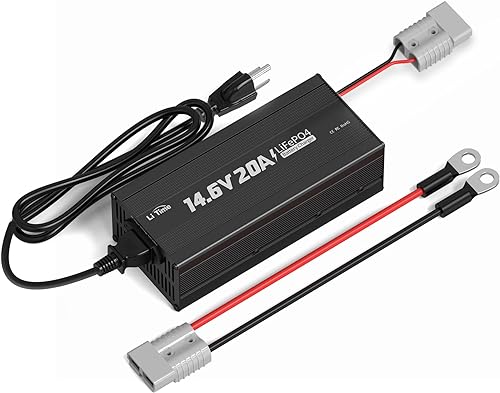
LiTime 12V 20A Lithium Battery Charger: Best for dedicated 12V LiFePO4 banks
LiTime 12V 20A Lithium Battery Charger: Best for dedicated 12V LiFePO4 banks
- 20A charging
- 14.6V output
- 0V activation
- Anderson 50A and M8 connections
The LiTime 20A charger is aimed at 12V LiFePO4 batteries and offers 0V activation for a deeply discharged battery under BMS protection. Its 14.6V output fits a dedicated lithium charging setup.
Pros
- 20A output
- 0V activation
- 2-year warranty
Cons
- Not waterproof
- Not suitable for marine environments
The LiTime 12V 20A charger is built around a 14.6V output for 12V LiFePO4 batteries. That makes it a focused choice for an RV with a lithium house battery.
The fixed 14.6V output simplifies setup because you do not choose between chemistries. It also means it is the wrong tool for lead-acid batteries.
Its 0V activation can wake a BMS-protected battery after deep discharge. That helps when a lithium battery has shut itself down and will not accept a normal charge at first.
Charging moves through constant-current, constant-voltage and float or cutoff stages. Protection covers over-temperature, over-voltage, short circuit, over-current, low voltage and reverse polarity, helping the charger ease off as the battery fills.
It uses an Anderson 50A connector and an M8 terminal. Those connections suit a more permanent setup where the charger stays connected to the bank.
LED indicators show charging status and stage, but they give less detail than an LCD showing amps and percentage. This model is not waterproof and is not suitable for marine use, so keep it in a ventilated dry space and check connections for tightness.
VEVOR RV Power Converter: Best for built-in RV charging
VEVOR RV Power Converter: Best for built-in RV charging
- 100A output
- 120V AC to 12V DC conversion
- LiFePO4 and lead-acid modes
- 13.0V, 14.6V and 16.5V fixed-voltage choices
The VEVOR is a high-output RV converter for replacing or adding a built-in charging system. Its 100A output is intended for large RV batteries rated from 75Ah to 80Ah and for powering 12V RV devices.
Pros
- 100A output
- Multi-stage smart charging
- Six protection functions
Cons
- Installation is more involved than using a portable charger
- Battery is not included
The VEVOR is the right type of charger when you need a built-in RV power converter rather than a portable battery charger. It converts 120V AC to 12V DC and can charge batteries while also powering 12V RV devices.
Its output reaches 100A and 1450W. VEVOR describes it for large-capacity RV batteries rated from 75Ah to 80Ah, with charging modes for LiFePO4 and lead-acid batteries.
You can choose fixed-voltage settings of 13.0V, 14.6V or 16.5V. Multi-stage charging, a cooling fan and a metal housing support the converter's higher output.
The unit includes a user manual and 4 fuses, but the battery is not included. Because this is a built-in converter, check your RV's existing wiring, fuse setup and installation space before choosing it.
Read will an RV converter charge lithium batteries before replacing a converter. Our guide to the best RV converter charger for lithium batteries covers the built-in option in more detail.
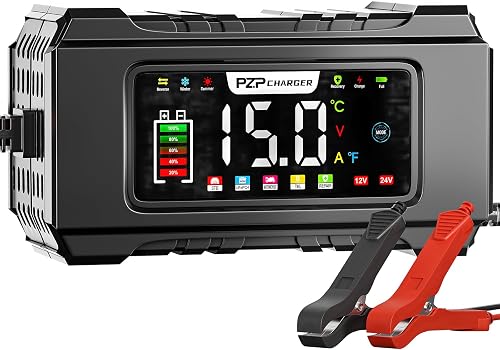
PZ.P 15-Amp 12V/24V Smart Battery Charger: Best for 12V and 24V RV systems
PZ.P 15-Amp 12V/24V Smart Battery Charger: Best for 12V and 24V RV systems
- 15A at 12V
- 8A at 24V
- 9-stage charging
- Color display with voltage, current, temperature and charge percentage
The PZ.P combines 12V and 24V charging with a color display and temperature compensation. It fits RV owners who want a mid-range output and support for both lithium and lead-acid batteries.
Pros
- 12V and 24V support
- 9-stage charging
- 18-month warranty
Cons
- Cannot activate totally dead batteries
- 15A output is lower than the fastest picks
The PZ.P gives you 15A at 12V and 8A at 24V, making it useful when an RV owner wants one portable charger for different battery systems. It supports LiFePO4, AGM, GEL, SLA and flooded lead-acid batteries.
The 15A 12V rate sits in the middle of this range. It charges faster than a 5A maintainer but slower than a 20A or 30A unit, which may suit overnight charging schedules.
Its 9-stage charging process switches to trickle or float mode after charging. That helps when a battery will sit unused for weeks and needs to stay ready.
The color display shows voltage, current, internal temperature, charge percentage, and summer or winter mode. That detail makes it easier to see whether charging is progressing as expected.
A 6.7 ft charging cable helps reach batteries that are not close to the outlet. The extra length can reduce the need to move the RV or the charger during setup.
Protection features include reverse polarity, overcurrent, overvoltage and short-circuit protection. Those protections are useful when connecting clamps in a tight compartment.
The PZ.P cannot activate or charge a totally dead battery. Choose it when your battery still has enough voltage for detection and you want more output than a 5A maintainer.
It also fits owners who want temperature compensation without moving up to a larger converter. The trade-off is a lower peak rate than the fastest portable options.
LiTime 12V 10A Lithium Battery Charger: Best for slower 12V lithium charging
LiTime 12V 10A Lithium Battery Charger: Best for slower 12V lithium charging
- 10A charging
- 14.6V output
- 0V activation
- Anderson connector and M8 terminal
The LiTime 10A charger suits RV owners who want a dedicated 12V LiFePO4 charger with a lower charging rate. It includes 0V activation and automatic CC, CV and float or cutoff transitions.
Pros
- 0V activation
- 10A output
- 2-year warranty
Cons
- Not waterproof
- Slower than the 20A LiTime charger
The LiTime 10A is a practical match for an RV owner who wants a dedicated LiFePO4 charger without the faster output of a 20A model. It uses a 14.6V output for 12V, 12.8V LiFePO4 batteries.
At 10A, charging is steady rather than fast. That rate often fits overnight charging, where there is plenty of time to replace the charge used during a day.
The charger supports 0V activation for batteries under BMS protection. That helps when a lithium battery has shut down after deep discharge and needs to be woken before normal charging can start.
Its automatic charging process moves through constant-current, constant-voltage and float or cutoff stages. The charger reduces its input as the battery approaches full charge.
A built-in fan supports operation from -4°F to 104°F. That range covers many storage and charging conditions, from cold garages to warm compartments.
The Anderson connector and M8 battery terminal give you two connection points, while the LED indicator shows charging status. The Anderson connection suits a fixed installation, and the terminal suits direct battery fitting.
This charger is not waterproof, so it belongs in a dry charging location. Outdoor or marine use would not suit this model.
Pick it when a 10A rate fits your battery capacity and charging schedule. It is a simpler choice when you do not need the speed of a 20A or 30A charger.
KAISAL 12V 30A Lithium Battery Charger 14.6V: Best for outdoor lithium charging
KAISAL 12V 30A Lithium Battery Charger 14.6V: Best for outdoor lithium charging
- 30A charging
- 14.6V output
- IP67 waterproof charger case
- M8 terminals and alligator clips
The KAISAL offers the highest portable lithium output in this group and adds water and dust resistance for outdoor use. Its 0V wake-up mode helps restore a low-voltage 12V LiFePO4 battery after BMS cutoff.
Pros
- 30A output
- IP67 waterproof case
- Two connection methods
Cons
- For LiFePO4 batteries only
- Heavier than several smaller chargers
The KAISAL provides the highest portable output in this group at 30A for 12V LiFePO4 batteries. Its IP67 waterproof case and IP68 waterproof cable make it the strongest outdoor-focused option here.
At 30A, this charger can replace charge much faster than a 10A or 15A unit. That helps when a short shore power stop needs to do more work.
The charger includes a 9 ft cable, M8 terminals and alligator clips. You can keep the M8 terminal attached to the battery or use the clips when you need a temporary connection.
The long cable gives more flexibility when the battery is inside the RV and the outlet is outside. It can also reduce the need for extension leads during outdoor charging.
A 0V wake-up mode can activate a low-voltage battery after BMS cutoff. That feature helps when a stored lithium battery has dropped too low for normal detection.
Three-stage charging moves through pre-charge, constant-current and constant-voltage modes, then reduces output as the battery approaches full charge. The 3-color indicator shows the stage in a simple visual way.
KAISAL lists eight protection functions, including overvoltage, overcurrent, overheating, short circuit, reverse connection and overcharge protection. Those protections support use in less controlled outdoor settings.
The charger is designed for LiFePO4 batteries only, so don't use it as a mixed-chemistry charger. That limit is worth noting if you also maintain lead-acid batteries in other vehicles.
E-FAST 20A Smart Car Battery Charger: Best for mixed 12V and 24V maintenance
E-FAST 20A Smart Car Battery Charger: Best for mixed 12V and 24V maintenance
- 20A at 12V
- 10A at 24V
- 7-stage charging
- LiFePO4 and lead-acid support
The E-FAST gives RV owners a 20A 12V output with 24V support and a repair mode for lead-acid batteries. Its auto-memory feature resumes the last selected mode after a power interruption.
Pros
- 20A output
- 12V and 24V support
- 7-stage charging
Cons
- Warranty is 1 year
- It is larger than some low-current maintainers
The E-FAST combines 20A output at 12V with 10A output at 24V. It supports LiFePO4, AGM, GEL, SLA, wet and deep-cycle batteries in vehicles such as RVs, trucks and boats.
That combination suits owners who move between different battery systems. One charger can handle a 12V RV battery one day and a 24V system on another vehicle later.
Its 7-stage charging process includes auto-memory, so the charger resumes the last selected mode after a power interruption. That is handy when charging is interrupted by a trip or a power cut.
A repair mode uses pulse technology for old, idle or stratified lead-acid batteries. It is aimed at batteries that have lost performance while sitting unused.
The built-in fan supports cooling during higher-current charging. At 20A, heat management matters more than it does with a small maintainer.
Protection covers reverse polarity, short circuit, overcharging and over-temperature conditions. Those features help when the charger is used in a busy workshop or vehicle bay.
Choose the E-FAST if you need broad battery support and 12V/24V flexibility. It gives a fast 12V rate without giving up 24V support.
Its 1-year warranty is shorter than several other options in this roundup. That is a trade-off to weigh against the charging speed and battery range.
How many amps should an RV lithium battery charger have?
A 10A charger suits slower charging, while 15A to 20A chargers refill many 12V RV batteries faster. The right rating depends on how much charge you use, battery size and time available to replace it.
A 30A charger cuts charging time further, and a 100A converter is for built-in RV systems rather than portable charging. Those higher rates help only when the battery can accept that current.
Match the charger to the battery's recommended charge rate. A higher rating will not charge every battery faster if the battery management system limits current.
That limit is key for lithium batteries. The BMS can reduce or stop charging when the battery would be pushed too hard, so charger and battery must work as a pair.
For lead-acid batteries, capacity also matters. A small battery fills quickly at a high rate, while a large battery takes longer at the same rate.
Think about your charging window too. Overnight charging can work at 10A, while a short campsite stop may call for 20A or 30A.
The Haisito, LiTime 20A and E-FAST offer 20A at 12V, the KAISAL reaches 30A, and the VEVOR reaches 100A as a converter. Most owners will land in the middle, where speed and battery size fit together.
A 1A or 5A maintainer is still right for storage over weeks. When comparing amps, also compare voltage and battery type support, because a 20A charger set for the wrong chemistry will not match the right 10A charger.
Can an RV converter charge a lithium battery?
An RV converter can charge a lithium battery when it has a suitable LiFePO4 profile and voltage. The profile controls behavior as the battery fills, which matters most near full charge.
A converter designed only for lead-acid batteries may hold a different voltage for too long or move into later stages in a way that does not suit lithium. Check for LiFePO4 mode, the required charging voltage and your RV's existing wiring before choosing.
Wiring matters because a converter is part of the RV electrical system, not a portable unit. Fuse size, cable rating and ventilation space all need to suit the installation.
A portable charger is simpler for occasional charging because you can connect it, charge, then store it without changing RV wiring. That is also a limit, since it will not power 12V devices while charging as a converter can.
Solar is another option for boondocking, adding charge in daylight but depending on sunlight rather than shore power. Compare these picks with the best RV solar battery charger if you need to recharge away from shore power.
Before replacing a converter, check the battery manual as well as the converter manual. The battery maker's voltage and charge limits should guide your settings.
How should you use a lithium battery charger in an RV?
Turn off unnecessary RV loads before charging, confirm the battery voltage and chemistry, then connect the charger using the correct terminals or clamps. Those steps help the charger start with the right settings and avoid confusion during charging.
Keep a non-waterproof charger in a dry location and follow the charger and battery instructions. Dry storage reduces the risk of moisture getting into the unit or its connections.
Use a charger with 0V activation only when its instructions support your battery. That feature is meant for specific situations, not as a routine first step for every flat battery.
A totally dead battery may need professional diagnosis rather than repeated charging attempts. Repeated attempts can waste time and may not fix a battery that has failed internally.
Keep cables away from heat, moving parts and wet areas. That simple care protects the cable and helps maintain a clean, reliable connection.
For a built-in converter, disconnect shore power before working on wiring and use the correct fuses for the installation. The fuse protects the wiring if something goes wrong during the work.
Check connections before you start charging each time. A loose clamp or corroded terminal can limit charging and make the charger appear faulty.
Let the charger run through its stages without unplugging it too soon. Interrupting the process can leave the battery short of a full charge, especially after heavy use.
Store the charger in a cool dry place when it is not in use. That storage helps both the charger and its cables last longer.
What is the best lithium battery charger for an RV?
Choose the Haisito if you want one portable charger for 12V or 24V systems and both lithium and lead-acid batteries. Choose the LiTime 20A for a dry, dedicated 12V LiFePO4 setup, or the KAISAL 30A for outdoor charging with water-resistant hardware.
The NOCO GENIUS1 and GENIUS5 are better for storage and maintenance than fast house-battery charging. Choose the VEVOR when you need a high-output converter integrated into the RV's 12V electrical system.
If you also maintain batteries in other vehicles, compare this roundup with the best lithium battery charger for golf cart. For portable power planning, see how long does lithium battery last in a power station and is it safe to fly with a lithium battery power station.
Our top pick is the Haisito because it balances charging speed, chemistry support, voltage flexibility and clear monitoring for common RV use.
Our top 3 picks at a glance
-
1
Best for flexible RV battery charging
Haisito 20-Amp Smart Battery Charger
9.7/10 our score
See it on Amazon -
2
Best for RV battery maintenance
NOCO GENIUS1 1A 6/12V Smart Battery Charger
9.6/10 our score
See it on Amazon -
3
Best for moderate RV battery maintenance
NOCO GENIUS5 5A 6/12V Smart Battery Charger
9.5/10 our score
See it on Amazon


