Will an RV Converter Charge Lithium Batteries?
An RV converter may charge lithium batteries, but only if its charging profile and voltage suit lithium chemistry. A lead-acid-only converter may undercharge the battery or keep charging in a way the battery maker does not approve.
On this page (10 sections)
- How does an RV converter charge a battery?
- Will my RV converter charge a lithium battery safely?
- What happens if a converter is lead-acid only?
- How do you check an RV converter before upgrading?
- Can a separate charger help with a lithium RV battery?
- Does the battery box affect lithium charging?
- Can extra cable length solve a converter problem?
- What should you replace for a lithium battery upgrade?
- How do you troubleshoot a lithium battery that won't charge?
- What is the final converter decision?
An RV converter may charge lithium batteries, but only when its charging profile is designed or approved for lithium chemistry. A converter made only for lead-acid batteries may charge slowly, stop before the lithium battery is full, or use settings that don't match the battery maker's instructions.
The key question is not only whether the converter produces 12V power. You also need to check its charging voltage, charge stages, lithium setting, maximum current, and compatibility with the RV's battery wiring.
How does an RV converter charge a battery?
An RV converter changes shore power into DC power for the RV's 12V system and battery. It also controls how charging power reaches the house battery.
A converter with a lithium mode can use a charge profile suited to lithium batteries. A lead-acid profile may have different voltage targets, float behavior, and charging stages.
Your battery bank still powers the RV when shore power is disconnected. The converter supplies charging power when the RV is connected to shore power, so its output affects both battery charging and the 12V electrical system.
Will my RV converter charge a lithium battery safely?
Your RV converter can charge a lithium battery safely only if the battery maker allows that converter profile. Look for a lithium setting or a converter model that specifically supports lithium batteries.
Check these details before connecting the battery:
- Battery chemistry supported by the converter
- Lithium charging mode or approved charging profile
- Charging voltage range
- Maximum charging current
- Charge stages and float behavior
- Converter wiring, fuse, and breaker requirements
- Battery manufacturer's instructions
A battery's built-in management system can protect against some unsafe conditions, but it doesn't turn every lead-acid converter into a lithium charger. The battery's protection system is not a substitute for a correctly matched converter.
For background on battery types, start with what is a deep cycle battery. Lithium batteries and lead-acid batteries can both serve as RV house batteries, but they don't necessarily use the same charging settings.
What happens if a converter is lead-acid only?
A lead-acid-only converter may charge a lithium battery without reaching its intended full-charge voltage. That can reduce usable capacity because the battery may remain partially charged.
Some lead-acid charging profiles also use a float stage or equalization behavior that isn't suitable for every lithium battery. Don't assume a converter is compatible because both the battery and converter are labeled 12V.
The reverse problem can also occur. A lithium-focused converter may not be the right choice for a lead-acid battery unless the converter supports that battery type and the selected mode matches it.
How do you check an RV converter before upgrading?
Read the converter model label and manual before buying a lithium battery. Search for the exact model, then confirm the charging modes and output specifications.
Inspect the converter for a switch, remote control, or menu that selects lithium charging. Some units use a built-in lithium setting, while others require a separate replacement converter or a charging module.
Also check the current rating. A higher-output converter can charge a battery faster, but the battery, wiring, fuses, and installation must support that current.
If the converter documentation is unclear, ask the converter or battery manufacturer for written compatibility guidance. Don't rely on a generic statement that the unit is a “smart charger.”
Can a separate charger help with a lithium RV battery?
A separate lithium-compatible charger can help when the installed converter is not suitable, but it doesn't automatically fix the RV's shore-power charging system. The separate charger must still match the battery's chemistry and charging instructions.
Use a separate charger when you need a controlled charging source, when the RV is in storage, or when you are diagnosing whether the built-in converter is working. Disconnect or isolate charging sources according to the battery and RV instructions so two chargers don't create an unexpected setup.
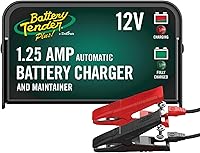
The Battery Tender Plus 12V 1.25 AMP Car & Motorcycle Battery Charger and Maintainer has a 12V output, 1.25A current rating, 4-step charging program, ring terminal and alligator clip cables, and a quick disconnect harness. Its stated compatible devices are cars, motorcycles, lawn mowers, and ATVs, so confirm lithium compatibility before using it with an RV lithium battery.
This charger is better suited to slow charging or maintenance than to quickly charging a large RV battery bank. Its 1.25A output can take a long time to charge a high-capacity battery, even when the battery and charger are compatible.
For a broader charging workflow, see how to charge a rv battery. It covers the connection and charging decisions that still matter when you use a separate charger.
Does the battery box affect lithium charging?
A battery box does not set the charging profile; the converter and battery do. The box still matters because the battery must be secured, protected, and installed with enough room for cables and the RV's mounting area.
The Attwood 9067-1 Vented Battery Box with Mounting Strap, Fits Group 27 Series Batteries, Black has interior dimensions of 13.06 x 6.9 x 10.5 inches. It is made from acid-resistant polypropylene, includes a 40-inch mounting strap and hardware, and is designed for boat and RV use.
Its stated battery type is lead acid, so don't assume it is the correct enclosure for every lithium battery. Check the lithium battery's dimensions, terminal layout, installation instructions, and enclosure requirements before using a Group 27 box.
A vented box also doesn't replace correct electrical protection. Use the fuse, cable size, mounting method, and disconnect procedure required by the battery and RV manufacturer.
Can extra cable length solve a converter problem?
Extra cable length can improve access, but it cannot correct an incompatible charging profile. A cable extension is useful only when the charger and connector are already compatible with the battery setup.
The Battery Tender 12 Foot Extension SAE Cable is a 12 ft male-to-female SAE cable for Battery Tender Junior, Plus, 2-Bank, 4-Bank, 5-Bank, and 10-Bank units. It is designed for 12V units and is not for Battery Tender products with hard-wired clips, 6V Battery Tender Plus units, or units with white quick-disconnect plugs.
Check the connector type before adding this cable. Extra length can also increase voltage drop, so follow the charger and battery instructions and avoid routing the cable where it can rub, pinch, or become wet.
What should you replace for a lithium battery upgrade?
Replace the converter when it lacks a lithium profile or fails the battery maker's charging requirements. A converter upgrade is usually the direct fix because it lets the RV charge the house battery from shore power with the correct settings.
You may not need to replace it if the current converter has a lithium mode and its voltage, current, and charging stages match the battery instructions. Confirm that the RV's wiring, fuse, and cooling space also suit the replacement converter.
The most direct comparison is in our guide to the best rv converter charger for lithium batteries. If your RV uses a separate charging setup, compare the best lithium battery charger for rv options instead.
For a system that charges several house batteries or uses a dedicated charger, see the best battery charger for rv house batteries. Choose by battery chemistry, charge profile, current, wiring, and installation requirements rather than by the 12V label alone.
How do you troubleshoot a lithium battery that won't charge?
Start by checking the converter mode, shore-power connection, battery disconnect, fuses, and battery management system. A lithium battery that appears not to charge may be disconnected, below the system's protection threshold, or connected to a converter with the wrong profile.
Follow this order:
- Confirm the RV is receiving shore power.
- Check that the battery disconnect is on.
- Verify the converter's lithium mode and output.
- Inspect fuses, breakers, terminals, and cable connections.
- Check the battery manufacturer's instructions for low-voltage or protection resets.
- Stop if cables heat up, terminals spark, or the wiring looks damaged.
Don't keep resetting a battery or forcing a charge when the cause is unclear. A qualified RV technician can check the converter output and wiring under load.
Power stations have different charging systems and should not be used as a direct comparison. If you are troubleshooting one, read why does my power station lose charge when not in use? and why is my portable power station losing charge overnight?.
What is the final converter decision?
Keep your RV converter only when its lithium mode and charging specifications match the battery instructions. Replace it when it is lead-acid only, its output is unclear, or its charge stages do not suit the lithium battery.
Pick a lithium-compatible RV converter for regular shore-power charging. Pick a separate lithium charger for controlled charging or storage only when its connector, current, and battery compatibility are confirmed.
A battery box or extension cable can support the installation, but neither one makes an unsuitable converter compatible.
Frequently asked questions
Will an old RV converter charge a lithium battery?
An old RV converter may put some charge into a lithium battery, but that does not mean it is a suitable long-term charger. Check whether it has a lithium charging mode, the correct voltage profile, and a charging stage approved by the battery manufacturer.
If it only supports lead-acid charging, replacement may be safer.
What voltage does a lithium RV battery need?
Most 12V lithium RV batteries need a charging voltage that matches their battery maker's instructions. The correct number depends on the battery design and charger profile, so don't choose a converter from voltage alone.
Confirm the converter's lithium mode, charge stages, and maximum current before connecting it.
Can a lithium battery use a lead-acid converter?
A lithium battery should not automatically use a lead-acid converter. Some converters can work when their output matches the battery maker's requirements, while others may stop early, charge incorrectly, or lack a suitable lithium setting.
Read both manuals before using an existing converter.
Do I need a new converter for lithium batteries in an RV?
You need a new converter when the existing unit lacks a lithium profile or cannot meet the battery maker's charging requirements. You may keep the current converter if its lithium mode, output voltage, charge stages, and current rating all match the battery instructions.
Confirm the wiring and fuse ratings too.