9 Best Battery Maintainers for Lithium Batteries (November 2026)
The best lithium battery maintainers include the Battery Tender Plus 12V 1.25 AMP Car for seasonal vehicle storage, the NOCO GENIUS1 1A 6/12V Smart Battery Charger for small LiFePO4 batteries, and the NOCO GENIUS5 5A 6/12V Smart Battery Charger for larger LiFePO4 batteries.
On this page (8 sections)
- Which battery maintainer is best for lithium batteries?
- How we compared lithium battery maintainers
- Best battery maintainer for lithium battery use: detailed picks
- What should you check before buying a LiFePO4 battery maintainer?
- Is a battery tender the same as a lithium battery maintainer?
- How do you use a LiFePO4 battery maintainer safely?
- Can you leave a LiFePO4 battery maintainer connected?
- Best battery maintainer for lithium battery: final choice
The best battery maintainer for lithium battery use is the NOCO GENIUS1 because it supports 6V and 12V batteries, includes a LiFePO4 profile, and adjusts charging with a thermal sensor.
Choose the GENIUS5 for larger batteries, or the OptiMATE Lithium 4s for a lithium-only 12.8V setup.
A maintainer is not automatically suitable for every lithium battery.
The charger needs the right voltage, chemistry setting and charging profile for the battery's built-in management system.
Capacity is just as important as chemistry.
A small 1A charger that suits a compact powersports battery may be too slow for a larger deep cycle battery.
If you need the basics first, our guide explains what is a deep cycle battery.
For broader charger choices, compare our best lithium battery chargers.
Our picks at a glance
-
1
 Best for seasonal vehicle storage
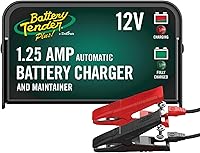
Battery Tender Plus 12V 1.25 AMP Car
9.7/10 our score
See it on Amazon -
2
 Best for small LiFePO4 batteries
NOCO GENIUS1 1A 6/12V Smart Battery Charger
9.6/10 our score
See it on Amazon -
3
 Best for larger LiFePO4 batteries
NOCO GENIUS5 5A 6/12V Smart Battery Charger
9.5/10 our score
See it on Amazon
- 4
 Check it
Battery Tender 3 AMP Battery Charger
Best for mixed battery garages - 5
 Check it
MOTOPOWER MP00205A 12V 800mA Automatic Battery Charger
Best for low-current storage care - 6
 Check it
LEICESTERCN Motorcycle Battery Charger and Maintainer 12V
Best for motorcycle LiFePO4 batteries - 7
 Best for compact powersports storageCheck it
- 8
 Best for 12V general-purpose useCheck it
- 9
 Best for lithium-only maintenanceCheck it
Which battery maintainer is best for lithium batteries?
The NOCO GENIUS1 is the best fit for small LiFePO4 batteries, while the GENIUS5 is better for larger batteries up to 120Ah.
A lithium-specific option such as the OptiMATE Lithium 4s makes sense when you only need to maintain a 12.8V lithium battery.
The right pick depends first on the battery in front of you.
Check the voltage marked on the battery case and match it to the charger before you check anything else.
Then check the chemistry.
LiFePO4 batteries need a charger that names a compatible lithium profile, not only a generic 12V output.
Capacity comes next.
A stated limit, such as 30Ah or 120Ah, tells you which battery sizes the charger is meant to handle.
Output current shapes how the charger fits daily use.
A 0.8A or 1A maintainer is gentle and well suited to storage, but it will not recover a large battery quickly.
A 5A model gives more headroom for larger batteries, while still being intended for maintenance rather than as a shop rapid charger.
Connection options also matter in a real garage.
Clamps suit a quick hookup, while included eyelet or ring terminals suit a cleaner semi permanent lead that stays near the battery.
Our score weighs specifications, charging profiles, safety features and buyer feedback against the needs of someone shopping for a battery maintainer for lithium battery use.
That balance favors clear lithium support over a higher headline current on a charger with no stated lithium mode.
How we compared lithium battery maintainers
We checked the stated battery chemistry, voltage, current, supported capacity and connection options. A charger with a lithium or LiFePO4 mode ranks above a model that only identifies lead-acid support.
Output matters because a 0.8A maintainer is gentle but slower than a 5A charger. Capacity matters too.
The GENIUS1 supports LiFePO4 batteries up to 30Ah, while the GENIUS5 reaches 120Ah and the Mroinge MBC022 reaches 85Ah.
A battery maintainer should match the battery's voltage. A 12V battery is not the same as a 24V or 48V battery, even when both use lithium chemistry.
For higher-voltage options, see 36V lithium battery chargers.
For larger systems, see the best 24V lithium battery chargers and best 48V lithium battery chargers.
Best battery maintainer for lithium battery use: detailed picks
1. NOCO GENIUS1: best for small LiFePO4 batteries
NOCO GENIUS1 1A 6/12V Smart Battery Charger: Best for small LiFePO4 batteries
- 6V and 12V charging
- LiFePO4 support up to 30Ah
- Integrated thermal sensor
- Force Mode
The GENIUS1 is the most flexible small-battery choice here because it supports 6V and 12V batteries, including LiFePO4 up to 30Ah. Its thermal sensor adjusts charging for ambient temperature.
Pros
- LiFePO4 profile
- 6V and 12V support
- Force Mode for batteries down to zero volts
Cons
- 1A output is slow for larger batteries
- LiFePO4 limit is 30Ah
The NOCO GENIUS1 is the strongest small-battery pick because it supports 6V and 12V batteries and includes a lithium-ion LiFePO4 mode.
The stated LiFePO4 limit is up to 30Ah, which fits many smaller motorcycle, powersports and compact deep-cycle batteries.
Its 1A output favors steady charging over fast recovery.
That pace suits overnight storage and seasonal maintenance, where the goal is to keep a small battery ready rather than to refill a large bank in a short window.
The integrated thermal sensor adjusts charging for ambient temperature, while Force Mode can manually charge batteries down to zero volts.
Temperature adjustment matters in a garage that swings between hot summer air and cold winter air.
Force Mode is the recovery path for a deeply discharged battery that a normal automatic start might leave behind.
The GENIUS1 also supports lead-acid types, including AGM, gel, SLA and VRLA.
That makes it useful when one garage has both lead-acid and LiFePO4 batteries.
Choose it when your lithium battery is within the 30Ah limit and you want one charger for 6V and 12V use.
It is less suitable when your battery sits above that stated limit, because a higher output model will match the larger capacity more comfortably.
2. NOCO GENIUS5: best for larger LiFePO4 batteries
NOCO GENIUS5 5A 6/12V Smart Battery Charger: Best for larger LiFePO4 batteries
- 6V and 12V charging
- LiFePO4 support up to 120Ah
- 5A output
- Integrated thermal sensor
The GENIUS5 adds a 5A output and a LiFePO4 capacity limit of 120Ah, making it the stronger choice for larger 12V lithium batteries. It also supports 6V batteries and includes Force Mode.
Pros
- 5A output
- LiFePO4 support up to 120Ah
- Mounting bracket and screws included
Cons
- More output than small batteries need
- 6V or 12V selection still matters
The NOCO GENIUS5 is the better choice for larger lithium batteries because its 5A output and stated LiFePO4 support up to 120Ah give it more capacity headroom than the GENIUS1.
It supports 6V and 12V lead-acid and LiFePO4 batteries.
That range covers a wider set of vehicles and compact systems than a 12V only charger.
The thermal sensor adjusts charging for temperature, and Force Mode can start charging a battery down to zero volts.
For a larger battery, the extra current means a more practical recovery time after deep discharge or long storage.
A mounting bracket, screws, battery clamps and integrated eyelet terminals are included.
The bracket is a small detail that helps in a workshop where the charger needs a fixed spot rather than a bench top.
The 72 in AC cable and 80 in DC cable give you useful reach for a garage or workshop setup.
Pick it when charging speed and battery capacity matter more than having the smallest maintainer.
The trade off is size and cost of ownership in space, since a higher output unit is a bigger commitment for a single small battery.
3. Battery Tender Plus: best for seasonal vehicle storage
Battery Tender Plus 12V 1.25 AMP Car: Best for seasonal vehicle storage
- 12V output
- 1.25A charging current
- 4-step charging program
- Fused ring terminal and alligator clip cables
The Battery Tender Plus combines a 12V, 1.25A output with a 4-step charging program and float maintenance. Its title identifies automotive and powersports use, but it does not identify a lithium or LiFePO4 charging profile.
Pros
- 4-step charging program
- Quick disconnect harness
- 10-year manufacturer's warranty
Cons
- No lithium profile identified
- 12V only
The Battery Tender Plus uses a 12V, 1.25A output and a 4-step charging program for automotive and powersports batteries.
It is a strong storage pick for cars, motorcycles, lawn mowers and ATVs.
The 4-step program is the core of the design, moving from initial charging through to float maintenance without manual switching.
That automatic progression suits seasonal vehicles that sit for weeks between short trips.
The included fused ring terminal and alligator clip cables support either a temporary connection or a more permanent setup.
Alligator clips are quick for a one off charge, while ring terminals suit a battery that stays in a fixed storage bay.
A quick disconnect harness makes switching between storage and regular use easier.
In practice, that means you can leave the lead in place and plug in only when the vehicle is parked for storage.
Its product data does not identify a lithium or LiFePO4 charging profile.
Choose it for compatible 12V vehicle batteries, and choose a dedicated lithium model when your battery requires a lithium-specific mode.
4. Battery Tender 3 AMP: best for mixed battery garages
Battery Tender 3 AMP Battery Charger: Best for mixed battery garages
- Switchable 6V or 12V operation
- 3A output
- Automatic float mode
- 11 ft combined cord reach
This 3A charger gives a garage more output than the small maintainers and switches between 6V and 12V. Its listed battery support covers lead-acid, AGM and gel, but does not identify lithium compatibility in the product data.
Pros
- 3A output
- 6V and 12V switch
- 5-year manufacturer's warranty
Cons
- Lithium profile is not identified
- Higher output needs careful battery matching
The Battery Tender 3 AMP provides more charging current than the smaller maintainers and switches between 6V and 12V.
Its 11 ft combined reach includes a 6 ft AC cord and a 5 ft DC output cable.
That combined length helps when the outlet is on one wall and the vehicle is parked across the garage.
It supports lead-acid, flooded, sealed maintenance-free, AGM and gel batteries.
The automatic float mode maintains voltage after charging, while the two-color LED shows charging status.
The float stage is what makes the charger suitable for storage rather than only for a one time top up.
A clear status light also helps during setup, since you can see at a glance whether the charger is still in the charging stage.
The product data does not identify lithium compatibility.
Treat it as a flexible lead-acid charger unless the battery and charger documentation confirm the correct lithium profile.
For a mixed garage, the 6V and 12V switch is the main appeal, but chemistry still needs to be confirmed before use on a lithium battery.
5. MOTOPOWER MP00205A: best for low-current storage care
MOTOPOWER MP00205A 12V 800mA Automatic Battery Charger: Best for low-current storage care
- 12V output
- 800mA current
- Automatic desulfation
- 13.6V maintenance level
The MP00205A is a low-current 12V maintainer for lead-acid battery storage. Its data describes desulfation and float maintenance, not a lithium or LiFePO4 charging mode.
Pros
- 800mA output
- Automatic float transition
- Alligator and ring terminal cables
Cons
- No lithium profile identified
- Not a high-output charger
The MOTOPOWER MP00205A is a 12V, 800mA maintainer for lead-acid, flooded, AGM and gel batteries.
It switches to a stated 13.6V maintenance level after charging.
That low maintenance level is designed for long storage, where the priority is holding charge without pushing the battery hard.
Its automatic desulfation function and low output suit long storage periods.
Desulfation matters most for a lead-acid battery that has sat unused, since sulfation builds during idle time.
The package includes an alligator clamp cable, a ring terminal cable and an instruction manual.
Having both cable types covers a quick bench connection and a cleaner installed lead for a vehicle kept in a corner bay.
This is not a lithium battery maintainer based on the supplied product information.
Choose it for compatible lead-acid storage, not for a LiFePO4 battery that needs a lithium charging profile.
The 800mA output is also a limit in daily use, because it favors gentle maintenance over timely recovery of a large or deeply discharged battery.
6. LEICESTERCN: best for motorcycle LiFePO4 batteries
LEICESTERCN Motorcycle Battery Charger and Maintainer 12V: Best for motorcycle LiFePO4 batteries
- 12V, 1.1A output
- LiFePO4 mode with built-in BMS
- Lead-acid mode
- Force-start charging below 8V
The LEICESTERCN is made for 12V motorcycle batteries from 5Ah to 32Ah and supports both LiFePO4 batteries with built-in BMS and lead-acid types. Its 1.1A output fits smaller powersports batteries.
Pros
- LiFePO4 mode
- Motorcycle-focused output
- 8 ft total reach
Cons
- 12V only
- Battery range is aimed at smaller batteries
The LEICESTERCN is designed around 12V motorcycle batteries from 5Ah to 32Ah.
It supports 12V LiFePO4 batteries with built-in BMS and also supports lead-acid, AGM, gel and related 12V types.
That motorcycle focus is important, because a small powersports battery needs a gentler current than a large car battery.
Its 1.1A output is suited to smaller motorcycle, ATV, scooter, dirt bike and lawn mower batteries.
In storage use, that pace means an overnight top up rather than a fast turnaround before a ride.
The 8 ft total reach and included alligator and ring connectors help with garage storage.
A long reach reduces the need for an extension cord, and a ring lead can stay installed under a seat or panel.
A force-start mode can begin charging batteries below 8V, but the product is described for recoverable batteries rather than physically damaged or fully dead 0V cells.
That distinction matters after winter storage, since a merely discharged battery is a different case from a damaged one.
Choose it for a small 12V motorcycle battery within the stated range, and check the BMS and chemistry setting before connecting.
7. Battery Tender Junior: best for compact powersports storage
Battery Tender Junior 12V: Best for compact powersports storage
- 12V output
- 800mA current
- Selectable lead-acid and lithium modes
- Spark-proof connection
The Battery Tender Junior is a compact 12V maintainer with selectable lead-acid and LiFePO4 modes. Its 800mA output suits powersports batteries that need gentle storage maintenance.
Pros
- Selectable lithium mode
- Compact design
- 5-year industry-leading warranty
Cons
- 800mA output is slow for larger batteries
- 12V only
The Battery Tender Junior is a compact 12V, 800mA charger with selectable lead-acid and lithium modes.
Its LiFePO4 setting makes it a practical choice for smaller powersports batteries.
The selectable mode is the key detail, because it lets one charger cover a lead-acid battery and a lithium battery in the same garage.
It includes alligator clips and fused ring terminals.
Alligator clips suit a quick seasonal hookup, while fused ring terminals suit a lead that stays on the battery between rides.
Spark-proof connection and reverse-polarity detection add useful protection during setup.
Those protections reduce the risk of a mistake when you are working in a tight space around a battery.
The lower output favors maintenance over fast charging.
Choose it for a motorcycle, ATV, UTV, personal watercraft or scooter battery that stays in storage between uses.
It is not the pick for a larger battery that needs a quicker recovery, since 800mA is a gentle current by design.
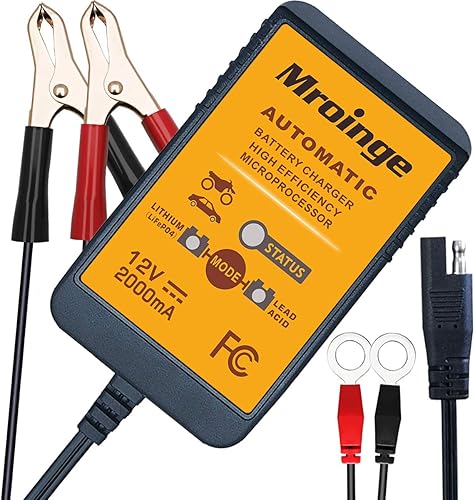
8. Mroinge MBC022: best for 12V general-purpose use
Mroinge MBC022: Best for 12V general-purpose use
- 12V, 2A output
- Lead-acid and LiFePO4 modes
- 5-stage charging
- 12V LiFePO4 support up to 85Ah
The MBC022 gives you a 2A 12V output and separate lead-acid and LiFePO4 options. It supports 12V LiFePO4 batteries up to 85Ah and includes a 12 ft output cord.
Pros
- 2A output
- LiFePO4 support up to 85Ah
- 12 ft output cord
Cons
- Disconnect the battery before changing modes
- 12V only
The Mroinge MBC022 provides 12V, 2A output and separate modes for lead-acid and LiFePO4 batteries.
Its stated lithium support reaches 12V LiFePO4 batteries up to 85Ah.
That puts it between the small 1A maintainers and the larger 5A chargers in daily use.
It uses a 5-stage charging process and includes alligator clips, O-ring terminals and a 12 ft output cord.
The staged process covers the full path from initial charging to float maintenance without manual intervention.
The longer cord can help when the battery is installed away from the nearest outlet.
A long DC lead also helps on a boat, RV or trailer where the battery may sit behind a panel.
Disconnect the battery before changing charge mode.
Select the LiFePO4 setting before connecting power when maintaining a compatible lithium battery.
That small step matters, because the mode must match the chemistry before charging begins.
Choose it for 12V general purpose use when you need more current than a small maintainer and a stated lithium capacity limit.
9. OptiMATE Lithium 4s: best for lithium-only maintenance
OptiMATE Lithium 4s 0.8A: Best for lithium-only maintenance
- 12.8V output
- 0.8A current
- 8-step charging
- BMS wake-up mode
The OptiMATE Lithium 4s is dedicated to 12.8V lithium batteries and uses an 8-step charging process. Its BMS wake-up mode can safely wake a battery with integrated BMS protection.
Pros
- Lithium-specific design
- BMS wake-up mode
- 8-step charging
Cons
- 0.8A output
- Not a lead-acid charger
The OptiMATE Lithium 4s is the most focused choice here because it is designed for 12.8V lithium batteries using LiFePO4, LiFe or LFP chemistry.
Its 0.8A output is intended for careful maintenance rather than rapid charging.
That narrow focus is both the strength and the limit of the charger.
The 8-step process includes a BMS wake-up mode for a battery with integrated BMS protection.
A wake up mode matters when a lithium battery has shut itself down in storage and will not accept a standard charge at first.
Clamps and a ringlet connector are included.
Clamps suit a quick connection, while a ringlet suits a lead that stays near the battery for repeat seasonal use.
Choose it when you only need a lithium charger.
Do not use it as a substitute for a lead-acid charger or for a battery system with a different voltage.
The 0.8A output also means patience, since a larger or deeply discharged battery will take longer to bring back.
What should you check before buying a LiFePO4 battery maintainer?
Check the battery's voltage, chemistry, capacity and BMS requirements before choosing a maintainer. The charger should identify a matching lithium or LiFePO4 profile, not just a generic automatic or float mode.
A 12V LiFePO4 battery commonly needs a charger designed for that battery type. A lead-acid maintainer may use a different charging pattern, so do not assume that any 12V charger is suitable.
For the broader compatibility question, see charging lithium with a regular charger.
If you are comparing a charger and maintainer in one unit, our guide to the best lithium battery charger and maintainer covers that specific use.
Is a battery tender the same as a lithium battery maintainer?
A battery tender can be a lithium battery maintainer only when it has a compatible lithium or LiFePO4 charging profile.
The word tender describes the maintenance role, not the battery chemistry it can safely charge.
That distinction is easy to miss, because many maintainers share the same float charge behavior.
Float behavior alone does not tell you whether the charging profile matches a lithium battery and its management system.
The Battery Tender Junior identifies selectable lead-acid and lithium modes.
That clear mode selection makes it a practical lithium option for smaller powersports batteries.
The Battery Tender Plus identifies a 12V 1.25A charging program but does not identify a lithium profile in the data.
So the two Battery Tender models should not be treated as interchangeable for lithium use.
The same check applies across brands.
A charger that lists AGM, gel and flooded support may still have no stated lithium mode.
Always confirm the chemistry setting in the product data or manual before connecting a LiFePO4 battery.
How do you use a LiFePO4 battery maintainer safely?
Use the correct lithium mode, confirm the battery voltage, connect the terminals with the charger unplugged, and follow the battery and charger instructions.
Keep the battery and charger in the conditions specified by their manuals.
Start by reading the battery label for voltage, chemistry and capacity.
Then set the charger to the matching lithium profile before you attach the leads.
Connect the positive lead first in a clean, dry area, and keep metal tools away from the terminals.
Do not change modes while the battery is connected when the charger instructions say to disconnect first.
The Mroinge MBC022 specifically requires disconnection before changing between lead-acid and lithium modes.
That rule is a reminder to treat mode selection as a setup step, not something to adjust mid charge.
A maintainer does not repair physical battery damage.
If a battery will not accept a correct charge, stop and check the battery manufacturer's guidance.
Swelling, leaking, heat or a damaged case are reasons to stop rather than to push a recovery mode.
Store the charger with its leads coiled loosely and keep the connectors clean between seasons.
Can you leave a LiFePO4 battery maintainer connected?
You can leave a compatible maintainer connected when its instructions support long-term maintenance and the charger is set to the correct lithium profile.
The NOCO GENIUS1 and GENIUS5 describe indefinite maintenance for supported batteries.
Long term connection is the main reason to buy a maintainer instead of a basic charger.
In storage, the maintainer watches the battery and adds charge only when the voltage falls.
Check the battery's BMS requirements and the charger's voltage range first.
A battery with a built-in management system may have its own storage rules, and those rules come first.
Long-term connection is not a reason to ignore an incorrect mode or mismatched battery size.
If the charger is set to lead-acid while the battery is lithium, storage use does not make that safe.
For seasonal storage, route the cable so it will not be pinched by a door or panel.
Check the connection and status light at the start of storage and again before the next season of use.
Best battery maintainer for lithium battery: final choice
The NOCO GENIUS1 is the best battery maintainer for lithium battery use when the LiFePO4 battery is up to 30Ah.
Pick the GENIUS5 for batteries up to 120Ah, the LEICESTERCN for small motorcycle batteries, or the OptiMATE Lithium 4s for a dedicated 12.8V lithium setup.
For multiple battery types, prioritize a charger with clearly marked modes and a capacity range that matches your largest battery.
A charger that covers both lead-acid and LiFePO4 batteries can simplify a garage with mixed vehicles.
But that flexibility only helps when each battery gets its correct mode at setup.
Match the voltage first, then the chemistry, then the capacity limit.
That order prevents the most common mistake, which is buying by output current alone.
For a small powersports battery, a gentle 0.8A to 1.1A maintainer is usually the right pace.
For a larger battery, a 2A or 5A model gives a more practical recovery time.
For higher-voltage systems, compare the best lithium battery charger and maintainer options before choosing a 12V model.
Our top 3 picks at a glance
-
1
Best for seasonal vehicle storage
Battery Tender Plus 12V 1.25 AMP Car
9.7/10 our score
See it on Amazon -
2
Best for small LiFePO4 batteries
NOCO GENIUS1 1A 6/12V Smart Battery Charger
9.6/10 our score
See it on Amazon -
3
Best for larger LiFePO4 batteries
NOCO GENIUS5 5A 6/12V Smart Battery Charger
9.5/10 our score
See it on Amazon
Frequently asked questions
What is the best battery maintainer for a lithium battery?
The NOCO GENIUS1 is the best overall choice for small LiFePO4 batteries because it supports 6V and 12V batteries, includes a lithium profile and handles LiFePO4 batteries up to 30Ah. Choose the GENIUS5 for batteries up to 120Ah or the OptiMATE Lithium 4s for 12.8V lithium-only maintenance.
Can you use a battery tender on a LiFePO4 battery?
Yes, but only when the tender has a compatible LiFePO4 or lithium charging profile. The Battery Tender Junior identifies selectable lithium and lead-acid modes.
A 12V maintainer without a stated lithium mode should not be assumed suitable for a LiFePO4 battery.
What amp maintainer should I use for a lithium battery?
Choose the current by the battery's capacity and the charger instructions. The 0.8A OptiMATE suits low-current 12.8V maintenance, while the 1A GENIUS1 supports LiFePO4 batteries up to 30Ah and the 5A GENIUS5 supports them up to 120Ah.
Is a LiFePO4 battery maintainer different from a lead-acid maintainer?
Yes. LiFePO4 and lead-acid batteries use different charging profiles, so the maintainer should identify the correct chemistry mode.
A charger that only names AGM, gel or flooded batteries does not automatically support lithium batteries.
Can I leave a lithium battery maintainer connected all winter?
You can when the charger supports long-term maintenance for that battery and is set to the correct lithium mode. Confirm the voltage, capacity range and BMS requirements first.
Do not leave a charger connected if the battery or charger instructions prohibit long-term connection.