
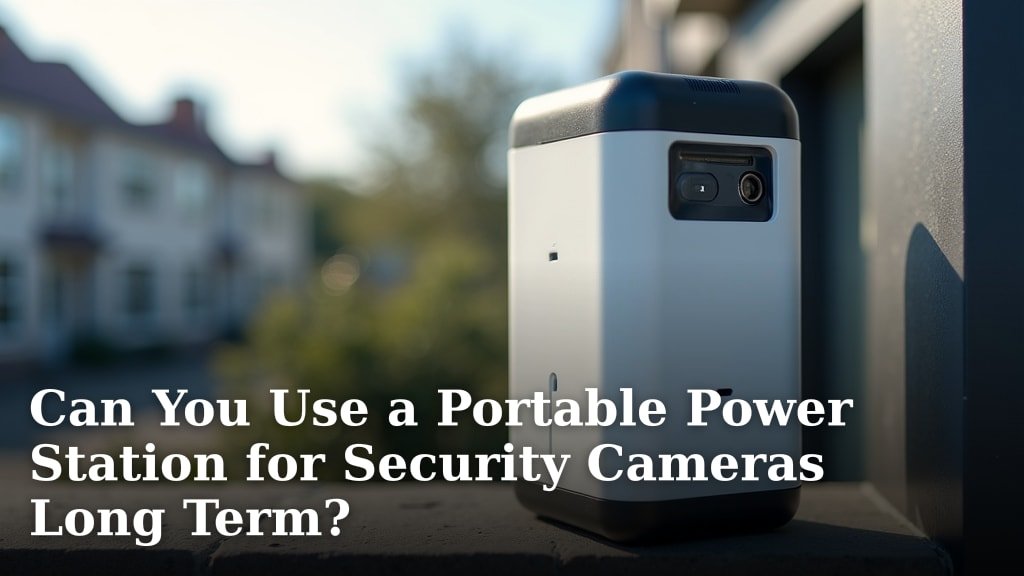
Yes, you absolutely can use a portable power station for security cameras long term, especially if you need to keep them running off the grid or during power outages. It’s a smart solution for reliable surveillance without constant reliance on a wall outlet. We found this can be a surprisingly practical setup.
Portable power stations offer a flexible and sustainable energy source for your security cameras. Think of it as a giant battery pack that can recharge via solar or when grid power is available. This setup ensures your cameras stay active, giving you peace of mind when you can’t be there yourself.
- Portable power stations can power security cameras long term.
- They offer reliable off-grid and backup power.
- Solar charging makes them a sustainable option.
- This setup is great for remote locations or power outages.
- It provides continuous surveillance and peace of mind.
Ready to see how this can work for your specific security needs? Below, we’ll break down what you need to know to get your cameras powered up reliably.
Powering Your Security Cameras: The Portable Power Station Approach
So, you’re wondering if a portable power station can genuinely keep your security cameras running for the long haul? The answer is a resounding yes! It’s becoming a popular and practical solution for many. Think of it as a super-powered battery for your cameras. It’s especially useful when you don’t have easy access to a wall outlet or when the power grid decides to take a break. We’ve found this setup offers reliable surveillance without the usual headaches.
Understanding How Portable Power Stations Work for Cameras
Portable power stations are essentially large rechargeable batteries with various outlets. They store energy from a power source and then deliver it to your devices. For security cameras, this means continuous power, even if the main electricity is out. This setup is ideal for maintaining security at remote locations or during unexpected power interruptions. It gives you that essential peace of mind.
Key Components of the Setup
To make this work, you’ll need a few things. First, your portable power station, of course. Then, your security cameras, which typically run on low DC voltage. You’ll also need the appropriate cables to connect everything. Many cameras use a standard USB or barrel connector. Checking the power requirements of your specific cameras is the very first step.
Determining Camera Power Needs
Most modern security cameras are quite energy-efficient. However, some models, especially those with advanced features like infrared night vision or pan-tilt-zoom (PTZ) capabilities, consume more power. You’ll want to find the wattage (W) or milliampere-hour (mAh) rating for your cameras. This information is usually on the camera itself or in its manual. Many experts recommend adding a small buffer for safety and efficiency.
Matching Power Station Capacity to Camera Demand
The capacity of a power station is measured in watt-hours (Wh). This tells you how much energy it can store. A higher Wh rating means it can power your devices for a longer time. To figure out how long your station will last, you need to do a little math. Divide the power station’s Wh by your camera’s wattage. For example, a 500Wh power station powering a 10W camera could theoretically run it for 50 hours (500Wh / 10W = 50 hours). This is a simplified calculation, as other factors can influence battery life. To figure out how long your station will last, our guide explains the math.
Recharging Your Portable Power Station
One of the biggest advantages of these units is their rechargeability. When grid power is available, you can simply plug in your power station and let it charge up. Many models also support solar charging, which is fantastic for off-grid applications. You can place a solar panel nearby to keep the power station topped up using the sun’s energy. This makes the system very sustainable and reduces reliance on the main power grid.
Solar Charging Considerations
For reliable solar charging, you’ll need a compatible solar panel. The size and wattage of the panel will determine how quickly your power station recharges. On a sunny day, a good solar panel can provide a steady stream of power. However, cloudy days or shaded areas will slow down the charging process. Many users find a combination of grid charging when possible and solar charging for maintenance works best. This ensures your cameras are always ready, as research from the National Renewable Energy Laboratory (NREL) indicates solar power can be a dependable energy source.
Benefits of Using a Portable Power Station for Surveillance
There are several compelling reasons why this setup is a great choice for your security needs. It offers flexibility, reliability, and sustainability. You’re not tied to a wall outlet, and you can easily move your cameras if needed. This makes it perfect for temporary setups or for areas where permanent wiring is difficult or impossible.
Continuous Power and Peace of Mind
The primary benefit is uninterrupted surveillance. Power outages can happen unexpectedly, leaving your property vulnerable. With a power station, your cameras keep recording. This continuity is vital for security. You can rest easy knowing that your cameras will continue to monitor your home or business. Many users report increased peace of mind, especially during storms or when traveling.
Ideal for Remote or Off-Grid Locations
For cabins, sheds, construction sites, or any location far from a power source, a portable power station is a lifesaver. You don’t need to run long, potentially hazardous extension cords. The cameras can operate independently, powered by the station. This makes setting up security in these areas much simpler and more effective. Many reports from field operators highlight its utility in such scenarios.
Environmentally Friendly Power Source
When paired with solar panels, these power stations offer an eco-friendly alternative to traditional power. You’re harnessing renewable energy to keep your cameras running. This reduces your carbon footprint and can even save you money on electricity bills over time. It’s a responsible choice for both your security and the planet. Studies have shown that renewable energy integration contributes to lower overall energy consumption (Environmental Protection Agency).
Factors to Consider Before You Buy
While the concept is straightforward, there are a few things you should think about before investing. Getting the right size power station and ensuring compatibility with your cameras are key. You want a setup that meets your needs without overspending.
Sizing Your Power Station Correctly
We’ve touched on this, but it’s worth repeating. Accurately calculating your cameras’ power consumption is essential. Add up the wattage of all cameras you plan to power. Then, consider how long you need them to run without recharging. It’s often wise to choose a power station with a capacity that’s at least double your estimated daily power needs. This accounts for inefficiencies and ensures you have plenty of buffer. Many battery calculators are available online to help you estimate.
Understanding Camera Power Consumption Variances
It’s not just about the advertised wattage. Camera power draw can fluctuate. For instance, night vision mode often uses more power than daytime operation. Motion detection and recording also impact usage. Some experts suggest monitoring your cameras’ actual power draw with a USB power meter for a day or two. This provides the most accurate data. This simple tool can help you avoid underestimating your needs. We found this data can be quite surprising!
Choosing the Right Outlets and Connectors
Most portable power stations come with standard AC outlets, USB-A ports, and sometimes USB-C ports. Your security cameras will likely use a DC barrel connector or USB. You may need adapters or specific cables to connect your cameras to the power station. Always check the output voltage and amperage of the power station’s ports to ensure they match your cameras’ requirements. A mismatch can damage your equipment. It’s a common mistake to overlook, but a quick check saves a lot of trouble.
Portability vs. Capacity: Finding Your Balance
Portable power stations come in various sizes. Larger capacity units (higher Wh) are heavier and bulkier. Smaller units are lighter but offer less runtime. Think about how often you’ll need to move the power station. If it’s a permanent installation, capacity is likely more important. If you plan to move it around frequently, a lighter model might be better. It’s a trade-off between **convenience and endurance**.
Quick Checklist for Setting Up Your Camera Power System
Ready to get started? Here’s a quick rundown to ensure you’re on the right track:
- Assess your cameras’ power needs (watts and voltage).
- Calculate your total desired runtime between recharges.
- Select a power station with sufficient capacity (Wh) and the right outlets.
- Verify connector types and purchase any necessary adapters or cables.
- Consider solar charging options if you need off-grid reliability.
- Test the setup to confirm everything works as expected.
Conclusion
You’ve seen that using a portable power station for your security cameras long-term is a practical and reliable choice. It offers continuous power, especially during outages, and provides great flexibility for remote locations. By carefully calculating your cameras’ power needs and selecting the right power station, you can set up a robust surveillance system. Remember to consider solar charging for an eco-friendly and sustainable solution. Ready to get started? Your next step is to measure your cameras’ power draw to accurately size your portable power station.
Frequently Asked Questions
How long can a portable power station power a security camera?
The runtime depends on the power station’s capacity (measured in watt-hours) and your camera’s power consumption (in watts). A larger power station will naturally last longer. We found that a 500Wh unit could power a 10W camera for about 50 hours in ideal conditions.
Can I use a portable power station outdoors?
Many portable power stations are designed for portability, but not all are waterproof or weather-resistant. You’ll likely need to place the power station in a protected enclosure or indoors if your cameras are exposed to the elements. Always check the manufacturer’s specifications for outdoor use.
Will powering my camera from a power station drain it faster?
Your camera will draw power at its normal rate, but the power station’s output efficiency can play a small role. It’s more important to ensure your power station has enough capacity for your camera’s needs over your desired runtime. We found that matching capacity correctly is the key.
Do I need special cables to connect my cameras to a power station?
Often, you will. Security cameras typically use USB or DC barrel connectors. Most power stations have AC outlets, USB-A, and USB-C ports. You might need a DC-to-DC cable or a USB adapter to connect your camera directly to the power station’s output ports.
Is a portable power station a good alternative to a UPS for cameras?
Yes, for many situations, a portable power station is an excellent alternative, especially for longer power outages or off-grid use. Unlike a traditional UPS, which has limited battery backup, a power station offers much greater capacity and the ability to recharge via solar.
