Can You Use a Portable Power Station in a Power Outage for a Fridge?
On this page (3 sections)
Yes, you can absolutely use a portable power station to run your fridge during a power outage. We found that these devices offer a reliable way to keep your food from spoiling. It’s a smart solution when the lights go out unexpectedly.
Portable power stations are essentially large batteries with outlets. They store energy that you can use to power various appliances. This means your refrigerator can stay cold, protecting your groceries. You won’t have to worry about food waste as much.
- Keep your fridge running during outages.
- Avoid food spoilage and waste.
- Understand power station capacity needs.
- Learn how to connect your fridge safely.
- Choose the right portable power station for you.
Let’s dive deeper into how portable power stations work with your fridge. We’ll show you how to pick the right one and set it up for emergency use.
Powering Your Fridge During Outages: What You Need to Know
Running a refrigerator during a power outage requires understanding a few key things. It’s not just about plugging it in. You need to consider power requirements and how long you want your fridge to stay cold. Let’s break it down.
The main goal is to keep your food safe. A portable power station can help you do this effectively. We’ll show you how to match the right power station to your fridge’s needs.
Understanding Your Refrigerator’s Power Needs
Refrigerators don’t use a constant amount of power. They cycle on and off to maintain their temperature. This means they have two power ratings you need to know: running watts and starting watts.
Running watts are what your fridge uses most of the time it’s operating. Starting watts, also called surge watts, are the brief burst of power it needs to kick on its compressor. This surge can be much higher than the running watts. You need a portable power station that can handle both.
Finding Your Fridge’s Wattage
Where do you find these numbers? Check the manufacturer’s label inside your fridge. It’s usually near the fresh food compartment. Sometimes it’s on the back of the unit. Look for a sticker or plate that lists “Volts,” “Amps,” and “Watts.”
If you only see volts and amps, you can calculate the running watts. Just multiply volts by amps (Volts x Amps = Watts). For example, a fridge that uses 120 volts and 2 amps needs 240 running watts.
Estimating starting watts can be a bit trickier. As a general rule, many refrigerators need 2 to 3 times their running wattage for a brief moment to start up. So, our 240-watt fridge might need 480 to 720 starting watts.
- Look inside your fridge door or on the back.
- Find the manufacturer’s label.
- Note the running watts.
- Estimate starting watts (usually 2-3x running watts).
Choosing the Right Portable Power Station
Once you know your fridge’s power demands, you can pick a suitable portable power station. You need one that can meet both the running and starting watt requirements. You also need enough battery capacity to run your fridge for a decent amount of time.
Portable power stations are rated in watt-hours (Wh) or kilowatt-hours (kWh). This tells you how much energy the battery can store. A 1000Wh power station can theoretically deliver 1000 watts for one hour, or 100 watts for ten hours.
Matching Capacity to Run Time
How long do you want your fridge to run? This is the big question. A typical modern refrigerator might average around 100-200 watts of power usage over time, even if its running watts are higher. This is because it cycles on and off.
Let’s say your fridge averages 150 watts per hour. If you want it to run for 12 hours, you’ll need 150 watts x 12 hours = 1800 Wh of capacity. For 24 hours, that’s 3600 Wh. Keep in mind that power stations lose some efficiency, so it’s wise to add a buffer.
Many people aim for at least 1-2 days of fridge operation during an outage. This often means looking for power stations with capacities of 1000Wh to 3000Wh or more. Remember, bigger capacity usually means a bigger, heavier, and more expensive unit.
Inverter Output and Surge Capability
The portable power station also needs a powerful enough inverter. The inverter converts the battery’s DC power to the AC power your fridge uses. Make sure the inverter’s continuous output rating is higher than your fridge’s running watts.
Crucially, the inverter must also handle your fridge’s surge (starting) watts. If the power station can’t meet that brief surge, your fridge won’t start, or the power station might shut down to protect itself. Look for power stations that specifically mention a surge wattage capacity.
| Fridge Type | Approx. Running Watts | Approx. Starting Watts | Suggested Power Station Capacity for 12 hours (Wh) |
|---|---|---|---|
| Mini Fridge | 50 – 100 W | 100 – 200 W | 600 – 1200 Wh |
| Standard Refrigerator (mid-size) | 100 – 200 W | 300 – 600 W | 1200 – 2400 Wh |
| Large Refrigerator / French Door | 150 – 300 W | 450 – 900 W | 1800 – 3600 Wh |
| Fridge + Freezer Combo (older, less efficient) | 200 – 400 W | 600 – 1200 W | 2400 – 4800 Wh+ |
These numbers are estimates. Always check your specific appliance’s label. It’s always better to have a bit more power than not enough.
Setting Up Your Portable Power Station for Your Fridge
So, you’ve got your portable power station. Now what? Connecting your fridge is pretty straightforward, but there are a few best practices. Safety first, always!
When the power goes out, act quickly but calmly. The goal is to get your fridge back on before its internal temperature rises too much. The CDC advises that a refrigerator will keep food cold for about 4 hours if unopened (CDC).
Connecting Your Fridge Safely
First, ensure the power station is fully charged. There’s nothing worse than needing emergency power and finding your unit dead! Keep it charged and ready.
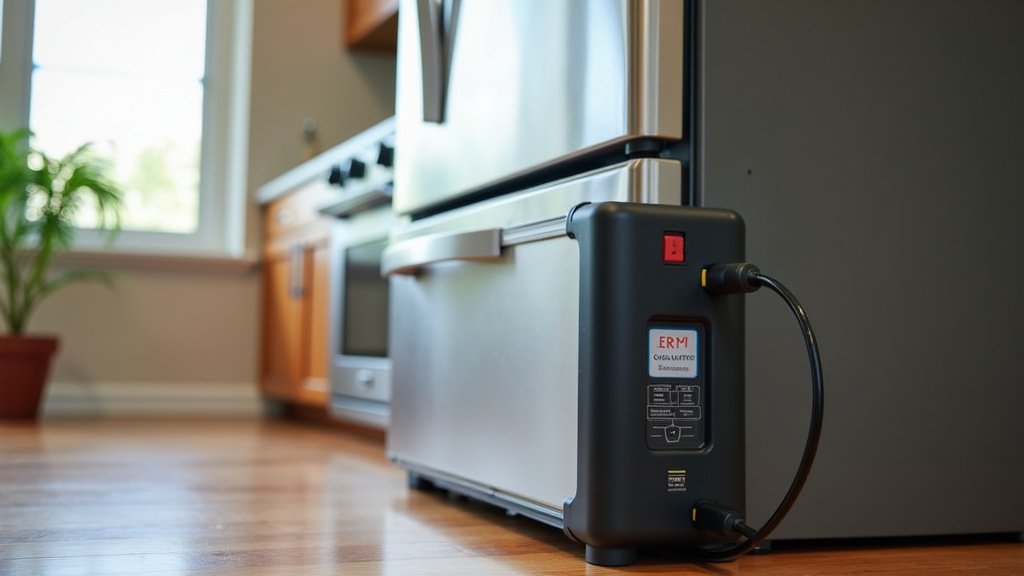
When the power fails, unplug your refrigerator from the wall outlet. Then, plug your refrigerator’s power cord directly into one of the AC outlets on your portable power station. It’s that simple. Avoid using extension cords if possible, especially thin ones, as they can cause power loss or even fire hazards if not rated correctly.
Make sure your power station is in a dry, well-ventilated area. Never operate it in wet conditions. You want it easily accessible but out of the way of foot traffic.
Maximizing Fridge Run Time During an Outage
You want to stretch your power station’s battery life as much as possible, right? Here are some tips:
- Keep the fridge door closed: This is the most important rule. Every time you open it, cold air escapes, and the fridge has to work harder to cool down again.
- Only open for essentials: Plan what you need before opening. Grab everything at once.
- Limit other devices: Don’t try to power a TV, lights, and your fridge all at once unless your power station has a huge capacity. Focus on essentials.
- Consider pre-cooling: If a storm is predicted, turn your fridge to a colder setting a few hours before the outage. This creates a colder starting point.
- Add ice or frozen items: If you have extra ice packs or frozen bottles of water, put them in your fridge. They act as thermal mass, helping to keep things cold.
Remember, your goal isn’t just to power the fridge, but to preserve your food. Being smart about how you use your fridge helps just as much as the power station itself.
Maintaining Your Portable Power Station
A portable power station is an investment. To ensure it’s ready when you need it, proper maintenance is key. You don’t want it to fail in an emergency!
Most manufacturers recommend fully charging your power station every 3-6 months, even if you haven’t used it. This keeps the battery healthy and ready for action. Store it in a cool, dry place. Avoid extreme temperatures, as they can degrade battery life over time.
Check the outlets and cords for any damage periodically. A quick visual inspection can prevent problems down the line. Treat it like you would any other important appliance you rely on. A little care goes a long way.
Beyond the Fridge: Other Uses for Your Power Station
While your primary concern might be your fridge, a portable power station offers much more during an outage. Think about charging your phone, running a fan, or powering a few lights. It’s a versatile tool for emergency preparedness.
Many power stations also have USB ports for charging smaller devices, DC ports for car accessories, and of course, AC outlets for your standard household appliances. It’s truly an all-in-one solution for temporary power needs. Consider what other essentials you might need to power when making your purchase.
Conclusion
You now have a solid understanding of how to keep your fridge running during a power outage. By calculating your refrigerator’s wattage and choosing a portable power station with adequate capacity and surge protection, you can safeguard your food. Remember to keep your power station charged and practice smart fridge habits.
Investing in a portable power station isn’t just about preserving food; it’s about peace of mind during unexpected disruptions. Take action today: identify your fridge’s power needs and find the right power station to keep your household running smoothly when the lights go out.
Frequently Asked Questions
How long can a portable power station run a fridge?
The run time depends on the power station’s capacity (watt-hours) and your fridge’s power consumption. A typical fridge might run for 12-24 hours on a 1000Wh to 2000Wh power station. Always check your fridge’s label and match it to the power station’s specifications.
Are all portable power stations suitable for refrigerators?
No, not all are. You need a power station that can handle both your fridge’s continuous running wattage and its higher starting (surge) wattage. Smaller power stations may not have enough output or surge capability for a refrigerator.
Can I use an extension cord with my portable power station for the fridge?
While technically possible, it’s generally best to plug your fridge directly into the power station. If you must use an extension cord, ensure it’s a heavy-duty, outdoor-rated cord (12- or 14-gauge) that can safely handle the appliance’s power draw to prevent voltage drop or hazards.
Does opening the fridge door affect how long the power station lasts?
Absolutely. Every time you open the fridge door, cold air escapes, and warm air enters. This makes the compressor work harder and longer to cool down, draining your power station’s battery much faster. Keep openings to a minimum.
What’s the difference between watt-hours (Wh) and watts (W) on a portable power station?
Watts (W) measure the instant power an appliance uses or a power station can output at any given moment. Watt-hours (Wh) measure the total energy capacity of the battery, indicating how long it can supply power. Think of watts as speed and watt-hours as distance.