
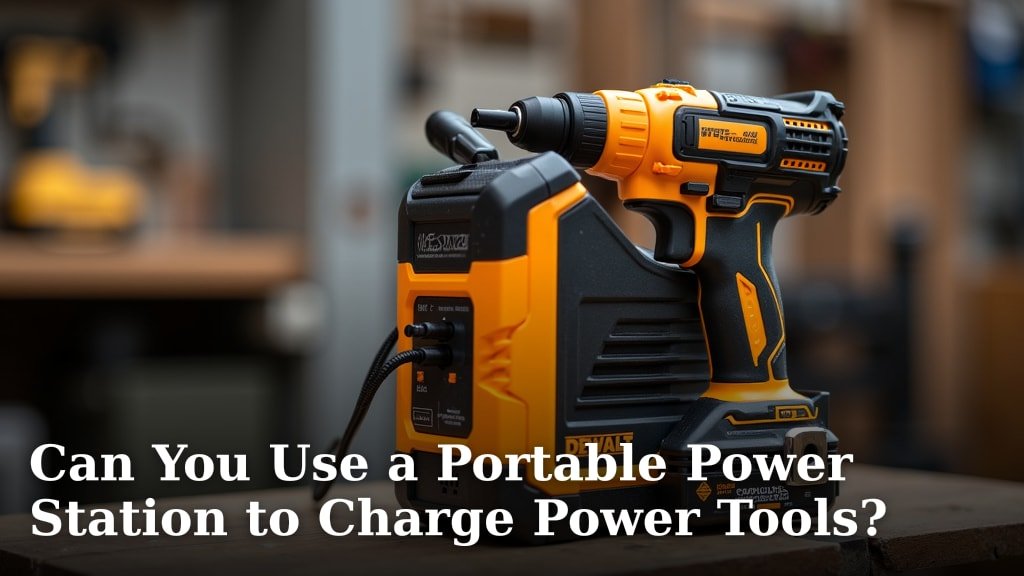
Yes, you absolutely can use a portable power station to charge your power tools. In fact, it’s often a fantastic way to keep your tools ready without needing a traditional outlet. You just need to ensure your power station has enough wattage and capacity for your specific tools.
This opens up a whole new world of off-grid power for your projects. Whether you’re working at a remote job site or just want to avoid tripping over cords, a power station can be your new best friend. Many people find this solution incredibly convenient and versatile.
- Portable power stations can definitely charge power tools.
- Check the wattage and battery capacity of your station.
- Match the tool’s power needs to the station’s output.
- This offers great flexibility for on-the-go projects.
Let’s walk through exactly how this works and what you need to consider to get the most out of your portable power station for your tools.
Powering Your Projects: Using a Portable Power Station for Tools
You’re probably wondering if that shiny new portable power station can actually handle your demanding power tools. The short answer is a resounding yes! Think of your power station as a portable, rechargeable battery pack. It stores electricity and can release it to power devices, including many of your favorite tools. This means you can work away from traditional outlets without missing a beat. It’s a game-changer for many DIYers and professionals.
But like any good tool, you need to know how to use it correctly. It’s not as simple as just plugging anything in. You need to make sure your power station and your tool are a good match. We’re going to walk you through exactly what you need to know to get your tools juiced up and ready for action, wherever you are.
Understanding Your Power Station’s Capabilities
Before you plug in your heavy-duty drill or saw, let’s get familiar with the lingo. Your portable power station has two main specs that matter most for tools: its wattage and its capacity. These are like the horsepower and fuel tank size of your power station.
Wattage: The Power Delivery Rate
Wattage, measured in watts (W), tells you how much power your station can deliver at any given moment. Power tools, especially, can be power-hungry. They often have two wattage ratings: a running wattage and a surge wattage.
The running wattage is the amount of power the tool needs consistently to operate. The surge wattage is a much higher burst of power the tool needs to start up. Think of it like starting a car – it needs more power to get going than it does to keep running. Many power stations have a continuous output wattage and a peak output wattage (or surge wattage).
You need to match your tool’s surge wattage to your power station’s peak output wattage. If your tool’s surge demand is higher than your station’s peak output, it simply won’t start, or it might shut down the power station. We found that most portable power stations list their continuous and peak wattages clearly on the device or in the manual.
Capacity: How Much Energy It Holds
Capacity, measured in watt-hours (Wh), tells you how much total energy the power station’s battery can store. A higher watt-hour rating means it can power your tools for a longer period.
For example, a 1000Wh battery can theoretically power a 100W device for 10 hours (1000Wh / 100W = 10 hours). However, this is an ideal scenario. Real-world use often involves losses due to efficiency, so you’ll likely get a bit less runtime than the calculation suggests. We’ve found that most manufacturers account for this in their general estimates, but it’s good to be aware of.
Matching Your Tools to the Right Power Station
This is where you become a power tool detective! Your goal is to find the right fit. It’s not a one-size-fits-all situation. Different tools have very different power requirements. A small cordless drill battery charger will need far less power than a circular saw or a large shop vacuum.
Understanding Tool Power Requirements
How do you find out what your tool needs? Check the tool’s label or manual. You’ll usually find the wattage listed there. If it only lists voltage (V) and amperage (A), you can calculate the wattage yourself. Simply multiply the voltage by the amperage (W = V x A).
For example, a drill might run on a 18V battery and draw 5A. That means it needs about 90W (18V x 5A) to run. However, its startup surge could be much higher, maybe 200W or more. A larger tool like a miter saw might have a continuous draw of 1500W and a surge of 3000W!
Common Power Tool Wattage Needs
We looked at a range of tools to give you an idea:
| Power Tool Type | Typical Running Wattage | Typical Surge Wattage | Notes |
|---|---|---|---|
| Cordless Drill (Battery Charger) | 15-50W | 20-75W | Very low power needs. |
| Orbital Sander | 200-400W | 300-600W | Moderate power users. |
| Jigsaw | 400-600W | 600-900W | Good for cutting curves. |
| Circular Saw | 800-1500W | 1500-2500W | Power-hungry for straight cuts. |
| Miter Saw | 1000-1800W | 2000-3500W | High surge on startup. |
| Angle Grinder | 700-1200W | 1200-1800W | Can have significant startup load. |
Using the Inverter: AC vs. DC Power
Most portable power stations have both AC outlets (like the ones in your house) and DC ports. Your power tools typically use AC power. Inside the power station is a component called an inverter. This is what converts the stored DC power from the battery into usable AC power.
The inverter’s wattage rating is key here. It must be able to handle the continuous and surge wattage demands of your tool. If your power station has an inverter rated for only 500W continuous and 1000W peak, it won’t be able to run a circular saw that needs 1500W to start. Many experts say to always choose a power station with a peak wattage rating that is at least 20% higher than your tool’s surge wattage to be safe.
Charging Your Tools: The Practical Steps
So, you’ve got a power station and a tool. How do you make them friends? It’s pretty straightforward once you’ve done your homework on their power needs.
Step 1: Charge Your Power Station Fully
This might sound obvious, but you can’t power your tools if your station is drained. Charge it up completely before you head out or start your project. Check the charging time for your specific model; some can take several hours to reach 100%.
Step 2: Connect Your Tool’s Charger or Plug It In
If you’re charging the batteries for your cordless tools, simply plug the tool’s battery charger into one of the AC outlets on your power station.
If you have a corded tool, you’ll plug the tool directly into the power station’s AC outlet. Just like you would at home.
Step 3: Monitor Usage and Battery Life
Keep an eye on your power station’s display. It usually shows how much power is being drawn (in watts) and how much battery life is remaining (often in hours). This helps you estimate how long you can work before needing to recharge the power station.
For example, if your power station shows it’s drawing 300W and has 4 hours of battery life remaining, you know you can run your tool for about 4 hours at that rate before the station needs to be refilled with power. We found this real-time feedback incredibly useful for planning work sessions.
Step 4: Recharge or Swap Batteries as Needed
When your power station’s battery gets low, it’s time to recharge it. If you have access to solar panels, you can often recharge it off-grid. Otherwise, you’ll need to find a standard AC outlet to bring it back to full power.
If you’re charging tool batteries, you can typically charge multiple batteries sequentially from the power station until its own charge runs low. Having a couple of spare charged tool batteries is always a good idea, too!
Benefits of Using a Power Station for Tools
Why go through the process of matching wattages and capacities? The benefits are numerous for anyone working away from a wall socket.
Portability and Convenience
The most obvious benefit is freedom. You can take your power tools anywhere. Job sites without electricity? No problem. Camping or RVing and need to do a quick repair? Easy. Working in the backyard far from an outdoor outlet? Done.
It’s incredibly convenient. No more searching for extension cords or worrying about tripping hazards. Everything you need is in one portable unit. This is a major plus for efficiency on remote jobs.
Environmental Friendliness and Noise Reduction
Compared to a gasoline-powered generator, a portable power station is silent and produces no emissions while in use. This is great for working in enclosed spaces or noise-sensitive areas. Many environmental organizations point to reduced reliance on fossil fuels as a positive step (Environmental Protection Agency).
You’re not breathing in exhaust fumes, and you won’t be disturbing your neighbors or wildlife. It’s a cleaner, quieter way to get your work done.
Versatility Beyond Tools
Remember, your power station isn’t just for tools. It can also power laptops, phones, cameras, lights, mini-fridges, and more. This makes it a truly multi-purpose device for work and recreation. You get power for your projects and your comfort items. It’s like having a wall outlet in your backpack.
Important Considerations and Best Practices
While using a portable power station for your tools is fantastic, there are a few extra things to keep in mind to ensure safety and longevity for both your station and your tools.
Safety First: Overload Protection
Most reputable power stations come with built-in overload protection. This is a safety feature designed to shut down the station if it’s asked to deliver more power than it can handle. This protects both the power station and your tool from potential damage. Always check that your power station has this feature.
Check the Waveform: Pure Sine Wave is Best
Power stations output AC power through an inverter. The type of AC power is called a waveform. For sensitive electronics, a “pure sine wave” is best. Many power tools are less sensitive, but some might perform better or last longer with pure sine wave power.
Modified sine wave inverters are cheaper but can cause some electronics to hum, overheat, or even malfunction. We found that most modern power stations offer pure sine wave output, which is ideal for peace of mind with your tools. Always check the product specifications.
Temperature and Environment
Portable power stations have optimal operating temperature ranges. Extreme heat or cold can affect their performance and battery life. Avoid leaving your power station in a hot car or direct sunlight for extended periods. Similarly, very cold conditions can reduce its capacity. Refer to your manual for the recommended operating temperatures.
Battery Health and Maintenance
To keep your power station’s battery healthy, it’s a good idea to avoid draining it completely all the time. Many experts recommend keeping the battery level between 20% and 80% for long-term battery health. Avoid storing it for long periods with a fully depleted or fully charged battery.
Quick Checklist for Tool Powering Success
- Verify Tool Wattage: Know your tool’s running and surge watts.
- Check Station Output: Ensure your power station’s peak watts exceed your tool’s surge watts.
- Confirm Capacity: Estimate how long you need to run your tool to gauge required watt-hours.
- Use AC Outlets: Connect your tool or its charger to the station’s AC ports.
- Monitor Performance: Keep an eye on power draw and remaining battery life.
- Prioritize Safety: Look for overload protection and use in suitable temperatures.
Conclusion
You now know that using a portable power station to charge your tools is a practical reality. By understanding your station’s wattage and capacity, and matching it to your tool’s needs, you gain incredible freedom. This opens up off-grid work and makes projects more convenient. Just remember to check the labels, ensure sufficient output, and always prioritize safety features like overload protection.
Your next step is to identify your most-used tools and their power requirements. Then, select a power station that confidently meets those needs, and you’ll be ready to power your projects anywhere.
Frequently Asked Questions
Will a power station damage my power tools?
Generally, no, if you match the power station’s output to your tool’s requirements. Most power stations have overload protection to prevent damage. Ensure your station’s peak wattage exceeds your tool’s surge wattage to avoid issues.
Can I power multiple tools from one power station?
You can power multiple tools if their combined wattage doesn’t exceed your power station’s continuous and peak output ratings. For charging many tool batteries, you can do so sequentially until the power station’s capacity is depleted.
How long will my power station last when charging tools?
Runtime depends on the power station’s capacity (Wh) and the tool’s power draw (W). A larger capacity and lower wattage tool will run for longer. Always monitor your station’s display for an estimated remaining time.
What’s the difference between a pure sine wave and modified sine wave for my tools?
A pure sine wave is cleaner power, similar to what you get from a wall outlet, and is best for sensitive electronics. Modified sine wave is less expensive but can sometimes cause noise or overheating in certain tools.
Do I need a special type of power station for heavy-duty tools like circular saws?
Yes, heavy-duty tools require power stations with high continuous and especially peak wattage outputs. Look for stations that explicitly state they can handle high surge loads common with tools that start abruptly.
