
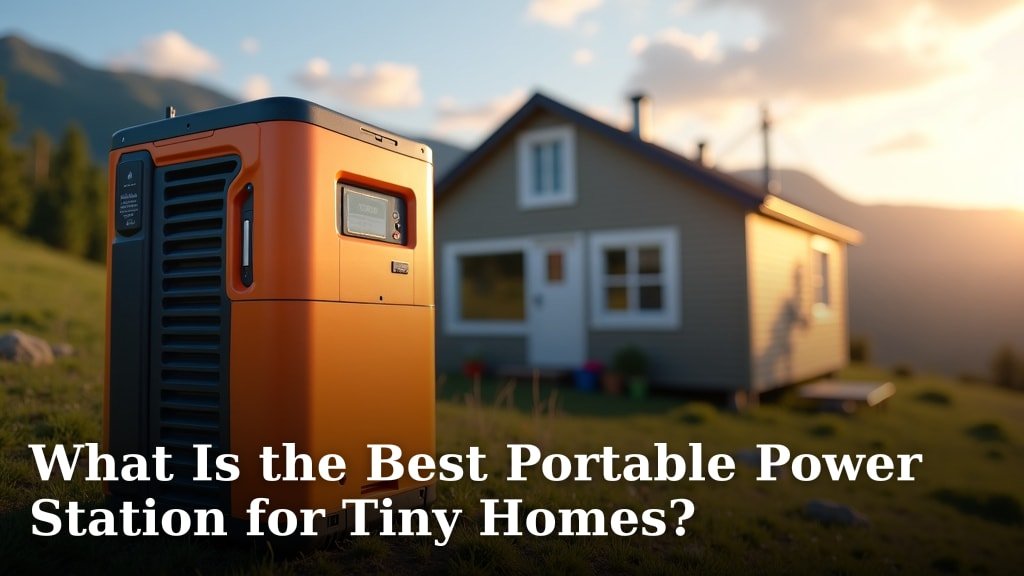
The best portable power station for tiny homes depends on your specific power needs, but generally, models offering 1000W continuous output and at least 1000Wh capacity are a great starting point. These units can power essential appliances like refrigerators, lights, and electronics without breaking a sweat. Finding the right balance between portability and power is key for off-grid living.
When choosing a power station for your tiny home, consider factors like recharge speed, durability, and the number of outlets. You’ll want something that can keep up with your daily routine and is built to last. Many models also offer solar charging capabilities, which can be a fantastic way to maintain your power supply sustainably and reduce reliance on grid electricity.
- Tiny homes need power stations with sufficient capacity for daily use.
- Look for at least 1000W output and 1000Wh capacity for essential appliances.
- Consider recharge times, outlet availability, and solar compatibility.
- Portability and durability are important for mobile or compact living.
Let’s walk through what to look for and some top contenders to help you power your cozy abode.
Choosing the Right Portable Power for Your Tiny Home
Selecting a portable power station for your tiny home is a big decision. It’s your lifeline to modern conveniences. You want something that’s reliable and fits your lifestyle. We’ve researched what makes a power station a great fit for compact living.
The goal is simple: keep your essential devices running smoothly. Think lights, your phone charger, maybe a small fan. We’re looking for power that supports your daily needs without being overly bulky or complicated.
Key Features to Consider for Tiny Home Power
When you’re powering a tiny home, a few things become really important. Portability matters, of course. But so does the sheer amount of power it can deliver and how long it lasts. Let’s break down the must-haves.
Capacity: How Much Energy Can It Store?
Capacity is measured in watt-hours (Wh). This tells you how much energy the battery can hold. For a tiny home, you’ll want a decent amount to get through your day. A 1000Wh unit is a solid starting point. This is enough for many common appliances. It can run a small refrigerator for several hours. Or it can charge your phone many times over.
Think about your daily routine. Do you use a lot of electronics? Do you need to run a coffee maker? If so, you might need more capacity. Some units go up to 2000Wh or even more. More capacity means more power, but also a larger and heavier unit.
Output Power: What Can It Run Simultaneously?
Output power is measured in watts (W). This is the maximum power the station can deliver at any one time. For tiny homes, look for a unit with at least 1000W continuous output. This means it can steadily power appliances that draw up to 1000W. Some appliances have a surge wattage, which is higher when they start up.
You need to check the wattage requirements of your appliances. A small fan might use 50W. A laptop charger might use 60W. Your refrigerator could use 100-200W. Some devices, like microwaves or hair dryers, can use 1000W or more. Make sure your power station can handle these peaks. You need to check the wattage requirements of your appliances to ensure compatibility.
Recharge Speed and Methods
How quickly can you refill the power station’s battery? This is crucial, especially if you’re relying on it heavily. Look at the recharge times from different sources. Wall outlets are the fastest for most units. But what about when you’re off the grid?
Solar Charging Capabilities
Solar charging is a game-changer for tiny homes. It lets you replenish your power sustainably. Most good power stations can accept solar input. Check the maximum solar input wattage the unit can handle. Higher wattage means faster charging from your solar panels. You’ll also need to consider the size and number of solar panels you plan to use. A good setup can keep your power station topped up on sunny days.
AC and Other Charging Options
While solar is great for sustainability, you’ll still want fast charging options. Can you recharge it from a car adapter? How long does it take to charge from a standard wall outlet? These methods are important for convenience and backup.
Portability and Size
Tiny homes are often mobile or have limited space. So, the size and weight of your power station matter. While you need sufficient power, you don’t want a unit that’s impossible to move. Many high-capacity units are heavier. Consider if you need to move it often.
Some units have built-in wheels, making them easier to transport. Others are more compact. Weigh the capacity and output you need against the portability you desire. It’s a balance you’ll have to strike.
Number and Types of Outlets
Check the variety of outlets available. You’ll likely need AC outlets for larger appliances. USB-A and USB-C ports are essential for charging phones, tablets, and laptops. Some units also have 12V DC ports, which can be useful for certain RV or camping equipment.
Consider how many devices you need to power at once. If you have multiple gadgets, more outlets are better. Ensure the outlet types match your devices.
Understanding Wattage: A Quick Guide
Let’s clarify wattage. Think of it like water pressure in a pipe. Watts (W) tell you how much power an appliance needs or how much power the station can deliver. Watt-hours (Wh) tell you how much total energy is stored.
- Wattage (W): The rate of power consumption or delivery.
- Watt-hours (Wh): The total amount of energy stored.
For example, a 100W light bulb uses 100 watts of power. If your power station has a 1000Wh capacity, it could theoretically power that 100W bulb for 10 hours (1000Wh / 100W = 10 hours). But remember, the station also needs to be able to *deliver* 100W continuously.
Top Features to Look For in a Tiny Home Power Station
Based on our research, these are the features that stand out for tiny home dwellers:
- Capacity: Aim for 1000Wh or more for sustained use.
- Continuous Output: At least 1000W is recommended.
- Solar Input: For sustainable, off-grid charging.
- Multiple Outlet Types: AC, USB-A, USB-C for versatility.
- Fast Recharging: From AC or other sources for convenience.
- Portability: Consider weight and size for your living space.
Many manufacturers offer units that meet these criteria. We found that brands like EcoFlow, Jackery, and Bluetti often have models that fit the bill. It’s always wise to check the latest reviews and specifications.
A Comparative Look at Power Station Capacities
To help you visualize, consider this breakdown. These are general estimates for how long certain devices might run on a 1000Wh power station. Actual runtimes will vary based on the exact wattage of your devices and the efficiency of the power station.
| Device Type | Typical Wattage | Estimated Run Time (on 1000Wh) |
|---|---|---|
| LED Light Bulb | 10W | ~100 hours |
| Laptop | 60W | ~16 hours |
| Smartphone Charging | 20W | ~50 charges |
| Small Refrigerator (Energy Star) | 150W | ~6.5 hours |
| Fan | 50W | ~20 hours |
As you can see, a 1000Wh unit can handle a lot. You can power multiple small devices throughout the day. For larger appliances or longer run times, you’ll need a higher capacity unit.
Making Your Final Choice: A Checklist
Ready to narrow down your options? Use this quick checklist:
- Does it have at least 1000Wh capacity?
- Does it offer 1000W or more continuous output?
- Does it support solar charging?
- Does it have the right mix of AC and USB ports?
- Is it a reasonable size and weight for your tiny home?
- What is the recharge time from a wall outlet?
Thinking through these questions will guide you toward the best portable power station for your unique tiny home setup. It’s about finding that perfect power companion for your cozy dwelling.
Conclusion
Finding the right portable power station for your tiny home boils down to matching its capacity and output to your lifestyle. We’ve seen that a 1000Wh capacity and 1000W continuous output is a fantastic starting point for essential needs. Remember to consider solar charging for sustainability and ensure the unit has enough outlets for your devices. Don’t forget portability and recharge speed! Your next step is to check the specific wattage requirements of your most-used appliances and compare those with the specs of top-rated models. This will guide you to a power solution that truly keeps your cozy home running smoothly.
Frequently Asked Questions
How long can a 1000Wh power station run a small refrigerator?
A 1000Wh power station can typically run an energy-efficient small refrigerator for about 6 to 7 hours. This estimate depends on the refrigerator’s exact wattage and how often its compressor cycles on and off.
Is solar charging really necessary for a tiny home power station?
Solar charging is highly recommended for tiny homes, especially if you plan to live off-grid. It provides a sustainable way to replenish your power, reducing your reliance on limited battery capacity and grid electricity.
What’s the difference between watt-hours (Wh) and watts (W)?
Watts (W) measure the rate of power an appliance uses or a power station can deliver at any given moment. Watt-hours (Wh) measure the total amount of energy stored in the battery over time, indicating how long it can supply power.
Can I power a microwave or hair dryer with a typical tiny home power station?
Most portable power stations suitable for tiny homes, especially those around 1000W continuous output, can handle a microwave or hair dryer for short periods. However, these high-wattage appliances will drain the battery very quickly, so it’s best to check the specific surge and continuous wattage of the appliance against the power station’s capabilities.
How many devices can I realistically power at once with a 1000W output station?
With a 1000W continuous output, you can power several devices simultaneously as long as their combined wattage doesn’t exceed 1000W. For instance, you could run lights, charge phones and laptops, and power a small fan all at the same time.
