Best 3000-Watt Portable Generators: Top 9 Picks (November 2026)
The best 3000-watt portable generators include the Aceup Energy 4000 Watt Gas Inverter Generator for balanced home and RV power, the Oxseryn Power Equipment 4400 Watts Inverter Generator for long light-load runtime, and the BLUETTI Elite 30 V2 Portable Power Station for quiet electronic backup.
On this page (8 sections)
- Which 3000 watt portable generator is best?
- The best 3000-watt portable generators
- How many watts do you need from a 3000-watt generator?
- Is an inverter generator better for sensitive electronics?
- Do you need an electric-start 3000-watt generator?
- How should you choose between a fuel generator and a power station?
- How do you use and maintain a portable fuel generator?
- Final choice for the best 3000 watt portable generator
The best 3000 watt portable generator for most medium loads is the Aceup Energy 4000 Watt Gas Inverter Generator. It offers 3200 rated watts, a 48 lb body, clean inverter power and an RV receptacle, while Oxseryn gives you longer light-load runtime and BLUETTI avoids fuel and engine noise.
A 3000-watt class generator can support refrigerators, lights, electronics, tools or RV equipment, but the usable number is the rated or running wattage. Peak watts only cover short startup demands, so add the running watts of your planned devices and leave room for motor surges.
If you want a broader look at fuel choices, read our gas generator buying guide. For an electric alternative, compare our Best Portable Power Station guide.
Our picks at a glance
-
1
 Best for balanced home and RV power
Aceup Energy 4000 Watt Gas Inverter Generator
9.5/10 our score
See it on Amazon -
2
 Best for long light-load runtime
Oxseryn Power Equipment 4400 Watts Inverter Generator
9.5/10 our score
See it on Amazon -
3
 Best for quiet electronic backup
BLUETTI Elite 30 V2 Portable Power Station
9.4/10 our score
See it on Amazon
- 4
 Check it
WEN 3600-Watt Portable Inverter Generator
Best for a light RV-ready generator - 5
 Check it
PECRON Portable Power Station F3000LFP
Best for large battery capacity - 6
 Check it
PowerSmart 3000 Watt Portable Inverter Generator
Best for quiet camping with CO protection - 7
 Best for refrigerator startup headroomCheck it
- 8
 Check it
MaXpeedingrods 3500 Watt Portable Inverter Generator EPA
Best for compact RV accessories - 9
 Check it
PowerSmart 3000 Watt Portable Inverter Generator
Best for simple USB and RV charging
Which 3000 watt portable generator is best?
Aceup is the best all-around fuel generator here, while Oxseryn leads for longer low-load operation. BLUETTI and PECRON are better matches when quiet battery power matters more than unlimited runtime from gasoline.
The right pick depends on how you will use it most days. Home backup needs useful running watts and safe outdoor placement, while camping and RV use put more weight on outlets, carry weight and sound at the campsite.
We compared rated output, starting capacity, weight, noise claims, outlets, runtime information and safety features. Our score weighs specs, features and buyer feedback against what you're shopping for.
Weight matters in daily use because a generator you can move to a clear outdoor spot is more useful than a stronger unit left in a garage. Outlet layout also matters, since the wrong connector can turn a simple RV hookup into an extra purchase.
Runtime claims need context before you rely on them. A figure at 25% load suits lights and small electronics, while a fridge, air conditioner or tool may pull the engine much harder and shorten that time.
Safety features deserve the same close look as wattage. Low oil shutdown, overload protection and carbon monoxide monitoring can matter more than a small gap in peak output.
That is why this guide treats peak watts as only part of the answer. Running watts, startup demand and your fuel or charging plan decide whether a model fits your load.
| Product | Best for | Rated output | Peak output | Weight | Our score |
|---|---|---|---|---|---|
| Aceup Energy 4000 Watt Gas Inverter Generator | balanced home and RV power | 3200 watts | 4000 watts | 48 lb | 9.5 |
| Oxseryn Power Equipment 4400 Watts Inverter Generator | long light-load runtime | 4400 watts | 56 lb | 9.5 | |
| BLUETTI Elite 30 V2 Portable Power Station | quiet electronic backup | 9.5 lb | 9.4 | ||
| WEN 3600-Watt Portable Inverter Generator | a light RV-ready generator | 2900 watts | 3600 watts | 46.3 lb | 9.3 |
| PECRON Portable Power Station F3000LFP | large battery capacity | 63.3 lb | 9.2 | ||
| PowerSmart 3000 Watt Portable Inverter Generator | quiet camping with CO protection | 2600 watts | 3000 watts | 42 lb | 8.7 |
| Generac | refrigerator startup headroom | 59.5 lb | 8.5 | ||
| MaXpeedingrods 3500 Watt Portable Inverter Generator EPA | compact RV accessories | 3500 watts | 47 lb | 8.3 | |
| PowerSmart 3000 Watt Portable Inverter Generator | simple USB and RV charging | 52 lb | 8.0 |
The best 3000-watt portable generators
The products below are arranged from highest score to lowest score. If propane is your preferred backup fuel, compare propane generators for home.
Compare running watts first, then check startup needs, outlet types, fuel handling, weight and the amount of noise your location allows.
Aceup Energy 4000 Watt Gas Inverter Generator: Best for balanced home and RV power
- 4000 peak watts and 3200 rated watts
- 48 lb body
- 60 dB in Eco mode at 25% load
- 1.32 gallon tank
Aceup combines 3200 rated watts with a 48 lb portable body. Its inverter output, RV receptacle and Eco mode suit medium home, camping and RV loads.
Pros
- 3200 rated watts
- Low 1.5% THD
- RV receptacle
- Parallel ready
Cons
- Recoil start
- Parallel kit sold separately
Aceup Energy is the strongest balance for a medium-load home, RV or camping setup. Its 149cc 4-stroke OHV engine produces 3200 rated watts and 4000 peak watts, giving you more running headroom than many generators marketed around 3000 watts.
The 48 lb body is easier to move than the larger units in this group. Eco mode reaches about 60 dB at 23 ft with a 25% load, and inverter output has stated THD below 1.5% for phones, televisions and other sensitive electronics.
Its panel includes a 120V 20A outlet, an RV receptacle and a 12V DC 8.3A car charger outlet. The digital gauge tracks voltage, runtime, gasoline, hertz and output, while the 1.32 gallon tank runs up to 5 hours at half-load.
Choose Aceup when you want a portable fuel generator with strong running output and clear operating information. It uses recoil start, and the parallel kit is sold separately.
Oxseryn Power Equipment 4400 Watts Inverter Generator: Best for long light-load runtime
- 4400 peak watts and 3400 running watts
- Up to 14 hours at 25% load
- 2 gallon tank
- 56 lb body
Oxseryn gives this group the highest stated running output and a 2 gallon tank. Its 14-hour 25% load claim fits extended low-demand backup or RV use.
Pros
- 3400 running watts
- 14-hour 25% load runtime
- Fuel gauge
- RV port
Cons
- Heavier than Aceup
- Noise is under 72 dBA at 23 ft
Oxseryn is the best fit when a light load may run through much of the day. Its 4400 peak watts and 3400 running watts give it the highest stated output in this roundup, while Eco mode and a 2 gallon tank support up to 14 hours at 25% load.
The open-frame generator weighs 56 lb and measures 19 x 15.6 x 19.1 in. Its panel has 2 120V AC ports, a 12V DC port and an RV port, so it suits camping, residential backup and commercial use patterns.
Noise is stated as under 72 dBA from 23 ft away. That is a useful comparison point, but it is not the quietest claim here, so plan placement carefully near campsites or neighbors.
Choose Oxseryn for higher running output and long light-load runtime. Its weight and open-frame design make it less appealing if easy carrying and low sound are your first priorities.
BLUETTI Elite 30 V2 Portable Power Station: Best for quiet electronic backup
- 288Wh LFP battery
- 600W continuous output
- 1500W Power Lifting Mode
- 10 ms UPS
BLUETTI is the quiet fuel-free option for smaller loads. Its 288Wh battery, 600W output and 10 ms UPS suit laptops, routers, lights, CPAP machines and small car fridges.
Pros
- 9.5 lb weight
- 10 ms UPS
- AC, car and solar charging
- 380W fast wall charging
Cons
- Much lower output than fuel generators
- 288Wh capacity limits long high-load use
BLUETTI is the best choice for quiet backup for electronics rather than long fuel-powered operation. Its 288Wh LFP battery provides 600W continuous output and 1500W in Power Lifting Mode, so it sits in a different class from the fuel generators above.
Treat Power Lifting as short term help, not a new continuous rating. Plan lights, chargers and medical devices around 600W.
At 9.5 lb, it is easy to carry for storms, road trips, camping and small emergency loads. A 10 ms UPS switch can keep laptops, routers and CPAP machines connected during a sudden outage.
There is no exhaust to manage, no gasoline smell and no need to move it outside for indoor use. That compact size suits a desk, nightstand or RV storage bay.
It supports AC wall charging up to 380W, car charging and solar charging. It reaches 0% to 80% in 45 minutes and 0% to 100% in 70 minutes on wall charging.
Choose BLUETTI for quiet, fuel-free power and fast charging. It suits phones, laptops, routers, lights, speakers and a small car fridge best, while the 288Wh capacity will limit high-wattage devices.
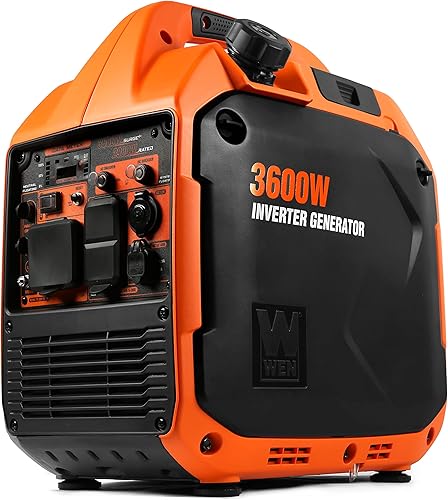
WEN 3600-Watt Portable Inverter Generator: Best for a light RV-ready generator
- 3600 surge watts and 2900 rated watts
- 46.3 lb body
- Fuel shutoff
- TT-30R RV receptacle
WEN keeps the package light while offering a TT-30R RV receptacle and clean inverter output. Fuel shutoff helps use fuel left in the carburetor before shutdown.
Pros
- Lightest fuel generator here
- RV receptacle
- Two USB ports
- Fuel shutoff
Cons
- 2900 rated watts
- Recoil start
WEN suits RV users who want a light inverter generator with the right connection built in. Its 149cc engine produces 3600 surge watts and 2900 rated watts, and the body weighs 46.3 lb.
That weight is a real advantage for loading an RV bay or carrying across a campsite. It is lighter than most fuel models here.
The panel includes 2 three-prong 120V receptacles, a TT-30R RV receptacle, a 12V DC receptacle and 2 USB ports. Clean inverter power is designed for phones, tablets and laptops.
The TT-30R outlet matches the connection many RVs expect. Household outlets can then cover a fan, light or charger without crowding the main RV lead.
The fully enclosed design supports quieter use, and the 1.6 gallon tank provides up to 5 hours at half-load. Eco mode can adjust fuel use as demand changes.
Choose WEN if transport weight and RV connection matter more than the highest running output. It has recoil start, so calculate simultaneous loads and start motor driven devices one at a time.
PECRON Portable Power Station F3000LFP: Best for large battery capacity
- 3072Wh LiFePO4 battery
- 3600W output
- 13 outlets
- 1800W AC charging
PECRON offers fuel-free power with a 3072Wh battery and 3600W output. It suits home backup users who need long battery capacity and many ports.
Pros
- 3072Wh capacity
- 3600W output
- 13 ports
- UPS mode
Cons
- 63.3 lb weight
- 120V output, not 240V
PECRON is the battery choice for buyers who need long stored energy and high output without gasoline. Its 3072Wh LiFePO4 battery and 3600W pure sine wave output can support refrigerators, air conditioners and power tools within stated limits.
That size puts it closer to whole home essentials than to a small travel pack. It can carry a fridge and lights through an outage, while fuel generators can keep going as long as gasoline lasts.
The F3000LFP has 13 ports, including 6 AC outlets, 2 100W USB-C ports, 2 USB-A ports, a carport and 2 DC 5525 outputs. It can charge up to 13 devices at once.
USB-C power at 100W is useful for laptops without a separate wall adapter. Multiple AC outlets also reduce the need for a power strip.
AC charging reaches 1800W, with a stated 0% to 100% charge time of 2 hours. It also supports solar and car charging, with an 8 to 20 ms UPS mode and app monitoring.
At 63.3 lb, PECRON fits a fixed home backup spot or a vehicle with room for its size. Remember it produces 120V output, not 240V.
PowerSmart 3000 Watt Portable Inverter Generator: Best for quiet camping with CO protection
- 3000 surge watts and 2600 rated watts
- 59 dBA at 23 ft
- CO sensor
- Parallel capable
PowerSmart is a compact 42 lb choice for camping and moderate home loads. Its CO sensor, low-oil shutdown and short-circuit protection add useful safety controls.
Pros
- 42 lb weight
- 59 dBA at 23 ft
- CO sensor
- Parallel capable
Cons
- 2600 rated watts
- Parallel kit sold separately
This PowerSmart is a practical camping pick because it combines a 42 lb weight with 3000 surge watts and 2600 rated watts. Its 59 dBA claim at 23 ft suits outdoor use where sound matters.
At 42 lb, it is one of the easiest fuel generators here to lift into a trunk or RV compartment. That matters for weekend camping, where you may carry it short distances often.
The generator includes a CO sensor, automatic low-oil shutdown, overload protection and short-circuit protection. Clean power with THD below 3% is intended for phones, tablets, cameras, refrigerators, televisions and power tools.
Those protections do not make indoor use safe. Keep the unit outdoors with exhaust directed away from tents, doors and windows.
It is parallel capable with a separately sold kit, and a 1.06 gallon tank can run up to 11 hours at 25% load. Budget for the kit and check that both units and cables match before counting on doubled output.
Choose this model for a lighter fuel generator with safety controls. Its 2600 rated watts suit a fridge, lights, TV and chargers when you stagger larger loads.
Generac: Best for refrigerator startup headroom
- 3300 starting watts
- 2500 running watts
- COsense technology
- 1.06 gallon tank
Generac focuses on starting capacity for refrigerators, RV air conditioners and motor-driven tools. It also offers TruePower clean power, Economy Mode and COsense monitoring.
Pros
- 3300 starting watts
- COsense shutdown
- RV-ready outlet
- 3-year residential warranty
Cons
- 2500 running watts
- 59.5 lb weight
Generac is the best match when startup headroom matters more than maximum running output. The GP3300i produces 3300 starting watts and 2500 running watts, with PowerRush technology for startup demand from refrigerators, RV air conditioners and motor-driven tools.
That split is the main trade off to understand before you buy. It can handle a fridge surge while still running lights and chargers, yet 2500 running watts leaves less room for several large appliances at once.
TruePower technology provides less than 3% THD for laptops, tablets, CPAP machines and other sensitive electronics. The 1.06 gallon tank runs up to 7 hours at 25% load or 4.5 hours at 50% load.
Those runtime figures show why load level matters so much. Light night time use can stretch the tank, while a daytime fridge and air conditioner load will use fuel faster.
The panel has 2 120V 20A household outlets, a 120V 30A twist-lock outlet and 2 USB-A ports. COsense monitors carbon monoxide, while Economy Mode adjusts engine speed to the load.
The twist-lock outlet suits RV style connections, but check your RV inlet before you assume it is a direct fit. USB ports cover phones and tablets without using household outlets.
At 59.5 lb, this is not the lightest choice. Pick Generac for its starting capacity, safety controls and RV-oriented outlet mix, but verify your running load because 2500 watts leaves less continuous headroom.
It is a strong fit for a fridge first plan with a few extras. Add up your running loads first, then let the starting watts cover the motor surge.
MaXpeedingrods 3500 Watt Portable Inverter Generator EPA: Best for compact RV accessories
- 3500 peak watts and 3000 running watts
- 47 lb body
- Up to 8.3 hours at 25% load
- 58 dB in Eco mode
MaXpeedingrods gives you 3000 running watts in a 47 lb inverter generator. Its RV outlet, USB ports and included parallel cables fit travel and backup use.
Pros
- 3000 running watts
- 47 lb weight
- 58 dB in Eco mode
- Parallel cables included
Cons
- Gasoline only
- Compression ignition system
MaXpeedingrods gives you 3000 running watts and 3500 peak watts in a 47 lb inverter generator. That combination makes it a useful middle option for an RV, small house or outdoor setup.
Running output is the figure to plan around for daily loads. It gives this model more continuous headroom than the 2600W PowerSmart picks, while peak watts remain there for short motor demands.
Eco mode supports up to 8.3 hours at a 25% load and up to 4.5 hours at a 50% load. The generator also claims 58 dB in Eco mode at 23 ft, which is one of the lower fuel-generator noise figures here.
That quieter claim helps at a campsite or near neighbors, especially in Eco mode. Place it downwind and away from sleeping areas, since sound still carries in open spaces.
Its outlets include a 120V 30A RV outlet, 2 120V 20A outlets and 2 5V DC USB outlets. The box includes an RV30 plug, parallel cables, a dust cover, an oil funnel, a spark plug socket wrench, a screwdriver and an owner manual.
Included parallel cables are a practical plus because some rivals sell that kit separately. The dust cover and tools also support basic care when the unit lives in a storage bay.
Choose it when 3000 running watts and travel accessories matter. It uses gas, and its 47 lb weight is portable without matching the smaller battery stations.
Check that the RV outlet matches your rig and keep the load list realistic. This model fits travel and backup use best when the main loads are known in advance.
PowerSmart 3000 Watt Portable Inverter Generator: Best for simple USB and RV charging
- 3000 starting watts and 2600 running watts
- 59 dBA at 23 ft
- L5-30R twist-lock outlet
- Two USB ports
This PowerSmart provides clean 2600W running output with household, twist-lock, DC and USB ports. It fits camping and residential use where a simple control panel matters.
Pros
- USB ports
- 59 dBA at 23 ft
- Parallel ready
- CO Protect
Cons
- 2600 running watts
- 52 lb weight
The second PowerSmart is a simple choice for camping and residential use when you want several charging ports. It provides 3000 starting watts and 2600 running watts with clean power below 3% THD.
That output suits a fridge, lights, TV and phone charging when you manage the total load. Sustained use should stay close to the 2600W running figure.
The control panel includes a 120V 20A duplex outlet, a 120V 30A L5-30R twist-lock outlet, a 12V 8A DC port and 2 5V 2.1A USB ports. Eco Mode can reduce fuel use when the connected load is lower.
The outlet mix covers household cords, an RV style twist-lock lead and direct USB charging. That can cut down on adapters for phones, tablets and small devices.
Its stated noise level is 59 dBA at 23 ft, and the 52 lb body is manageable for occasional transport. Parallel operation can double output with a separately sold kit.
Choose this PowerSmart when the L5-30R outlet and USB ports fit your setup. Use it outdoors on level ground and keep exhaust away from occupied spaces.
How many watts do you need from a 3000-watt generator?
A 3000-watt generator should have enough rated output for your running devices plus room for startup surges. Add the running watts of your refrigerator, lights, chargers, television or tools, then check the highest starting demand from motors and compressors.
A generator labeled 3000 watts may produce less than 3000 running watts. For example, Generac provides 2500 running watts, while Aceup provides 3200 rated watts, so the label alone doesn't tell you how much continuous load the unit can handle.
Use Eco mode for changing or smaller loads when the model offers it. It can reduce engine speed and fuel use, but it does not create more available wattage.
Is an inverter generator better for sensitive electronics?
An inverter generator is usually the better fit for laptops, phones, televisions and other sensitive electronics when its stated THD is low. The models here describe clean inverter output, with Aceup stating below 1.5% THD, WEN stating below 1.2% at full load and PowerSmart stating below 3%.
Keep the generator outdoors and away from doors, windows and vents. Never use a fuel generator inside a home, garage, RV or tent because carbon monoxide can build up quickly.
If you want to understand hybrid designs, read What Is a Hybrid Inverter Generator?. For a smaller fuel option, compare our best 2000 watt portable generator guide.
Do you need an electric-start 3000-watt generator?
Electric start is useful when you don't want to pull a recoil starter, but none of the product data above should be treated as having electric start unless the model specifically states it. Compare the ignition method, battery needs and starting procedure before choosing.
That distinction matters because a recoil pull is simple, but it can be harder for some users in cold weather or with limited strength. Electric start adds convenience, yet it also adds a battery and charging checks to ownership.
Look for the exact ignition wording in the specs rather than assuming it from the wattage class. Swap in a model that clearly lists electric start only if that feature is a priority for you.
Also check whether the starter battery is included, how it is charged and what happens if it runs low during storage. A generator that will not start easily is not much help during an outage.
For that feature, read how to choose a 3000 watt generator with electric start. If sound is your main concern, our best 3000 watt generator quiet guide compares quieter options.
Those guides can help you narrow the field by the features you value most. Use them alongside the running watt totals here, since start type and noise do not replace a proper load plan.
If you plan to use the generator often, think about who will start it and where it will be stored. The best start method is the one that person can use safely and without strain.
How should you choose between a fuel generator and a power station?
Choose a fuel generator for longer operation when you can store and safely use gasoline. Choose a power station for quiet, fuel-free backup where battery capacity and recharge plan match your loads.
Fuel gives you refuel and go endurance for a fridge, tools or RV air conditioner. A power station gives you silent indoor use for electronics, but only until its stored energy runs out.
BLUETTI is the lightest option here at 9.5 lb, but its 288Wh battery and 600W continuous output suit smaller devices. PECRON weighs 63.3 lb but raises capacity to 3072Wh and output to 3600W.
That gap changes the use case. BLUETTI fits a router, laptop, lights and CPAP backup, while PECRON aims at longer home essentials and larger appliances.
Weight also changes where each one can live. BLUETTI can move between a car, tent and home easily, while PECRON works best in a fixed spot or a vehicle with space to spare.
A power station needs a charging plan. Check whether AC, solar or car charging fits your routine before relying on it for extended backup.
Noise and exhaust should guide the choice as much as wattage. Power stations suit tents, RV interiors and quiet neighborhoods, while fuel generators must stay outdoors and clear of doors and windows.
How do you use and maintain a portable fuel generator?
Use the generator on a stable outdoor surface with clear airflow, connect only suitable loads, and follow the model's operating instructions. Let the engine cool before refueling, and keep gasoline in an approved container away from ignition sources.
A level surface helps the engine run as designed and keeps cords from slipping into water or mud. Leave space around the unit so hot exhaust does not build up near walls, tents or stored gear.
Check oil and fuel before starting, then use the correct outlet for household, RV or DC equipment. Avoid overloading the unit, and stop using it if a warning, unusual sound or safety sensor shutdown occurs.
Start with the largest motor load first, then add smaller devices one by one. That order can make startup easier and helps you notice when the generator is close to its limit.
For storage, follow the manufacturer's fuel and oil guidance. Fuel shutoff features can help some models use remaining carburetor fuel, but they don't replace the maintenance schedule.
Clean vents, check cords for damage and store the unit dry between uses. Basic care before storage usually makes the next start smoother and safer.
Keep the manual with the generator so start steps and service notes stay easy to find. A short checklist at the storage spot can prevent rushed mistakes during an outage.
Final choice for the best 3000 watt portable generator
Choose Aceup Energy if you want the best balance of rated output, weight, inverter quality and RV use. Choose Oxseryn if long 25% load runtime and 3400 running watts matter most.
Aceup suits a medium load with 3200 rated watts in a 48 lb body. Oxseryn suits a lighter load that may run for many hours, with more running output and a larger tank.
Pick BLUETTI for quiet electronic backup, PECRON for large battery capacity, or WEN for a lighter RV-ready fuel generator. For camping, PowerSmart and MaXpeedingrods offer useful low-noise and portability combinations.
BLUETTI is the clear pick for a small, quiet station that can move easily. PECRON is the pick when stored energy and many ports matter more than carry weight.
Generac deserves a look when a fridge or RV air conditioner needs strong startup headroom. Its running output is lower, so it fits best when that surge is the main problem to solve.
WEN and MaXpeedingrods sit in the middle for RV and outdoor use. WEN is lighter with a TT-30R outlet, while MaXpeedingrods adds 3000 running watts and travel accessories.
The best 3000 watt portable generator is the one whose running watts, startup capacity, outlets, fuel plan and safety setup match your actual load. Write down your fridge, lights, chargers and other devices, then add their running watts.
Keep every fuel generator outdoors and away from doors, windows and vents. That safety step applies no matter which model tops your short list.
Our top 3 picks at a glance
-
1
Best for balanced home and RV power
Aceup Energy 4000 Watt Gas Inverter Generator
9.5/10 our score
See it on Amazon -
2
Best for long light-load runtime
Oxseryn Power Equipment 4400 Watts Inverter Generator
9.5/10 our score
See it on Amazon -
3
Best for quiet electronic backup
BLUETTI Elite 30 V2 Portable Power Station
9.4/10 our score
See it on Amazon
Frequently asked questions
What is the best 3000 watt portable generator for home backup?
Aceup Energy is the strongest all-around choice here because it provides 3200 rated watts, 4000 peak watts, inverter output and a 48 lb body. Oxseryn offers more running output and longer light-load runtime, while Generac focuses on refrigerator and motor startup capacity.
Keep the generator outdoors and calculate your total running load before use.
What is the difference between running watts and starting watts?
Running watts describe the power a generator can provide continuously. Starting watts cover the short surge required when a refrigerator, air conditioner, pump or tool motor starts.
Choose by adding your running loads, then confirm the generator has enough peak capacity for the largest startup demand.
Are 3000-watt inverter generators safe for laptops?
Inverter generators are designed to produce cleaner power than conventional generators, and the models here state THD figures below 3% or lower. That makes them suitable for sensitive electronics when used correctly.
Keep the generator outdoors, use undamaged cords and follow the manual's load limits.
Is a 3000-watt power station the same as a fuel generator?
No. A power station stores energy in a battery, while a fuel generator makes electricity as its engine runs.
A power station is quieter and produces no exhaust at the point of use, but its runtime depends on battery capacity and recharge access.
PECRON offers 3072Wh and 3600W output, while BLUETTI is smaller at 288Wh and 600W.
Can you run an RV with a 3000-watt generator?
Yes, if the generator has a compatible RV outlet and enough running and starting watts for the RV's devices. WEN includes a TT-30R receptacle, while Aceup, Oxseryn, Generac and MaXpeedingrods list RV-oriented outlets.
Check the RV air conditioner startup demand before connecting it.