9 Best Dual Fuel Inverter Generators (November 2026)
The best dual fuel inverter generators include the Westinghouse 5000 Peak Watt Super Quiet Dual for RV and home backup balance, the WEN 6800-Watt Dual Fuel RV-Ready Electric Start for high output and 240V use, and the WEN Quiet and Lightweight 3600-Watt Dual Fuel for light portable camping power.
On this page (11 sections)
- How we compared these dual fuel inverter generators
- The best dual fuel inverter generators for RV, home and camping
- Which dual fuel inverter generator gives the best value for the money?
- How we compared these dual fuel inverter generators
- What size dual fuel inverter generator do you need?
- Gasoline or propane: which fuel should you pick?
- How quiet should a dual fuel inverter generator be?
- What outlets and safety features should you check?
- What is a hybrid inverter generator and how does it differ?
- How should you set up and care for a dual fuel inverter generator?
- Verdict: pick the best dual fuel inverter generator by your main job
The best dual fuel inverter generator for most buyers is the Westinghouse iGen5000DF, because it pairs 3,900 rated watts with remote start, a TT-30R RV outlet and up to 18 hours on a 3.4-gallon gasoline tank. If you need more output, the WEN 6800 model gives 5,100 rated watts on gasoline and a 120V/240V outlet.
If carrying weight matters more, the lighter WEN and Champion models trade output for easier transport.
A dual fuel inverter generator lets you run on gasoline or propane. If you want another fuel choice, compare tri-fuel inverter generators as well.
That choice matters during outages, at camp sites and on the road, because one fuel may be easier to store or find than the other.
Inverter technology also gives cleaner, more stable power for sensitive electronics.
Our score weighs specs, features and buyer feedback against what you are shopping for. We have not tested these units, and we base this guide on product data and owner reports.
Our picks at a glance
-
1
 Best for RV and home backup balance
Westinghouse 5000 Peak Watt Super Quiet Dual
9.7/10 our score
See it on Amazon -
2
 Best for high output and 240V use
WEN 6800-Watt Dual Fuel RV-Ready Electric Start
9.7/10 our score
See it on Amazon -
3
 Best for light portable camping power
WEN Quiet and Lightweight 3600-Watt Dual Fuel
9.5/10 our score
See it on Amazon
- 4
 Check it
Champion 4000-Watt Dual Fuel RV Ready Portable
Best for simple dual fuel use - 5
 Best for compact quiet backupCheck it
- 6
 Check it
PowerSmart 4400 Watt Dual Fuel Portable Generator
Best for mid-size home essentials - 7
 Check it
BILT HARD 5500W Dual Fuel Inverter Generator
Best for RV and campsite versatility - 8
 Check it
AIVOLT 8000W Dual Fuel Inverter Generator 50A
Best for large 50-amp RV power - 9
 Check it
PowerSmart 3800 Watt Dual Fuel Inverter Generator
Best for quiet neighborhood use
How we compared these dual fuel inverter generators
We compared rated watts on each fuel, weight, noise claims, runtime, outlet types and safety sensors. Peak or surge watts matter for motor starts, but running watts decide what you can power all day.
We also checked which models suit RV use, home backup, camping or work sites. A 50-amp RV needs different outlets than a tent camper charging phones and running a small fridge.
If you want background on inverter power itself, read How Does Inverter Technology Work In Solar Generator?. For a broader fuel generator overview, start with our gas generator guide.
Propane models often show longer runtime on a 20 lb tank, while gasoline models can show higher watts. We kept those fuel differences visible instead of averaging them into one number.
The best dual fuel inverter generators for RV, home and camping
The Westinghouse and WEN 6800 models lead on output and features. The Champion, WEN 3600 and Pulsar models lead on lighter carrying and simpler use.
The AIVOLT leads on sheer size for large RVs.
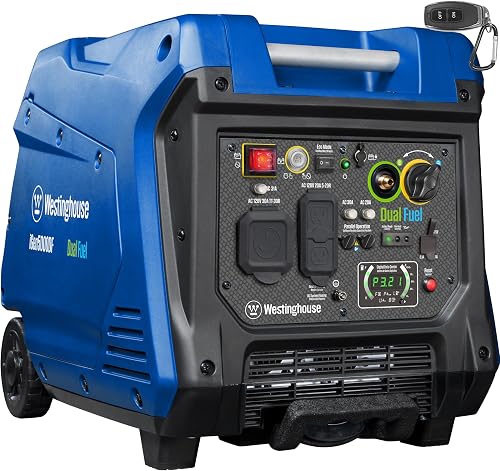
Westinghouse 5000 Peak Watt Super Quiet Dual: Best for RV and home backup balance
- 5,000 peak watts and 3,900 rated watts
- Gas or propane powered
- Remote electric start with key fob
- As low as 52 dBA and up to 18 hours on a 3.4-gallon tank
- Less than 3% THD
High rated output with remote start and long gasoline run time for RV and home use.
Pros
- Remote start with key fob
- Long 18-hour gasoline run time
- TT-30R RV outlet
Cons
- 104.7 lb weight
- Heavier than compact picks
The Westinghouse suits RV owners and home backup buyers who want remote start and a full outlet set. It gives 5,000 peak watts and 3,900 rated watts, with less than 3% THD for sensitive electronics.
Remote start with the included key fob means you can start it without walking to the unit each time. Electric and recoil start give you a backup if the battery is low.
The outlet mix includes a 5-20R 120V duplex, an RV-ready TT-30R 30 amp outlet and two USB outlets. That covers travel trailers, household plugs and phone charging at the same time.
Westinghouse says noise can be as low as 52 dBA, with up to 18 hours on a 3.4-gallon gas tank. Economy mode helps stretch fuel under lighter loads.
The trade-off is weight at 104.7 lb and dimensions of 24.5 x 16.3 x 20 inches. It has wheels and a telescoping handle, but it is not a one-hand carry.
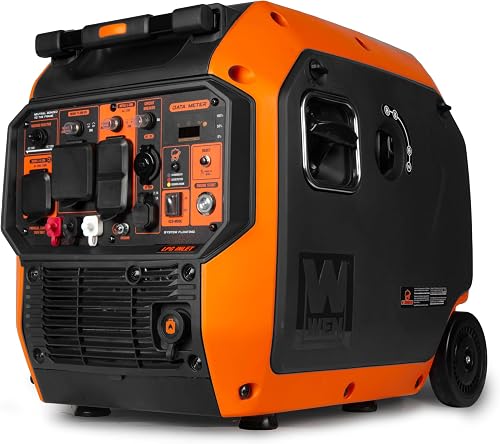
WEN 6800-Watt Dual Fuel RV-Ready Electric Start: Best for high output and 240V use
- 6,800 surge watts and 5,100 rated watts on gasoline
- 6,000 surge watts and 4,500 rated watts on propane
- 224cc dual-fuel engine
- L14-30R 120V/240V receptacle
- CO Watchdog shutdown sensor
The highest rated output in this group, with 240V outlet for RV and vehicle charging needs.
Pros
- Highest rated watts here
- 120V/240V L14-30R outlet
- CO Watchdog sensor
Cons
- 99.2 lb weight
- Louder than quietest picks
The WEN 6800 suits buyers who need the most rated power in this group. It gives 6,800 surge watts and 5,100 rated watts on gasoline, and 6,000 surge watts and 4,500 rated watts on propane.
Its 224cc engine and bonded-neutral 240V setup support low-power Level 2 charging for battery and hybrid electric vehicles. That makes it useful for RV, home and vehicle backup in one unit.
Outlets include one L14-30R 120V/240V receptacle, two 120V receptacles, one TT-30R RV receptacle, one 12V DC receptacle and two USB ports. A voltage selector switch helps match the outlet to your load.
WEN says operation is about 64 decibels at quarter load. The CO Watchdog sensor shuts the unit down if dangerous carbon monoxide is detected, and fuel shutoff helps limit carburetor buildup.
At 99.2 lb, it is lighter than the Westinghouse but still a two-person lift for many buyers. For a closer look, see wen 6800 inverter generator reviews.
WEN Quiet and Lightweight 3600-Watt Dual Fuel: Best for light portable camping power
- 3,600 surge watts and 2,900 rated watts on gasoline
- 3,500 surge watts and 2,600 rated watts on propane
- 149cc engine
- 49 lb weight
- CO Watchdog shutdown sensor
Light and quiet for camping and tailgating where carrying weight matters most.
Pros
- Only 49 lb
- Quiet conversation-level operation
- TT-30R RV outlet
Cons
- Lower output for home backup
- 1.5-gallon tank limits runtime
The WEN 3600 suits campers and tailgaters who want quiet, light power. It gives 3,600 surge watts and 2,900 rated watts on gasoline, and 3,500 surge watts and 2,600 rated watts on propane.
At 49 lb, it is one of the easiest models here to carry to a tent, truck bed or job site. Its 149cc engine is described as producing conversation-level sound.
Clean power with low harmonic distortion helps protect phones, tablets and laptops. The CO Watchdog sensor adds a key safety feature for family camping use.
Outlets include two 120V receptacles, one TT-30R RV receptacle, one 12V DC receptacle and two USB ports. A tool-free LPG connector makes switching to propane simpler.
The trade-off is lower output and a 1.5-gallon tank with up to 5 hours at half load. It suits essentials, not a whole home load.
Champion 4000-Watt Dual Fuel RV Ready Portable: Best for simple dual fuel use
- 4,000 starting watts and 3,000 running watts
- 64 dBA from 23 feet
- Up to 10 hours on gasoline and 25 hours on propane
- CO Shield auto shutoff
- 51.8 lb weight
Simple recoil-start dual fuel power with long propane runtime and a light frame.
Pros
- Long propane runtime
- Light 51.8 lb frame
- CO Shield sensor
Cons
- Recoil start only
- Lower output than large picks
The Champion 4000 suits buyers who want simple dual fuel use without extra controls. It gives 4,000 starting watts and 3,000 running watts, with CO Shield carbon monoxide auto shutoff.
At 51.8 lb, it is light for its output class. Champion says it runs at 64 dBA from 23 feet, which helps at camp sites and in neighborhoods.
Runtime is up to 10 hours on gasoline and up to 25 hours on a 20 lb propane tank at 25% load. That long propane runtime is a strong point for overnight backup.
Outlets include a 120V 25A TT-30R, a 120V 20A household duplex with clean power, a 12V automotive outlet and parallel outlets. An optional parallel kit, sold separately, can add power.
The trade-off is recoil start only, with no electric or remote start. For brand-focused picks, compare our best champion inverter generator dual fuel guide and best champion dual fuel generator guide.
Pulsar: Best for compact quiet backup
- 2,200 peak watts and 1,800 rated watts on gas
- 2,000 peak watts and 1,600 rated watts on LPG
- 60 dB quiet operation
- Parallel capability
- 1.18-gallon fuel tank
Compact and quiet for phones, lights and small appliances, with parallel capability.
Pros
- Very compact carrying case
- 60 dB quiet operation
- Parallel capability
Cons
- Lowest output in this group
- Short LPG runtime on small tank
The Pulsar PG2200BiS suits campers who need small, quiet power for phones, lights and small appliances. It gives 2,200 peak watts and 1,800 rated watts on gas, and 2,000 peak watts and 1,600 rated watts on LPG.
Super quiet operation at 60 dB and a compact carrying case design make it easy to store in a car or RV compartment. It also has parallel capability for buyers who want to add a second unit later.
The 80cc engine, two 120V 15A outlets and one USB outlet cover basic camping loads. Stable sine wave output suits sensitive electronics.
Runtime is 8 hours on a single tank of gas and 75 minutes on a 1 lb LPG tank at half load. That LPG tank size is small, so gasoline is the practical choice for longer use.
At 44 lb, it is the lightest model here. The trade-off is the lowest output, so it will not run large appliances or air conditioners.
PowerSmart 4400 Watt Dual Fuel Portable Generator: Best for mid-size home essentials
- 4,400 starting watts and 3,600 running watts on gasoline
- 4,000 starting watts and 3,300 running watts on LPG
- 223cc engine
- 8 hours on gasoline and 24 hours on propane at 25% load
- Less than 3% THD
Mid-size output for fridges and household appliances during blackouts.
Pros
- Strong 3,600 running watts
- Long propane runtime
- Parallel ready
Cons
- 68 lb weight
- 76 dB at full load
The PowerSmart 4400 suits home backup buyers who need mid-size power for fridges, TVs and appliances. It gives 4,400 starting watts and 3,600 running watts on gasoline, and 4,000 starting watts and 3,300 running watts on LPG.
Its 223cc engine, inverter technology and less than 3% THD help power phones, tablets and cameras. Eco-mode helps reduce fuel use under lighter loads.
Runtime is 8 hours on a 1.6-gallon gasoline tank and 24 hours on a standard 20 lb propane tank at 25% load. That propane runtime suits overnight outage use.
The control panel has a 120V 30A L5-30R twist-lock outlet, a 120V 20A duplex, a 12V 8A DC port and a digital display. CO Protect adds carbon monoxide auto shutoff.
At 68 lb, it sits in the middle for weight. Noise is listed at 76 dB at 23 feet at full load, so it is not the quietest pick for close camp sites.
BILT HARD 5500W Dual Fuel Inverter Generator: Best for RV and campsite versatility
- 5,500 starting watts and 4,000 running watts on gasoline
- 5,000 starting watts and 3,600 running watts on LPG
- 160cc OHV engine
- 1.14-gallon tank
- CO auto-shutoff
Versatile outlet mix and economy mode for home backup, RV and camping.
Pros
- 4,000 running watts on gas
- TT-30R and USB-C/USB-A
- Economy mode
Cons
- Small 1.14-gallon tank
- Recoil start
The BILT HARD 5500W suits buyers who want strong output with a versatile outlet mix. It gives 5,500 starting watts and 4,000 running watts on gasoline, and 5,000 starting watts and 3,600 running watts on LPG.
Its 160cc OHV engine, economy mode and digital display help manage fuel and noise under lighter loads. The display cycles through volts, frequency, amps, watts, runtime hours and fuel level.
Outlets include 120V 20A outlets, a 120V 30A RV TT-30R outlet, 12V DC 8A output and a USB-C/USB-A adapter. Parallel connectors let you pair two identical units.
CO auto-shutoff, overload indicators, AC/DC breakers and low-oil protection help monitor operation. At 61.7 lb, it is manageable for truck or garage use.
The trade-off is a small 1.14-gallon tank and recoil start. Runtime will be shorter than larger-tank models under steady load.
AIVOLT 8000W Dual Fuel Inverter Generator 50A: Best for large 50-amp RV power
- 8,000 surge watts and 6,100 running watts
- 7200 starting watts and 5500 running watts on LPG
- 322cc 4-stroke OHV engine
- 62 dBA from 23 feet
- CO Alert auto shutoff
Largest output here for 50-amp RVs, job sites and emergency backup.
Pros
- Highest surge output
- 62 dBA quiet claim
- 50A RV capability
Cons
- 130.7 lb weight
- Large footprint
The AIVOLT 8000W suits large RVs, job sites and emergency backup where output comes first. It gives 8,000 surge watts and 6,100 running watts, with 7,200 starting watts and 5,500 running watts on LPG.
Its 322cc 4-stroke OHV engine and automatic fuel-switching technology help switch between gas and propane without manual adjustments. Eco-mode helps cut fuel costs under lighter loads.
AIVOLT says noise is 62 dBA from 23 feet. A 5-in-1 LCD display shows fuel use, voltage and runtime, with four outlets, a 12V DC outlet and dual USB adapter.
CO Alert technology shuts the unit down if unsafe carbon monoxide is detected. An upgraded low-temperature lithium battery supports electric start from -4F to 140F.
At 130.7 lb with a telescopic handle and two 7-inch wheels, it is built for loading into a truck or RV bay. The trade-off is size and weight, so it is not a tent camping pick.
PowerSmart 3800 Watt Dual Fuel Inverter Generator: Best for quiet neighborhood use
- 3,800 starting watts and 3,300 running watts on gasoline
- 3,500 starting watts and 3,100 running watts on propane
- 59 dBA in Eco Mode
- 8 hours on gasoline and 24 hours on propane
- CO Protect sensor
Quiet Eco Mode and long propane runtime for home emergency use.
Pros
- 59 dBA in Eco Mode
- 24-hour propane runtime
- Parallel ready
Cons
- Recoil start
- 50.7 lb still needs carrying
The PowerSmart 3800 suits home emergency use where quiet operation matters. It gives 3,800 starting watts and 3,300 running watts on gasoline, and 3,500 starting watts and 3,100 running watts on propane.
It runs 8 hours at 25% load on a 1.3-gallon gas tank, or up to 24 hours with a standard 20 lb propane tank. At 59 dBA in Eco Mode, it is one of the quietest claims in this group.
Outlets include a 120V 30A twist-lock, a 120V 20A duplex, a 12V 8A DC port and dual USB ports. Overload, short-circuit and carbon monoxide protection cover key safety needs.
At 50.7 lb with a built-in handle, it is portable for camping trips and garage storage. Parallel ready design lets you connect two units to double power.
The trade-off is recoil start and lower surge output than the larger models. It suits essentials and sensitive electronics rather than heavy motor loads.
Which dual fuel inverter generator gives the best value for the money?
The Westinghouse gives the best balance of rated watts, runtime, remote start and RV outlets. The WEN 6800 gives more power, while the Champion and WEN 3600 give lighter carrying at a lower output.
| Product | Best for | Rated Watts | Fuel | Outlets | Our score |
|---|---|---|---|---|---|
| Westinghouse 5000 Peak Watt Super Quiet Dual | RV and home backup balance | 3,900 watts | Gasoline, LPG | TT-30R, 5-20R duplex, USB | 9.7 |
| WEN 6800-Watt Dual Fuel RV-Ready Electric Start | high output and 240V use | 5,100 watts on gasoline | Gasoline, LPG | L14-30R, TT-30R, 120V, 12V DC, USB | 9.7 |
| WEN Quiet and Lightweight 3600-Watt Dual Fuel | light portable camping power | 2,900 watts on gasoline | Gasoline, LPG | TT-30R, 120V, 12V DC, USB | 9.5 |
| Champion 4000-Watt Dual Fuel RV Ready Portable | simple dual fuel use | Gasoline, propane | TT-30R, 5-20R, 12V | 9.4 | |
| Pulsar | compact quiet backup | 1,800 watts on gas | Gas, LPG | Two 120V 15A, USB, parallel | 9.1 |
| PowerSmart 4400 Watt Dual Fuel Portable Generator | mid-size home essentials | Gasoline, LPG | L5-30R, 5-20R, 12V DC | 9.0 | |
| BILT HARD 5500W Dual Fuel Inverter Generator | RV and campsite versatility | Gasoline, LPG | 120V 20A, TT-30R, 12V DC, USB | 8.5 | |
| AIVOLT 8000W Dual Fuel Inverter Generator 50A | large 50-amp RV power | Gasoline, propane | 50A, 12V DC, dual USB | 8.3 | |
| PowerSmart 3800 Watt Dual Fuel Inverter Generator | quiet neighborhood use | Gasoline, LPG | 30A twist-lock, 5-20R, 12V DC, USB | 8.1 |
How we compared these dual fuel inverter generators
We checked rated watts on gasoline and propane separately, because many models lose output on propane. We also compared weight, tank size, runtime claims, noise claims and outlet types.
Safety features mattered in every comparison. Carbon monoxide auto shutoff, low oil shutdown and overload protection help reduce risk, but they do not make indoor use safe.
We excluded models with unclear rated watts or missing safety data. Every pick here has a stated dual fuel option and inverter technology for stable power.
Brand support also factored in, including warranty length where stated in the product data. Westinghouse states 3-year coverage, WEN states 3 years on several models, and Champion states 3 years with lifetime technical support.
What size dual fuel inverter generator do you need?
Choose rated watts for your running loads, not peak watts. Peak watts help start motors, but running watts decide what stays on.
For camping and tailgating
A 1,800 to 2,900 rated watt model runs lights, phones, a small fridge and fans. The Pulsar and WEN 3600 fit this use because they are light and quiet.
For RV use
Check your RV plug type first. TT-30R fits many travel trailers, while 50-amp RVs need a larger model like the AIVOLT.
Our best dual fuel generator with 50 amp plug guide covers that outlet choice in more detail.
For home backup
Add up your fridge, lights, fans, phone chargers and medical device needs, if any. A 3,300 to 4,000 rated watt model covers essentials for many homes, while larger models cover more appliances.
Gasoline or propane: which fuel should you pick?
Propane often wins for storage and long runtime, while gasoline often wins for higher watts and easy availability. Many dual fuel models give less power on propane, so compare rated watts for each fuel.
When propane makes sense
Propane stores cleanly for long periods and a 20 lb tank can run many hours at light load. That suits emergency kits and RV trips where you already carry propane.
When gasoline makes sense
Gasoline is widely available and several models here list higher rated watts on gasoline. If you need maximum output for a motor load, check the gasoline figures first.
How to switch fuels safely
Turn the unit off, let it cool and follow the manual for the fuel selector and hose steps. Never switch fuels while the engine is running or while loads are connected.
How quiet should a dual fuel inverter generator be?
Compare noise claims only when load and distance match. A 52 dBA claim and a 64 dBA claim may use different test setups.
Camp site and neighborhood use
Look for Eco Mode, inverter efficiency and a low dBA claim at light load. The Westinghouse at 52 dBA and the PowerSmart 3800 at 59 dBA in Eco Mode stand out here.
Full load reality
Noise rises as load rises. If you run a fridge, air conditioner or power tools, expect more sound than the light-load claim.
For quiet-focused options, see our best dual fuel quiet inverter generator guide. For smaller loads, compare our best small dual fuel generator guide.
What outlets and safety features should you check?
Match the outlet to your RV or home plug before you compare extra features. A TT-30R, L5-30R, L14-30R and 50-amp outlet are not interchangeable.
Outlets that matter most
RV buyers need TT-30R or 50-amp. Home backup buyers need household duplex outlets.
USB and 12V DC ports help for phones and small devices.
Safety features to require
Carbon monoxide auto shutoff is a must for family use. Low oil shutdown, overload protection and breakers help protect the unit and your loads.
Always run the generator outdoors with exhaust pointed away from doors, windows and vents. Keep the unit on dry ground and away from wet conditions.
What is a hybrid inverter generator and how does it differ?
A hybrid inverter generator may pair engine power with battery storage or solar input, while a dual fuel inverter generator pairs gasoline and propane. The fuel choice and the power units are different decisions.
Read What Is a Hybrid Inverter Generator? if you are comparing engine power with battery-based systems. That guide explains when stored power helps and when it adds cost and weight.
If you want higher voltage for RV or home loads, check our best inverter generator dual fuel 240v guide. The WEN 6800 in this roundup lists a 120V/240V outlet for that use.
For brand-specific dual fuel picks, compare our best wen dual fuel generator guide and best westinghouse dual fuel generator guide.
How should you set up and care for a dual fuel inverter generator?
Set up on level ground, check oil before first use and start with no loads connected. That routine protects the engine and helps the unit start cleanly.
Before first use
Add the oil type and amount stated in your manual, connect the fuel you plan to use and check that hoses and outlets are secure. Many models include oil, a funnel and a propane hose, but always confirm what is in your box.
During use
Connect loads only after the engine is running and stable. Add loads one at a time and stay within rated watts for the fuel you chose.
Storage and maintenance
Use fuel shutoff where fitted, run the engine as the manual directs and store fuel in approved containers away from living spaces. Follow oil change and spark plug intervals in the manual.
Verdict: pick the best dual fuel inverter generator by your main job
Pick the Westinghouse for RV and home backup balance, the WEN 6800 for higher output and 240V use, and the WEN 3600 or Champion for lighter camping power. Pick the AIVOLT only if you need 50-amp class output and have room to carry it.
If quiet matters most, compare the Westinghouse and PowerSmart 3800 claims at light load. If runtime matters most, propane on a 20 lb tank gives the longest claims in this group.
Start with your plug type and your running watt total. That decision will narrow this list faster than any extra feature or badge.
Our top 3 picks at a glance
-
1
Best for RV and home backup balance
Westinghouse 5000 Peak Watt Super Quiet Dual
9.7/10 our score
See it on Amazon -
2
Best for high output and 240V use
WEN 6800-Watt Dual Fuel RV-Ready Electric Start
9.7/10 our score
See it on Amazon -
3
Best for light portable camping power
WEN Quiet and Lightweight 3600-Watt Dual Fuel
9.5/10 our score
See it on Amazon
Frequently asked questions
What is a dual fuel inverter generator?
A dual fuel inverter generator runs on gasoline or propane and uses inverter technology for stable power. That stable output suits phones, laptops and other sensitive electronics better than rough generator power.
Is propane or gasoline better for dual fuel use?
Propane often gives longer runtime from a 20 lb tank and stores cleanly for long periods. Gasoline is easier to find in many places and some models give higher watts on gasoline, so check rated watts for each fuel.
How loud is a quiet dual fuel inverter generator?
Noise claims in this guide range from 52 dBA to 76 dB depending on load and measurement distance. Compare dBA figures only when the distance and load are similar, and expect more noise near full load.
Can a dual fuel inverter generator power an RV?
Yes, if it has a TT-30R or 50-amp outlet that matches your RV and enough rated watts for your loads. Check your RV power needs against running watts, not peak watts, before you buy.
What safety features should you look for?
Look for a carbon monoxide auto shutoff sensor, low oil shutdown and overload protection. No sensor makes indoor use safe, so always run any fuel generator outdoors with exhaust away from doors and windows.